Vanua Lava
p. 18 · Read in the full issue
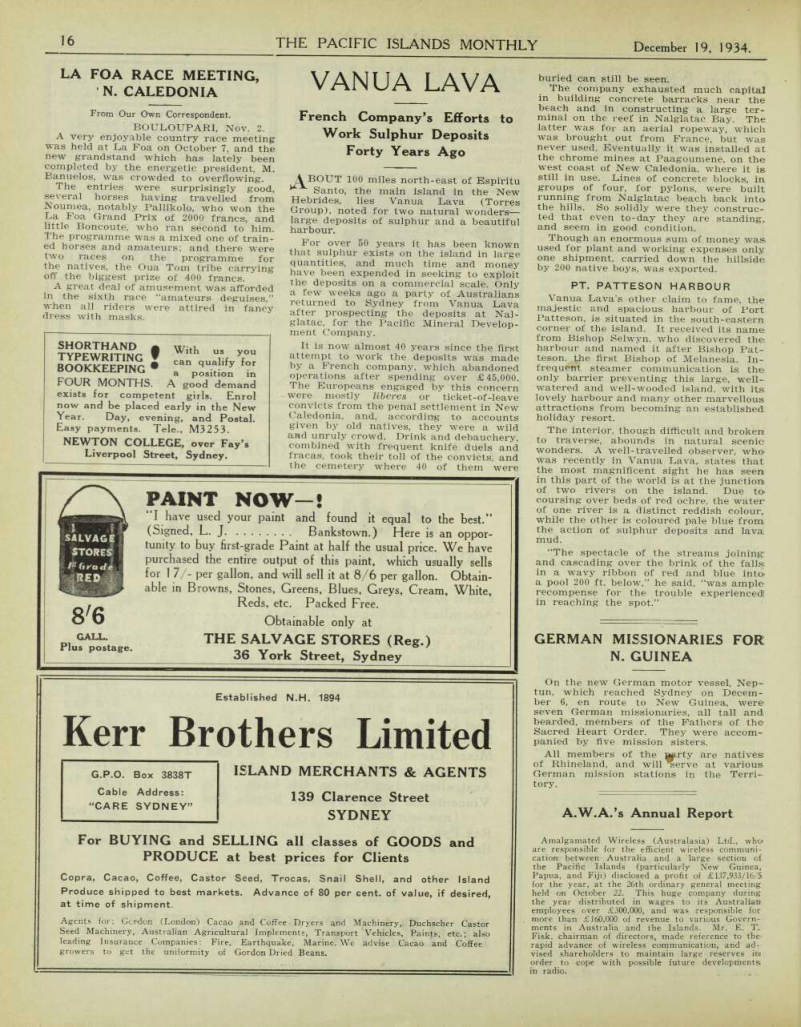
French Company’s Efforts to Work Sulphur Deposits Forty Years Ago
ABOUT 100 miles north-east of Espiritu Santo, the main island in the New Hebrides, lies Vanua Lava (Torres Group), noted for two natural wonders — large deposits of sulphur and a beautiful harbour.
For over 50 years it has been known that sulphur exists on the island in large quantities, and much time and money have been expended in seeking to exploit the deposits on a commercial scale. Only a few weeks ago a party of Australians returned to Sydney from Vanua Lava after prospecting the deposits at Nal glatac, for the Pacific Mineral Develop ment Company, It is now almost 40 years since the first attempt to work the deposits was made by a French company, which abandoned operations after spending over £45,000.
The Europeans engaged by this concern were mostly liheres or ticket-of-leave convicts from the penal settlement in New Caledonia, and, according to accounts given by old natives, they were a wild and unruly crowd. Drink and debauchery, combined with frequent knife duels and fracas, took their toll of the convicts, and the cemetery where 40 of them were
buried can still be seen.
The company exhausted much capital in building concrete barracks near the beach and in constructing a large ter minal on the reef in Nalglatac Bay. The latter was for an aerial ropeway, which was brought out from France, but was never used. Eventually it was installed at the chrome mines at Paagoumene, on the west coast of New Caledonia, where it is still in use. Lines of concrete blocks, in groups of four, for pylons, were built running from Nalglatac beach back into the hills. So solidly were they construc ted that even to-day they are standing,, and seem in good condition.
Though an enormous sum of money was. used for plant and working expenses only one shipment, carried down the hillside by 200 native boys, was exported,
Ft. Patteson Harbour
Vanua Lava’s other claim to fame, the majestic and spacious harbour of Port Patteson, is situated in the south-eastern corner of the island. It received its name from Bishop Selwyn, who discovered the harbour and named it after Bishop Pat teson, the first Bishop of Melanesia. In frequent steamer communication is the only barrier preventing this large, well watered and well-wooded island, with its lovely harbour and many other marvellous attractions from becoming an established holiday resort.
The interior, though difficult and broken to traverse, abounds in natural scenic wonders. A well-travelled observer, who was recently in Vanua Lava,, states that the most magnificent sight he has seen in this part of the world is at the junction of two rivers on the island. Due to coursing over beds of red ochre, the water of one river is a distinct reddish colour, while the other is coloured pale blue from the action of sulphur deposits and lava mud.
“The spectacle of the streams joining; and cascading over the brink of the falls; in a wavy ribbon of red and blue into a pool 200 ft. below,” he said, “was ample recompense for the trouble experienced! in reaching the spot.”