Mysterious Mangaia
p. 33 · Read in the full issue
Modern Sanitation Comes To
What Rockefeller Institute is Doing in Cook Islands.
From Our Own Correspondent.
Rarotonga, July 18.
THE Rockefeller Foundation has every reason to be satisfied with its work at Mangaia (Southern Cooks).
Mangaia is the third island in this Group to undergo a Rockefeller sanitation transformation, but, on account of the island’s coral structure, the majority of latrine shafts had to be driven down through hard coral strata.
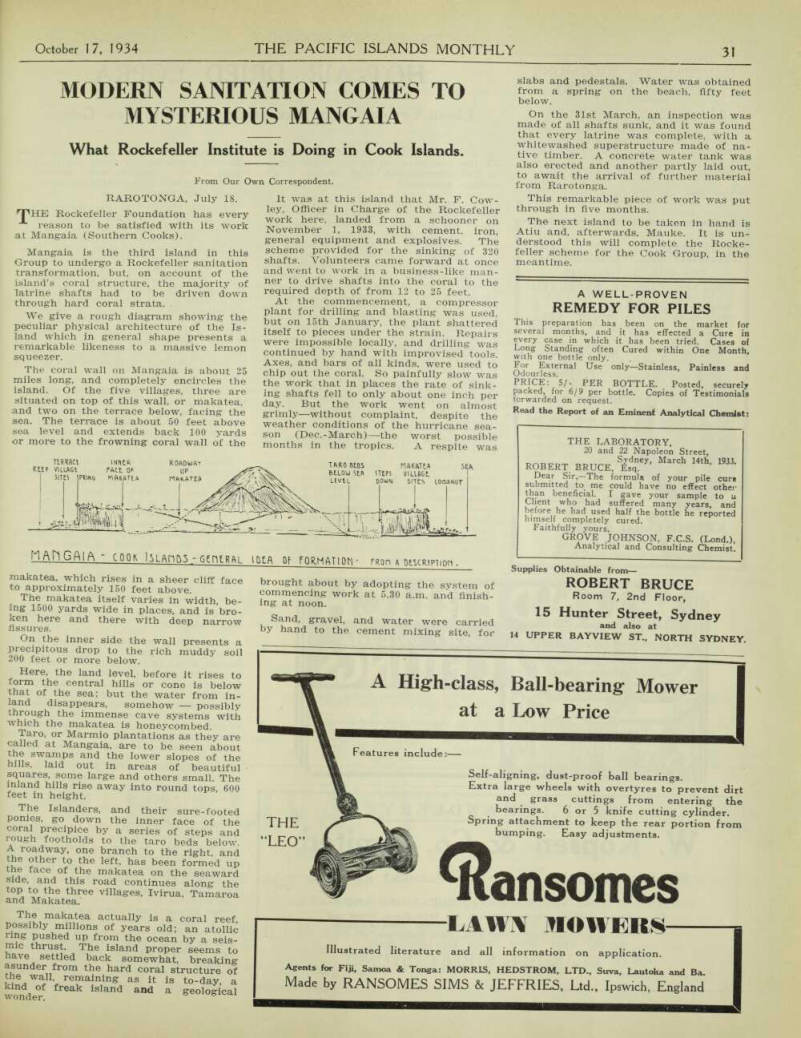
We give a rough diagram showing the peculiar physical architecture of the Is land which in general shape presents a remarkable likeness to a massive lemon squeezer.
The coral wall on Mangaia is about 25 miles long, and completely encircles the island. Of the five villages, three are situated on top of this wall, or makatea, and two on the terrace below, facing the sea. The terrace is about 50 feet above sea level and extends back 100 yards or more to the frowning coral wall of the
makatea. which rises in a sheer cliff face to approximately 150 feet above.
The makatea itself varies in width, be ing 1500 yards wide in places, and is bro ken here and there with deep narrow fissures.
On the inner side the wall presents a precipitous drop to the rich muddy soil 200 feet or more below.
Here, the land level, before it rises to form the central hills or cone is below that of the sea; but the water from in land disappears, somehow possibly through the immense cave systems with which the makatea is honeycombed.
Taro, or Marmio plantations as they are called at Mangaia, are to be seen about the swamps and the lower slopes of the hills, laid out in areas of beautiful squares, some large and others small. The inland hills rise away into round tops, 600 feet in height.
The Islanders, and their sure-footed ponies, go down the inner face of the coral precipice by a series of steps and lough footholds to the taro beds below.
A roadway, one branch to the right, and the other to the left, has been formed up the face of the makatea on the seaward side, and this road continues along the to P the three villages, Ivirua, Tamaroa and Makatea.
The makatea actually is a coral reef possibly millions of years old; an atollic ring pushed up from the ocean by a seis mic thrust. The island proper seems to have settled back somewhat, breaking asunder from the hard coral structure of the wall, remaining as it is to-day, a kind of freak island and a geological wonder.
It was at this island that Mr. F. Cow ley, Officer in Charge of the Rockefeller work here, landed from a schooner on November 1, 1933, with cement, iron, general equipment and explosives. The scheme provided for the sinking of 320 shafts. Volunteers came forward at once and went to work in a business-like man ner to drive shafts into the coral to the required depth of from 12 to 25 feet.
At the commencement, a compressor plant for drilling and blasting was used, but on 15th January, the plant shattered itself to pieces under the strain. Repairs were impossible locally, and drilling was continued by hand with improvised tools.
Axes, and bars of all kinds, were used to chip out the coral. So painfully slow was the work that in places the rate of sink ing shafts fell to only about one inch per day. But the work went on almost grimly—without complaint, despite the weather conditions of the hurricane sea son (Dec.-March) —the worst possible months in the tropics. A respite was
brought about by adopting the system of commencing work at 5.30 a.m. and finish ing at noon.
Sand, gravel, and water were carried by hand to the cement mixing site, for
slabs and pedestals. Water was obtained from a spring on the beach, fifty feet below.
On the 31st March, an inspection was made of all shafts sunk, and it was found that every latrine was complete, with a whitewashed superstructure made of na tive timber. A concrete water tank was also erected and another partly laid out, to await the arrival of further material from Rarotonga.
This remarkable piece of work was put through in five months.
The next island to be taken in hand is Atiu and, afterwards, Mauke. It is un derstood this will complete the Rocke feller scheme for the Cook Group, in the meantime.