The Departed Glory Of Lau
pp. 48-50 · Read in the full issue

Lonely, Lovely Islands of an Isolated Fijian Group
By G. Scoresby Shepherd
ABOUT 200 miles east of Suva —right on the very outskirts of the Fijian Archi pelago—lie scattered a little collection of about thirty Isles. The group is known as the Lau, and its Islands are among the loneliest in the South Seas.
These islands lie far off the usual track of steamers. White men seldom visit their shores and the group seems to be almost forgotten. Occasionally, a cutter or ketch from Suva will touch at some of the larger islands and leave provisions for the few trading stores that remain. At many of the islands a strange sail is never seen and the tiny European population that lingers —together with the native inhabitants — lead an almost independent existence.
For several months, I roamed footloose in this forgotten group, and on all the isles that I touched at I felt an atmosphere of forlornness and desertion. Even the many copra plantations, that not so long ago had produced some of the best copra in the South Seas, were almost deserted.
Eventually, I came to Loma Loma, and in that picturesque little settlement I dwelt for several months. Loma Loma once was the capital of the group and had a glory all of its own, but to-day it is only a straggling little trading outpost, on the eastern shores of the Island of Vanua Balavu, utterly lonely and left by the outside world, to bask in dreams of the past.
It was evident that Loma Loma had known better days. Fifty years ago the Lau Islands were a centre of commerce, and the now empty harbour of Loma Loma was one of the busiest ports in the South Seas. In those days, craft of all kinds lay at anchor in the harbour —whalers from the South; brigs from America waiting to take away the cotton; graceful schooners that carried in a regular trade between the
islands, and many strange ships that came from lands far away, Loma Loma was then a port of entry into Fiji and was almost equal in size to Levuka, the old Fijian capital. The popu lation then was indeed cosmopolitan, and there were a dozen hotels in the town, ceaselessly ringing with the boisterous talk and laughter of the sea -faring men. To day Loma Loma is without Europeans,
and all that remain of the hotels are a few ruins and tumble-down buildings, over run with hibiscus, and their only occu pants are natives.
I was told that there had been an avenue of shops and I looked for the site —in vain.
I did find three stores, in different parts of the town. Two of them were very old and decrepit: they belonged to an Indian and a Chinese firm, who just managed to eke out an existence by trading with the frugal native population. The other store belonged to a European firm, and was more pretentious, but it seemed to me to be nearly always deserted. The natives preferred to deal with the Chinese, where they could get better credit and, being on a more equal footing, they could lounge about the counter and haggle over the prices all day, if they so wished.
Back in the fifties, the Lau Islands were invaded and captured by the Tongans, under the leadership of Maafu, a great Tongan warrior and a relative to the King of Tonga. Maafu not only conquered Lau, but extended his conquests to the larger Islands of the Fijis, and there is no telling where he would have finished had he not been checked by circumstances. However,
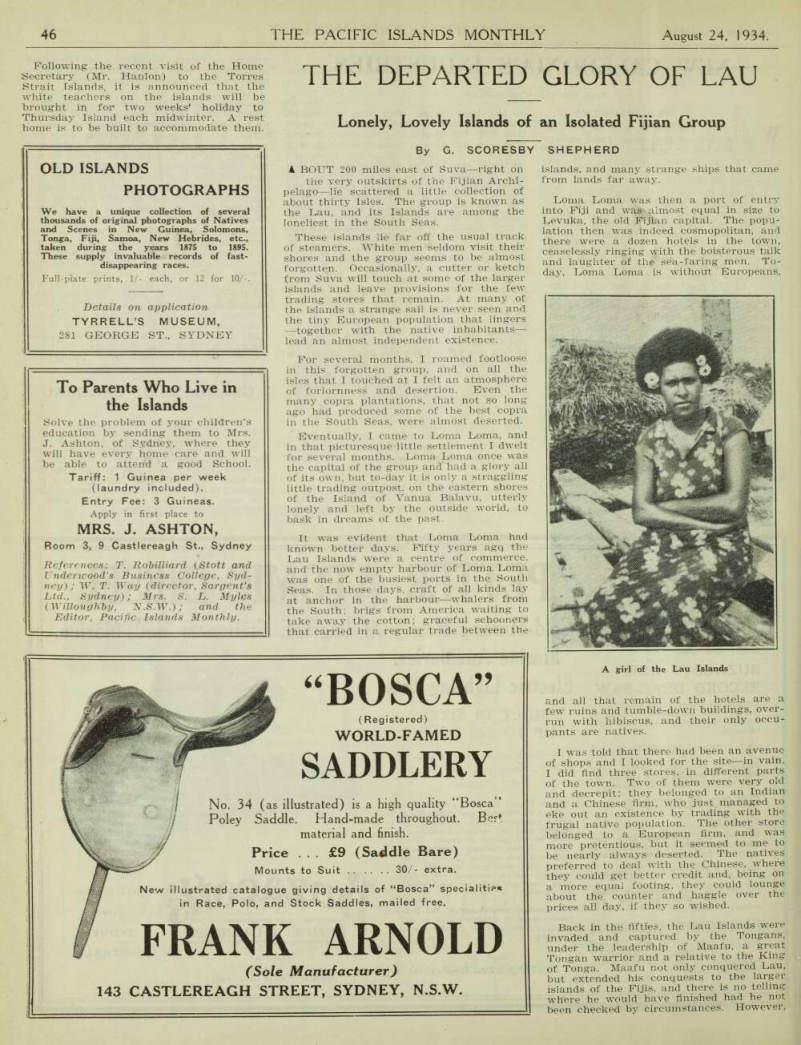
A girl of the Lau Islands
he and his followers chose to remain in Lau, and it was at Loma Loma that he made his headquarters. There he reigned supreme as Tui Lau —King of Lau.
Even to-day, in Loma Loma, there is a complete Tongan colony, and they have their own village. In most of the Lau Islands the people are a mixture of Tongan
and Fijian blood —the descendants of the invaders who settled down and inter married with the Fijians. The Tongan strain is particularly noticeable in their features, and in complexion they are light —much lighter than the Fijians. Certainly they are superior, both in intellect and physique.
Among some of the smaller Islands I found that many of the younger natives regarded white men as an object of curiosity and, perhaps, it is because they have so seldom come into contact with Europeans in recent years that they are so unspoiled and have so many charms.
To me they were hospitable to a degree, and showed none of that cock-sureness that is so characteristic of their more sophisticated cousins on the larger Islands.
Near Vanua Balavu is the small but mountainous Island of Munia. It lies only about four miles east and, as seen from Loma Loma, Munia resembles the tur quoise or emerald tropical Isle of fiction, for it is exceedingly beautiful and domi nates the Lau group, towering far above the other low Islands. Its craggy summit rises to 1,000 feet above the sea and, if one can struggle up through the dense growth to the top, a wonderful view is obtained.
As far as the eye can see, tiny islands dot the coral seas, surrounded by reefs, crumbling walls of foam.
The second island of importance in the group is Lakemba. It lies nearly 40 miles south of Vanua Balavu and sometimes, if the day be clear, it can be seen on the horizon as a dull amethyst blur.
Lakemba, too, like Loma Loma, has seen better days. It was on this Island that the first missionaries landed in Fiji and introduced Christianity and, for many years, Lakemba was the headquarters of the Wesleyan Mission to the Fijian and Tongan groups. Now it is but the last outpost; only a solitary missionary re mains, and he leads a very lonely existence.
On Vanua Balavu a missionary was also stationed for many years but now he has
gone and his place will not be taken, ex cept by perhaps a native pastor.
Until several years ago, a little tramp steamer called at a few of the Lau ports monthly for the copra and, often, tourists were in the boat, anxious to get a glimpse of the wonderful Bay of Islands.
This famous little beauty spot lies far to the north of Loma Loma, on the extreme northern point of Vanua Balavu. By land it is very difficult to reach; one has to pass through dense virgin forests and the few tracks have been so neglected that the jungle has for long encroached upon them.
Still, the journey is worth while, for the islands are unimaginably beautiful. They lie scattered in a secluded bay; in numbers they are countless, and of a thousand fantastic shapes. Some of them are mere rocks and pinnacles, rising sheer from the clear, calm waters, while others are larger —miniature Islands —densely clothed with tropical verdure. And they are all in accessible, except to the sea birds which have made them their home.
To-day, there are scarcely a dozen Euro peans and educated half-castes living in the group—and their numbers are gradu ally dwindling. Those who remain are mostly planters, who have leased copra plantations.
The rich soil of the group produces wonderful crops of nuts; but, nowadays, owing to a stagnant market and prices that are down to bedrock, there is little induce ment for the planters to continue the struggle, for in Lau they have no other source of income apart from copra. Suva is far away, and freight is high.
On some of the Islands, cotton was once produced extensively, but that industry has long been dead, and now it is feared that the same fate will overtake copra.
With the passing of this industry the Lau Islands would become even more lonely.
Copra is their last link with “civilisation.”’
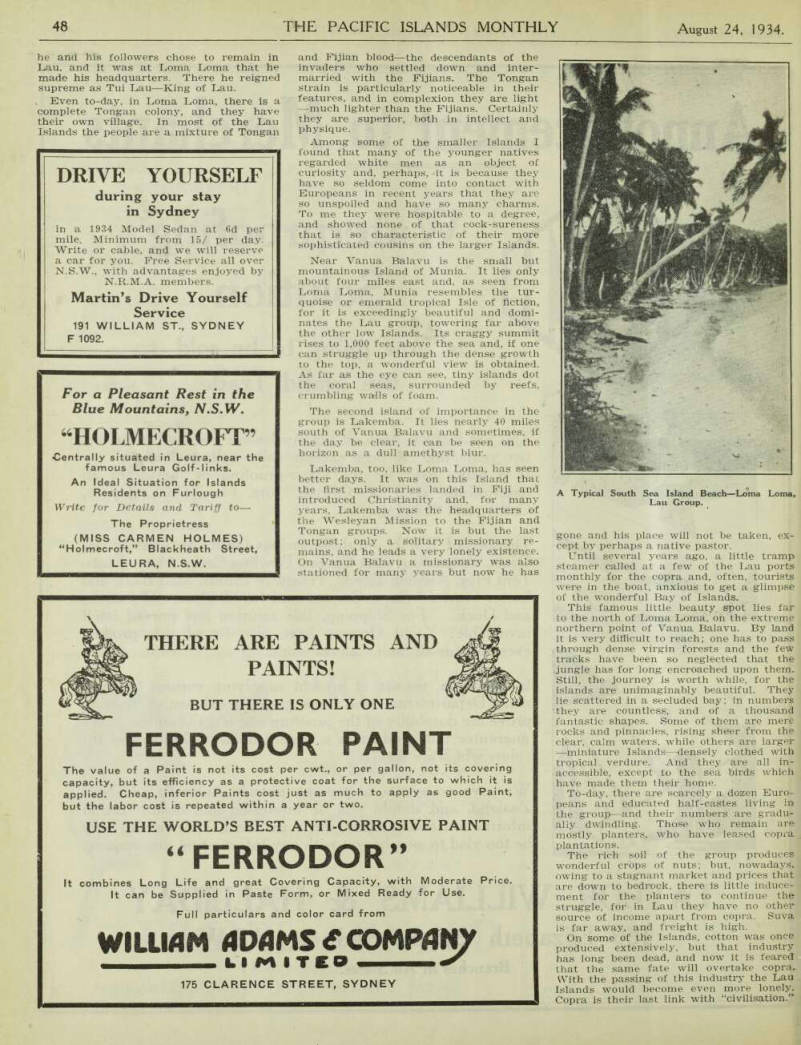
A Typical South Sea Island Beach—Loma Loma, Lau Group.