The Affair Of The Auto-Gee-Gee
pp. 12-13 · Read in the full issue
By W. Gill.
IT was a despondent group of fellows who met at the bar of the Coconut Club after seeing poor old Henry hoisted aboard the mail steamer in a bo’sun’s chair and a strait jacket.
Not that the sight of a human being in a strait jacket endeavouring to bend him self to fit a bo’sun’s chair was particu larly depressing —on the contrary!—but we were all sorry to witness the sad fate of a fellow whom we liked and to know that jealousy had been his downfall.
Henry had managed Uavaruka, the most remote plantation on the Island, for years and never seemed to mind his isolation.
Although we had all urged him to visit the settlement more frequently for sanity’s sake, pointing out that evferyone who had managed Uavaruka had gone mad there save Vogle (who was mad before he went), he stuck to his one visit a year and seemed little the worse for it.
Nevertheless, it was one of these an nual visits which started him on the down grade and here is how it came about. Henry reached the settlement about noon one day and met all the fel lows there. He had his usual cocktail with each, and appeared to be quite nor mal. It wasn’t until the boy announced lunch that he deviated from his usual pro gramme and failed to appear at the table.
We all thought it was merely an attack of malaria, brought on by the excitement of seeing so many friends all at once, and passed the matter off with some jocu lar remark. But when sundown found him brooding, and refusing to drink with anyone, those club members who still re tained their faculties exchanged signifi cant glances.
Towards 1 a.m. Henry showed signs of returning animation: becoming almost articulate, in fact, although he showed a marked inclination to repeat himself.
“Why has the company given all you fel lows cars and left me out?” appeared to be the burthen of his monologue.
And, next morning, he returned to the fastness of the jungle, instead of spend ing his usual fortnight at the club.
We gathered that the poor fellow was jealous of the other employees of the company having cars, whilst he had only a ewe-necked mare. When the R.M. paid his usual quarterly visit, Henry aired this grievance. The R.M. pointed out that Uavaruka, situated as it was in the hills and in the wet belt, averaging an inch of rain daily, was an impossible place for a car, unless fitted with legs; but Henry insisted that, if a car was out of the question, then something ought to be sup plied as a substitute, adding that he had given a great deal of thought to the matter.
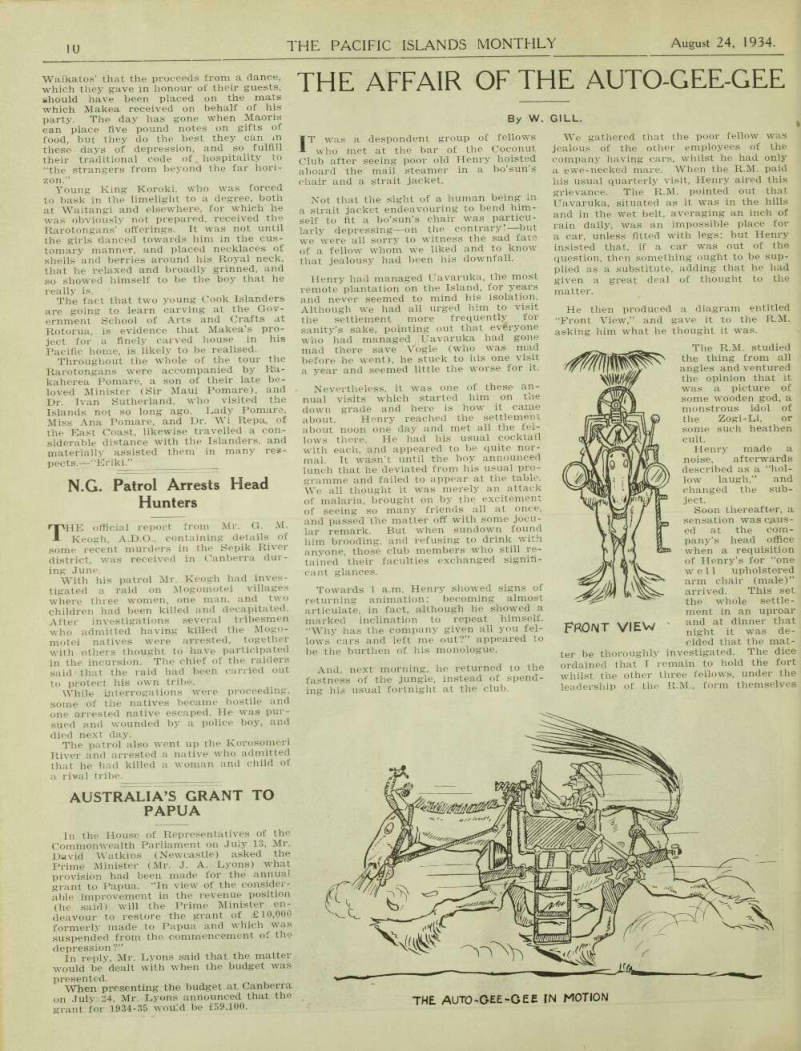
He then produced a diagram entitled “Front View,” and gave it to the R.M. asking him what he thought it was.
The R.M. studied the thing from all angles and ventured the opinion that it was a picture of some wooden god, a monstrous idol of the Zogi-Li, or some such heathen cult.
Henry made a noise, afterwards described as a “hol low laugh,” and changed the sub ject.
Soon thereafter, a sensation was caus ed at the com pany’s head office when a requisition of Henry’s for “one well upholstered arm chair (male)” arrived. This set the whole settle ment in an uproar and at dinner that night it was de cided that the mat
ter be thoroughly investigated. The dice ordained that I remain to hold the fort whilst the other three fellows, under the leadership of the R.M., form themselves
into a punitive expedition and proceed to Uavaruka.
For the following week the settlement had to look after itself, as I was far too busy speculating on the outcome of the expedition to attend to it—or to myself, for that matter, though the native bar tender looked after me well enough.
On the eighth day the expedition re turned with a gang of carriers, bearing a strange bundle slung on a bamboo pole.
Without attempting to alleviate my anxiety, the expedition headed straight for a series of pahits, in the middle of which the mail steamer arrived on its monthly visit. It was then that the R.M. explained to me that the strange bundle was Henry in a strait jacket, and he was to be consigned to the nearest asylum.
That night, in the club, the R.M. gave an account of the adventures of the expedition.
“Gentlemen,” he began, and I endeavour ed to look as plural as possible, “the ex pedition proceeded to Uavaruka. It was met by Henry, who invited it to partake of refreshments and otherwise behaved normally.”
On being questioned, however, the ob ject of the expedition had stated that he no longer felt peeved about the other company employees having cars. “After all,” he had said, “a car would be useless here, as you all know: and, anyway. I have an idea which will make me inde pendent of all your cars.”
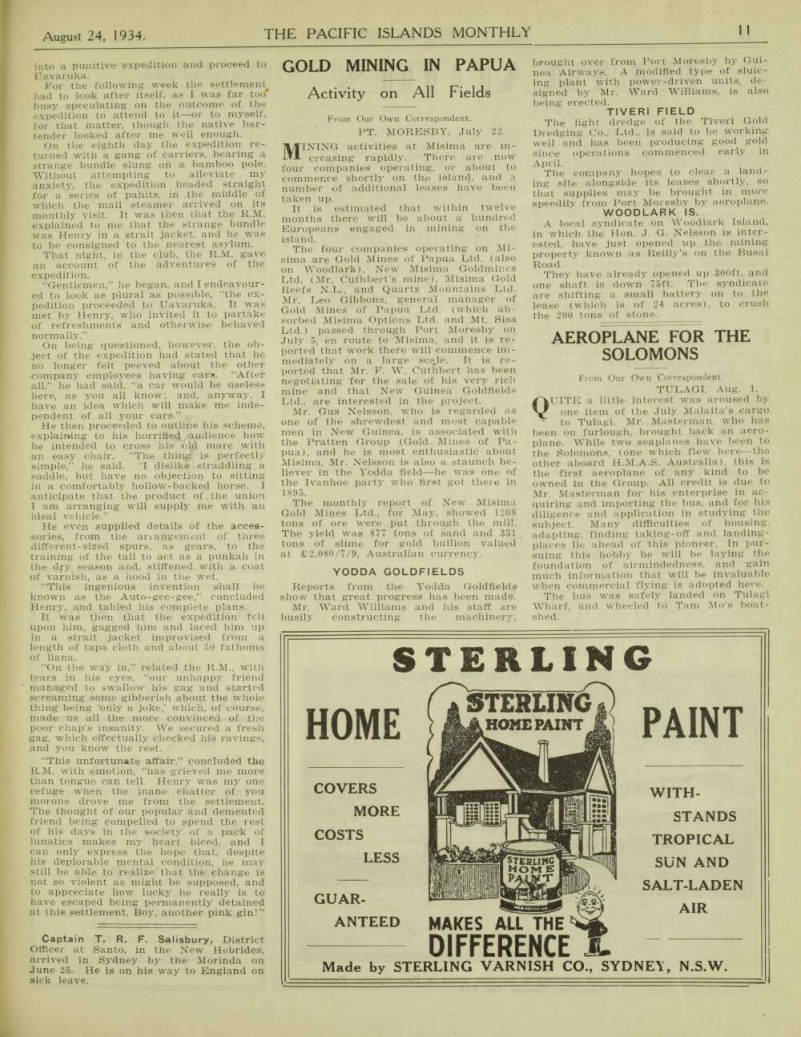
He then proceeded to outline his scheme, explaining to his horrified audience how he intended to cross his old mare with an easy chair. “The thiixg is perfectly simple,” he said. “I dislike straddling a saddle, but have no objection to sitting in a comfortably hollow-backed horse. I anticipate that the product of the union I am arranging will supply me with an ideal vehicle.”
He even supplied details of the acces sories, from the arrangement of three different-sized spurs, as gears, to the training of the tail to act as a punkah in the dfy season and, stiffened with a coat of varnish, as a hood in the wet.
“This ingenious invention shall be known as the Auto-gee-gee,” concluded Henry, and tabled his complete plans.
It was then that the expedition fell upon him, gagged him and laced him up in a strait jacket improvised from a length of tapa cloth and about 50 fathoms of liana.
“On the way in,” related the R.M., with tears in his eyes, “our unhappy friend managed to swallow his gag and started screaming some gibberish about the whole thing being ‘only a joke,’ which, of course, made us all the more convinced of the poor chap’s insanity. We secured a fresh S&g, which effectually checked his ravings, and you know the rest.
“This unfortunate affair,” concluded the R.M. with emotion, “has grieved me more than tongue can tell. Henry was my one refuge when the inane chatter of you morons drove me from the settlement.
The thought of our popular and demented friend being compelled to spend the rest of his days in the society of a pack of lunatics makes my heart bleed, and I can only express the hope that, despite his deplorable mental condition, he may still be able to realize that the change is not so violent as might be supposed, and to appreciate how lucky he really is to have escaped being permanently detained at this settlement. Boy, another pink gin!”
Captain T. R. F. Salisbury, District Officer at Santo, in the New Hebrides, arrived in Sydney by the Morinda on June 25. He is on his way to England on sick leave.