Rarotongans And Maoris
pp. 11-12 · Read in the full issue
Very Cordial Relationship
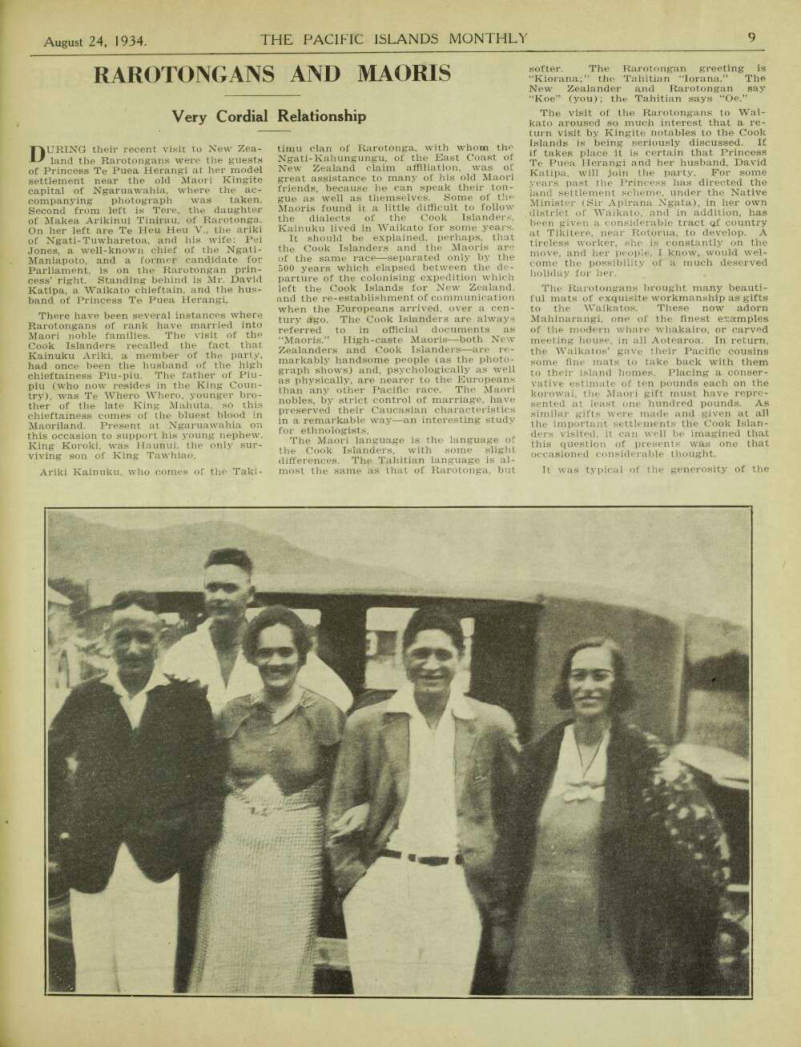
DURING their recent visit to New Zea land the Rarotongans were the guests of Princess Te Puea Herangi at her model settlement near the old Maori Kingite capital of Ngaruawahia, where the ac companying photograph was taken.
Second from left is Tere, the daughter of Makea Arikinui Tinirau, of Rarotonga.
On her left are Te Heu Heu V., the ariki of Ngati-Tuwharetoa, and his wife: Pei Jones, a well-known chief of the Ngati- Maniapoto, and a former candidate for Parliament, is on the Rarotongan prin cess’ right. Standing behind is Mr. David Katipa, a Waikato chieftain, and the hus band of Princess Te Puea Herangi, There have been several instances where Rarotongans of rank have married into Maori noble families. The visit of the Cook Islanders recalled the fact that Kainuku Ariki, a member of the party, had once been the husband of the high chieftainess Piu-piu. The father of Piu piu (who now resides in the King Coun try), was Te Whero Whero, younger bro ther of the late King Mahuta. so this chieftainess comes of the bluest blood in Maoriland. Present at Ngaruawahia on this occasion to support his young nephew.
King Koroki, was Haunui, the only sur viving son of King Tawhiao.
Ariki Kainuku. who comes of the Taki
timu clan of Rarotonga, with whom the Ngati-Kahungungu, of the East Coast of New Zealand claim affiliation, was of great assistance to many of his old Maori friends, because he can speak their ton gue as well as themselves. Some of the Maoris found it a little difficult to follow the dialects of the Cook Islanders.
Kainuku lived in Waikato for some years.
It should be explained, perhaps, that the Cook Islanders and the Maoris are of the same race—separated only by the 500 years which elapsed between the de parture of the colonising expedition which left the Cook Islands for New Zealand, and the re-establishment of communication when the Europeans arrived, over a cen tury ago. The Cook Islanders are always referred to in official documents as “Maoris.” High-caste Maoris —both New Zealanders and Cook Islanders —are re markably handsome people (as the photo graph shows) and, psychologically as well as physically, are nearer to the Europeans than any other Pacific race. The Maori nobles, by strict control of marriage, have preserved their Caucasian characteristics in a remarkable way—an interesting study for ethnologists.
The Maori language is the language of the Cook Islanders, with some slight differences. The Tahitian language is al most the same as that of Rarotonga, but
softer. The Rarotongan greeting is “Kiorana;” the Tahitian “lorana.” The New Zealander and Rarotongan say “Koe” (you); the Tahitian says “Oe.”
The visit of the Rarotongans to Wai kato aroused so much interest that a re turn visit by Kingite notables to the Cook Islands is being seriously discussed. If if takes place it is certain that Princess Te Puea Herangi and her husband, David Katipa, will join the party. For some years past the Princess has directed the land settlement scheme, under the Native Minister (Sir Apirana Ngata), in her own district of Waikato, and in addition, has been given a considerable tract qf country at Tikitere, near Rotorua, to develop. A tireless worker, she is constantly on the move, and her people, I know, would wel come the possibility of a much deserved holiday for her. , The Rarotongans brought many beauti ful mats of exquisite workmanship as gifts to the Waikatos. These now adorn Mahinarangi, one of the finest examples of the modern whare whakairo, or carved meeting house, in all Aotearoa. In return, the Waikatos’ gave their Pacific cousins some fine mats to take back with them to their island homes. Placing a conser vative estimate of ten pounds each on the korowai, the Maori gift must have repre sented at least one hundred pounds. As similar gifts were made and given at all the important settlements the Cook Islan ders visited, it can well be imagined that this question of presents was one that occasioned considerable thought.
It was typical of the generosity of the
Waikatos’ that the proceeds from a dance, which they gave in honour of their guests, should have been placed on the mats which Makea received on behalf of his party. The day has gone when Maoris can place five pound notes on gifts of food, but they do the best they can m these days of depression, and so fulfill their traditional code of hospitality to “the strangers from beyond the far hori zon.”
Young King Koroki, who was forced to bask in the limelight to a degree, both at Waitangi and elsewhere, for which he was obviously not prepared, received the Rarotongans’ offerings. It was not until the girls danced towards him in the cus tomary manner, and placed necklaces of shells and berries around his Royal neck, that he relaxed and broadly grinned, and so showed himself to be the boy that he really is.
The fact that two young Cook Islanders are going to learn carving at the Gov ernment School of Arts and Crafts at Rotorua, is evidence that Makea’s pro ject for a finely carved house in his Pacific home, is likely to be realised.
Throughout the whole of the tour the Rarotongans were accompanied by Ra kaherea Pomare, a son of their late be loved Minister (Sir Maui Pomare), and Dr. Ivan Sutherland, who visited the Islands not so long ago. Uady Pomare, Miss Ana Pomare, and Dr. Wi Repa, of the East Coast, likewise travelled a con siderable distance with the Islanders, and materially assisted them in many res
pects.—“Eriki.”