Cultivation Of Tung Trees
pp. 49-51 · Read in the full issue
Heavy Demand for Tung Oil Suggests Profitable Alternative Islands Crop
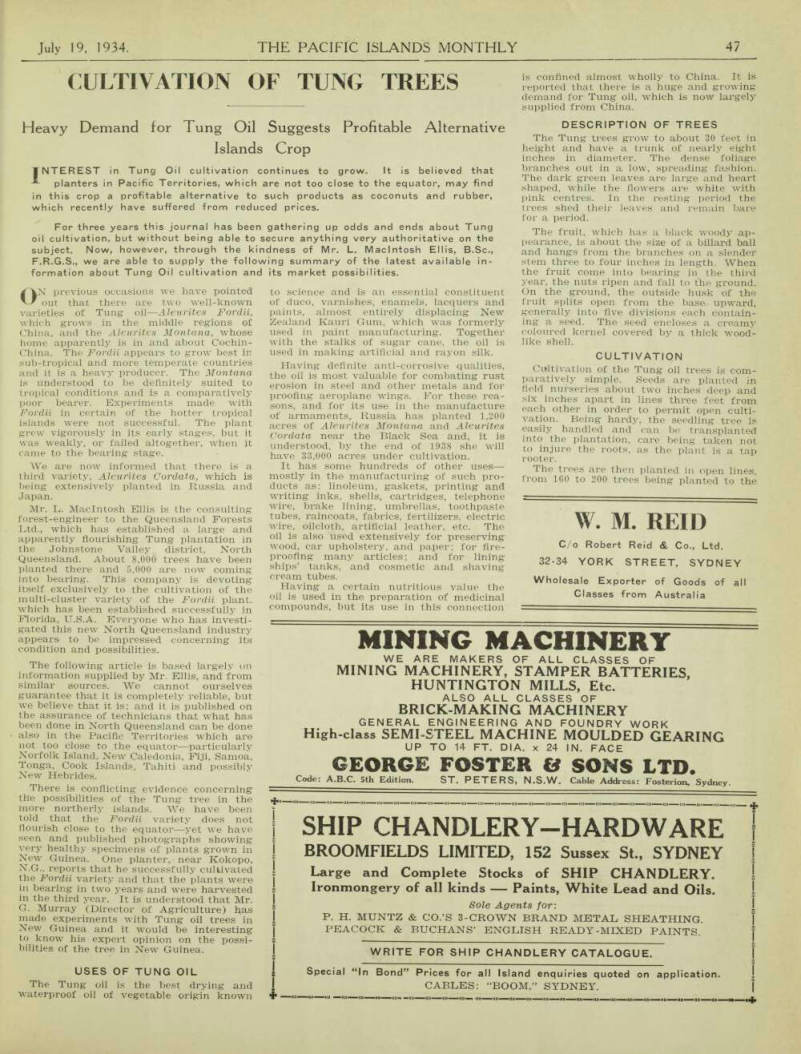
INTEREST in Tung Oil cultivation continues to grow. It is believed that planters in Pacific Territories, which are not too close to the equator, may find in this crop a profitable alternative to such products as coconuts and rubber, which recently have suffered from reduced prices.
For three years this Journal has been gathering up odds and ends about Tung oil cultivation, but without being able to secure anything very authoritative on the subject. Now, however, through the kindness of Mr. L. Macintosh Ellis, B.Sc., F.R.G.S., we are able to supply the following summary of the latest available in formation about Tung Oil cultivation and its market possibilities.
ON previous occasions we have pointed out that there are two well-known varieties of Tung oil — Aleurites Fordii, which grows in the middle regions of China, and the Aleurites Montana, whose home apparently is in and about Cochin- China. The Fordii appears to grow best in sub-tropical and more temperate countries and it is a heavy producer. The Montana is understood to be definitely suited to tropical conditions and is a comparatively poor bearer. Experiments made with Fordii in certain of the hotter tropical islands were not successful. The plant grew vigorously in its early stages, but it was weakly, or failed altogether, when it came to the bearing stage.
We are now informed that there is a third variety, Aleurites Cordata, which is being extensively planted in Russia and Japan.
Mr. L, Macintosh Ellis is the consulting forest-engineer to the Queensland Forests Ltd., which has established a large and apparently flourishing Tung plantation in the Johnstone Valley district, North Queensland. About 8,000 trees have been planted there and 5,000 are now coming into bearing. This company is devoting itself exclusively to the cultivation of the multi-cluster variety of the Fordii plant, which has been established successfully in Florida, U.S.A. Everyone who has investi gated this new North Queensland industry appears to be impressed concerning its condition and possibilities.
The following article is based largely on information supplied by Mr. Ellis, and from similar sources. We cannot ourselves guarantee that it is completely reliable, but we believe that it is; and it is published on the assurance of technicians that what has been done in North Queensland can be done also in the Pacific Territories which are not too close to the equator—particularly Norfolk Island, New Caledonia, Fiji, Samoa, Tonga, Cook Islands, Tahiti and possibly New Hebrides.
There is conflicting evidence concerning the possibilities of the Tung tree in the more northerly islands. We have been told that the Fordii variety does not flourish close to the equator—yet w T e have seen and published photographs showing very healthy specimens of plants grown in New Guinea. One planter, near Kokopo, N.G.. reports that he successfully cultivated the Fordii variety and that the plants were in bearing in two years and harvested in the third year. It is understood that Mr.
G. Murray (Director of Agriculture) has made experiments w r ith Tung oil trees in New Guinea and it would be interesting to know his expert opinion on the possi bilities of the tree in New Guinea.
Uses Of Tung Oil
The Tung oil is the best drying and waterproof oil of vegetable origin known
to science and is an essential constituent of duco, varnishes, enamels, lacquers and paints, almost entirely displacing New Zealand Kauri Gum, which was formerly used in paint manufacturing. Together with the stalks of sugar cane, the oil is used in making artificial and rayon silk.
Having definite anti-corrosive qualities, the oil is most valuable for combating rust erosion in steel and other metals and for proofing aeroplane wings. For these rea sons, and for its use in the manufacture of armaments, Russia has planted 1,200 acres of Aleurites Montana and Aleurites Cordata near the Black Sea and, it is understood, by the end of 1938 she will have 33,000 acres under cultivation.
It has some hundreds of other uses— mostly in the manufacturing of such pro ducts as: linoleum, gaskets, printing and writing inks, shells, cartridges, telephone wire, brake lining, umbrellas, toothpaste tubes, raincoats, fabrics, fertilizers, electric wire, oilcloth, artificial leather, etc. The oil is also used extensively for preserving wood, car upholstery, and paper; for fire proofing many articles; and for lining ships’ tanks, and cosmetic and shaving cream tubes.
Having a certain nutritious value the oil is used in the preparation of medicinal compounds, but its use in this connection
is confined almost wholly to China. It is reported that there is a huge and growing demand for Tung oil, which is now largely supplied from China.
Description Of Trees
The Tung trees grow to about 30 feet in height and have a trunk of nearly eight inches in diameter. The dense foliage branches out in a low, spreading fashion.
The dark green leaves are large and heart shaped, while the flowers are white with pink centres. In the resting period the trees shed their leaves and remain bare for a period.
The fruit, which has a black woody ap pearance, is about the size of a billard ball and hangs from the branches on a slender stem three to four inches in length. When the fruit come into bearing in the third year, the nuts ripen and fall to the ground.
On the ground, the outside husk of the fruit splits open from the base upward, generally into five divisions each contain ing a seed. The seed encloses a creamy coloured kernel covered by a thick wrood like shell,
Cultivation
Cultivation of the Tung oil trees is com paratively simple. Seeds are planted in field nurseries about two inches deep and six inches apart in lines three feet from each other in order to permit open culti vation. Being hardy, the seedling tree is easily handled and can be transplanted into the plantation, care being taken not to injure the roots, as the plant is a tap rooter.
The trees are then planted in open lines, from 160 to 200 trees being planted to the
acre. Tung oil trees in their early stages require only the same attention as other crops—a clean orchard floor, and freedom from weeds —and care should be taken to guard the young trees from straying cattle.
Although the trees bear fruit after the second year, it is not until they mature and have been bearing for about three years that they produce a crop on a profitable commercial basis. The trees reach full bearing in their tenth year, and continue to produce fruit for another 20 years. The oldest trees in Florida, U.S.A., are about 28 years old and are still bearing a full crop.
When the fruit is gathered, husked and the seeds bagged, they are sent to the mill where the oil is extracted by an up-to-date expressing plant. The oil when extracted is a pale neutral colour and in appearance is not unlike eucalyptus oil. In China, however, the extraction is done in very primitive fashion and consequently the extracted oil contains impurities and par ticles of the nut and husk. The Chinese growers adulterate the oil 20 per cent, by the addition of soya bean oil, sesame oil, rape seed oil, poppy seed oil and peanut oil. This process of adulteration gives the oil a light golden colour, and it is then marketed under the name of Chinese wood oil.
Estimated Returns
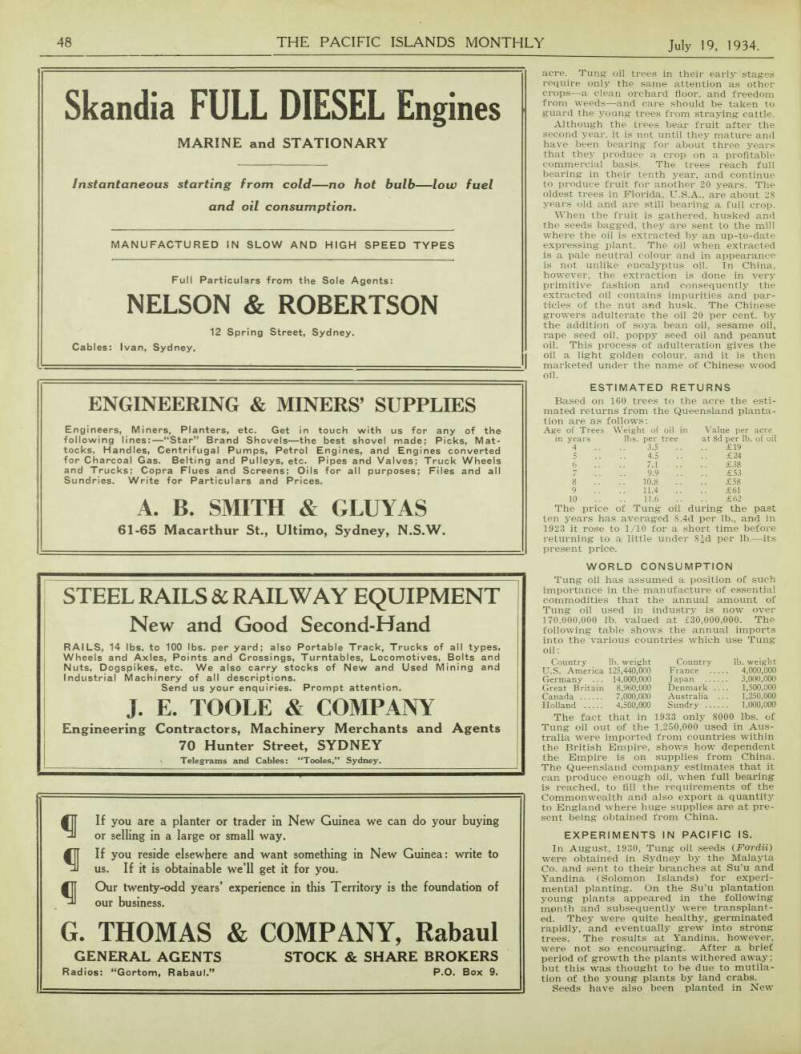
Based on 160 trees to the acre the esti mated returns from the Queensland planta tion are as follows:
The price of Tung oil during the past ten years has averaged 8.4 d per lb., and in 1923 it rose to 1/10 for a short time before returning to a little under 8½d per lb.—its present price.
World Consumption
Tung oil has assumed a position of such importance in the manufacture of essential commodities that the annual amount of Tung oil used in industry is now over 170,000,000 lb. valued at £30,000,000. The following table shows the annual imports into the various countries which use Tung oil:
The fact that in 1933 only 8000 lbs. of Tung oil out of the 1,250,000 used in Australia were imported from countries within the British Empire, shows how dependent the Empire is on supplies from China.
The Queensland company estimates that it can produce enough oil, when full bearing is reached, to fill the requirements of the Commonwealth and also export a quantity to England where huge supplies are at pre sent being obtained from China.
Experiments In Pacific Is.
In August, 1930, Tung oil seeds ( Fordii) were obtained in Sydney by the Malayta Co. and sent to their branches at Su’u and Yandina (Solomon Islands) for experi mental planting. On the Su’u plantation young plants appeared in the following month and subsequently were transplant ed. They were quite healthy, germinated rapidly, and eventually grew into strong trees. The results at Yandina, however, were not so encouraging. After a brief period of growth the plants withered away; but this was thought to be due to mutila tion of the young plants by land crabs.
Seeds have also been planted in New
Age of Trees Weight of oil in Value per acre in years lbs. per tree at 8d per lb. of oil 4 3.5 £19 5 4.5 £24 6 7.1 £38 7 9.9 £53 8 10.8 £58 9 11.4 £61 10 11.6 £62
Country lb. weight Country lb. weight U.S. America 125,440,000 France ... 4,000,000 Germany ... 14,000,000 Japan .. ... 3,000,000 Great Britain 8,960,000 Denmark ... 1,500,000 Canada 7,000,000 Australia ... 1,250,000 Holland 4,500,000 Sundry .. ... 1,000,000
Hebrides by the Compagnie Cotonnier at Norsup, by the French Government in New Caledonia, by Mr. Tom Nevitt in Pa pua, and by a Mr. Duncan in Fiji; but to date no advice has been received in Sydney regarding the results of these experiments.
In New Zealand, it is understood, the results have not been satisfactory and all efforts to establish the industry there have failed. Much trouble has been experienced in N.Z. through a lack of suitable soil— for instance, one experimenter planted ex tensive areas of Tung plants in hard clayey soil, in spite of the experts’ conten tion that it is essential for best results to cultivate the crop in volcanic soil.
Process Of Extraction
When Tung Oil cultivation was first experimented with in Australia, three years ago, the oil was extracted from the nuts by a chemical process—by using sol vents. After a couple of days, the result ing oil congealed, and this of course was useless for commercial purposes. In this way, a prejudice grew against Tung oil.
But it since has been learned that there is no such trouble when the oil is obtained by expression. The director of the Sydney Technological Museum reports that he has taken the oil. by pressure, from various samples supplied by Mr. Ellis, with com pletely satisfactory results.
Seeds For Islands Planters
The Queensland crop has now been har vested and samples will be sent all over the world for experimental purposes.
To assist Tung oil cultivation in the Pacific Islands, Mr. Ellis has reserved 100 lbs. of Tung seeds for Islands planters, and his company is prepared to handle and crush seeds grown in the Islands. Resi dents in Pacific Territories can obtain, free of charge, supplies of Tung oil seeds and further information from Mr. L. Macintosh Ellis, at the office of Queensland Forests Ltd., 8-14 Bond Street, Sydney.
Queensland Forests Ltd. is a bond-sell ing company; and both investors and planters in Australia have reason to regard all bond-selling concerns with suspicion.
So far as we can ascertain, Queensland Forests Ltd. is a well-conducted company, which appears to be making a genuine effort to establish a new industry soundly, as well as profitably. Mr. Ellis is a gentle man of excellent reputation, professionally as well as personally.