Oil Extraction
Experiment with Beckman Process in B.S.I.
AN interesting experiment covering the proposed extraction of oil from green coconuts by a chemical process is pro ceeding at a plantation near Cape Marsh, Solomon Islands, under the auspices of the Malayta Company. The experiment has not been successful, but it has given so much promise that it is being pro ceeded with. The process employed Is called the Beckman process.
In the “Pacific Islands Monthly” of June, 1931, there appeared an article headed “Recovery of Coconut Oil —American Chemist Introduces a New Bacterial Process —Claimed to be Much Cheaper and Better Than Crushing.”
It was then explained that Mr. John W.
Beckman, of California, had patented a process under which, by a combination of bacteria and certain chemicals, he claimed that he could quickly and cheaply separate the oil from the undried coco nuts. An apparatus had been constructed in which large quantities of green coco nuts were placed in hoppers, and passed on slowly into chambers where they make contact with a bacteria culture, calcium carbonate, etc. After under going treatment for some five or six days, there was discharged from the apparatus a definite quantity of pure coconut oil, shredded nut and water. It was claimed that both the oil and oil-cake were im mediately marketable.
Nothing further was heard of Mr. Beck man’s discovery for some years.
A few months ago Mr. L. Corlander arrived from America with authority to experiment with the process in this part of the world. He succeeded in interesting the enterprising Malayta Company and the experiment at the Cape Marsh plan tation Was the result.
We have no details of what has been accomplished, but we understand that the small experimental plant established at Cape Marsh has not completely fulfilled what was expected of it. The results of the experiment, however, have justified Mr. Corlander and his associates, and the Malayta Company, in obtaining some further apparatus in Sydney which has been sent to Cape Marsh to enable the experiment to be continued. Mean while, Mr. Corlander has come to Sydney for medical attention, and at present is in hospital.
It will be apparent to practical coconut planters that this system of recovering coconut oil for profit may have some ad vantages over the present system. It is claimed that the cost of treatment in the bacterial plant is no greater than the cost of drying copra. The shipment of copra has three disadvantages under pre sent conditions—namely, its bulkiness, which demands considerable freight space; the cost of sacks; and the fact that even after the copra has been dried it still retains a certain amount of water.
Against those disadvantages may be placed the fact that it is easily and con veniently handled.
The bacterial process, if it were proved commercially practicable, would haye the advantage probably of great saving in freight space (oil being carried instead of bagged copra) but it has the disadvant age that the cost of oil containers would probably be heavy and that it still is necessary to ship the coconut cake to a.
market somewhere if the value of that important by-product of the crushing mills is not to be lost. It is claimed, however, that if this method of treating coconuts were adopted on a large scale it would be possible to fatten cattle from the coconut-cake near the works—in other words, the cattle might be brought to the coconuts instead of the coconuts being sent overseas to the cattle.
The result of the Cape Marsh experi ment will be awaited with interest.
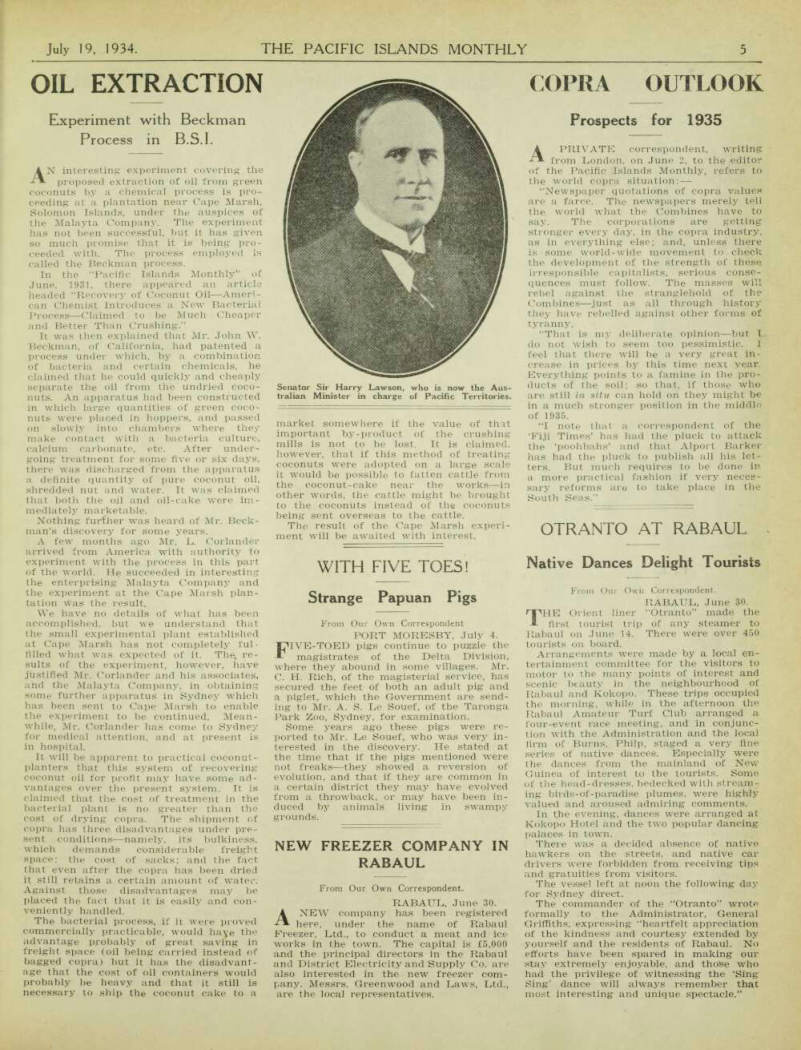
Senator Sir Harry Lawson, who is now the Aus tralian Minister in charge of Pacific Territories.