Tahiti
p. 51 · Read in the full issue
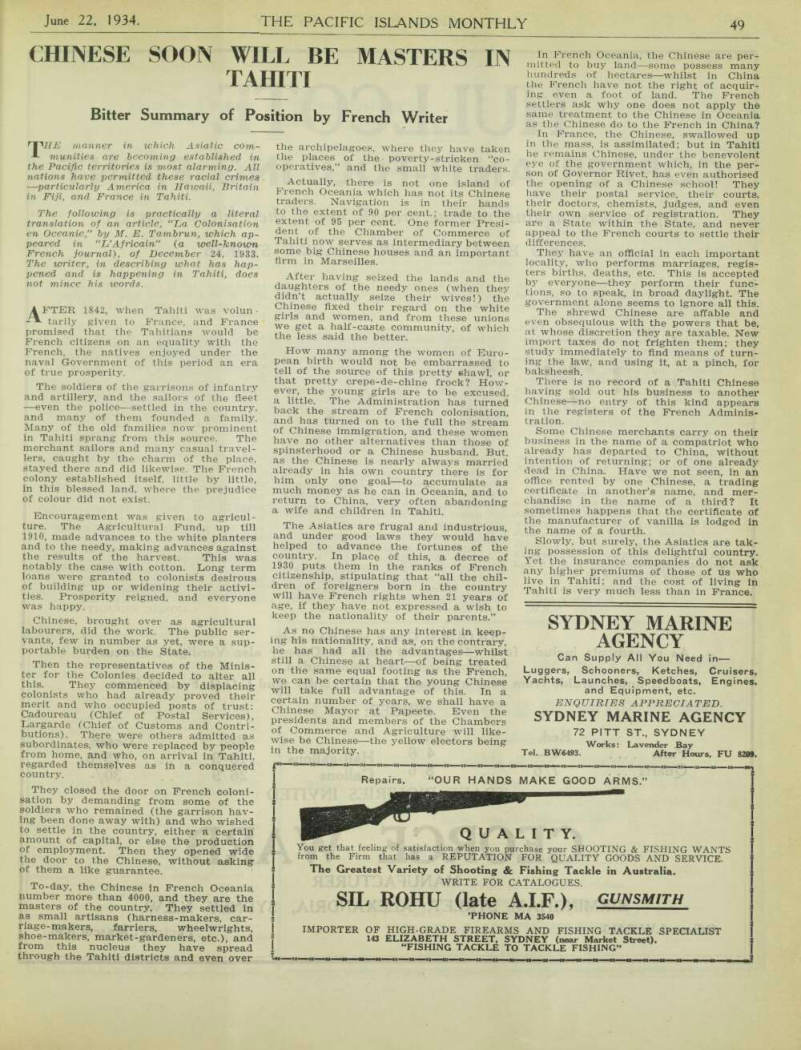
Chinese Soon Will Be Masters In
Bitter Summary of Position by French Writer
The manner in which Asiatic communities are becoming established in the Pacific territories is most alarming. All nations have permitted these racial crimes —particularly America in Hawaii, Britain in Fiji, and France in Tahiti.
The following is practically a literal translation of an article, “La Colonisation en Oceanic,” by M. E. Tambrun, which ap peared in “L'Africain” (a well-known French journal), of December 24, 1933.
The writer, in describing what has hap pened and is happening in Tahiti, does not mince his words.
AFTER 1842, when Tahiti was voluntarily given to France, and France promised that the Tahitians would be French citizens on an equality with the French, the natives enjoyed under the naval Government of this period an era of true prosperity.
The soldiers of the garrisons of infantry and artillery, and the sailors of the fleet —even the police—settled in the country, and many of them founded a family.
Many of the old families now prominent in Tahiti sprang from this source. The merchant sailors and many casual travel lers, caught by the charm of the place, stayed there and did likewise. The French colony established itself, little by little, in this blessed land, where the prejudice of colour did not exist.
Encouragement was given to agricul ture. The Agricultural Fund, up till 1910, made advances to the white planters and to the needy, making advances against the results of the harvest. This was notably the case with cotton. Long term loans were granted to colonists desirous of building up or widening their activi ties. Prosperity reigned, and everyone was happy.
Chinese, brought over as agricultural labourers, did the work. The public ser vants, few in number as yet, were a sup portable burden on the State.
Then the representatives of the Minis ter for the Colonies decided to alter all this. They commenced by displacing colonists who had already proved their merit and who occupied posts of trust: Cadoureau (Chief of Postal Services), Largarde (Chief of Customs and Contri butions). There were others admitted as subordinates, who were replaced by people from home, and who, on arrival in Tahiti, regarded themselves as in a conquered country.
They closed the door on French coloni sation by demanding from some of the soldiers who remained (the garrison hav ing been done away with) and who wished to settle in the country, either a certain amount of capital, or else the production of employment. Then they opened wide the door to the Chinese, without asking of them a like guarantee.
To-day, the Chinese in French Oceania number more than 4000, and they are the masters of the country. They settled in as small artisans (harness-makers, car riage-makers, farriers, wheelwrights, shoe-makers, market-gardeners, etc.), and from this nucleus they have spread through the Tahiti districts and even over
the archipelagoes, where they have taken the places of the poverty-stricken “co operatives,” and the small white traders.
Actually, there is not one island of French Oceania which has not its Chinese traders. Navigation is in their hands to the extent of 90 per cent.; trade to the extent of 95 per cent. One former Presi dent of the Chamber of Commerce of Tahiti now serves as intermediary between some big Chinese houses and an important firm in Marseilles.
After having seized the lands and the daughters of the needy ones (when they didn’t actually seize their wives!) the Chinese fixed their regard on the white girls and women, and from these unions we get a half-caste community, of which the less said the better.
How many among the women of Euro pean birth would not be embarrassed to tell of the source of this pretty shawl, or that pretty crepe-de-chine frock? How ever, the young girls are to be excused, a little. The Administration has turned back the stream of French colonisation, and has turned on to the full the stream of Chinese immigration, and these women have no other alternatives than those of spinsterhood or a Chinese husband. But, as the Chinese is nearly always married already in his own country there is for him only one goal—to accumulate as much money as he can in Oceania, and to return to China, very often abandoning a wife and children in Tahiti.
The Asiatics are frugal and industrious, and under good laws they would have helped to advance the fortunes of the country. In place of this, a decree of 1930 puts them in the ranks of French citizenship, stipulating that “all the chil dren of foreigners born in the country will have French rights when 21 years of age, if they have not expressed a wish to keep the nationality of their parents.”
As no Chinese has any interest in keep ing his nationality, and as, on the contrary, he has had all the advantages—whilst still a Chinese at heart —of being treated on the same equal footing as the French, we can be certain that the young Chinese will take full advantage of this. In a certain number of years, we shall have a Chinese Mayor at Papeete. Even the presidents and members of the Chambers of Commerce and Agriculture will like wise be Chinese—the yellow electors being in the majority.
In French Oceania, the Chinese are per mitted to buy land—some possess many hundreds of hectares—whilst in China the French have not the right of acquir ing even a foot of land. The French settlers ask why one does not apply the same treatment to the Chinese in Oceania as the Chinese do to the French in China?
In France, the Chinese, swallowed up in the mass, is assimilated; but in Tahiti he remains Chinese, under the benevolent eye of the government which, in the per son of Governor Rivet, has even authorised the opening of a Chinese school! They have their postal service, their courts, their doctors, chemists, judges, and even their own service of registration. They are a State within the State, and never appeal to the French courts to settle their differences.
They have an official in each important locality, who performs marriages, regis ters births, deaths, etc. This is accepted by everyone—they perform their func tions, so to speak, in broad daylight. The government alone seems to ignore all this.
The shrewd Chinese are affable and even obsequious with the powers that be, at whose discretion they are taxable. New import taxes do not frighten them; they study immediately to find means of turn ing the law, and using it, at a pinch, for baksheesh.
There is no record of a Tahiti Chinese having sold out his business to another Chinese—no entry of this kind appears in the registers of the French Adminis tration.
Some Chinese merchants carry on their business in the name of a compatriot who already has departed to China, without intention of returning; or of one already dead in China. Have we not seen, in an office rented by one Chinese, a trading certificate in another’s name, and mer chandise in the name of a third? It sometimes happens that the certificate of the manufacturer of vanilla is lodged in the name of a fourth.
Slowly, but surely, the Asiatics are tak ing possession of this delightful country.
Yet the insurance companies do not ask any higher premiums of those of us who live in Tahiti; and the cost of living in Tahiti is very much less than in France.