How Kalekona Got His Head
p. 44 · Read in the full issue
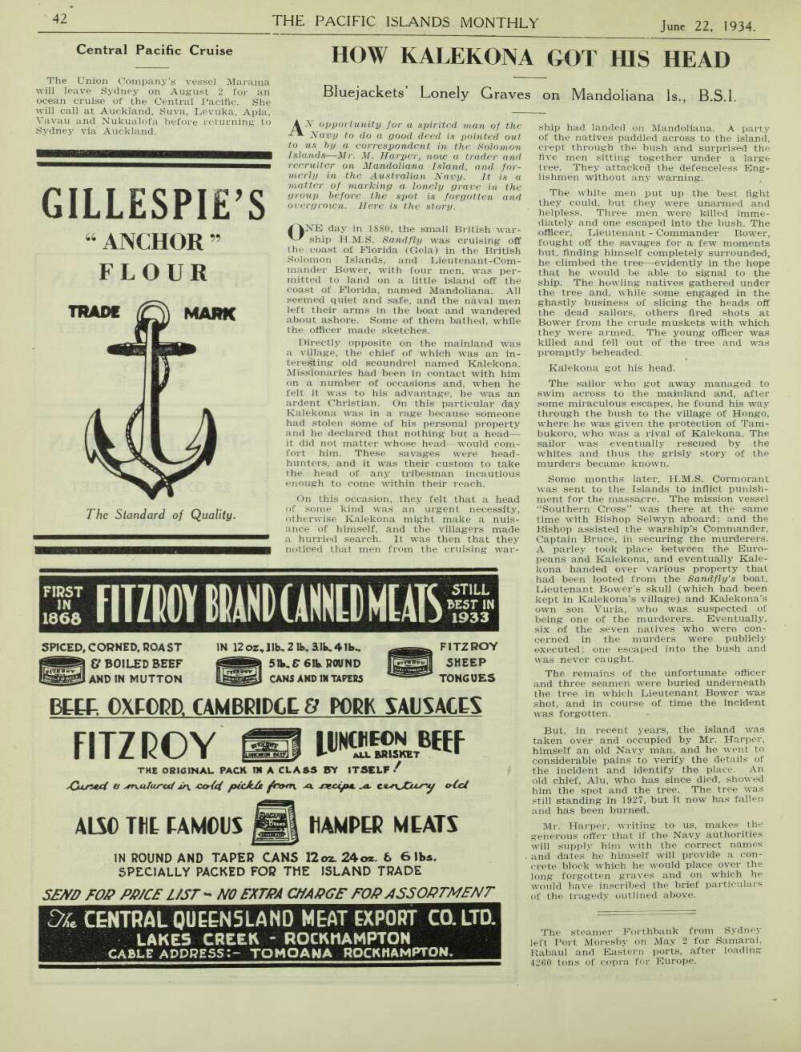
Bluejackets’ Lonely Graves on Mandoliana Is., B.S.I.
AN opportunity for a spirited man of the Navy to do a good deed is pointed out to us by a correspondent in the Solomon Islands — Mr. M. Harper, now a trader and recruiter on Mandoliana Island, and for merly in the Australian Navy. It is a matter of marking a lonely grave in the group before the spot is forgotten and overgrown. Here is the story.
One day in 1880, the small British warship H.M.S. Sandfly was cruising off the coast of Florida (Gela) in the British Solomon Islands, and Lieutenant-Com mander Bower, with four men, was per mitted to land on a little island off the coast of Florida, named Mandoliana. All seemed quiet and safe, and the naval men left their arms in the boat and wandered about ashore. Some of them bathed, while the officer made sketches.
Directly opposite on the mainland was a village, the chief of which was an in teresting old scoundrel named Kalekona.
Missionaries had been in contact with him on a number of occasions and, when he felt it was to his advantage, he was an ardent Christian. On this particular day Kalekona was in a rage because someone had stolen some of his personal property and he declared that nothing but a head — it did not matter whose head—would com fort him. These savages were head hunters, and it was their custom to take the head of any tribesman incautious enough to come within their reach.
On this occasion, they felt that a head of some kind was an urgent necessity, otherwise Kalekona might make a nuis ance of himself, and the villagers made a hurried search. It was then that they noticed that men from the cruising war
ship had landed on Mandoliana. A party of the natives paddled across to the island, crept through the bush and surprised the five men sitting together under a large tree. They attacked the defenceless Eng lishmen without any warning.
The white men put up the best fight they could, but they were unarmed and helpless. Three men were killed imme diately and one escaped into the bush. The officer, Lieutenant - Commander Bower, fought off the savages for a few moments but, finding himself completely surrounded, he climbed the tree —evidently in the hope that he would be able to signal to the ship. The howling natives gathered under the tree and, while some engaged in the ghastly business of slicing the heads off the dead sailors, others fired shots at Bower from the crude muskets with which they were armed. The young officer was killed and fell out of the tree and was promptly beheaded.
Kalekona got his head.
The sailor who got away managed to swim across to the mainland and, after some miraculous escapes, he found his way through the bush to the village of Kongo, where he was given the protection of Tam bukoro, who was a rival of Kalekona. The sailor was eventually rescued by the whites and thus the grisly story of the murders became known.
Some months later, H.M.S. Cormorant was sent to the Islands to inflict punish ment for the massacre. The mission vessel “Southern Cross’’ was there at the same time with Bishop Selwyn aboard; and the Bishop assisted the warship’s Commander, Captain Bruce, in securing the murderers.
A parley took place between the Euro peans and Kalekona, and eventually Kale kona handed over various property that had been looted from the Sandfly's boat.
Lieutenant Bower’s skull (which had been kept in Kalekona’s village) and Kalekona’s own son Vuria, who was suspected of being one of the murderers. Eventually, six of the seven natives who were con cerned in the murders were publicly executed; one escaped into the bush and was never caught.
The remains of the unfortunate officer and three seamen were buried underneath the tree in which Lieutenant Bower was shot, and in course of time the incident was forgotten.
But, in recent years, the island was taken over and occupied by Mr. Harper, himself an old Navy man, and he went to considerable pains to verify the details of the incident and identify the place. An old chief, Alu, who has since died, showed him the spot and the tree. The tree was still standing in 1927, but it now has fallen and has been burned.
Mr. Harper, writing to us, makes the generous offer that if the Navy authorities will supply him with the correct names and dates he himself will provide a con crete block which he would place over the long forgotten graves and on which he would have inscribed the brief particulars of the tragedy outlined above.
The steamer Forthbank from Sydney left Port Moresby on May 2 for Samarai, Rabaul and Eastern ports, after loading 4260 tons of copra for Europe.