Religious Stir In Nauru
pp. 30-31 · Read in the full issue
When High Chief Detudamo Founded New Denomination
IT was stated in the January issue of the "Pacific Islands Monthly” that there was a certain amount of political friction among the natives of Nauru which ap peared to be based on religious contro versy. It was also stated that there was some feeling in the Roman Catholic com munity owing to the advent of a second priest and that, as a consequence, two factions came into existence in the Roman Catholic community and that there was such a fierce argument that the Adminis trator was obliged to take official notice of it.
It was further stated that there was some conflict between the new Adminis trator, Commander R. Garsia, and the leading chief of the islatid who had a fol lowing of about 400 natives, regarding a new religious sect on the island called the Anglican Church of Nauru.
FURTHER information from this small Mandated Territory indicates that the implications in the article referred to were not quite correct.
There is the most complete harmony between the two Fathers and there never has been any friction in the Roman Catholic community at Nauru. A second Father was sent to Nauru not recently, but six years ago, at the beginning of 1928, at the special request of Father Kayser, who had been carrying on mis sion work on the island for the previous 30 years. The new mission priest, an Australian, assisted the Father already on the island by taking over from him the responsibility of one of the mission sta tions.
In 1923 the Administration took over from the missions the task of educating the young Nauruans and the schools were then conducted on purely secular lines.
However, the Roman Catholic community, believing that the new system of educa
tion was detrimental to the natives in their primitive state, appealed to the authorities to allow them to establish a denominational school. The authorities in Canberra, after lengthy consideration of the matter, decided to allow the R.C. community to do so. In due course a school was set up, under the charge of the Australian Father. All the young Catholic Nauruans attended this school, together with some of the older pupils who had left the Administration’s school, after attending there for the prescribed number of years. However, the work of the Roman Catholic school was restricted by the Administrator, who took certain deputed them for commercial work to the chiefs of the island. older trainees away from the school and Later, the Australian priest became ill and went on sick leave for a few months.
He returned shortly afterwards with ad ditional material and requisites for his school, and began to resume the inter rupted classes. It was then that the Ad ministrator “took official notice of it”— he stopped the priest from recommencing the classes and prohibited the denomina tional school.
That is the correct story of the first part of the article, and the other matter — slight friction between the new Adminis trator and the leading chief and his fol lowers—has a long history.
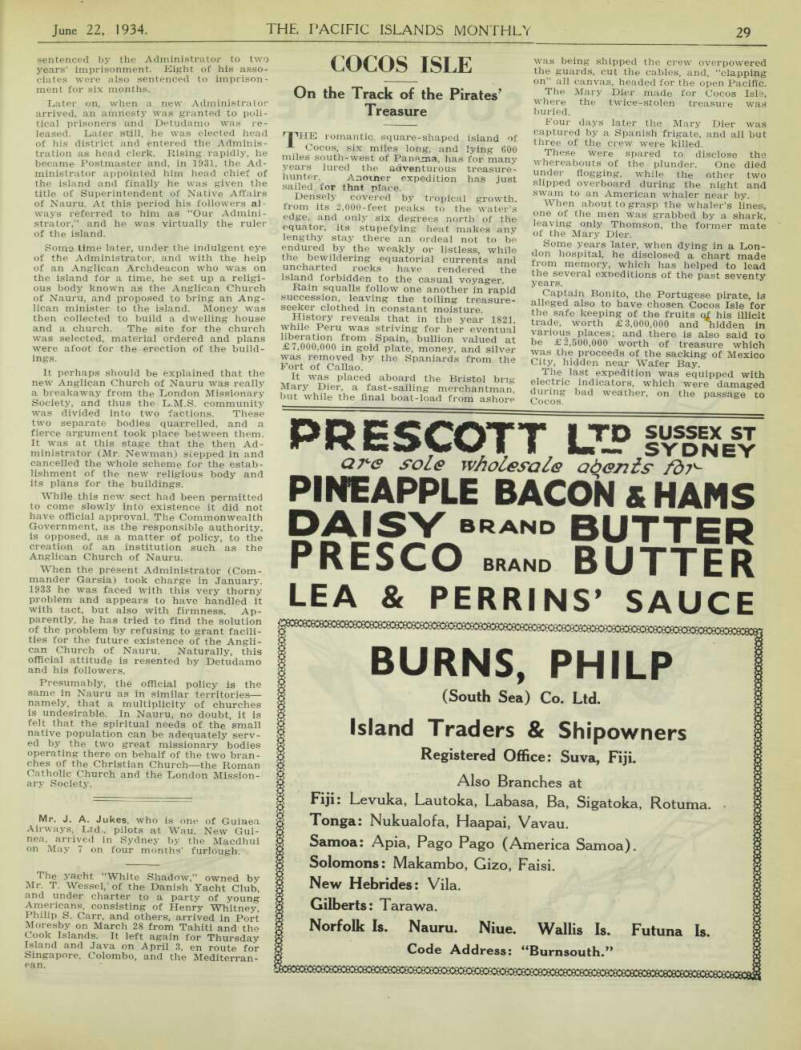
During the war a clever young native named Detudamo went to the United States and received training as a mis sionary for the Methodist Mission, which
at that time had a station on the island.
Returning to Nauru about 1920, he found that the Methodist Mission station there had been taken over by the London Mis sionary Society. He was then a restless young man of some what fiery tempera ment, and he had a good knowledge of the English lan guage.
Being a good deal cleverer than most
of his fellow countrymen, he was confi dent that he could do much to improve the political, moral, and social conditions of the Nauruans. Shortly after his arri val, he started a campaign for a form of self-government, and, under his leader ship, a political upheaval was threatened.
Subsequently, a plot was discovered, and he and the head chief of that time were
Detudamo
sentenced by the Administrator to two years’ imprisonment. Eight of his asso ciates were also sentenced to imprison ment for six months.
Later on, when a new Administrator arrived, an amnesty was granted to poli tical prisoners and Detudamo was re leased. Later still, he was elected head of his district and entered the Adminis tration as head clerk. Rising rapidly, he became Postmaster and, in 1931, the Ad ministrator appointed him head chief of the island and finally he was given the title of Superintendent of Native Affairs of Nauru. At this period his followers al ways referred to him as “Our Admini strator,” and he was virtually the ruler of the island.
Soma time later, under the indulgent eye of the Administrator, and with the help of an Anglican Archdeacon who was on the island for a time, he set up a religi ous body known as the Anglican Church of Nauru, and proposed to bring an Ang lican minister to the island. Money was then collected to build a dwelling house and a church. The site for the church was selected, material ordered and plans were afoot for the erection of the build ings.
It perhaps should be explained that the new Anglican Church of Nauru was really a breakaway from the London Missionary Society, and thus the L.M.S. community was divided into two factions. These two separate bodies quarrelled, and a fierce argument took place between them.
It was at this stage that the then Ad ministrator (Mr. Newman) stepped in and cancelled the whole scheme for the estab lishment of the new religious body and its plans for the buildings.
While this new sect had been permitted to come slowly into existence it did not have official approval. The Commonwealth Government, as the responsible authority, is opposed, as a matter of policy, to the creation of an institution such as the Anglican Church of Nauru.
When the present Administrator (Com mander Garsia) took charge in January, 1933 he was faced With this very thorny problem and appears to have handled it with tact, but also with firmness. Ap parently, he has tried to find the solution of the problem by refusing to grant facili ties for the future existence of the Angli can Church of Nauru. Naturally, this official attitude is resented by Detudamo and his followers.
Presumably, the official policy is the same in Nauru as in similar territories— namely, that a multiplicity of churches is undesirable. In Nauru, no doubt, it is felt that the spiritual needs of the small native population can be adequately serv ed by the two great missionary bodies operating there on behalf of the two bran ches of the Christian Church—the Roman Catholic Church and the London Mission ary Society.
Mr. J. A. Jukes, who is one of Guinea Airways, Ltd., pilots at Wau, New Gui nea, arrived in Sydney by the Macdhui on May 7 on four months’ furlough.
The yacht “White Shadow,” owned by Mr. T. Wessel, of the Danish Yacht Club, and under charter to a party of young Americans, consisting of Henry Whitney, Philip S. Carr, and others, arrived in Port Moresby on March 28 from Tahiti and the Cook Islands. It left again for Thursday Island and Java on April 3, en route for Singapore, Colombo, and the Mediterran ean.