Lever Bros. Profit: £6,200,000
pp. 27-28 · Read in the full issue
Head of the Unilever Group Pays 15%
The growth of the Unilever Combine can be traced from developments before and during the war. Originally, there were two big opera tors in the Copra market—Jurgens and Vanden berghs, both Dutch. During the war, while the competing firms of the combatant nations were otherwise occupied, these two big concerns got together and bought a controlling interest in certain German mills.
After the war, a strong German organisation, the Heimer Combine, sprang up, and took con trol of mills in Czecho-Slovakia, Austria, ana Switzerland. It fought the Dutch Combine, and competition was healthy.
But the next move was bad for the copra producers—there came a Jurgens-Vandenberghs- Heimer combination, which secured control of the margarine industry in nearly every European country. It bought a mill at Latvia, a controlling interest in two big mills in Sweden, and, in 1930, it got control of the Norwegian mills.
Meanwhile, this Continental organisation linked up with British manufacturers—and so we get the famous “Margarine Union,” controlling margarine manufacture and distribution throughout Europe and, in the copra market, buying for the mills of Britain, Scandinavia, Holland, Germany, Swit zerland, Austria, and Czecho-Slovakia, During this period, Lever Brothers were creat ing, in the soap-making industry of Europe the same dominant organisation that the Dutcn- German combine had brought into being in the margarine business. Since their chief raw materials were the same, it was inevitable that the Margarine Union and Lever Bros, should come closer together—either as friends or enemies.
To the discomfiture of the oil seed producers of the world, they amalgamated their interests.
And thus, in 1928, Unilever was born. —From an article, “Unilever knd Copra’s Future,” published in the Pacific Islands Monthly, May, 1931.
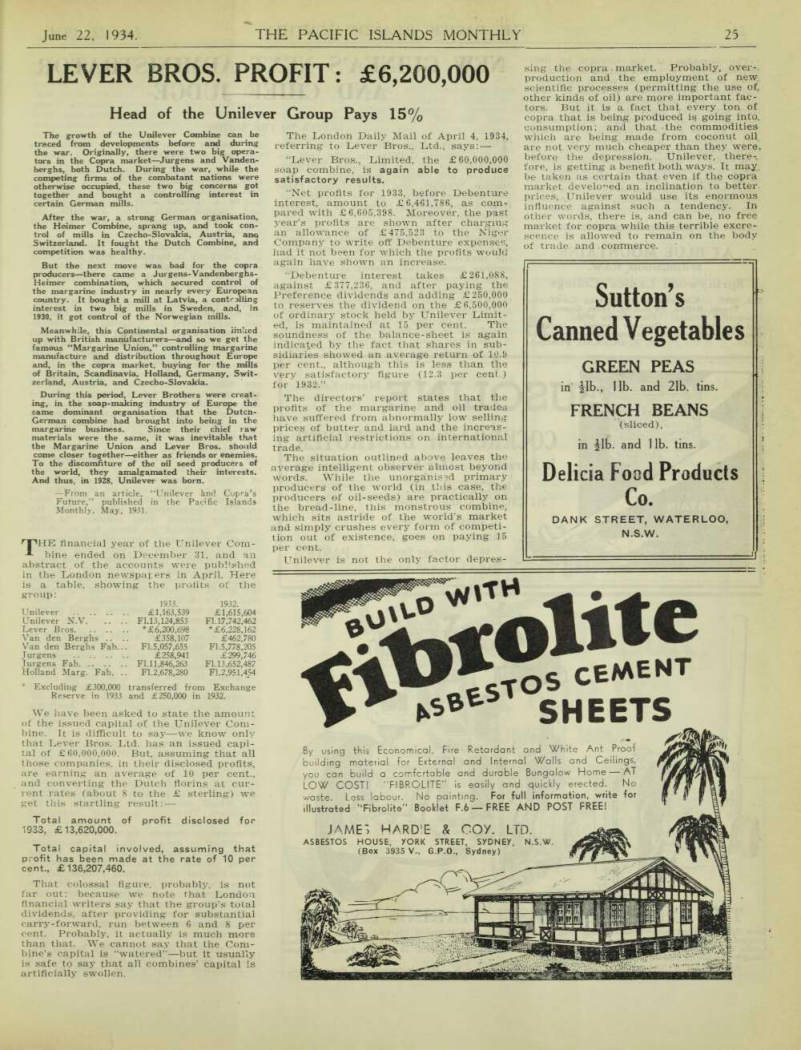
THE financial year of the Unilever Combine ended on December 31. and an abstract of the accounts were published in the London newspapers in April. Here is a table, showing the profits of the group:
We have been asked to state the amount of the issued capital of the Unilever Com bine. It is difficult to say—we know only that Lever Bros. Ltd. has an issued capi tal of £60,000,000. But, assuming that all those companies, in their disclosed profits, are earning an average of 10 per cent., and converting the Dutch florins at cur rent rates (about 8 to the £ sterling) we get this startling result; Total amount of profit disclosed for 1933, £13,620,000.
Total capital involved, assuming that profit has been made at the rate of 10 per cent., £136,207,460.
That colossal figure, probably, is not far out: because we note that London financial writers say that the group’s total dividends, after providing for substantial carry-forward, run between 6 and 8 per cent. Probably, it actually is much more than that. We cannot say that the Com bine’s capital is “watered” —but it usually is safe to say that all combines’ capital is artificially swollen.
The London Daily Mail of April 4, 1934, referring to Lever Bros., Ltd., says: “Lever Bros., Limited, the £60,000,000 soap combine, is again able to produce satisfactory results.
“Net profits for 1933, before Debenture interest, amount to £6,461,786, as com-* pared with £6,605,398. Moreover, the past year’s profits are shown after charging an allowance of £475,523 to the Niger Company to write off Debenture expenses, had it not been for which the profits would again have shown an increase.
“Debenture interest takes £261,088, against £377,236, and after paying the Preference dividends and adding £250,000 to reserves the dividend on the £6,500,000 of ordinary stock held by Unilever Limit ed, is maintained at 15 per cent. The soundness of the balance-sheet is again indicated by the fact that shares in sub sidiaries showed an average return of 10.9 per cent., although this is less than the very satisfactory figure (12.3 per cent.)
for' 1932.”
The directors’ report states that the profits of the margarine and oil trades have suffered from abnormally low selling prices of butter and lard and the increas ing artificial restrictions on international trade.
The situation outlined above leaves the average intelligent observer almost beyond words. While the unorganised primary producers of the world (in this case, the producers of oil-seeds) are practically on the bread-line, this monstrous combine, which sits astride of the world’s market and simply crushes every form of competi tion out of existence, goes on paying 15 per cent.
Unilever is not the only factor depres
sing the copra market. Probably, overproduction and the employment of new scientific processes (permitting the use of other kinds of oil) are more important fac tors. But it is a fact that every ton of copra that is being produced is going into consumption; and that the commodities which are being made from coconut oil are not very much cheaper than they were, before the depression. Unilever, there fore, is getting a benefit both ways. It may be taken as certain that even if the copra market developed an inclination to better prices, Unilever would use its enormous influence against such a tendency. In other words, there is, and can be, no free market for copra while this terrible excre scence is allowed to remain on the body of trade and commerce.
1933. 1932.
Unilever £1,163,539 £1,615,604 Unilever N.V. .. .
Fl.13,124,853 FI. 17,742,462 Lever Bros *£6,200,698 *£6,228,162 Van den Berghs .. £358,107 £462,780 Van den Berghs Fab..
FI.5,057,655 FI.5,778,205 Jurgens £258,941 £299,746 Jurgens Fab Fl.l 1,846,263 FI. 13,652,487 Holland Marg. Fab. .
FI.2,678,280 FI. 2,951,454 * Excluding £300,000 transferred from Exchange Reserve in 1933 and £250,000 in 1932.
The combine is big enough to defy governments. It is not called upon to do much defying in the old world, however; European governments seldom, if ever, interfere with monopolies, no matter how they may prey upon the masses. The governments of the younger world some times go out on the warpath after trusts and combines. But Unilever, for some reason, has been left strictly alone. The New Guinea Planters’ Association formally asked the Commonwealth Government to make inquiries about Unilever and the effect of its operations on the copra mar ket, but the government, with delicacy and deliberation, sidestepped the issue.