The Future Of Islands Planting
pp. 5-6 · Read in the full issue
THERE is a slight recovery in the price of first-class copra, and on present rates a debt-free coconut planter might make just a bare living. Planters who have borrowed heavily, or who have incurred obligations based on 1925-29 expectations, are in a hopeless position, so long as copra remains under £12 or £14 per ton.
The outlook is not very cheering. The process of economic recovery is being retarded by a growing menace of war, and by the. international evil called “eco nomic nationalism”—the practice of trying to obtain selfish advantages by erecting tariffs and other barriers against the free movement of inter national trade.
That is a general condition. So far as copra is concerned, the position is complicated by a variety of factors. Two of them —the competition of whale oil, and the new American processing tax — are dealt with elsewhere in this issue.
Coconut planters must just hang on.
All the copra produced is being mar keted and consumed —it is, at least,
something to the good that there is no
vast over-production.
Meanwhile, the planter must live. He must provide for present requirements, and for a possibly long period in the immediate future, when copra will re turn little profit. Most plantation-own ers have lost no time. Already one hears of planters, throughout the length and breadth of the South Seas, who are try ing out new crops. Experiments appear to cover almost the whole range of tropi
cal agriculture.
Rubber has been the alternative to copra in Papua; and, under the encour agement of a very definte Australian preference, the Papuan rubber industry has made headway recently, and actually has saved the Territory. There is much talk of over-production of rubber; but the growers need not worry unduly. The demand for rubber is growing steadily throughout the world, and there is no substitute worth mentioning.
Several planters in Papua and New Guinea have been keeping the wolf from the door with coffee and cocoa. Both
commodities are worth attention. Coffee has been regarded as an over-produced crop: but Australian preference guar antees in Australia a steady and profit able, if limited, market for coffee grown in Australian territories. Mr. Loudon, of Port Moresby, is reported to be doing well with his coffee plantation.
A New Guinea planter informs us that he is finding cocoa well worth while.
He is getting £32 per ton for it, in Syd ney. This includes an Australian Com monwealth bonus of £11 per ton, which remains until 1936. He says he regards cocoa as an easy crop to handle; and with good soil he can count on half-a-ton to the acre. His average is about 6 cwt. —and, interplanted with coconuts, cocoa pays well.
The Germans introduced cocoa to Western Samoa as a staple crop, and, during the past few years, since the copra slump, it has saved that rich Territory. The cocoa price fell disas trously several months ago, and there was much alarm in Samoa, but the mar ket has now recovered a little. It is the Australian bonus, however, which makes it of special interest to planters in New Guinea and Papua.
The Pacific Islands Territories im port large quantities of three main com modities—namely, tobacco, rice and tea —and planters, in search for an alterna tive crop with a stable market, have been giving attention to the three. Trade tobacco is in such general use throughout the Melanesian islands that it is prac tically currency. For instance, one may buy almost any kind of native produce in the native market in Rabaul with a few sticks of trade tobacco. It is not surprising, therefore, to learn that an attempt is being made in New Guinea to manufacture trade tobacco. A factory has been established near Rabaul, and is now in operation, and a number of planters in New Britain are producing tobacco-leaf to meet this new demand.
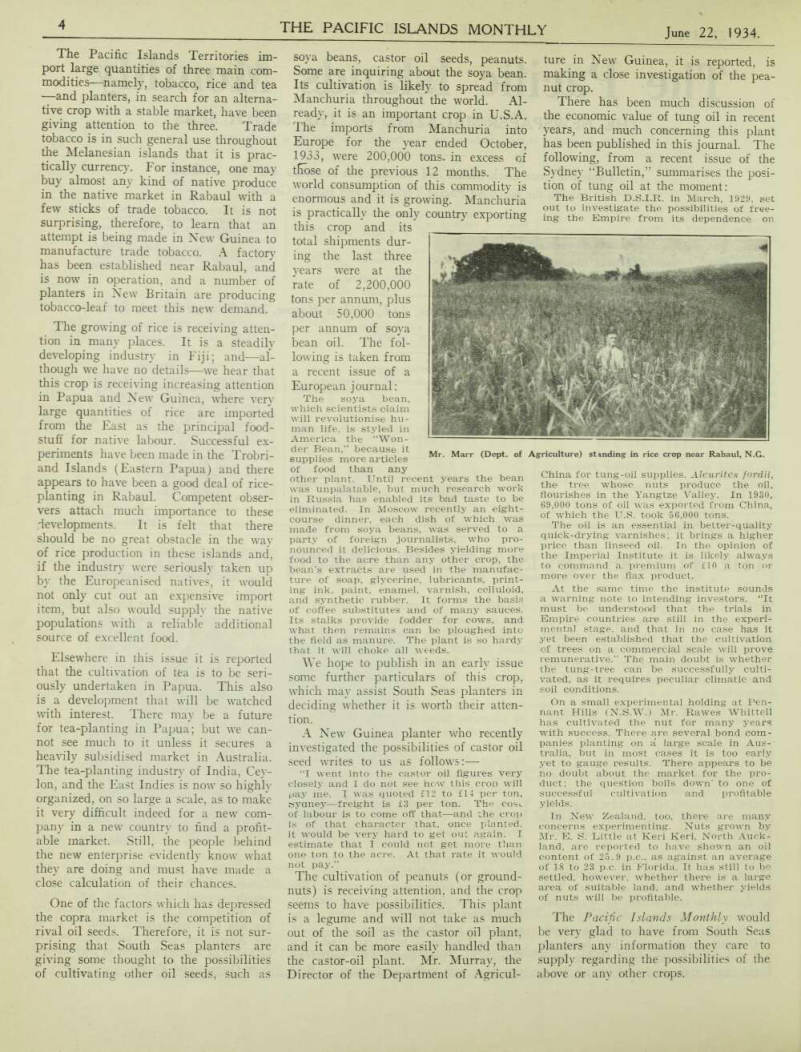
The growing of rice is receiving atten tion in many places. It is a steadily developing industry in Fiji; and —although we have no details —we hear that this crop is receiving increasing attention in Papua and New Guinea, where very large quantities of rice are imported from the East as the principal food stuff for native labour. Successful ex periments have been made in the Trobri and Islands (Eastern Papua) and there appears to have been a good deal of rice planting in Rabaul. Competent obser vers attach much importance to these developments. It is felt that there should be no great obstacle in the way of rice production in these islands and, if the industry were seriously taken up by the Europeanised natives, it would not only cut out an expensive import item, but also would supply the native populations with a reliable additional source of excellent food.
Elsewhere in this issue it is reported that the cultivation of tea is to be seri ously undertaken in Papua. This also is a development that will be watched with interest. There may be a future for tea-planting in Papua; but we can not see much to it unless it secures a heavily subsidised market in Australia.
The tea-planting industry of India, Cey lon, and the East Indies is now so highly organized, on so large a scale, as to make it very difficult indeed for a new com pany in a new country to find a profit able market. Still, the people behind the new enterprise evidently know what they are doing and must have made a close calculation of their chances.
One of the factors which has depressed the copra market is the competition of rival oil seeds. Therefore, it is not sur prising that South Seas planters are giving some thought to the possibilities of cultivating other oil seeds, such as
soya beans, castor oil seeds, peanuts.
Some are inquiring about the soya bean.
Its cultivation is likely to spread from Manchuria throughout the world. Al ready, it is an important crop in U.S.A.
The imports from Manchuria into Europe for the year ended October, 1933, were 200,000 tons, in excess of tEose of the previous 12 months. The world consumption of this commodity is enormous and it is growing. Manchuria is practically the only country exporting
this crop and its total shipments dur ing the last three years were at the rate of 2,200,000 tons per annum, plus about 50,000 tons per annum of soya bean oil. The fol lowing is taken from a recent issue of a
European journal:
The soya bean, which scientists claim will revolutionise hu man life, is styled in America the “Won der Bean,” because it supplies more articles of food than any
other plant. Until recent years the bean was unpalatable, but much research work in Russia has enabled its bad taste to be eliminated. In Moscow recently an eight course dinner, each dish of which was made from soya beans, was served to a party of foreign journalists, who pro nounced it delicious. Besides yielding more food to the acre than any other crop, the bean’s extracts are used in the manufac ture of soap, glycerine, lubricants, print ing ink, paint, enamel, varnish, celluloid, and synthetic rubber. It forms the basis of coffee substitutes and of many sauces.
Its stalks provide fodder for cows, and what then remains can be ploughed into the field as manure. The plant is so hardy that it will choke all weeds.
We hope to publish in an early issue
some further particulars of this crop,
which may assist South Seas planters in deciding whether it is worth their atten
tion.
A New Guinea planter who recently
investigated the possibilities of castor oil
seed writes to us as follows:
“I went into the castor oil figures very closely and I do not see how this crop will pay me. I was quoted £12 to £14 per ton, Sydney —freight is £3 per ton. The cost of labour is to come off that —and the crop is of that character that, once planted, it would be very hard to get out again. I estimate that I could not get more than one ton to the acre. At that rate it would not pay.”
The cultivation of peanuts (or ground
nuts) is receiving attention, and the crop
seems to have possibilities. This plant
is a legume and will not take as much out of the soil as the castor oil plant, and it can be more easily handled than
the castor-oil plant. Mr. Murray, the
Director of the Department of Agricul
ture in New Guinea, it is reported, is making a close investigation of the pea nut crop.
There has been much discussion of the economic value of tung oil in recent years, and much concerning this plant has been published in this journal. The following, from a recent issue of the Sydney “Bulletin,” summarises the posi tion of tung oil at the moment: The British D.S.I.R. in March, 1929, set out to investigate the possibilities of free ing the Empire from its dependence on
China for tung-oil supplies. Aleurites fordii, the tree whose nuts produce the oil, flourishes in the Yangtze Valley. In 1930, 69,000 tons of oil was exported from China, of which the U.S. took 56,000 tons.
The oil is an essential in better-quality quick-drying varnishes; it brings a higher price than linseed oil. In the opinion of the Imperial Institute it is likely always to command a premium of £10 a ton or more over the flax product.
At the same time the institute sounds a warning note to intending investors. “It must be understood that the trials in Empire countries are still in the experi mental stage, and that in no case has it yet been established that the cultivation of trees on a commercial scale will prove remunerative.” The main doubt is whether the tung-tree can be successfully culti vated, as it requires peculiar climatic and soil conditions.
On a small experimental holding at Pen nant Hills (N.S.W.) Mr. Rawes Whittell has cultivated the nut for many years with success. There are several bond com panies planting on a large scale in Aus tralia, but in most cases it is too early yet to gauge results. There appears to be no doubt about the market for the pro duct; the question boils down to one of successful cultivation and profitable yields.
In New Zealand, too, there are many concerns experimenting. Nuts grown by Mr. E. S. Little at Keri Keri, North Auck land, are reported to have shown an oil content of 25.9 p.c., as against an average of 18 to 23 p.c. in Florida. It has still to be settled, however, whether there is a large area of suitable land, and whether yields of nuts will be profitable.
The Pacific Islands Monthly would
be very glad to have from South Seas planters any information they care to
supply regarding the possibilities of the
above or any other crops.
Mr. Marr (Dept, of Agriculture) standing in rice crop near Rabaul, N.G.