Mr. E. F. Powell
p. 19 · Read in the full issue
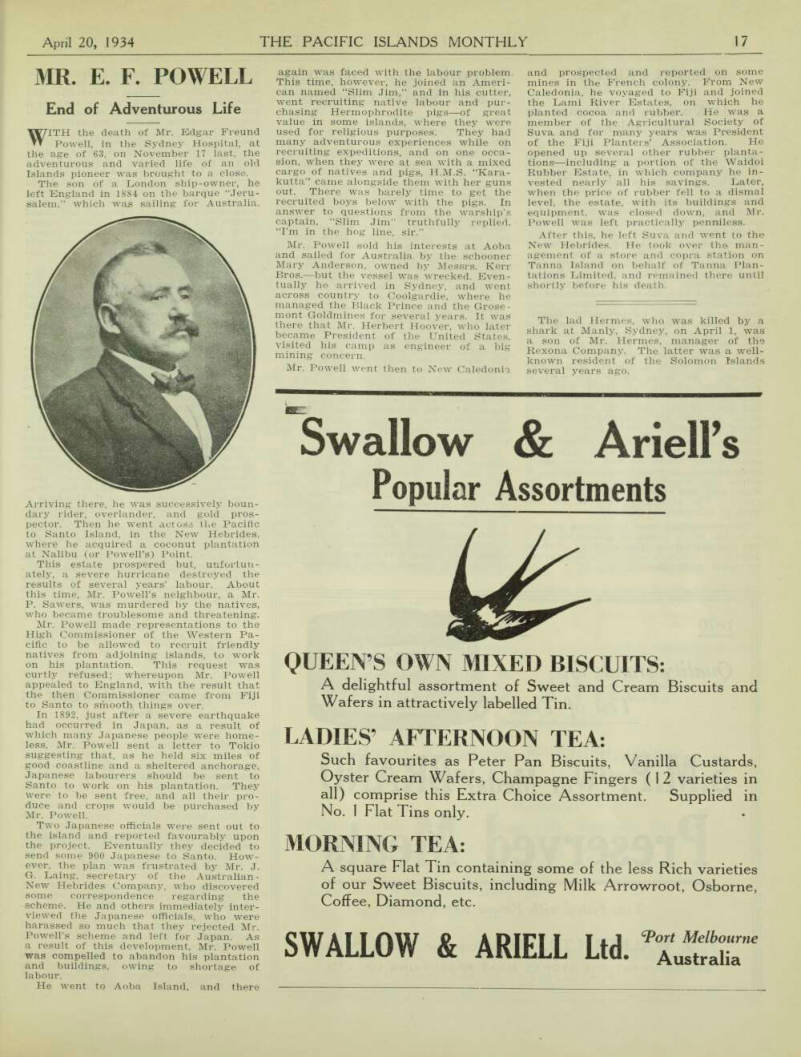
End of Adventurous Life
WITH the death of Mr. Edgar Freund Powell, in the Sydney Hospital, at the age of 63, on November 17 last, the adventurous and varied life of an old Islands pioneer was brought to a close.
The son of a London ship-owner, he left England in 1884 on the barque “Jeru salem,” which was sailing for Australia.
Arriving there, he was successively boun dary rider, overlander, and gold pros pector. Then he went across the Pacific to Santo Island, in the New Hebrides, where he acquired a coconut plantation at Nalibu (or Powell’s) Point.
This estate prospered but, unfortun ately, a severe hurricane destroyed the results of several years’ labour. About this time, Mr. Powell’s neighbour, a Mr.
P. Sawers, was murdered by the natives, who became troublesome and threatening.
Mr. Powell made representations to the High Commissioner of the Western Pa cific to be allowed to recruit friendly natives from adjoining islands, to work on his plantation. This request was curtly refused; whereupon Mr. Powell appealed to England, with the result that the then Commissioner came from Fiji to Santo to smooth things over.
In 1892, just after a severe earthquake had occurred in Japan, as a result of which many Japanese people were home less, Mr. Powell sent a letter to Tokio suggesting that, as he held six miles of good coastline and a sheltered anchorage, Japanese labourers should be sent to Santo to work on his plantation. They were to be sent free, and all their pro duce and crops would be purchased by Mr. Powell.
Two Japanese officials were sent out to the island and reported favourably upon the project. Eventually they decided to send some 900 Japanese to Santo. How ever, the plan was frustrated by Mr. J.
G. Laing, secretary of the Australian- New Hebrides Company, who discovered some correspondence regarding the scheme. He and others immediately inter viewed the Japanese officials, who were harassed so much that they rejected Mr.
Powell’s scheme and left for Japan. As a result of this development, Mr. Powell was compelled to abandon his plantation and buildings, owing to shortage of labour.
He went to Aoba Island, and there
again was faced with the labour problem.
This time, however, he joined an Ameri can named “Slim Jim,” and in his cutter, went recruiting native labour and pur chasing Hermophrodite pigs—of great value in some islands, where they were used for religious purposes. They had many adventurous experiences while on recruiting expeditions, and on one occa sion, when they were at sea with a mixed cargo of natives and pigs, H.M.S. “Kara kutta” came alongside them with her guns out. There was barely time to get the recruited boys below with the pigs. In answer to questions from the warship’s captain, “Slim Jim” truthfully replied, “I’m in the hog line, sir.”
Mr. Powell sold his interests at Aoba and sailed for Australia by the schooner Mary Anderson, owned by Messrs. Kerr Bros. —but the vessel was wrecked. Even tually he arrived in Sydney, and went across country to Coolgardie, where he managed the Black Prince and the Grose mont Goldmines for several years. It was there that Mr. Herbert Hoover, who later became President of the United States, visited his camp as engineer of a big mining concern.
Mr. Powell went then to New Caledonia
and prospected and reported on some mines in the French colony. From New Caledonia, he voyaged to Fiji and joined the Lami River Estates, on which he planted cocoa and rubber. He was a member of the Agricultural Society of Suva and for many years was President of the Fiji Planters’ Association. He opened up several other rubber planta tions —including a portion of the Waidoi Rubber Estate, in which company he in vested nearly all his savings. Later, when the price of rubber fell to a dismal level, the estate, with its buildings and equipment, was closed down, and Mr.
Powell was left practically penniless.
After this, he left Suva and went to the New Hebrides. He took over the man agement of a store and copra station on Tanna Island on behalf of Tanna Plan tations Limited, and remained there until shortly before his death.
The lad Hermes, who was killed by a shark at Manly, Sydney, on April 1, was a son of Mr. Hermes, manager of the Rexona Company. The latter was a well known resident of the Solomon Islands several years ago.