Pacific
Islands
Monthly
April 20th 1934
6 d
[Registered at the G.P.O., Sydney, for transmission by post as a newspaper.]
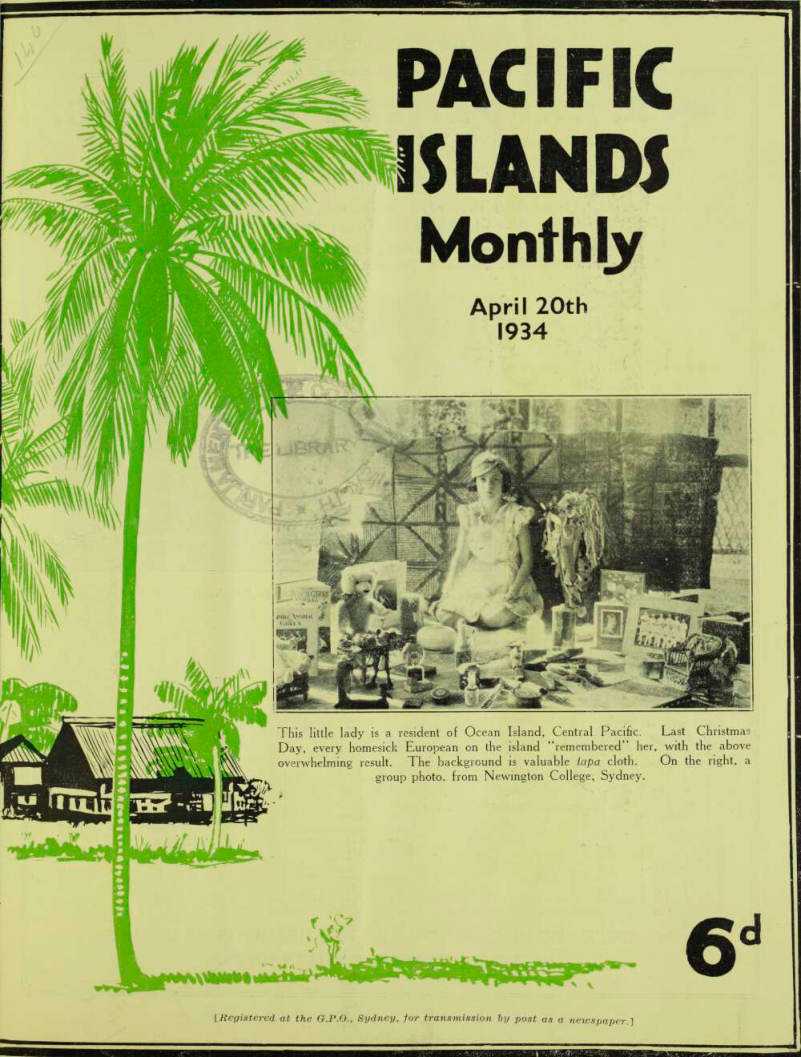
This little lady is a resident of Ocean Island, Central Pacific. Last Christmas Day, every homesick European on the island “remembered” her, with the above overwhelming result. The background is valuable tapa cloth. On the right, a group photo, from Newington College, Sydney.
Advertisements & other items, p. 2 (1 item)
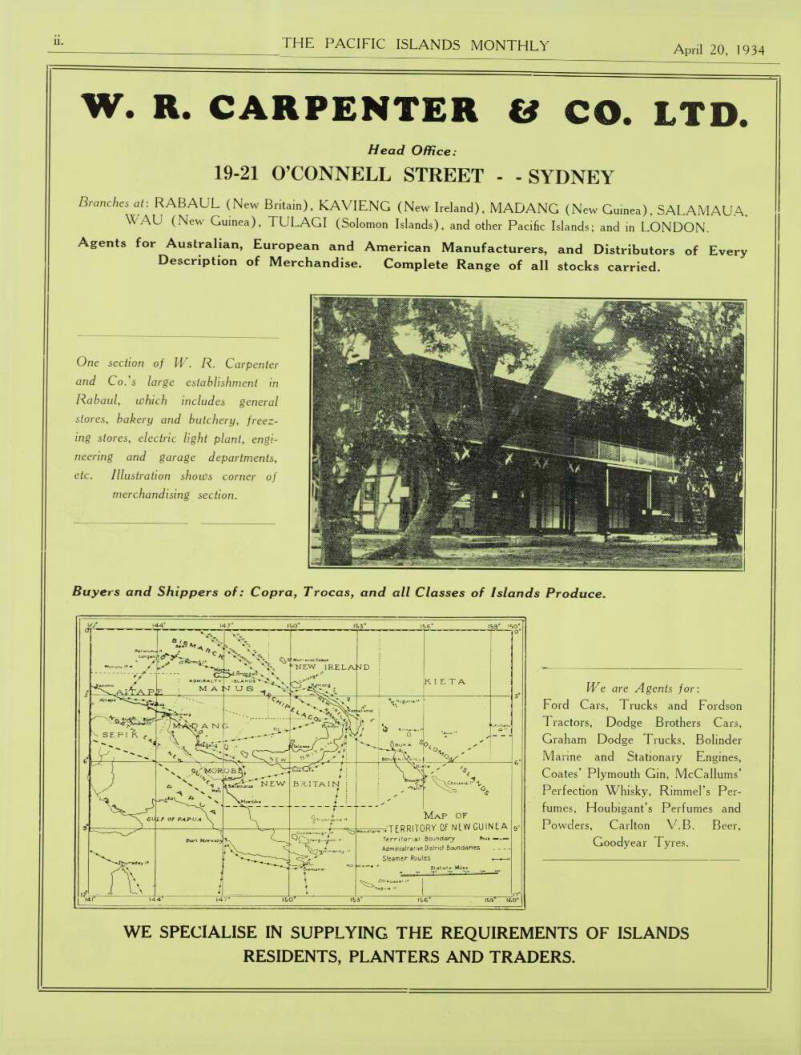
W. R. Carpenter & Co. Ltd.
Head Office:
19-21 O’CONNELL STREET - - SYDNEY
Branches at: RABAUL (New Britain), KAVIENG (New Ireland), MADANG (New Guinea), SALAMAUA, WAU (New Guinea), TULAGI (Solomon Islands), and other Pacific Islands; and in LONDON.
Agents for Australian, European and American Manufacturers, and Distributors of Every Description of Merchandise. Complete Range of all stocks carried.
One section of W. R. Carpenter and Co.’s large establishment in Rahaul, which includes general stores , bakery and butchery, freezing stores, electric light plant, engineering and garage departments, etc. Illustration shows corner of merchandising section.
Buyers and Shippers of: Copra, Trocas , and all Classes of Islands Produce.
We are Agents for: Ford Cars, Trucks and Fordson Tractors, Dodge Brothers Cars, Graham Dodge Trucks, Bolinder Marine and Stationary Engines, Coates’ Plymouth Gin, McCallums’
Perfection Whisky, Rimmel’s Perfumes, Houbigant’s Perfumes and Powders, Carlton V.B. Beer, Goodyear Tyres.
WE SPECIALISE IN SUPPLYING THE REQUIREMENTS OF ISLANDS
RESIDENTS, PLANTERS AND TRADERS.
Pacific Islands Travellers
Passengers Per Tanda Which Arriv
Ed In Sydney From Rabaul, New
GUINEA, ON MARCH 22: Mr. N. C. Barry, Mr.
F. S. Moody, Mr. A. R. Irvine, Mrs. H. C.
Hosking and infant, Rev. Mother Electa, Rev.
Mother Georgia, Mr. and Mrs. W. M. Deans, Mr.
M. R. Jones, Mr. P. D. McKenzie, Mr. W. D.
Marquis, Mr. and Mrs. E. W. P. Chmnery, Mr.
J. G. White, Mr. F. V. Saunders, Miss A.
Marquis, Miss M. Rogers, Mr. J. Hill, Mr. P. M.
Doyle, Mrs. E. Costin.
Passengers Per Nellore Which
Sailed From Sydney For Rabaul, New
GUINEA, ON MARCH 14: Mr. and Mrs. C.
Jones and infant, Mr. J. Costelloe, Mrs. J. Cos telloe and two children, Mrs. E. M. Hawnt, Mr.
J. F. Sidery.
Passengers Per Montoro, Which
Sailed From Sydney For Papua And
NEW GUINEA ON MARCH 15: Mr. and Mrs.
R. Walshe, Mr. and Mrs. F. T. Moates, Mesdames A. Pollard, E. Farnham, A. D. Thompson, Shelton- O’Reilly, V. Ledingham, J. Brown, C. T. Drane, D. Latimer, Corfe, E. Clark; Misses A. G. Pol lard, M. Brown, I. Corfe, M. M. Woodhouse; Messrs. Griffiths, A. Ferguson. G. H. Graham, F. J. Titcomb, R. Alke, H. T. Robson, R. B.
McKenzie, T. Fairey, Tompsett, Captain A. Pent land, A. R. Long, A. A. Bellhouse, W. D. Nutley, B. W. Crookshanks, H. W. Forrester, E. J. Cook, Pastor A. G. Stewart, A. Devany, D. Ewing, C. C.
Macauley, R. Saker, W. H. Taylour, R. D. Hut chison, N. F. Davies, H. Vine, Mr, and Mrs.
Heming.
Passengers Per Morinda Which Ar
Rived In Sydney From Norfolk And
LORD HOWE ISLANDS ON MARCH 17: Mrs.
E. S. Adams, Mr. F. T. Adams, Miss A. M.
Anderson, Mr. L. Blucher, Miss A. Bohan, Mr.
H. G. Campbell, Mr. F. E. Chase, Mrs. H. F.
Chase, Miss B. E. Dwane, Mr. C. H. O. Fairlie, Mrs. A. Fairlie and child, Miss L. A. Hawkes, Miss E. Hungartner, Mr. G. W. Lake, Master J.
Macrae, Mrs. K. McCoy and two children, Miss L. E. Maguire, Miss E. M. Moppett, Miss G.
Nobbs Mr. S. Rankin, Mrs. G. Rankin, Mr. C.
Rankin, Mrs. M. Rankin, Miss E. Soiling, Miss E. Tweedie, Mr. J. Whelan, Mrs. E. M. Wickstead, Miss C. Baxter, Mr. D. Black, Mr. R. Bruce, Mr.
A. E. Crisp, Mr. G. C. Cannon, Mr. W. Court, Mrs. P. Court, Miss M. Court, Mr. C. Collins, Miss G. Chisholm, Mr. J. C. Douglass, Mr. and Mrs. S. Everett, Mr. C. Fenton, Mr. B. P. Fieldon, Miss J. Fraser, Mr. E. Giles, Mr. W. Hammil, Mrs. M. Hankinson, Mr. H. Half, Miss Hatten, Mr. and Mrs. Jones, Mrs. E. M. Kirby, Mrs. J.
King, Miss Laing, Miss M. Maslen, Mr. J. Mc- Mahon, Mr. J. Morrison, Miss O. Mackenzie, Mrs.
E. L. Mortimer, Miss Mortlock, Miss Mackenzie, Mr. W. Pearcey, Miss O. Pye, Miss E. Smythe, Mr. G. Vial, Miss M. Valli, Miss E. Vincent, Mr.
H. Waterman, Mrs. S. Wyatt, Miss Wyatt, Miss J. Weekes, Mr. J. Williams, Mr. and Mrs. O. D.
Ward, Mr. F. Cridland, Mr. J. Tanner.
Passengers Per Morinda Which
Sailed From Sydney For Lord Howe
And Norfolk Islands And New Heb
RIDES ON MARCH 20: Mr. S. L. Anderson, Miss H. Aynsley, Miss E. Bebbington, Mr. K. Brad field, Mr. C. Berckelman, Mr. W. Bathurst, Mr.
G. J. Busby, Mr. and Mrs. P. A. Cameron, Miss Covell, Miss Denning, Miss V. Ellis, Mr. and Mrs.
C. H. Eyre, Mr. W. Farrow, Mr. and Mrs. A. E.
Fennell, Miss D. Fisher, Miss I. M. Gore, Mr. P.
Game, Mr. H. Heywood, Mr. and Mrs. G. Hunt, Mr. and Mrs. A. E. Heagney, Mrs. Hudson, Mrs.
Hines, Miss P. Harris, Miss Hetherington, Miss F. Jones, Mr. E. J. James, Mr. Kerr, Miss I.
Kelly, Mr. G. W. Lake, Mr. F. Lane, Mr. P.
Ludgater, Mr. H. F. Lamberton, Mr. and Mrs.
J. F. Morell, Miss Moore, Miss Madden, Mr. G.
Menzies, Mr. E. M. Mitchell, Mr. A. J. McGrath, Miss P. Nott, Miss H. A. Onions, Mr. J. Pollock, Mr. A. E. Packer, Mr. R. Payne, Misses W. and E. Pashley, Miss F. Packer, Miss H. Pratt, Mr.
E. Quintal, Miss I. Ross, Miss Rigby, Mr. E. A.
Stanner. Mr. S. P. Stanley, Mr. Sutton, Mrs.
Smith and child, Mrs. A. R. Slade, Mrs. Stopp, child and infant, Miss Stephenson, Mr. S. Tapping, Mr. and Mrs. R. Thomson, Mr. N. J. Taylor, Miss L. Thompson, Miss Thompson, Mr. R. W.
Wilson, Mr. W. Williams, Mrs. M. Williams, Misses Wallace (2), Miss E. Weston.
Passengers Per Macdhui, Which Ar
RIVED IN SYDNEY FROM PAPUA AND NEW GUINEA ON MARCH 27: Mr. W. T. Adamson, Mr. E. A. Beattie, Mr. H. Black, Miss L. M.
Caswell, Miss M. Clark, Mr. E. F. Clay, Mr. P.
Connolly, Mr. A. Crestini, Mrs. P. D. Davidson, Mr. J. Dole, Mr. and Mrs. J. W. Duncan, Mr.
J. I. Elston, Master J. A. Ewen, Miss J. Ewen, Mr. and Mrs. C. L. Flavelle, Miss K. Fitzgerald, Mr. I. T. Garrad, Mr. J. B. Gibson, Miss B. J.
Grose, Mr. F. R. Hanson, Mr. A. R. Haviland, Mrs. F. L. Higgleton, Miss B. M. Holmes, Mr.
D. Honeysett, Mrs. L. F. S. Hore, Mr. W. R.
Humphries, Mr. E. Imbert, Mrs. D. Irvine, Mrs.
C. J. Izod. Mr. C. Jones, Mr. and Mrs. Fritz Jung, Mr. M. V. Kelly, Major and Mrs. G. Kinlock, Mrs. A. Lambert, Mr. H. J. Lockrey, Mr.
G. A. Lohe, Mr. G. Luff, Mr. J. Lumbers, Mr.
W. G. McNamee, Mr. A. C. Mackay, Mr. B. R.
Man, Brother Beda Marx, Mr. and Mrs. R. P.
Mills, Mr. C. A. Moulston, Mr. E. Mustar, Mr.
T. A. Parer, Mr. and Mrs. N. E. Penfold, Mr.
R. H. Phillips, Mr. G. W. Pratt, Mrs. S. R.
Reilly, Mr. S. W. Ryde, Mr. and Mrs. W. J.
Saville, Mr. A. C. Scott, Mr. W. A. Sherman, Mr. and Mrs. W. C. Sparks, Mr. T. W. Sullivan, Mrs. A. Spence, Mr. L. Tracy, Mr. and Mrs.
J. W. Vandercook, Mr. and Mrs. T. E. Warbrick, Brother J. Wassenberg, Mr. H. G. Watsford, Mr.
S. A. Webb, Mrs. R. S. Whitelaw, Mr. V. A.
Williams.
Passengers Per Malaita Which Sail-
Ed From Sydney For Solomon Islands
AND BOUGAINVILLE ON APRIL 7: Mr. and Mrs. A. E. Osborne, Mr. and Mrs. F. R. Isom, Mesdames C. M. Mason, G. Love, L. Stuart, J.
Monteath, J. A. L. Macandrew, M. E. Lotze, L. E.
Barnes, Misses M. Mullen, G. R. Roberts, Gooud, G. M. Elvy, M. Hargrave, M. Burgess, Messrs.
F. E. Johnson, Dr. W. S. Porter, F. W. Machin, R. Comb, Baron von Freyberg, A. H. Goodall, J. K. Pace, J. Ellis, J. G. Heath.
Passengers Per Malaita Which Ar-
Rived In Sydney From Solomon Islands
AND BOUGAINVILLE ON MARCH 31: Miss S.
E. Flanagan, Miss J. Jackson, Miss L. Job, Mr.
J. Minney, Mrs. E. Pink, Mrs. E. Ratz, Mrs.
K. E. Pile, Miss H. Mason, Mr. P. E. Mason, Mr.
S. E. Furley, Mr. H. J. Darmamin, Mr. K. L.
Hume, Mr. W Jameson, Mr. W. H. Frost, Mr.
E. C. Johnston, Mrs C. Meller, Mr. J. W. Anderson, Bishop W. H. Baddeley, Mr. K. Bolton, Mr.
A. C. Coulter, Major F. R. Hewitt, Mrs. R. Hill, Master A. Hill, Dr. and Mrs. F .A. Macpherson, Rev. H. J. Nind, Mr. W. B. Seaton, Father J.
Simler, Mr. L. R. Grant-Smith, Mr. A. J. G. Smith, Mr. C. R. Suisted, Mr. W. G. Ure, Mr. G. H.
West.
Passengers Per Macdhui Which Sail-
ED FROM SYDNEY FOR PAPUA AND NEW GUINEA ON APRIL 5: His Excellency Sir J. H.
Murray and Lady Murray, The Hon. H. L. Murray, Mr. and Mrs. J. Nicholson, Mr. and Mrs.
A. Mackenzie, Mr. and Mrs. Allen Innes, Mr. and Mrs. Ward Williams, Captain and Mrs. E. A.
Mustar, Mr. and Mrs. L. E. Hanson, Mr. and Mrs. C. W. Fox, Mr. and Mrs. Denny, Mr. and Mrs. J. F. Bunney, Mr. and Mrs. S. R. Miroutt, Mesdames Langley Hall, Kent. M. E. Dee, M.
Hotz, J. Irwin, G. Pieper, J. T. Dickson, G. A.
Loudon, M. Waugh, C. Hedgecock, Misses J. C.
Here, J. E. Adams, J. Kirkland, M. Tracey, M.
Givney, A. Furnifull, B. Cox, K. M. Darcy, A.
Bulmer, Messrs. L. G. Hill, G. B. Hart, K. K.
Horne, I. D. Truman, A, R. Martin, Dr. A. V. G.
Price, H. F. Jensen, Father H. Tomlinson, Father B. Baldwin, Father L. Sorin, F. W. Torrington, E.
Gallet, G. G. Chadderton, E. M. Granter, Rev, J. Benson, D. S. Hore-Lacy, Pastor W. J. Wester man, W. A. Caines, G. Harland, J. C. Haie, J.
Craig, W. F. .'Scanned, T. T. Reynolds, P. C. Con well, H. W. Skinner, W. J. Clark, L. Cay, H.
Wilson, T. K. Billing, A. W. Wakefield, C. Gat tenby, G. I. Davey, S. W. Dye, H. S. Buchanan, S. Kantzow, C. Martin, J. W. Rutherford, W. D.
Mason, R. Nicholson, H. Partridge, Gillingwater, H. W. Wormald, H. F. Watson.
Passengers Per Morinda Which Ar
Rived In Sydney From New Hebrides,
Lord Howe, And Norfolk Islands On
APRIL 9: Mr. H. Alexander, Mr. S. Anderson, Miss H. Aynsley, Miss E. Bebbington, Mr. and Mrs. P. Cameron, Mr. L. Crommelin, Mrs. Crosby Brown and child, Miss M. C. Chapman, Miss J.
Denning, Mrs. E. Dixon, Mr. and Mrs P. E.
Dewey, Mr. W. R. Delmar, Miss V. Ellis, Mrs.
Elwin, Mr. and Mrs. C. Eyre, Mr. A. G. Elliott, Mr. W. Farrow, Mr. and Mrs. A. Fennell, Miss D. Fisher, Miss I. Gore, Mrs. M. Grayson, Mrs.
Hancock, Miss P. Harris, Mrs. E. Harvey, Mr.
H. Hayward, Mr. and Mrs. Heagney, Mrs. Henry, Miss P. Hinkley, Mr. and Mrs. G. Hunt, Miss B. Hetherington, Mrs. J. Jenkins and two chil dren, Mr. A. Jackson, Mr. E. James, Miss F.
Jones, Miss B. Kelly, Mr. F. B. Kiarl, Mrs. Laing, Mr. H. Lamberton, Mr. W. Lober, Mr. P. Lud gater, Mr. G. Menzies, Mr. Mitchell, Miss G.
Moore, Mr. and Mrs. J. Morrell, Mr. G. Murray, Miss F. M. Master, Mr. and Mrs. D. C. Milson, Mrs. W. Maher and child, Miss P. Nott, Mr. W.
O’Brien, Miss H. A. Onions, Mr. A. E. Packer, Miss F. Packer, Miss E. Pashley, Miss N.
Pashley, Mr. R. Payne, Miss H. Pratt, Mr.
H. L. Piper, Miss I. Ross, Mrs. G. Sander son, Miss V. Savage, Mrs. A. Slade, Mrs. E.
Stanner, Miss Stephenson, Mrs. H. Street, Mr. C.
Sutton, Mr. and Mrs. A. Stewart, Mr. S. Tapping, Miss G. Thompson, Mr. and Mrs. R. Thompson, Mr. and Mrs. A. E. Teall, Miss M. Wallace, Miss K Wallace, Miss E. Weston, Mrs. M. Williams, Mr. W. Williams, Mr. G. Wilson, Mr. R. L.
Wills, Mr. G. H. Wickstead, Mr. J. Warren, Miss M. S. Wills, Mr. L. K. Gahagan.
Passengers Per Niagara, Which
SAILED FROM SYDNEY FOR SUVA, FIJI, ON MARCH 29: Mr. and Mrs. D. W. Robertson, Mrs. E. M. Robertson, Miss L. V. Frazer, Mr.
E. G. Theodore Mr. and Mrs. H. Kmg-Irvmg, Mr. F. H. Jackson, Miss F. Cruickshank, Mrs.
M. C. Evans, Mr. and Mrs. L. W. Vance, Mr.
W. J. Candler, Mr. L. C. Calmyre, Mrs. G. W.
Somerville, Miss F. I. Hutchings, Mrs. J. Calli gan, Mr. A. W. Brooks and wife, Mr. and Mrs.
G. S. Rowley and two children, Mr. L. B. Law ton, Mr. and Mrs. J. A. Elmsley and two chil dren, Mr. W. A. Brooks, Mr. G. M. Thomas, Mr A. G. E. King, Miss M. Brooks, Miss A M.
M Rice, Mrs. M. E. Robley, Mr. H. B. Bowen, Mrs. H. B. Bowen, Mr. W. E. Stevenson, Miss V. Stevenson, Mr. C. C. Barry, Major and Mrs.
J. R. Boose, Mr. Malcolm Cameron, Mr. S. W.
Carr, Mrs. S. W. Carr, Mr. R. C. Smith, Mr.
I. G. M. Schnoveck, Mr. L. Beyers, Mrs. E. E.
Tilney. (Continued on next page.)
(Continued from page 1.)
Passengers Per Mariposa Which Ar
Rived In Sydney From American Samoa
AND FIJI ON MARCH 26: Mrs. Ruby Adams, Mr. Y. Banno, Mr. J. G. Beohm, Miss I. Blakeley, Mr. J. G. Bradshaw, Mr. Dickson Brown, Mrs.
T. N. K. Carew, Mr. W. G. Chapman, Miss Phyllis Chapman, Mr. and Mrs. R. V. Clark, Mr.
W. H. Clark, Mr. Ambrose Corrighan, Mrs. M.
Earl, Mrs. T. Lyon Field, Mr. and Mrs. C. F.
Gamson, Master Ian Gamson, Miss Joan Gatehouse, Mrs. C. M. Hedger, Dr. Paul W. Hopkins, Miss W. Johnson, Mr. Keith C. Matthews, Miss C. M. McIntyre, Mrs. E. Mune, Master Arthur Mune, Captain J. R. Neville, Mr. W. C. Nicholson, Miss H. Pankhurst, Miss F. Springall, Mr. J. J.
Sullivan, Mr. and Mrs. J. Hart, Master J. Hart, Miss F. Lister, Mr. and Mrs. C. W. Mann, Mrs.
T. P. Nicholson, Mr. L. Noerr, Mr B. S. Seeto.
Passengers Per Mariposa Which
Sailed From Sydney For Fiji And
AMERICAN SAMOA ON APRIL 4. Rev. Edgar Blake, Miss V. Graham, Mr. J. Griffiths, Mrs. J.
Griffiths, Major F. R. Hewitt, Mr. F. R. Hockey, Dr. R. L. Jack, Mr. D. MacGregor, Mrs. D. Mac- Gregor, Mrs. W. G. McKay, Mr. J. P. Mayne, Mrs. M. McLeod, Miss Alice Murphy, Mr. and Mrs. F. S. Parrett, Miss Jean Parrett, Mr. K R.
Pinkerton, Mrs. E. Rixson, Mr. W. J. Stephens, Miss M. P. Thomas, Miss C. E. Thomas, Dr. and Mrs. W. Yum, Mrs. A. G. Binks, Miss A. Dick son, Miss J. C. Leslie, Mrs. D. A. Murray, Miss S. Murray, Mrs. Doris Quai Hoi, Masters A. and P. H. Quai Hoi, Miss O. H. Russell, Mrs. A. J.
Rutledge, Masters D. B. and P. J. Rutledge, Mr. and Mrs. E. W. Simm, Miss Hilda Taylor.
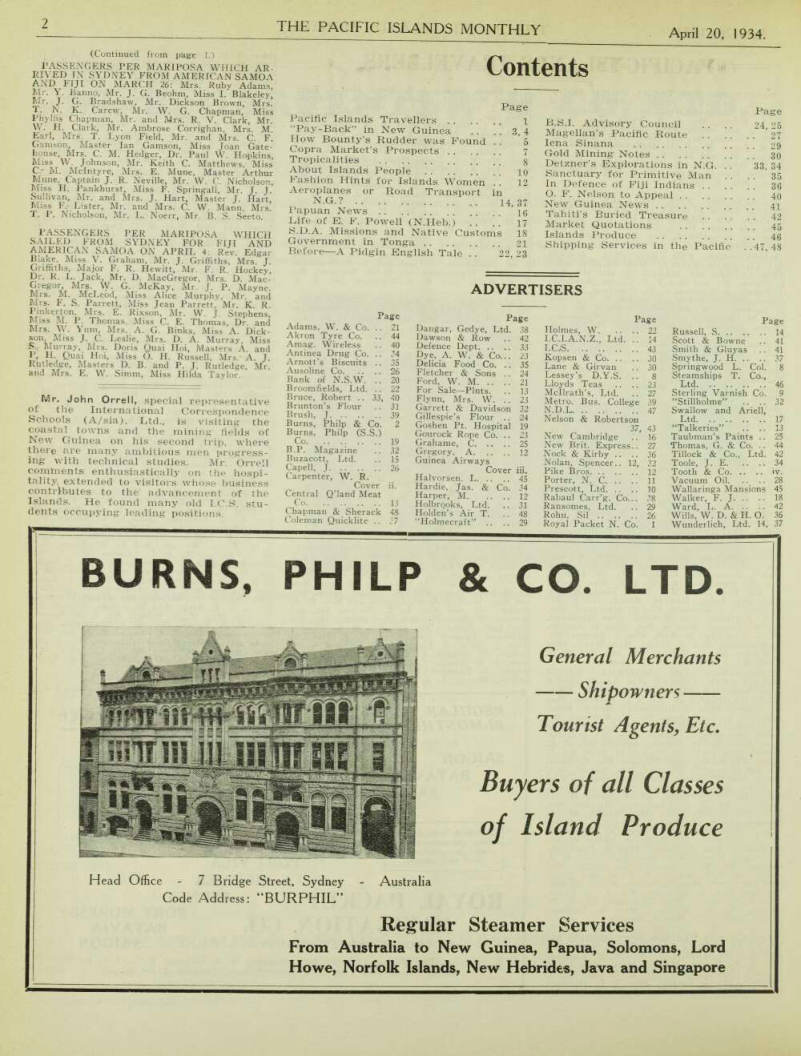
Mr. John Orrell, special representative of the International Correspondence Schools (A/sia), Ltd., is visiting the coastal towns and the mining fields of New Guinea on his second trip, where there are many ambitious men progress ing with technical studies. Mr. Orrell comments enthusiastically on the hospi tality extended to visitors whose business contributes to the advancement of the Islands. He found many old I.C.S. stu dents occupying leading positions.
Advertisements & other items, p. 3 (1 item)
bi-monthly Freight and Passenger Service
by the fast and modern K.P.M. Steamer VAN REES as under:
SAIGON
BATAVIA
SAMARANG
PORT MORESBY
SAMARAI
RABAUL
PORT VILA
NOUMEA
Saloon & Intermediate class passengers carried in comfortable and airy cabins.
Cargo for Africa accepted for transhipment at Batavia.
ROYAL PACKET
NAVIGATION CO.
255 GEORGE STREET, SYDNEY.
SYDNEY
PORT MORESBY
BATAVIA
SAIGON
E. A. James, Port Moresby; Whitten Bros., Samarai; W. R. Carpenter & Co., Ltd., Rabaul; Gubbay Freres, Port Vila; Carlo Leoni, Noumea; Diethelm & Co., Saigon,
Contents
Page Pacific Islands Travellers 1 “Pay-Back” in New Guinea . . . . 3, 4 How Bounty’s Rudder was Found . . 5 Copra Market’s Prospects 7 Tropicalities g About Islands People 10 Fashion Hints for Islands Women !’. 12 Aeroplanes or Road Transport in N.G.? 14, 37 Papuan News 16 Life of E. F. Powell (N.Heb;) . . 17 S.D.A. Missions and Native Customs 18 Government in Tonga 21 Before—A Pidgin English Tale . . 22, 23
Page B.S.I. Advisory Council . . . . 24, 25 Magellan’s Pacific Route 27 Iena Sinana 29 Gold Mining Notes 30 Detzner’s Explorations in N.G. . . 33, 34 Sanctuary for Primitive Man . . . . ’35 In Defence of Fiji Indians 36 O. F. Nelson to Appeal 40 New Guinea News 41 Tahiti’s Buried Treasure 42 Market Quotations 45 Islands Produce 40 Shipping Services in the Pacific . . 47, 48
Advertisers
Page Adams, W. & Co. .. 21 Akron Tyre Co. .. 44 Amag. Wireless .. 40 Antinea Drug Co. .. 34 Arnott’s Biscuits .. 35 Ausoline Co 26 Bank of N.S.W. .. 20 Broomfields, Ltd. .. 22 Bruce, Robert .. 33, 40 Brunton’s Flour .. 31 Brush, J 39 Burns, Philp & Co. 2 Burns, Philp (S.S.) Co 19 B.P. Magazine .. 32 Buzacott, Ltd. .. 15 Capell, J. 26 Carpenter, W. R.
Cover ii.
Central Q’land Meat Co 13 Chapman & Sherack 48 Coleman Quicklite .. 37
Page Dangar, Gedye, Ltd. 38 Dawson & Row .. 42 Defence Dept 33 Dye, A. W. & Co... 23 Delicia Food Co. .. 35 Fletcher & Sons .. 24 Ford, W. M 21 For Sale—Pints. .. 13 Flynn, Mrs. W. .. 23 Garrett & Davidson 32 Gillespie’s Flour .. 24 Goshen Pt. Hospital 19 Gourock Rope Co. .. 23 Grahame, C 25 Gregory, A 12 Guinea Airways Cover iii.
Halvorsen, L 45 Hardie, Jas. & Co. 34 Harper, M 12 Holbrooks, Ltd. .. 31 Holden’s Air T. .. 48 “Holmecraft” .. .. 29
Page Holmes, W 22
I.C.I.A.N.Z., Ltd. .. 14
I.C.S. 43
Kopsen & Co 30 Lane & Girvan .. 30 Lessey’s D.Y.S. .. 8 Lloyds Teas .. .. 23 McIlrath’s, Ltd. .. 27 Metro. Bus. College 39
N.D.L 47
Nelson & Robertson 37, 43 New Cambridge .. 16 New Brit. Express.. 27 Nock & Kirby .. .. 36 Nolan, Spencer., 12, 32 Pike Bros 12 Porter, N. C. 11 Prescott, Ltd 10 Rabaul Carr’g. Co... 38 Ransomes, Ltd. .. 29 Rohu, Sil 26 Royal Packet N. Co. 1
Page Russell, S 14 Scott & Bowne .. 41 Smith & Gluyas .. 41 Smythe, J. H. 37 Springwood L. Col. 8 Steamships T. Co., Ltd 46 Sterling Varnish Co. 9 “Stillholme” .. .. 32 Swallow and Ariell, Ltd 17 “Talkeries” .. .. 13 Taubman’s Paints .. 25 Thomas, G. & Co. .. 44 Tillock & Co., Ltd. 42 Toole, J. E 34 Tooth & Co iv.
Vacuum Oil. .. .. 28 Wallaringa Mansions 45 Walker, F. J 18 Ward, L. A 42 Wills, W. D. & H. O. 36 Wunderlich, Ltd. 14, 37
Advertisements & other items, p. 4 (1 item)
Burns, Philp
Head Office - 7 Bridge Street, Sydney - Australia Code Address: “BURPHIL”
& CO. LTD.
General Merchants
Shipowners
Tourist Agents, Etc.
Buyers of all Classes
of Island Produce
Regular Steamer Services From Australia to New Guinea, Papua, Solomons, Lord Howe, Norfolk Islands, New Hebrides, Java and Singapore
The Pacific Islands Monthly
The Newspaper-Magazine Of The South Seas
[Registered at G.P.O., Sydney, for transmission hy post as a newspaper.]
Published Once Each Month and Circulated in Australia and New Zealand and in the following Pacific Territories and Islands Groups:
Crown Colony of Fiji.
Australian Territory of Papua.
Mandated Territory (Australia) of New Guinea, Bismarck Archipelago, and Northern Solomon Islands.
Mandated Territory (Japan) of Marshall, Caroline and Mariana Islands.
American Territory of Guam M?Xed Territory of Naum.
British Crown Colony of Gilbert and Ellice Islands French Territory of New Caledonia.
British and French Condominium of New Hebrides.
American Territory of Eastern Samoa.
Mandated Territory (New Zealand) of Samoa.
British Solomon Islands Protectorate.
British Protectorate of Tongan Islands.
New Zealand Territory of Cook Islands.
Australian Territory of Norfolk Island.
French Colony of Oceania (Tahiti, etc.).
American Territory of Hawaiian Islands.
Owned and Produced by Pacific Publications, Ltd., Union House, 247 George Street, Sydney.
Telephone Bw 5037
P.O. Box 3408 R
Contributions Articles, Stories, and Photographs dealing with Pacific Islands Subjects are invited, and will be paid for on publication at usual rates.
Subscription Rates Per Annum, within British Empire, Prepaid Post Free Per Annum, elsewhere, prepaid, Post Free .. 8/- Single Copies 6d.
Editor and Publisher:
R. W. Robson.
Advertisements
Advertising rates furnished on application.
Colours, etc. by Arrangement.
Process Blocks made at Advertiser’s expense when required. Screen, 100.
Changes of Advertising Copy should reach this Office by 8th of each month, otherwise previous advertisement may be repeated.
Registered Address for Radiograms and Cables: “PACPUB” Sydney
Agents The following are authorised to receive subscrip tions for “The Pacific Islands Monthly”— Islands Branches of Burns, Philp & Co., Ltd., and Burns, Philp (South Seas) Co., Ltd.
Islands Branches of W. R. Carpenter & Co., Lt-.
All Branches of Morris, Hedstrom & Co., Ltd.
G. Thomas & Co., Rabaul.
Whitten Bros., Ltd., Samarai.
P. Costello, Suva, Fiji.
All Branches and Representatives of W. H. Grove and Sons, Ltd., Auckland.
S. Russell, Papeete, Tahiti.
Cook Islands Trading Co., Rarotonga* Mrs. M. Campbell, Cascades, Norfolk Island.
Vol. IV., No. 9.
Sydney, April 20, 1934.
Price 6d. Per Copy Prepaid: 6/- p.a.
“Pay-Back” In New Guinea
THE murder of Captain Bernard Mc- Grath, in the Ramu area of the INew Guinea goldfields, on February 17, has attracted a good deal of attention; and it is noted that, based on this tragic occurrence, a lot of criticism is being directed against the Administration and the Federal Government.
Mr. S. G. Farnham, writing from Upper Ramu, New Guinea, to the Melbourne Argus, reminds readers that the murder of McGrath was preceded in this area by the murder of A. D. O. Ian Mack, and that Patrol Officer McCarthy was severely wounded. Cadet Black was also savagely attacked and wounded, Mr. Farnham pleads urgently for very much stronger measures against the “savages” in this part of New Guinea. in the Argus of April 6 the following letter is published. The writer is Mrs.
Nerva Levy, a sister of Bernard Me- Grath: — A terrible indictment of the Government’s futile methods in New Guinea in leaving the white pioneer in the uncontrolled hinterland to the mercy of the
savage natives, and then after his murder calling in a few district officers and a handful of native police boys to search for the murderers over hundreds of miles of impenetrable wilderness, is made by Mr. Sydney Farnham, of Upper Ramu in "The Argus" of April 5. From Mr.
Farnham’s list of recent murders of white men is omitted Mr. Baum who was beaten to death with stone clubs and then terribly mutilated. My brother, Captain Bernard McGrath, was murdered on the Karamanting River by savages of the Bena Bena tribe after 15 years of pioneering work in the inland. There, on the fringe of the most unknown country in the world, a few Australians, unassisted and unprotected, are penetrating farther and farther inland, blazing a track for others to follow — their only reward a horrible and violent death, while an uninterested Administration and a bunch of parliamentarians at Canberra are indifferent to their efforts, and sensitive only to uninformed comment on Government treatment of the native races.
The foregoing is typical of the views
expressed by many people and supports
their general argument. It represents the
generally accepted viewpoint of the
sturdy European pioneer, who has
pushed out over all the world, and who
has driven the aboriginal inhabitants of other lands into subjection or has ex terminated them and has seized their countries for the purposes of his vigorous colonisation. But there is another point of view.
As is pointed out elsewhere in this issue by a well-known author, New Guinea is practically the last corner of the earth’s surface where the native in habitants still wander free and un checked, in their primitive condition, uninfluenced by the white man. Had it not been for the discovery of gold, it is likely that this exceedingly broken, jungle-clad land of New Guinea would have remained in its primitive condition for many more decades. But the pres ence of gold has been proved, and the white man is thrusting forward eagerly and tirelessly in his search for it. In evitably, he has come into conflict with the native people, and some of the pioneers have been killed. Why should the advance of civilisation and our organised effort to obtain gold be delayed or interrupted by these ignorant savages? —ask the white men, and they are turn
ing indignantly to their Government with demands for adequate protection.
And now look at the other side of the question—and it is the side which neces sarily concerns the Government. It has been accepted as a fundamental principle of international relationships that a country belongs to its native inhabitants.
That principle was established at Ver sailles in 1919. It is the base upon which mandates to govern were issued to Great Britain, and to other nations.
Australia holds the mandate for New Guinea, on the clearly-expressed under standing that Australia is merely the trustee for the League of Nations; and the League of Nations is based upon the plan that the lands of the earth belong to the people who are described as the indigent population.
It is quite impossible, therefore, under present conditions, for the New Guinea Administration to take any notice of the argument that New Guinea belongs to Australia, that Australia is entitled to exploit that country’s natural wealth in whatever fashion she thinks fit and that, if the native inhabitants interfere, the native inhabitants must be swept away.
As plain, common-sense folk, we know that the League of Nations is practically dead, and will soon be buried, and that, in actual fact, New Guinea is now as much a part of Australia as is the Northern Territory; but forms and for malities still have to be observed by the Commonwealth Government, as the Mandatory. We know that Australian enterprise, as the years pass, will be very active in the exploitation of the enormous natural wealth of New Guinea; but we know, also, that the Australian Govern ment, whether Conservative or Labour, will be most scrupulous in protecting the interests of the native inhabitants. There is not the slightest prospect of punitive expeditions being sent into New Guinea to slaughter a few hundreds or thousands of these primitive natives, and so to clear the way for the gold-prospecting parties.
The new humanitarianism which dictates governmental policies nowadays forbids anything like that.
But, in this New Guinea situation, there is a more pronounced and definite factor than any we have mentioned.
Any man who has studied the native peoples of Papua and New Guinea knows that the tribal life of those primi tive men is dominated by two considera tions —readiness for war, and the obligation to “pay-back.” It is a fundamental rule of native life that an injury done
to a tribe in the person of one of its members shall be paid back in kind.
That is something ingrained in the character of the New Guinea native, in the same way that respect for private property or the obligation to tell the truth is ingrained in the character of the cultured European. The rule of “pay back” is a well-known thing in New Guinea, and any official charged with responsibility of governing these primi tive people must recognise it.
There is no doubt that “hard-boiled” prospectors and traders, with no know ledge of or sympathy with native psychology, have treated these fierce and spirited New Guinea natives on occasion with injustice, cruelty and lack of understanding, and thus have committed an injury which brought into operation the “law of pay-back.” To the native, all white men are the same—and the misconduct of one white man has been frequently the cause of attacks on other white men. Those who know the Ramu region declare that, without any doubt, the murder of Baum, Ian Mack and Bernard McGrath (who understood and were kind to the natives), and the sharp attacks on various patrol officers and prospectors, are part of the system of “pay-back.” It is as logical to go out into the bush and shoot down these natives for the murders referred to as it would be to shoot them down for having black skins. If we did that, we should ourselves be invoking the savages’ own law of “pay-back.”
The Administration very wisely recog nises this. It accepts a certain responsi bility for the protection of gold-seekers and traders; but it also accepts an obli gation towards the natives which is based upon a knowledge of native psychology and of the facts to which we have re ferred. It hopes to bring these wild bush peoples, gradually and slowly, to a bet ter understanding of the white man’s laws and the white man’s culture; and when these things are accepted in New Guinea, as they are in Papua, the white men may go into the far interior of New Guinea with the same comparative safety that they now enter the hinterland of Papua. It seems to us that the N.G.
Administration is following generally the lines laid down as a result of the experience of that wisest of all Mela nesian Administrators —Sir Hubert Mur ray. While slowly establishing the white man’s law and discipline, he always has set his face resolutely against wholesale or bitter punishment of natives for doing
things which, in the white man’s view, are crimes, but which actually are rooted in native custom and tradition. Little by little, with extraordinary patience, he has sought the confidence of the native people and, following that rule, is bring ing them to a respect for the white man’s laws and prejudices.
We are not making an invidious dis tinction between New Guinea and Papua.
Such a comparison would be improper and unfair. Australia has been 50 years in Papua, and less than 15 in New Guinea. Moreover, it is barely seven years since gold-mining interests began to penetrate the Morobe district of New Guinea, which was then officially labelled “uncontrolled.” Taking these things into consideration, it can be said that Australia’s record in New Guinea is as good as it is in Papua; and that its success in dealing with and protect ing the Pacific Islands natives generally will bear favourable comparison with the achievements of any colonising nation.
For these reasons, it is to be hoped that the authorities will not be stampeded into any extreme action in New Guinea as the result of criticism by people who feel justifiable distress owing to recent tragic events, but who have little under standing of native psychology and the immutable, savage law of “pay-back.”
New Guinea Mortgages
Interest Reduced
THE reduction of interest on mortgages registered in New Guinea has been provided for in a New Guinea ordinance (No. 31 of 1934) which has just been pro mulgated.
It provides that in the ensuing two years all mortgages on New Guinea land other than mining land shall be reduced at the rate of 5/- for every £1 of interest, but that the rate of interest is not to be reduced by this new law to a lesser sum than £ 6 per cent.
This means, of course, that where the rate of interest has been 8 per cent, it now will become automatically reduced to 6 per cent. Where the rate of interest has been 7 per cent, the reduction propor tionately will be less, because the pro vision in regard to a minimum of 6 per cent, becomes operative. Where the in terest has been 10 per cent, the reduc tion will be from 10 per cent, to 7½ per cent, (that is £10, less ten times 5/-).
Nine per cent, now becomes 6¾ per cent.
This matter of the reduction of mort gage interest in New Guinea was placed before the meeting of Pacific Administra tors in Canberra in March last. For this reason some surprise has been expressed that the law has been introduced in New Guinea and not in Papua, where condi tions are similar.
A Treacherous Dinghy
Tulagi, B.S.I., March 24.
ONE day recently Mr. Ken Bolton set out from the Tulagi jetty in his dinghy, bound for his trading schooner, which was lying off a little distance. He carried, as passengers, Major Hewitt, the well-known manager of Levers Pacific Plantations Ltd., and Mr. Carl Younger, an equally well-known planter.
The two passengers were spick and span in newly-laundered whites. They scorned the foul seats of the Bolton dinghy, and stood upright.
All went well until Mr. Younger, a big man, suddenly sneezed. The dinghy quivered, and Mr. Younger went suddenly overboard. This upset Major Hewitt, and he also went overboard.
The dinghy oscillated violently. Mr.
Bolton clawed at the thwarts like a wild cat, but it was no use. The dinghy turned turtle, and over went Mr. Bolton, and the boat-boy.
No one, at first, realised that Mr.
Younger could not swim. When they noticed his plight, he had swallowed part of Tulagi harbour. Then he was helped by Mr. Bolton and a couple of boys off the schooner, which was only a few yards away.
When the excitement died down, a new sensation arose. Where was Major Hewitt? They discovered him presently.
He had swum ashore, and was seated in three feet of water, a picture of soaking misery, philosophically awaiting the next move in this afternoon’s pleasant enter tainment, and regarding Mr. Bolton’s dinghy with an expression that cannot be put into words.
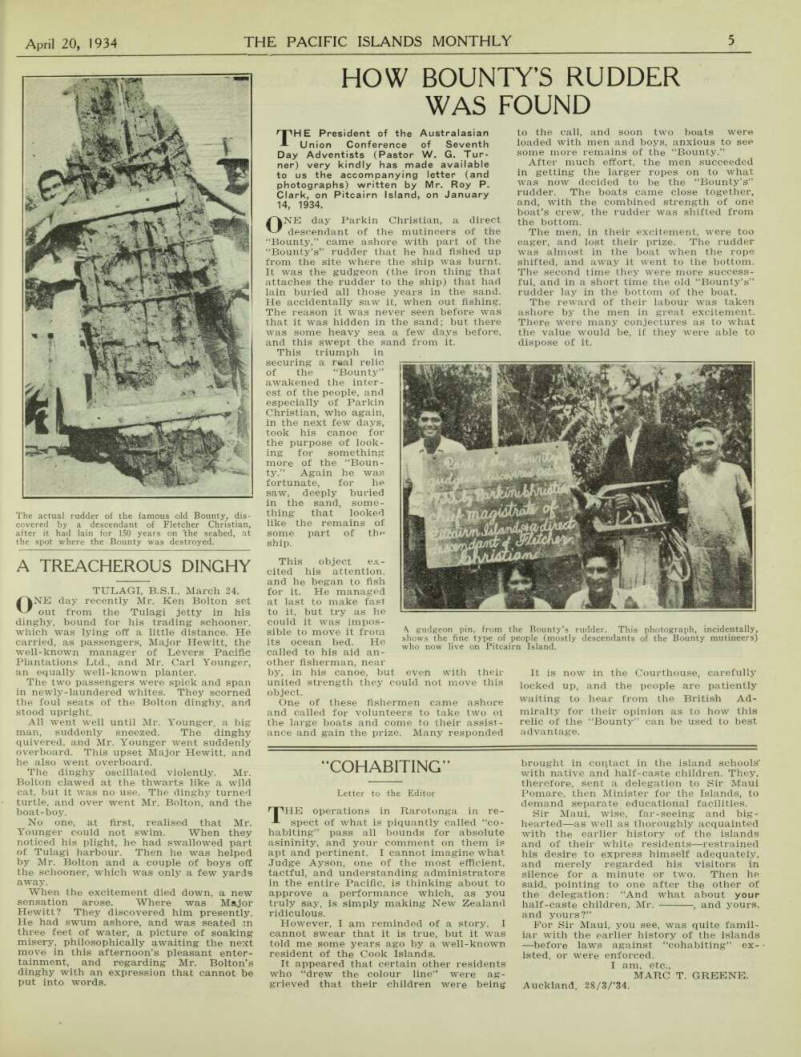
The actual rudder of the famous old Bounty, dis covered by a descendant of Fletcher Christian, after it had lain for 150 years on 'the seabed, at the spot where the Bounty was destroyed.
Was Found
How Bounty’S Rudder
THE President of the Australasian Union Conference of Seventh Day Adventists (Pastor W. G. Turner) very kindly has made available to us the accompanying letter (and photographs) written by Mr. Roy P.
Clark, on Pitcairn Island, on January 14, 1934.
ONE day Parkin Christian, a direct descendant of the mutineers of the “Bounty,” came ashore with part of the “Bounty’s” rudder that he had fished up from the site where the ship was burnt.
It was the gudgeon (the iron thing that attaches the rudder to the ship) that had lain buried all those years in the sand.
He accidentally saw it, when out fishing.
The reason it was never seen before was that it was hidden in the sand; but there was some heavy sea a few days before. and this swept the sand from it.
This triumph in
securing a real relic of the “Bounty” awakened the inter est of the people, and especially of Parkin Christian, who again, in the next few days, took his canoe for the purpose of look ing for something more of the “Boun ty.” Again he was fortunate, for he saw, deeply buried in the sand, some thing that looked like the remains of some part of the ship.
This object ex cited his attention, and he began to fish for it. He managed at last to make fast to it, but try as he could it was impos sible to move it from its ocean bed. He called to his aid an other fisherman, near
by, in his canoe, but even with their united strength they could not move this object.
One of these fishermen came ashore and called for volunteers to take two of the large boats and come to their assistance and gain the prize. Many responded
to the call, and soon two boats were loaded with men and boys, anxious to see some more remains of the “Bounty.”
After much effort, the men succeeded in getting the larger ropes on to what was now decided to be the “Bounty's” rudder. The boats came close together, and, with the combined strength of one boat’s crew, the rudder was shifted from the bottom.
The men, in their excitement, were too eager, and lost their prize. The rudder was almost in the boat when the rope shifted, and away it went to the bottom.
The second time they were more success ful, and in a short time the old “Bounty’s” rudder lay in the bottom of the boat.
The reward of their labour was taken ashore by the men in great excitement, There were many conjectures as to what the value would be, if they were able to dispose of it.
It is now in the Courthouse, carefully locked up, and the people are patiently waiting to hear from the British Ad miralty for their opinion as to how this relic of the “Bounty” can be used to best advantage.
A gudgeon pin, from the Bounty’s rudder. This photograph, incidentally, shows the fine type of people (mostly descendants of the Bounty mutineers) who now live on Pitcairn Island.
"Cohabiting”
Letter to the Editor THE operations in Rarotonga in re spect of what is piquantly called “co habiting” pass all bounds for absolute asininity, and your comment on them is apt and pertinent. I cannot imagine what Judge Ayson, one of the most efficient, tactful, and understanding administrators in the entire Pacific, is thinking about to approve a performance which, as you truly say, is simply making New Zealand ridiculous.
However, I am reminded of a story. I cannot swear that it is true, but it was told me some years ago by a well-known resident of the Cook Islands.
It appeared that certain other residents who “drew the colour line” were ag grieved that their children were being
brought in contact in the island schools’ with native and half-caste children. They, therefore, sent a delegation to Sir Maui Pomare, then Minister for the Islands, to demand separate educational facilities.
Sir Maui, wise, far-seeing and big hearted—as well as thoroughly acquainted with the earlier history of the islands and of their white residents—restrained his desire to express himself adequately, and merely regarded his visitors in silence for a minute or two. Then he said, pointing to one after the other of the delegation: “And what about your half-caste children, Mr. —, and yours, and yours?”
For Sir Maui, you see, was quite famil iar with the earlier history of the islands —before laws against “cohabiting” ex isted, or were enforced.
I am, etc.,
Marc T. Greene.
Auckland, 28/3/’34.
Lighting Plant For Moafaga Mission, Tonga
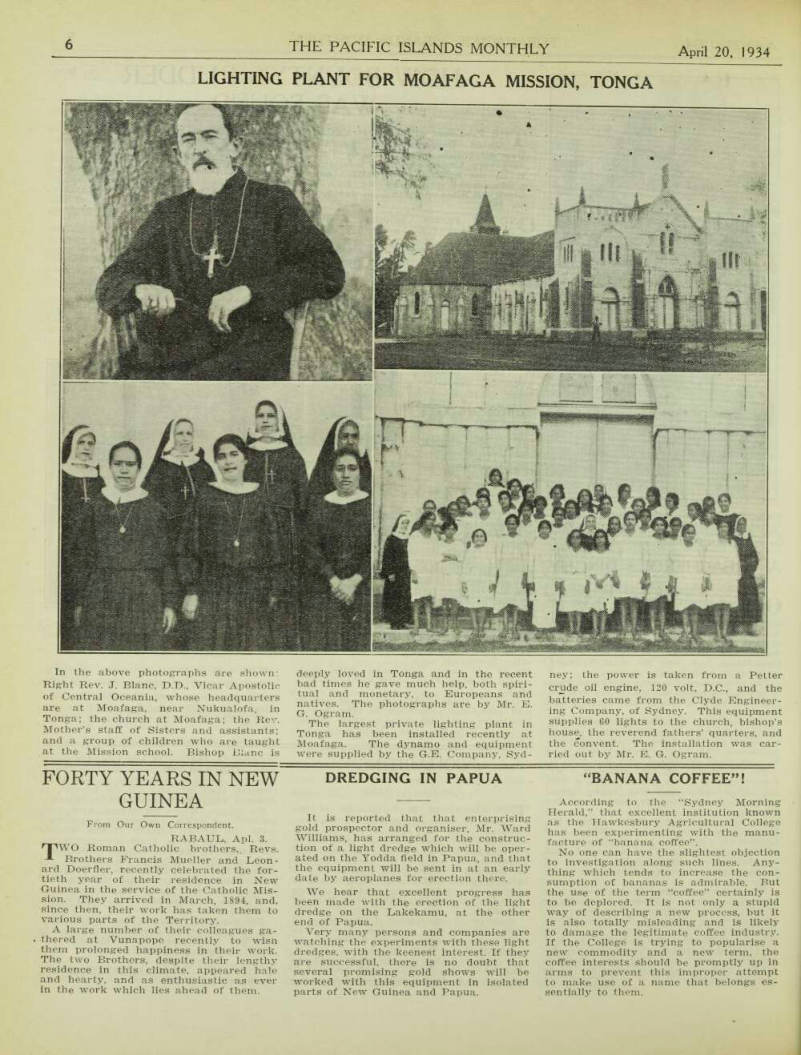
In the above photographs are shown: Right Rev. J. Blanc, D.D., Vicar Apostolic of Central Oceania, whose headquarters are at Moafaga, near Nukualofa, in Tonga; the church at Moafaga; the Rev.
Mother’s staff of Sisters and assistants: and a group of children who are taught at the Mission school. Bishop Blanc is
deeply loved in Tonga and in the recent bad times he gave much help, both spiri tual and monetary, to Europeans and natives. The photographs are by Mr. E.
G. Ogram.
The largest private lighting plant in Tonga has been installed recently at Moafaga. The dynamo and equipment were supplied by the G.E. Company, Syd
ney; the power is taken from a Petter crude oil engine, 120 volt, D.C., and the batteries came from the Clyde Engineer ing Company, of Sydney. This equipment supplies 60 lights to the church, bishop’s house, the reverend fathers’ quarters, and the convent. The installation was car ried out by Mr. E. G. Ogram.
Forty Years In New
Guinea
From Our Own Correspondent.
Rabaul, Apl. 3.
TWO Roman Catholic brothers,. Revs.
Brothers Francis Mueller and Leon ard Doerfler, recently celebrated the for tieth year of their residence in New Guinea in the service of the Catholic Mis sion. They arrived in March, 1894, and, since then, their work has taken them to various parts of the Territory.
A large number of their colleagues ga thered at Vunapope recently to wish them prolonged happiness in their work.
The two Brothers, despite their lengthy residence in this climate, appeared hale and hearty, and as enthusiastic as ever in the work which lies ahead of them.
Dredging In Papua
It is reported that that enterprising gold prospector and organiser, Mr. Ward Williams, has arranged for the construc tion of a light dredge which will be oper ated on the Yodda field in Papua, and that the equipment will be sent in at an early date by aeroplanes for erection there.
We hear that excellent progress has been made with the erection of the light dredge on the Lakekamu, at the other end of Papua.
Very many persons and companies are watching the experiments with these light dredges, with the keenest interest. If they are successful, there is no doubt that several promising gold shows will be worked with this equipment in isolated parts of New Guinea and Papua.
"Banana Coffee"!
According to the “Sydney Morning Herald,” that excellent institution known as the Hawkesbury Agricultural College has been experimenting with the manu facture of “banana coffee”.
No one can have the slightest objection to investigation along such lines. Any thing which tends to increase the con sumption of bananas is admirable. But the use of the term “coffee” certainly is to be deplored. It is not only a stupid way of describing a new process, but it is also totally misleading and is likely to damage the legitimate coffee industry.
If the College is trying to popularise a new commodity and a new term, the coffee interests should be promptly up in arms to prevent this improper attempt to make use of a name that belongs es sentially to them.
Copra Prospects
More Optimistic Summary from London
HERE is better news about copra mar ket prospects.
So far, we have not sugared the pill— we have told the Pacific planters the cold, brutal truth about the condition of their industry. Now, the outlook is a little better, and we are glad to say so.
The prices of many commodities have improved—it is part of a general, world wide move. Copra is one of the few commodities used in international trade which is still very sick, but there are some healthy signs.
On February 13, the Lieutenant-Gov ernor of Papua cabled to the Australian High Commissioner’s office in London, and asked for a frank indication con cerning the future of the copra market.
Was it correct, asked Sir Hubert, to de scribe coconut-planting as a dying indus try.
This is the reply, despatched from Lon don on February 20: “In reply to yours of 13th, copra trade does not consider copra a dying indus try. Price recovery is expected as and when general commodity prices im prove.
“At the moment the market is fully supplied with copra and other edible oils. Low price butter has discouraged the use of margarine.
“Owing to the depreciation of the dollar Philippines copra, which is usually sold in the United States, is finding a better market at Marseilles.
“It probably will be some consider able time before price will exceed £10 but recent arrival of good quality hot air dried copra from Rabaul obtained £8/15/- c.i.f. Rotterdam.
“There is no doubt that the position is improving gradually.”
Help For Papuan Planters
Following upon the receipt of this radiogram, Sir Hubert Murray announced that, subject to the Federal Minister’s consent, the Government of Papua would take £8000 from its accumulated insurance funds and, with this money, would assist Papuan copra-producers during 1934—presumably by a subsidy on pro duction. The details of the relief scheme are being worked out by Messrs. A. Jewell and Tom Nevitt.
Stole His Partner’S
Money
From Our Own Correspondent
Apia, Feb. 22.
A PAINFUL sensation was caused here when I. F. Kronfeld, a young Auckland lawyer, who has been in partnership here since 1928 with Mr. G. Klinkmueller, who was well and favourably known, was sen tenced to two years’ imprisonment on a series of charges of theft and forgery.
It appears that Mr. Klinkmueller looked after the court work, and Mr. Kronfeld was in charge of the office. The latter drew a considerable salary but, for some reason not explained, he required much more money and not only borrowed from many people, but finally converted much of the firm’s money to his own personal use. The sums under the notice of the court totalled £400, but the total defalcations, it is reported, run into thou sands.
Kronfeld will serve his sentence in Samoa.
“Jock of the Islands”
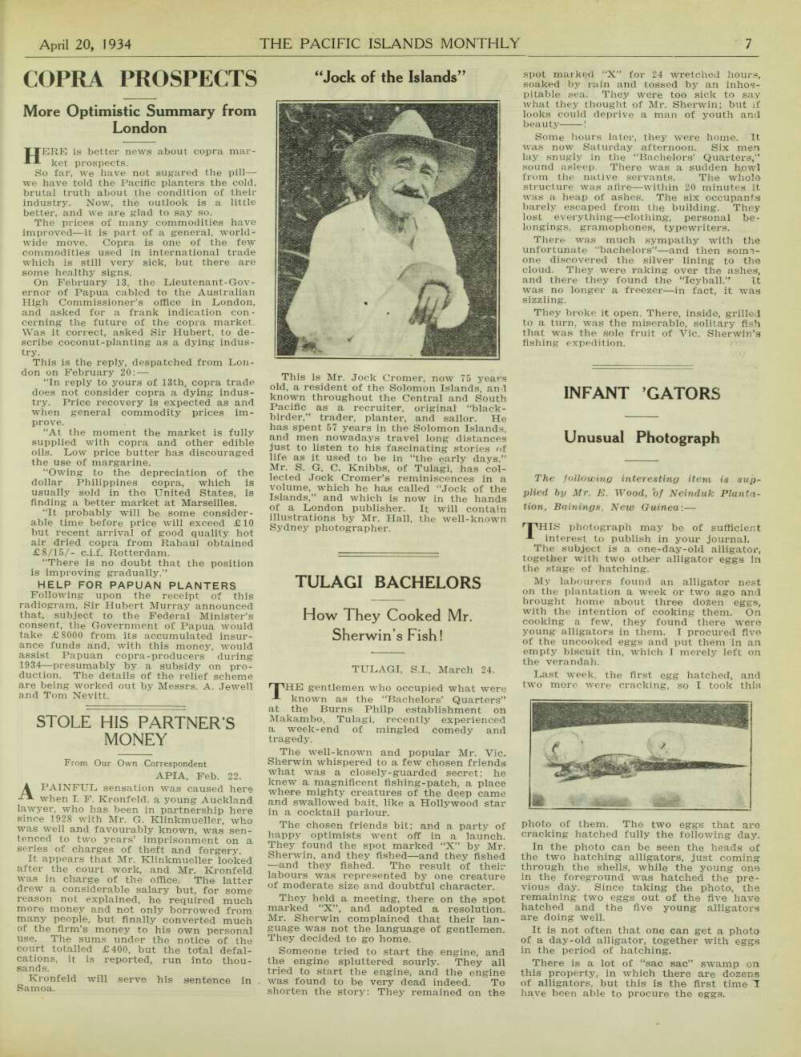
This is Mr. Jock Cromer, now 75 old, a resident of the Solomon Islands, and known throughout the Central and South Pacific as a recruiter, original “black birder,” trader, planter, and sailor. He has spent 57 years in the Solomon Islands, and men nowadays travel long distances just to listen to his fascinating stories of life as it used to be in “the early days.”
Mr. S. G. C. Knibbs, of Tulagi, has col lected Jock Cromer’s reminiscences in a volume, which he has called “Jock of the Islands,” and which is now in the hands of a London publisher. It will contain illustrations by Mr. Hall, the well-known Sydney photographer.
Tulagi Bachelors
How They Cooked Mr.
Sherwin’s Fish!
TULAGI, 5.1., March 24.
T'HE gentlemen who occupied what were known as the “Bachelors’ Quarters” at the Burns Philp establishment on Makambo, Tulagi, recently experienced a week-end of mingled comedy and tragedy.
The well-known and popular Mr. Vic.
Sherwin whispered to a few chosen friends what was a closely-guarded secret; he knew a magnificent fishing-patch, a place where mighty creatures of the deep came and swallowed bait, like a Hollywood star in a cocktail parlour.
The chosen friends bit; and a party of happy optimists went off in a launch.
They found the spot marked “X” by Mr.
Sherwin, and they fished—and they fished —and they fished. The result of their labours was represented by one creature of moderate size and doubtful character.
They held a meeting, there on the spot marked “X”, and adopted a resolution.
Mr. Sherwin complained that their lan guage was not the language of gentlemen.
They decided to go home.
Someone tried to start the engine, and the engine spluttered sourly. They all tried to start the engine, and the engine was found to be very dead indeed. To shorten the story: They remained on the
spot marked “X” for 24 wretched hours, soaked by rain and tossed by an inhos pitable sea. They were too sick to say what they thought of Mr. Sherwin; but if looks could deprive a man of youth and beauty ’
Some hours later, they were home. It was now Saturday afternoon. Six men lay snugly in the “Bachelors’ Quarters,” sound asleep. There was a sudden howl from the native servants. The whole structure was afire —within 20 minutes it was a heap of ashes. The six occupants barely escaped from the building. They lost everything—clothing, personal be longings, gramophones, typewriters.
There was much sympathy with the unfortunate “bachelors”—and then some one discovered the silver lining to the cloud. They were raking over the ashes, and there they found the “Icyball.” It was no longer a freezer—in fact, it was sizzling.
They broke it open. There, inside, grilled to a turn, was the miserable, solitary fish that was the sole fruit of Vic. Sherwin’s fishing expedition.
Unusual Photograph
Infant ’Gators
The following interesting item is sup plied by Mr. E. Wood, of Neinduk Planta tion, Bainings, New Guinea: — THIS photograph may be of sufficient interest to publish in your journal.
The subject is a one-day-old alligator, together with two other alligator eggs in the stage of hatching.
My labourers found an alligator nest on the plantation a week or two ago and brought home about three dozen eggs, with the intention of cooking them. On cooking a few, they found there were young alligators in them. I procured five of the uncooked eggs and put them in an empty biscuit tin, which I merely left on the verandah.
Last week, the first egg hatched, and two more were cracking, so I took this
photo of them. The two eggs that are cracking hatched fully the following day.
In the photo can be seen the heads of the two hatching alligators, just coming through the shells, while the young one in the foreground was hatched the pre vious day. Since taking the photo, the remaining two eggs out of the five have hatched and the five young alligators are doing well.
It is not often that one can get a photo of a day-old alligator, together with eggs in the period of hatching.
There is a lot of “sac sac” swamp on this property, in which there are dozens of alligators, but this is the first time I have been able to procure the eggs.
Tropicalities
AN irate friend in New Guinea writes threatening penalties “unless you drop your irritating and quite inappropriate use of the word ‘coon.’ To those of us who have any respect for our language, and out of my knowledge and understanding of natives, I say that ‘coon’ is frankly offen sive. Gordon Thomas has never used it— though recently one of his correspondents did —but will not in future. The word con notes, or rather epitomises, that rotten attitude of European-native irreconcilabil ity that is the greatest stumbling block against progress here. And it is also of very recent origin—not known here in 1922-1926. We must reconcile the two sets of interests —each is vital to the other —else we kill the goose that lays the egg. So let’s have ‘natives,’ ‘Melanesians,’ ‘primi tives,’ even ‘kanakas’ (there’s no connota tion of contempt in this last) but not the negro spirituel ‘coon.’ ”
We stand corrected. But, in pleading guilty, we would point out that the term is used very widely in New Guinea—and not contemptuously or sourly, but rather in a good-natured way.
THE following appeared in a Melbourne newspaper in March: An important step towards civilising the natives of New Guinea and Papua is under discussion by the Minister for Territories (Mr. Marr) and the administrators of those areas. While admitting the magnitude of the task, the authorities are seriously inclined to order the schools and mis sions to teach the English language to native children in the localities that have been brought under Government control. The proposal is that the very young children should be taught English from their earliest days, and that native children already attending schools should be gradually weaned from their tribal dialects, and given a fairly thorough grounding in English. It is not proposed that the adults should be given more than a rudimentary knowledge of our words. One of the effective methods of converting the natives to the official language will be to send into their villages educated natives, who will undertake the teaching.
It is impossible to believe that such a “step” is under serious consideration. It is much more likely that a fanciful scheme, along the lines indicated, has been sub mitted by some of the earnest souls who always are hanging about the Depart ments, and who never get down to the practical facts of hard, every-day life. It might be, perhaps, a good thing if the coming generations of natives were given a little better knowledge of the official language (English); but the suggestion that they should be “gradually weaned from their tribal dialects” is simply fan tastic, and could have come only from someone who is either a fool or is ignorant of conditions in Melanesia. The natives who are under European influence do not need more education. What is needed Is a system of education that is more scien tifically adapted to their requirements— less “education,” if anything, and the inculcation of knowledge that will allow the natives to handle more efficiently the various problems created for them by their inevitable contacts with European life. The aim should be to preserve native languages, customs and conditions of life to the fullest extent compatible with the removal of what we must regard as criminal or semi-criminal practices. The most horrible things one can see in the Islands are mostly the direct results of attempts by earnest old gentlemen to “Europeanise” the stone-age Melanesian peoples.
THE following was sent to us by a resi dent of Gizo, B.S.I., who vouches for its truth; Nowadays the lady tourists on the “Malaita” look forward with eagerness and trepidation to the Gizo district, where they hope to meet our local Samson— the man who hugged an alligator to death.
“What a glorious death!” said one little blonde.
Samson was walking along the beach of his plantation, when he came on a “croc,” asleep on the sand. Without thinking of the danger of blood-poisoning from the reptile’s teeth and claws, he crept up to it and leaped on its back.
He got an arm-hold on its throat and, after a long struggle, managed to throttle it.
Apart from a number of bruises on his chest and arms, Samson was unhurt.
Now, then, you Delilahs!
Mr. George C. Dromgold Writes
from Los Angeles to the editor of the P.I.M. to say that he and his partner, Mr. Shackelford, are still busy editing the 50,000 feet of film which the Shackelford- Dromgold expedition took in New Guinea and Fiji last year. This enterprise was very well planned and equipped, and, as a result of its activities, it may be expected that a really worth-while film about the South Seas will at last be released.
One curious result of imposing a semi- European education upon Melanesian natives is disclosed by complaints from mail-order houses in Sydney and Bris bane. It appears that the natives study the advertisements in the newspapers, and not infrequently write to the store con cerned, and ask for the despatch of selected goods, under the system by which payment is collected through the post office on delivery. It is discovered, even tually, that the addressee is a more or less educated Kanaka, whose healthy opti mism, while most praiseworthy, cannot be converted into the necessary cash. So the goods have to be returned, to the annoyance of everyone concerned, WE have been gently censured by our friends of the Bulolo Gold Dredging Company Ltd. for referring to that con cern as “American”; and we are assured that by far the greater portion of the company’s capital is British and Austra lian. We tender fitting apology. But when we said “American” we did not mean “United States.” We were taking notice of the fact that there is much Canadian capital in the Bulolo and Placer concerns, and we described that group as “American” in order to distinguish it from the New Guinea Goldfields group, which has closer European affiliations.
“I NOTICE that you keep hammering away at the Larkin case” writes a friend from New Guinea. “I am afraid that you are not really doing yourself any good by this agitation. Some of the most influential people in the Administra tion are against you, in this, and you do not want to earn their illwill. Better let it die. Larkin will get a substantial re mission of his sentence for good-conduct, anyway.”
To which we reply, formally and editorially: We are convinced that when James Larkin, having injured a native and contributed to his death, was found guilty of murder, and sentenced to ten years’ hard labour, a grave and cruel miscarriage of justice occurred, and we shall not cease our agitation until this verdict and sentence have been reviewed by a competent authority. Although fre quently urged to do so, the P.I.M. does not engage in irresponsible criticism of Islands governments and institutions; on the contrary, the editor keeps constantly in mind the fact that Pacific Administra tions occupy no beds of roses, and that tionest officials ought always to be pro tected from underground attacks. But, conversely, the P.I.M. does not care two hoots for the goodwill or otherwise of any Pacific Administration or any person; and if it thinks an injustice has been done, it will say so, in the loudest voice it can command.
We have been disappointed by the leth argy of New Guinea residents concerning the Larkin case. Many of them agree in private letters that Larkin’s sentence was excessive and cruel; but they do nothing.
Do they not realise that, so long as that verdict of “murder,” and that sentence of ten years’ hard labour stand unchal lenged, so long is their personal security menaced, and a grave reflection cast upon the soundness of the legal system under which they live?
Advertisements & other items, p. 10 (1 item)
Drive Yourself
AT BLUE MOUNTAINS
SPRINGWOOD, N.S.W.
Springwood Ladies’ College
Est. 1897. Kindergarten to Leaving Certificate.
Tennis, Riding, Swimming, Team Games.
Unequalled climate. Pure Jersey Milk. Senior and Junior Houses. Open-air sleeping. Inclusive fees. Special vacation arrangements for Island pupils. M. E. DURAND, Principal.
When Visiting Sydney
Send a Wire to
LESSEY’S
Drive Yourself
Box 8, Post Office,
PADDINGTON,
and an up-to-date car will meet you at the boat, which you can hire on very reasonable terms to
DRIVE YOURSELF.
Head Office and Service Station at
RUSHCUTTER'S BAY
(Near Stadium). Tel.: F 3196.
Radio Address: “Lessey’s,” Paddington, Sydney.
Oil Values Oyer 20 Years
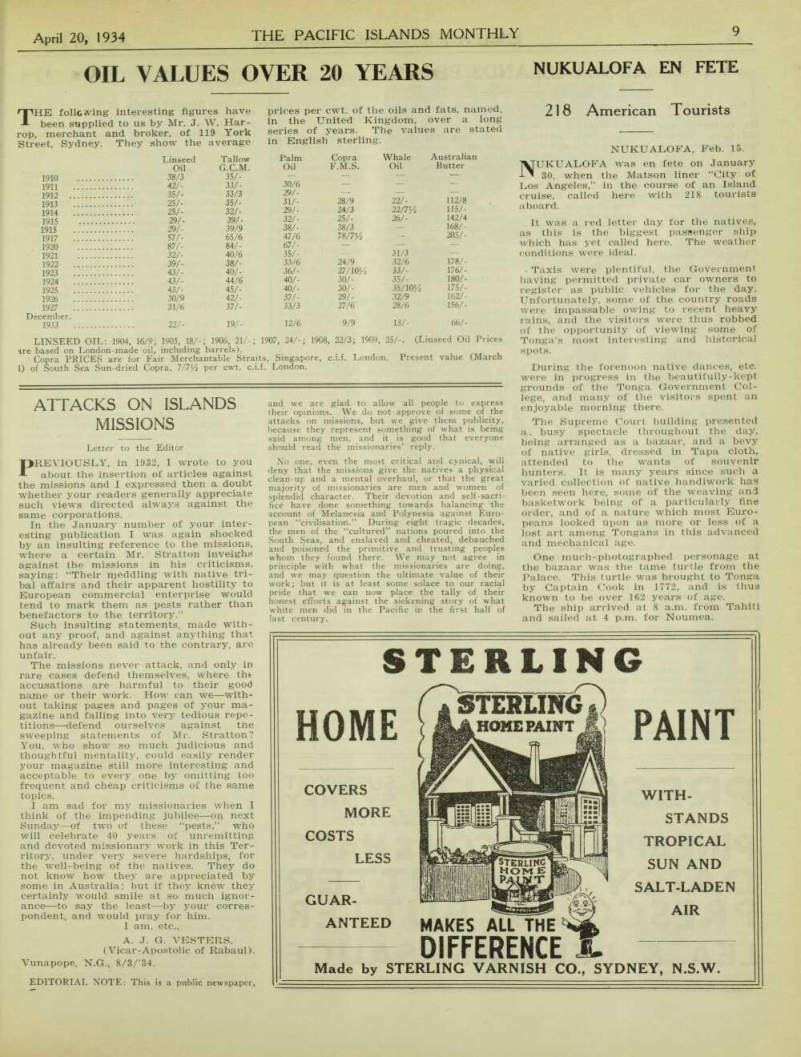
THE following interesting figures have been supplied to us by Mr. J. W. Har rop, merchant and broker, of 119 York Street, Sydney. They show the average
prices per cwt. of the oils and fats, named, in the United Kingdom, over a long series of years. The values are stated in English sterling.
LINSEED OIL: 1904, 16/9; 1905, 18/-; 1906, 21/-; 1907, 24/-; 1908, 22/3; 1909, 25/-. (Linseed Oil Prices are based on London-made oil, including barrels).
Copra PRICES are for Fair Merchantable Straits, Singapore, c.i.f. London. Present value (March I) of South Sea Sun-dried Copra, 7/7)4 per cwt. c.i.f. London.
1910 Linseed Oil 38/3 Tallow
G.C.M.
35/- Palm Oil Copra
F.M.S.
Whale Oil Australian Butter 1911 42/- 33/- 30/6 — — — 1912 35/- 33/3 29/- — — — 1913 25 /- 35/- 31/- 28/9 22/- 112/8 1914 25/- 32/- 29/- 24/3 22/7^ 115/- 1915 29/- 39/- 32/- 25/- 26/- 142/4 1915 29/- 39/9 38/- 38/3 — 168/- 1917 57/- 65/6 47/6 78/7J4 — 205/- 1920 87/- 84/- 67/- — — — 1921 32/- 40/6 35/- — 31/3 — 1922 39/- 38/- 33/6 24/9 32/6 178/- 1923 43/- 40/- 36/- 27/ioy 2 33/- 176/- 1924 43/- 44/6 40/- 30/- 35/- 180/- 1925 43/- 45/- 40/- 30/- 35/10½ 175/- 1926 30/9 42/- 37/- 29/- 32/9 162/- 1927 31/6 37/- 33/3 27/6 28/6 156/- December. 1933 22/- 19/- 12/6 9/9 13/- 66/-
Attacks On Islands
Missions
Letter to the Editor PREVIOUSLY, in 1932, I wrote to you about the insertion of articles against the missions and I expressed then a doubt whether your readers generally appreciate such views directed always against the same corporations.
In the January number of your inter esting publication I was again shocked by an insulting reference to the missions, where a certain Mr. Stratton inveighs against the missions in his criticisms, saying: “Their meddling with native tri bal affairs and their apparent hostility to European commercial enterprise would tend to mark them as pests rather than benefactors to the territory.”
Such insulting statements, made with out any proof, and against anything that has already been said to the contrary, are unfair.
The missions never attack, and only in rare cases defend themselves, where the accusations are harmful to their good name or their work. How can we—with out taking pages and pages of your ma gazine and falling into very tedious repe titions —defend ourselves against the sweeping statements of Mr. Stratton?
You, who show so much judicious and thoughtful mentality, could easily render your magazine still more interesting and acceptable to every one by omitting too frequent and cheap criticisms of the same topics.
I am sad for my missionaries when I think of the impending jubilee—on next Sunday—of two of these “pests,” who will celebrate 40 years of unremitting and devoted missionary work in this Ter ritory, under very severe hardships, for the well-being of the natives. They do not know how they are appreciated by some in Australia; but if they knew they certainly would smile at so much ignor ance—to say the least —by your corres pondent, and would pray for him.
I am, etc.,
A. J. G. Vesters.
(Vicar-Apostolic of Rabaul).
Vunapope, N.G., 8/3/’34.
EDITORIAL NOTE: This is a public newspaper,
and we are glad to allow all people to express their opinions. We do not approve of some of the attacks on missions, but we give them publicity, because they represent something of what is being said among men, and it is good that everyone should read the missionaries reply.
No one, even the most critical and cynical, will deny that the missions give the natives a physical dean-up and a mental overhaul, or that the great majority of missionaries are men and women of splendid character. Their devotion and self-sacrifice have done something towards balancing the account of Melanesia and Polynesia against European “civilisation.” During eight tragic decades, the men of the “cultured” nations poured into the South Seas, and enslaved and cheated, debauched and poisoned the primitive and trusting peoples whom they found there. We may not agree in principle with what the missionaries are doing, and we may question the ultimate value of their work; but it is at least some solace to our racial pride that we can now place the tally of their honest efforts against the sickening story of what white men did in the Pacific in the first half of last century.
Nukualofa En Fete
218 American Tourists
Nukualofa, Feb. 15.
NUKUALOFA was en fete on January 30, when the Matson liner “City of Los Angeles,” in the course of an Island cruise, called here with 218 tourists aboard.
It was a red letter day for the natives, as this is the biggest passenger ship which has yet called here. The weather conditions were ideal.
Taxis were plentiful, the Government having permitted private car owners to register as public vehicles for the day.
Unfortunately, some of the country roads were impassable owing to recent heavy rains, and the visitors were thus robbed of the opportunity of viewing some of Tonga’s most interesting and historical spots.
During the forenoon native dances, etc. were in progress in the beautifully-kept grounds of the Tonga Government Col lege, and many of the visitors spent an enjoyable morning there.
The Supreme Court building presented a busy spectacle throughout the day, being arranged as a bazaar, and a bevy of native girls, dressed in Tapa cloth, attended to the wants of souvenir hunters. It is many years since such a varied collection of native handiwork has been seen here, some of the weaving and basketwork being of a particularly fine order, and of a nature which most Euro peans looked upon as more or less of a lost art among Tongans in this advanced and mechanical age.
One much-photographed personage at the bazaar was the tame turtle from the Palace. This turtle was brought to Tonga by Captain Cook in 1772, and is thus known to be over 162 years of age.
The ship arrived at 8 a.m. from Tahiti and sailed at 4 p.m. for Noumea.
Advertisements & other items, p. 11 (1 item)
Home
STEELING
COVERS
MORE
COSTS
LESS
GUAR-
ANTEED
STERLING
HOME PAINT
MAKES ALL THE
DIFFERENCE
PAINT
WITH-
STANDS
TROPICAL
SUN AND
SALT-LADEN
AIR
Made by STERLING VARNISH CO., SYDNEY, N.S.W.
About Islands People
Mr. J. Johnston, an old resident of Apia, died on February 11 after a long illness.
He formerly was in the service of the old-time “German Firm,,” and latterly was employed by the Administration.
Brother Beda Marx and Brother J. Wassenberg, of the Mission of the Divine Word, Alexishafen, New Guinea, arrived by the Macdhui in Sydney on March 27. Brother Marx has been in New Guinea for 27 years, with only an occasional visit to Australia. They will both return to Alexi shafen.
Major M. Kinlock, representative of New Guinea Goldfields, Ltd., at Salamaua, ar rived in Sydney in March by the Macdhui, accompanied by his wife.
Dr. W. M. Bevington, formerly port medical officer at Thursday Island, and Mrs. Bevington, arrived in Sydney by the Taiping on March 29.
Major F. R. Hewitt, manager for Lever Pacific Plantations Ltd. in the Solomon Islands, arrived in Sydney by the Malaita at the end of March, and went on to Suva, on business connected with his firm.
Mr. F. R. Isom, printer at the Melane sian Mission Press, Solomon Islands, with Mrs. Isom and their infant daughter, re turned to the Solomons from furlough this month. The new infant was baptised in St. James Church, Sydney, on April 5 by Dr. Baddeley, Bishop of Melanesia, who had arrived in Sydney from the Solomon Islands a couple of days before.
Rev. H. J. Nind, of North Malo, Solo mon Islands, who has been a missionary in the Pacific for 35 years, arrived in Sydney on April 1 and went immediately into St. Luke’s Hospital for treatment.
He probably will retire from mission work and return to England.
Rev. G. H. West, an Anglican missionary from the Santa Cruz Group, arrived in Sydney by the Malaita on April 1 on fur lough, and proceeded to New Zealand. Mr.
West has served in the Islands mission field for 21 years.
Rev. W, B. Seaton, who has had charge of the mission school at Maravovo Lagoon, Solomon Islands, is in Australia on fur lough, and is at present in Goulburn,
N.S.W.
Dr. and Mrs. F. A. McPherson, from the Melanesian Mission Hospital at North
Malo, Solomon Islands, arrived in Sydney on furlough by the last Malaita.
Mr. and Mrs. H. Barham, Seventh Day Adventist missionaries, who have been in Sydney on furlough from the Solomon Islands, returned to the S.D.A. headquar ters in that group by the Malaita on April 7.
Pastor W. G. Turner, Chairman of the Seventh Day Adventist Mission Board in Australasia, will leave Sydney by the La Perouse for Noumea, New Caledonia, and the New Hebrides on April 26. He will be accompanied by Pastor H. E.
Piper, of New Zealand, and Mr. Hopkins, of Queensland.
Pastor and Mrs. S. W. Carr, S.D.A. mis sionaries of Naquia, Fiji, who have been in Australia on furlough, returned to Fiji in April. They have gone to the Bure sala Training School at Ovalau.
Pastor W. J. Westerman, Vice-president of the Australasian Union Conference of Seventh Day Adventists, left Sydney for New Guinea by the Macdhui on April 5.
He met Pastor A. G. Stewart at Port Moresby, and together they made an ex tended tour of the Mandated Territory.
Captain A. Tramoni, who was formerly in command of the Messageries Maritimes Islands steamer Laperouse, has replaced Captain Caboufigue in command of the M.M. motor vessel Eridan.
Mr. W. C. Groves, who has spent sev eral months on anthropological work at Tabar Island, off the coast of New Ire land, and who since has been in Rabaul, preparatory to returning to Melbourne, has now had his leave extended by the Victorian Department of Education in order that he may spend another six months on anthropology in New Guinea.
He has gone to Finchshafen, at the east ern end of the mainland of New Guinea.
Miss D. Lucas, Methodist Mission worker among the Fijian girls at Levuka, Fiji, left Sydney for Suva by the Aorangi on March 1, after short furlough in Aus tralia.
Rev. H. Robinson, of the Methodist Church of N.S.W., has left Sydney for Rossel Island, in the Louisiade Group, Papua. He will have no permanent resi dence there, but will live on a small launch, as most of his time will be spent
in travelling to and from the various islands in the group.
Nurse Dorothy Beale, of Tasmania, will be proceeding to New Guinea shortly to join the staff of the Methodist Mission’s Stewart Hospital, at Vunairima, New Britain.
Rev. A. W. Guy, Methodist missionary of Victoria, has been re-appointed to the Methodist Mission station at Bunama, Papua. He and his wife were at this sta tion two years ago, but returned to Aus tralia to enable their children to study at a Victorian school.
Miss J. Barton, of South Australia, has been appointed to the Girls’ School at Matavelo, Fiji, which is conducted by the Methodist Missionary Society. She will leave Sydney for Suva in June next.
Judge Ayson, Resident Commissioner of the Cook Islands, is at present on fur lough in New Zealand, and Mr. S. Savage, late Registrar, is acting as Deputy Com missioner.
Lady Hadfield, of 22 Carlton House Terrace, London, who is accompanied by Mrs. McNeill, arrived in Tahiti in Feb ruary from Barbados, on the S.S. Fran conia, and is staying at the Murnau estab lishment in the Punaavia district. Her Ladyship has since been joined by her nephew, the Comte de Breuserret, who came by way of Australia and New Zea land. The party appear to be enjoying Tahitian life and there seems evefy pros pect that they will remain there for sev eral months.
Commander R. A. H. McConnell, for merly of the Royal Navy and the Royal Indian Marine, who reached Sydney on April 5 by the Strathaird, has been hunt ing game in Kashmir for the last 12 months. He proposes to proceed to Ta hiti, where he will purchase a small schooner, and wander about the southern Pacific for two years. He will then spend 12 months in the northern Pacific.
Major C. B. Joske, a well-known mer chant of Suva, Fiji, arrived in Sydney at the end of March, and since has been en gaged on various matters connected with the trade problems which have arisen be tween Australia and Fiji.
Aeroplane Sent To
Rabaul
A SEAPLANE, which was built at Mas cot by Tugan Aircraft, Ltd., for Ra baul Airways, Ltd., was loaded on the motorship Macdhui in Sydney on April 4. for shipment to Rabaul. It is proposed to use the seaplane for services in New Guinea.
The seaplane has a Gipsy III. engine.
Its floats were designed by Wing-Com mander Wackett. The ’plane has accom modation for a pilot, two passengers, and 50lb. of luggage.
Filling station attendant: “Excuse me, this sixpence doesn’t ring good!”
Motorist: “What do you expect for six pence—a set of chimes?”
Advertisements & other items, p. 12 (1 item)
Prescott Ltd
are sole wholesale agents for
PINEAPPLE BACON & HANS
DAISY BRAND BUTTER
FRESCO BRAND BUTTER
LEA & PERRINS’ SAUCE
Seeking
Planters Go Gold
Experienced Men from Ramu and Sepik, N.G.
From a Special Correspondent.
RABAUL, March 20.
THERE has just left, on the “Mirani,” for Vanimo, Aitape, Mr. V. B. Penne father, of Tokua plantation, Kokopo, a former D.O. of this Territory.
Now that copra is languishing, the planters are making in numbers for the western end of New Guinea —gold-seeking.
Mr. Pennefather is following Messrs. Eric Randahl and Obi Hertz, who went off by the m.v. "Enuk” a few weeks ago. They plan to go up the Sepik—to the very upper reaches.
Mr. Pennefather will go inland from Vanimo, and hopes to join them. Each party will prospect the inner valleys—and as Pennefather knows Aitape district (as D.O.) pretty well, and was a great bush patrol man, they should be able to bring back some useful information about the auriferous possibilities of the Aitape-Sepik hinterland.
Mr. George Naess, former Government police master at Wide Bay and now the owner of a fine young plantation there, is also aboard the “Mirani,” bound for the Upper Ramu —Purari. His plantation is just bearing fully, but he hopes for gold fields success to help him over. Mr. Naess was one of the earliest on Edie Creek in the big rush, and he tells some good yarns of Harry Darby and the early hands. He is accompanied by Mr. Johannsen, former engineer of the “Duranbah,” and recently employed on the Bulolo Gold Dredging Coy’s property. These two ought to do some good combing in the Ramu-Purari region—where Bernard McGrath was killed recently.
Native Crime In
Solomons
Letter to the Editor IN recent issues you have remarked about something being wrong with the B.S.I. Government. I might say it is about time they began to realise that the white population here require just as much protection as the natives.
A stricter rule is needed over the na tives, and corporal punishment should be enforced throughout the group. The “boys” do not worry over a gaol sentence.
The end of last year, natives broke into one of Levers food stores at Cape Marsh and stole a large number of bags of rice and also meat. If those boys had known that the penalty would be a thrashing they would not have been so eager to commit those crimes, but the punishment they get is nothing to them.
Also, they should be made pay for the food stolen, and the damage done. They do not fear the Government one scrap, so how can a planter hope to manage them?
I also notice by the same issue that in New Guinea it is an offence for natives to carry knuckle-dusters or razor blades.
Why isn’t such a law made here in the Solomons forbidding natives to carry knives in sheaths, when their work does not require same.
I am, etc.,
F. J. Whitlock.
Cape Marsh, 22/2/’34.
Advertisements & other items, p. 13 (1 item)
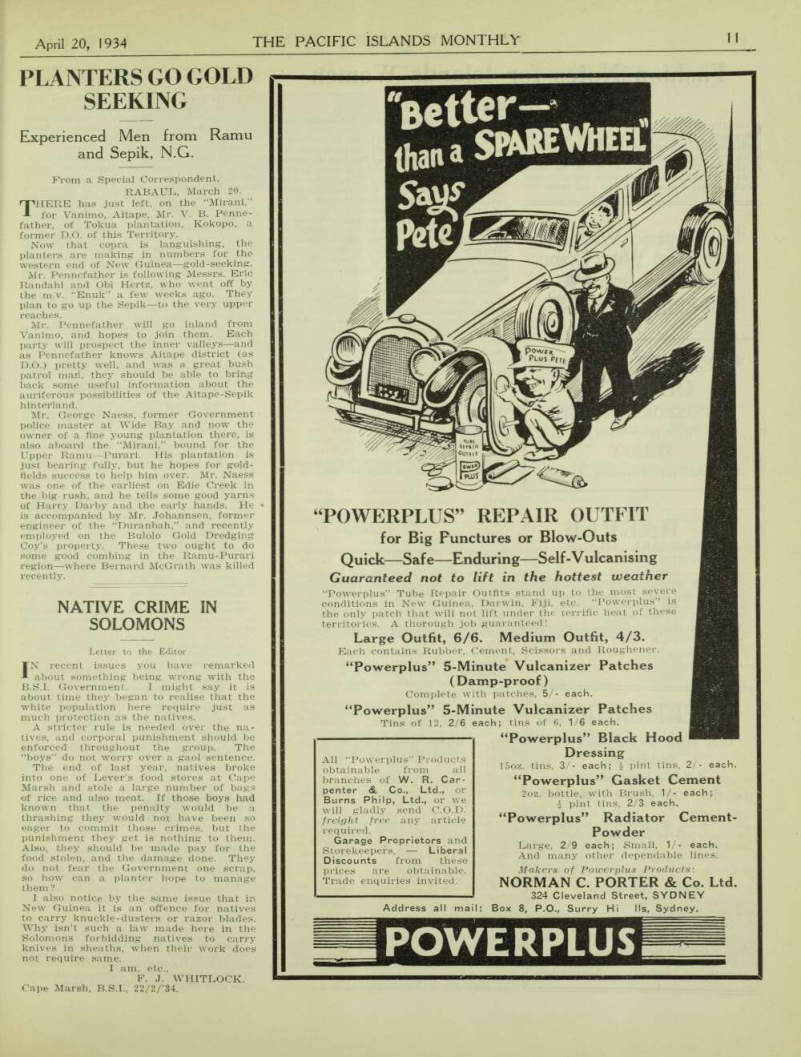
Powerplus
“POWERPLUS” REPAIR OUTFIT
for Big Punctures or Blow-Outs
Quick —Safe —Enduring—Self-Vulcanising
Guaranteed not to lift in the hottest weather “Powerplus” Tube Repair Outfits stand up to the most severe conditions in New Guinea, Darwin, Fiji, etc. “Powerplus” is the only patch that will not lift under the terrific heat of these territories. A thorough job guaranteed!
Large Outfit, 6/6. Medium Outfit, 4/3.
Each contains Rubber, Cement, Scissors and Roughener.
“Powerplus” 5-Minute Vulcanizer Patches
(Damp-proof)
Complete with patches, 5/- each.
“Powerplus” 5-Minute Vulcanizer Patches Tins of 12, 2/6 each; tins of 6, 1/6 each.
“Powerplus” Black Hood
Dressing
15oz. tins, 3/- each; \ pint tins, 2/- each.
“Powerplus” Gasket Cement
2oz. bottle, with Brush, 1/- each; ½ pint tins, 2/3 each.
“Powerplus” Radiator Cement-
Powder Large, 2/9 each; Small, 1/- each.
And many other dependable lines.
Makers of Powerplus Products:
NORMAN C. PORTER & Co. Ltd.
324 Cleveland Street, SYDNEY Address all mail: Box 8, P. O., Surry Hills, Sydney.
All “Powerplus” Products obtainable from all branches of W. R. Carpenter & Co., Ltd., or Burns Philp, Ltd., or we will gladly send C.O.D. freight free any article required.
Garage Proprietors and Storekeepers. Liberal Discounts from these prices are obtainable.
Trade enquiries invited.
POWERPLUS
Fashion Notes for Islands Women
By Therese.
GREEN leaves, turning to gold, clear, crisp, invigorating mornings, make us alive to the joy in everything and fill us with the spirit of adventure. Adventure in clothes, too, for with the contempt born of long familiarity, we regard our summer clothes with a jaundiced eye and turn our
wayward fancies to fresh fields and pas tures new.
To discourse on Winter to a tropic dweller seems not only superfluous but cruel; but the woman of wisdom in search of chic realizes that be the season Spring, Summer, (Autumn or Winter in other climes she must study well the dictates of fashion to ensure discriminating choice when the necessity arises.
The new weaves are delightful—wools shaggy and smooth and, of course, the inevitable tweed for the taileur, dull un crushable velvets, their rough surface looking like the bark of a tree, and pat terned jerseys for both blouses and sports wear.
For evenings, marocains, crushed vel vets soft as silk, flamisols, wind-swept satins, come to us under the same name, but in slightly different guises, and their colours are gorgeous. The rich autumnal tints of falling leaves, the new berry shades, cocktail and Shanghai reds, lizard and bronzine greens vie with each other for supremacy, and make the approaching Winter so gay in perspective that surely we must forget its icy blast.
The streamline silhouette, following the lines of the figure, still predominates, but ’tis whispered in overseas’ fashion circles, that the full curves of Venus are being madly sought. What balm for those of us who slavishly follow the eighteen days’ diet with regrettably imperceptible results.
Cream cakes ad lib may now be our por tion.
The vogue of the blouse and skirt is still with us, and little wonder, when one con siders the attractive blouses —silk, velvet, knitted —each variety of such tremendous appeal that choice is difficult.
For evening, a cocktail red Russian blouse, its tunic hip-length only, is worn with a skirt of black satin or velvet. The sleeves are wrist length, the fulness start ing from the elbow and tapering to slim ness about the wrist. A slit from wrist to elbow bound with gold and silver lame adds a perfect finish and supplies the necessary coolth for tropical wear.
There are endless capes, too —short, long, waist length, dipping at the back— made of fringe, feathers, georgettes, vel vets —in fact, of any material that suits the need of the moment.
An adorable little jacket of patterned silver tissue, reaching to the waist at the back, is lined with flesh-tinted georgette and has a collar of hand-made silver roses. It is particularly charming when worn with deep rose or sea green lace.
Long evening coats reaching to the hem of the gown, give definite grace to the wearer.
Hats, for the most part, are frankly absurd. Small and vivacious, they perch on the head in a provocative manner, and their success in many instances lies in the moulding of the model to the head, and in the cleverly draped crowns. Pert little goblin caps, flat crowns with the tiniest of brims, turned up fronts, twisted backs, fill the need for something diminutive to be worn with high necks and upstanding fur collars.
Unfortunately, only the ingenue can be really a success in these infinitesimal wisps of nothingness, but there is also the trend towards the wider brimmed cha peaux of velour and velvet, and these are charming for the woman past the first flush of youth.
Accessories are still as important as ever. Your shoes, gloves and bag may be in the same materials, and this applies to both day and evening.
Wood is well to the fore for decorative purposes. There are delightful, highly polished wooden clips to take the place of metal ones, and wooden beads and but tons have been with us for some time.
The newest of new fads is the handbag of the thinnest imaginable piece of Eng lish ash, beautifully grained. It is quite flexible and completely charming.
The most popular new season’s foot wear, other than the übiquitous court shoe, is the low vamp lace shoe, which looks well with a costume of either silk or wool. The Ghillie tie is often seen for sports wear, as is the light brogue.
Sandals for evening are triumphant and are obtainable in a variety of designs.
Many dispense with toes altogether, merely being held to the sole of the foot by means of a few bands. A very sheer stocking is worn with these, but toeless sandals are not always attractive and are the choice of only the ultra smart.
Silver and gold kid shoes are returning to favour, and bags of the same kid are distinctly fascinating. In plain envelope shades, sporting a jewelled clasp, they are the dernier cri of the season.
Here is a belt and link fastening in crochet. Try it.
Novel String Accessories.
Nowadays it is possible to make the most fas cinating of fashion accessories from such an ordi nary medium as string. Here are two ideas —a frock fastening and a belt. Both are crocheted in string. The link fastening consists of two long buttons joined together and passed through bound buttonholes in the frock.
For the buttons: Form a small ring of the string. 1st Round: Work 9 double crochet into ring, and join, 2nd Round: Work double crochet into the back loop of each d.c. of previous row, increasing once by working twice into one stitch (making 10 d.c.). 3rd Round: Work 1 d.c. into each d.c. of pre vious round. 4th Round: Like 3rd Round.
To form the openwork centre: sth Round: 4 ch. (3 stitches of this chain to form first treble), 1 tr. into 2nd stitch (1 ch., 1 tr.) 3 times, missing a stitch between to form a space, 1 ch. into 3rd stitch of commencing chain.
Repeat 4th, 3rd and 2nd rows on other side cf openwork part.
Make a tiny roll of the material of the coat or frock and pad the button, then to decrease, work (1 d.c., miss a stitch) 5 times. Break off.
Draw the ends to the inside with the hook.
Make a second button, and poin the two together with a chain of about 8 stitches.
For the Belt: Crochet a chain long enough to pass round the waist loosely; turn with 1 ch.
Ist Row: D.c. into every ch., turn. 2nd Row: Slipstitch to 2nd stitch, 2 ch. to form first tr, * 1 ch., miss 1 stitch, 1 tr into next stitch, repeat from * to end of row, turn. 3rd Row: D.c. into each stitch of previous row, omitting the last two stitches; turn. 4th Row; Like the 2nd row. sth Row: Like the 3rd row. D.c. along slanting end to make neat. Break off and darn the end in.
To Sydney
Flight From New Guinea
Sydney Marshall, an Australian pilot, landed at Mascot Aerodrome on April 15, completing a flight from New Guinea in three and a half days. Mr. Marshall flew a Westland Widgeon monoplane. It was the first time that the flight has been accomplished.
Mr. Marshall, who is attached to Guinea Airways in New Guinea, is on three months’ leave. He decided to spend his leave in Sydney. His flight commenced from Lae. He flew via Port Moresby and Cooktown and thence down the Queens land and New South Wales coasts.
Advertisements & other items, p. 14 (1 item)
(advert)
(advert)
(advert)
Samoans Take Readily To Boxing.
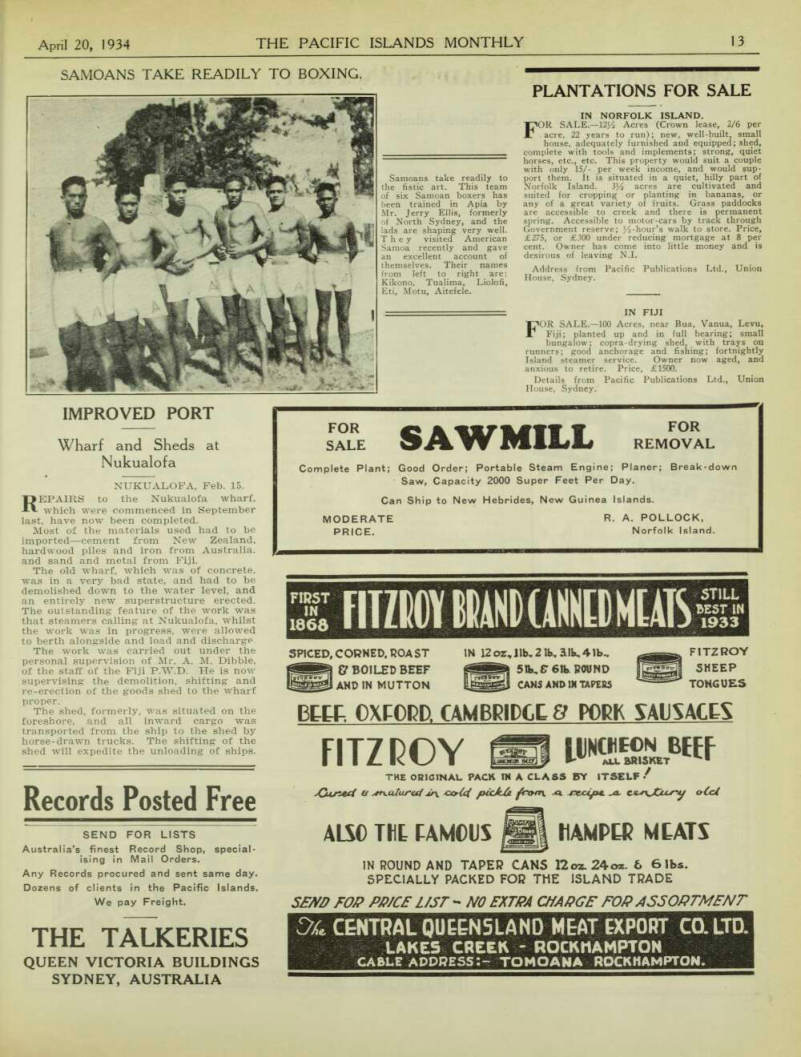
Samoans take readily to the fistic art. This team of six Samoan boxers has been trained in Apia by Mr. Jerry Ellis, formerly of North Sydney, and the lads are shaping very well.
They visited American Samoa recently and gave an excellent account of themselves. Their names from left to right are: Kikono, Tualima, Liolofi, Eti, Motu, Aitefele.
Improved Port
Wharf and Sheds at Nukualofa
Nukualofa, Feb. 15.
REPAIRS to the Nukualofa wharf, which were commenced in September last, have now been completed.
Most of the materials used had to be imported—cement from New Zealand, hardwood piles and iron from Australia, and sand and metal from Fiji.
The old wharf, which was of concrete, was in a very bad state, and had to be demolished down to the water level, and an entirely new superstructure erected.
The outstanding feature of the work was that steamers calling at Nukualofa, whilst the work was in progress, were allowed to berth alongside and load and discharge The work was carried out under the personal supervision of Mr. A. M. Dibble, of the staff of the Fiji P.W.D. He is now supervising the demolition, shifting and re-erection of the goods shed to the wharf proper.
The shed, formerly, was situated on the foreshore, and all inward cargo was transported from the ship to the shed by horse-drawn trucks. The shifting of the shed will expedite the unloading of ships.
Plantations For Sale
In Norfolk Island.
FOR SALE.—12½ Acres (Crown lease, 2/6 per acre, 22 years to run); new, well-built, small house, adequately furnished and equipped; shed, complete with tools and implements; strong, quiet horses, etc., etc. This property would suit a couple with only 15/- per week income, and would sup port them. It is situated in a quiet, hilly part of Norfolk Island. 3½ acres are cultivated and suited for cropping or planting in bananas, or any of a great variety of fruits. Grass paddocks are accessible to creek and there is permanent spring. Accessible to motor-cars by track through Government reserve; walk to store. Price, £275, or £300 under reducing mortgage at 8 per cent. Owner has come into little money and is desirous of leaving N.I.
Address from Pacific Publications Ltd., Union House, Sydney.
In Fiji
FOR SALE. —100 Acres, near Bua, Vanua, Levu, Fiji; planted up and in full bearing; small bungalow; copra-drying shed, with trays on runners; good anchorage and fishing; fortnightly Island steamer service. Owner now aged, and anxious to retire. Price, £1500.
Details from Pacific Publications Ltd., Union House, Sydney.
Advertisements & other items, p. 15 (2 items)
Fitzroy
SALE SAWMILL REMOVAL
Complete Plant; Good Order; Portable Steam Engine; Planer; Break-down Saw, Capacity 2000 Super Feet Per Day.
Can Ship to New Hebrides, New Guinea Islands.
MODERATE
PRICE.
R. A. POLLOCK,
Norfolk Island.
FIRST
IN 186 ft
SPICED, CORNED. ROAST
& BOILED BEEF
AND IN MUTTON
CANS AND IN TAPERS
FITZROY
SHEEP
TONGUES
BEEF, OXFORD, CAMBRIDGE & POCK SAUSAGES
FITZROY
THE ORIGINAL PACK IN A CLASS BY ITSELF!
ALSO THE EAMOUS
HAMPER MEATS
IN ROUND AND TAPER CANS 240*. 6 6 lbs.
SPECIALLY PACKED FOR THE ISLAND TRADE
SEND FOP PPJCEUSD •> NO EXTPA CHAPGE FOP ASSORTMENT Ou CENTRAL QUEENSLAND MEAT EXPORT CO. LTD.
LAKES CREEK - ROCKHAMPTON
CABLE APPPHSS:- TOMOAMA ROCKHAMPTON.
Records Posted Free
SEND FOR LISTS
Australia’s finest Record Shop, specialising in Mail Orders.
Any Records procured and sent same day.
Dozens of clients in the Pacific Islands.
We pay Freight.
THE TALKERIES
QUEEN VICTORIA BUILDINGS
SYDNEY, AUSTRALIA
Aeroplanes Or Road Transport?
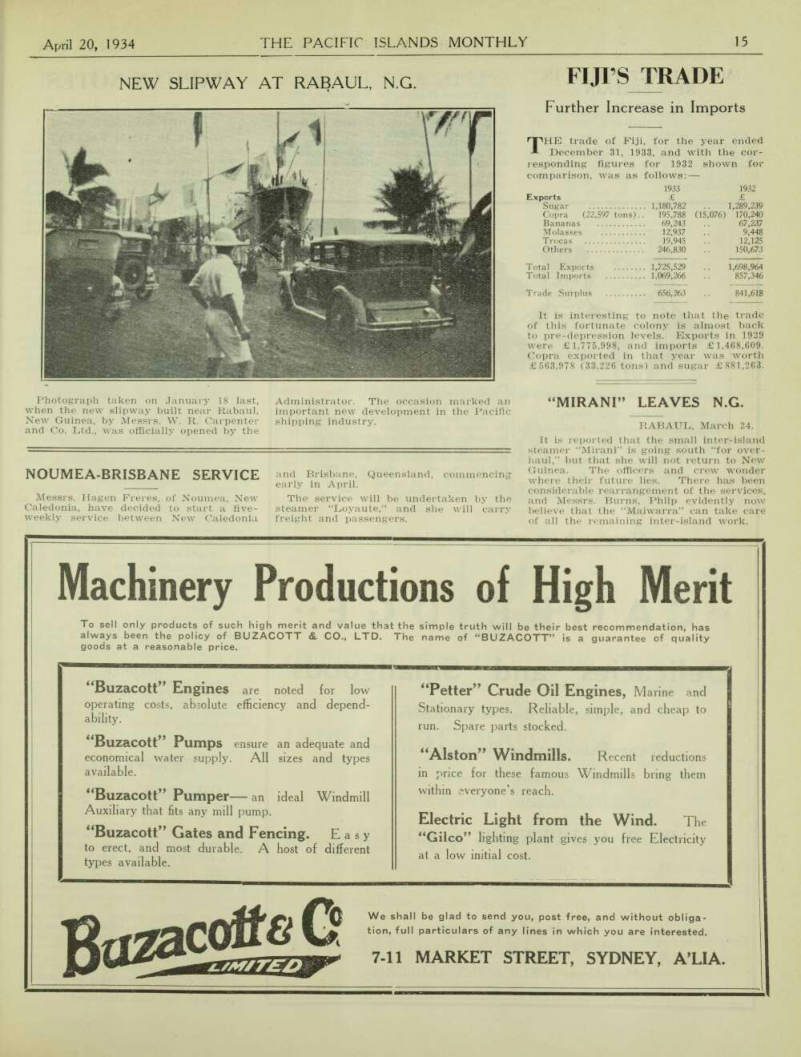
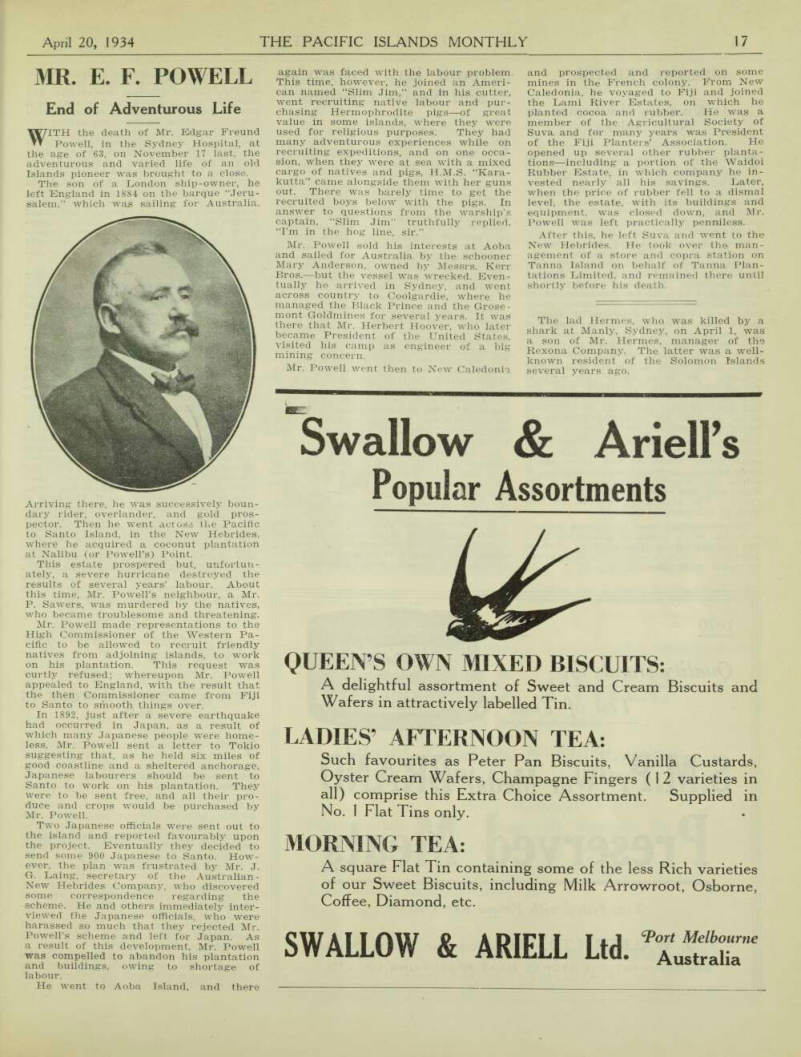
Thorny Problem for N. Guinea Administration
Administration of New Guinea has under consideration a plan for im proving the means of communication be tween the sea coast and the Morobe gold field. It embraces the provision at Sala maua of deep water wharfage; and the construction of a graded road between Salamaua and Wau.
At present, both of these transport facilities are lacking. Steamers lie some distance out, opposite Salamaua (but within the sheltered bay) and goods are lightered ashore. There is no road at all from the coast to the goldfield centres— only a few native tracks over the in credibly wild and broken country. So far all transport has been carried out by aeroplanes. The astonishing development of the Morobe gold industry during the past five years is the direct outcome of
the equally remarkable efficiency and re liability of the aeroplane services.
The goldfields road has had much con sideration in the past, and it has not been built because of three things—the great engineering difficulties; the problem of financing the very high cost, variously estimated from £150,000 to £250,000; and the fact that in this broken country of very steep grades and phenomenal rainfall the annual charge for mainten ance will be very high.
The gold industry on the Morobe field, however, has now become very valuable and important, and men and money con tinue to pour in. Expeditions, large and small, continuously are pushing further into the interior seeking and finding new gold, and the field is steadily being en larged. For that reason the Administration believes that a trafficable road from the coast to the centre of the goldfields is necessary, not only to assist further de velopment of the gold industry, but also to encourage the establishment of a per manent agricultural industry on these tablelands and the possible development of an important timber industry.
The method of finance under considera tion is an additional royalty on gold. At present, gold pays a royalty of 5 per cent.
It is reported that the Administration contemplates an increase to 7½ per cent, until such time as the capital cost of the road is provided for.
The plan is not by any means finding popular support in the goldfields section of New Guinea. Any increase in the royalty is naturally being resisted by the gold interests: the aviation interests claim that they are entitled to fair con sideration, seeing that they have by en terprise and efficiency made possible the establishment in New Guinea of a very valuable industry; while the general public still has to be convinced that the construction of a road, in view of all the exceptional engineering difficulties, will not place a greater tax upon them than they already are bearing in order to main tain the present efficient aeroplane trans port services.
We understand that surveys already are under way and data being assembled in order that a definite and compre hensive plan may be submitted to the next meeting of the Legislative Council of New Guinea. Probably the plan will come before the Council in two sections — one, to build the road; two, to increase the gold royalty. If the plan is approved
it will be submitted by the Administrator to the Commonwealth Government.
We have heard recently much discus sion of the plan, and it may be helpful if at this stage we briefly summarise the arguments for and against.
It is contended that a public highway from the coast is desirable. The reply is that the regular aeroplanes provide a dependable means of transport available to everyone.
It is contended that a public highway would permit the private ownership of motor vehicles, which could use the road when and how the owners wished. In similar manner, the air may be used by private aeroplanes—anyone can now pur chase a small aeroplane and learn to fly it as easily as they learn to drive a car.
The main argument in favour of the road is that freight rates would be re duced from £30-£35 per ton to a possible £5-£7 per ton. The aviation ex perts—and others who are not connected with aviation —cast ridicule upon these figures. They contend that if a first class graded road were built from Sala maua to Wau the conditions of transport would be such that it would be impossible to have a freight rate of less than 2d. per lb., or £18 per long ton. Probably, it would be more. If any form of toll were placed on road-users, the freight rate must exceed the present rate. The nom inal freight rate on which the aeroplanes are now operating is 4d. per lb., or about £35 per ton.
The aeroplane companies have been steadily reducing freights, and it is ex pected that if there is no interference with present conditions a general rate of 3d. per lb. between the coast and Wau will be possible at no distant date.
It is argued on behalf of the road ad vocates that the highway would assist the development of additional gold-bear ing areas. The mining interests reply that all known gold-bearing areas within range of the proposed road already are developed; and that to reach other simi lar areas additional expensive reading, extending up to 150 miles, would be ne cessary. All these areas already are ser
(Continued on page 37.)
viced by the aeroplanes, and this could be done at a cheaper rate in the future under the conditions named. The more distant areas are now serviced by the aeroplanes at less than cost; but if the profitable coast-Wau traffic (of which the aeroplanes now have the monopoly) were diverted to a road the aeroplanes would have to correspondingly increase their freights to the more distant places.
Replying to the argument that a road is necessary to permit the establishment of agricultural and timber industries, the aviation companies point out that there is now nothing to prevent the establish ment of such industries; and if such in dustries could provide the big aeroplanes with back loading from the interior to the coast, that factor would materially assist in the reduction of freights.
In favour of the road, it is said that it would open up the country along the route, and that communication would be carried on irrespective of weather con ditions. The argument against this is that there is no country worth developing along the route between Salamaua and Wau (it is mostly standing on end!) and that the same phenomenal rainfall over these mountains —which sometimes, but rarely, interferes with the aeroplane timetables —would almost certainly cause washaways and temporary dislocation of road traffic. So far as speed and safety are concerned, the facts and arguments are all in favour of the aeroplanes. Dur ing operations extending over nearly seven years, aviation accidents have caused the deaths of only one passenger and two pilots. The aeroplane transport is rapid, even the heaviest freight being transported from the steamers to the mines in a few hours. In the case of road transport, the case would be very dif ferent. It is calculated that one truck would take 12 days to transport what one aeroplane can carry in one day; and the aeroplane gives absolutely smooth car riage, as against the rough shaking of the truck.
One suggestion is that the aviation inter ests might make alternative suggestions to the Administration, urging that if the latter will subsidise the aeroplanes to an
amount considerably less than the esti mated annual cost of maintaining the road, and will provide improved aero dromes or landing-grounds, the aero plane companies will guarantee to give even better service than in the past, at rates that will compare favourably with the best that can be expected from road transport.
If the good spirit of the present argu ment persists, it looks as if the Adminis tration, in collaboration with the various interests concerned, will find a solution of the Goldfields transport problem that will be for the good of the Territory.
Advertisements & other items, p. 16 (1 item)
Durabesto
UoZS. shot in a
and* Cd Cartridge
hitting at long range—a load in a 2^4-inch cartridge—
Without Excessive Pressure
or Jarring Sensation of Recoil
“Neoflak” marks a definite step in the progress of propellants for shot guns secured by its scientific and accurate grading and controlled rate of burning.
Use “Duxbac” and
“Icil Special”
Waterproof Cartridges
Loaded with “Neoflak”
Both these brands are a definite safeguard against “lost” birds, each being remarkable in its pattern and so effectively waterproofed as to be impervious to moisture or even actual immersion in water itself.
Put
Them
to the
Test
OBTAINABLE EVERYWHERE
AT POPULAR PRICES
SAMUEL RUSSELL
ESTATE AND GENERAL AGENT.
P.O. Box 64, Papeete, Tahiti
Real Estate. Investments. Estate Management and Administration. Valuations and Reports. Houses and Lands for Lease or Sale.
Sole Proprietor: TAHITI PERFUMES Cables: Russell, Tahiti (Bentley’s Code)
DURABESTO
ISLAND HOME BUILDERS.—You can now
erect everlasting Homes quickly and at LOW COST by using DURABESTOS (Asbestos Cement) Building Sheets for Walls and Ceilings.
Big, sturdy sheets —economical to transporteasy to fix —fireproof—does not need painting Write for prices and Free Catalogue, “Durabestos Homes of Colourful Beauty,” WUNDERLICH LTD
Box 474 AA. G.P.O.. SYDNEY.
RESISTS TIME - WEATHER - WHITE ANTS
New Slipway At Rabaul, N.G.
Photograph taken on January 18 last, when the new slipway built near Rabaul, New Guinea, by Messrs. W. R. Carpenter and Co. Ltd., was officially opened by the
Administrator. The occasion marked an important new development in the Pacific shipping industry.
Noumea-Brisbane Service
Messrs. Hagen Freres, of Noumea, New Caledonia, have decided to start a five weekly service between New Caledonia
and Brisbane, Queensland, commencing early in April.
The service will be undertaken by the steamer “Loyaute,” and she will carry freight and passengers.
Fiji’S Trade
Further Increase in Imports
THE trade of Fiji, for the year ended December 31, 1933, and with the cor responding figures for 1932 shown for comparison, was as follows; —
It is interesting to note that the trade of this fortunate colony is almost back to pre-depression levels. Exports in 1929 were £1,775,998, and imports £1,468,609.
Copra exported in that year was worth £563,978 (33,226 tons) and sugar £881,263.
1933 1932 Exports £ £ Sugar 1,180,782 1,289,239 Copra (22,597 tons).. 195,788 (15,076) 170,240 Bananas 69,243 67,237 Molasses 12,937 9,448 Trocas 19,945 12,125 Others 246,830 150,673 Total Exports 1,725,529 1,698,964 Total Imports 1,069,266 857,346 Trade Surplus 656,263 841,618
“Mirani” Leaves N.G.
RABAUL, March 24.
It is reported that the small inter-island steamer “Mirani” is going south “for over haul,” but that she will not return to New Guinea. The officers and crew wonder where their future lies. There has been considerable rearrangement of the services, and Messrs. Burns, Philp evidently now believe that the “Maiwarra” can take care of all the remaining inter-island work.
Advertisements & other items, p. 17 (1 item)
Machinery Productions of High Merit
To sell only products of such high merit and value that the simple truth will be their best recommendation, has always been the policy of BUZACOTT & CO., LTD. The name of “BUZACOTT” is a guarantee of quality goods at a reasonable price.
“Buzacott” Engines are noted for low operating costs, absolute efficiency and dependability.
“Buzacott” Pumps ensure an adequate and economical water supply. All sizes and types available.
“Buzacott” Pumper — an ideal Windmill Auxiliary that fits any mill pump.
“Buzacott” Gates and Fencing. Easy to erect, and most durable. A host of different types available.
“Better” Crude Oil Engines, Marine and Stationary types. Reliable, simple, and cheap to run. Spare parts stocked.
“Alston” Windmills. Recent reductions in price for these famous Windmills bring them within everyone’s reach.
Electric Light from the Wind. The “Gilco” lighting plant gives you free Electricity at a low initial cost.
We shall be glad to send you, post free, and without obligation, full particulars of any lines in which you are interested.
7-11 MARKET STREET, SYDNEY, A’LIA.
Mission Activities In
New Britain
From a Special Correspondent.
RABAUL, March 24.
Extension of Anglican mission work by the establishment of a central training in stitution is proposed for the New Britain South Coast, as a result of the recent visit by the Bishop of Melanesia in the M.V.
“Southern Cross.”
No doubt, some of the £70,000 legacy left to the Australian Board of Missions by Mrs. Canon Hughes, of Melbourne, will be made available for this new institution.
Since the Vunapope Mission (Catholic), the Anglican, and now (it is rumoured) the Seventh Day Adventists, are working along the South Coast, there will soon occur the tragedy of religious divisions amongst these never-very-homogeneous native people.
Papuan Notes
From Our Own Correspondent
Port Moresby, March 17.
Where Is Tinai Valley?
In a detailed survey of the border line between Papua and New Guinea, which is being carried out by the New Guinea Administration, to avoid disputes regard ing mining leases, it is reported that it is unlikely that the gold mining leases taken up in the Tinai Valley lie within the border of Papua, It is considered that they will be found to be situated well within New Guinea territory.
Kunimaipa And Police.
At the Central Court on March 12 sen tences were passed by Mr. Justice Gore on the six native constables who were concerned in the brush with natives of Kunimaipa early in the year. When un provoked, they fired on the people of Kamrak village.
Two of the accused policemen found guilty of murder, were each sentenced to four years’ imprisonment. The other four, for attempted murder, were each sen tenced to three years’ imprisonment.
Registered Companies.
Two important companies were regis tered in Papua early in March: Genairco Airway, Limited, as a foreign company, having nominal capital of £100,000 in shares of £1 each. Registered office at the office of Burns, Philp and Co., Ltd., Port Moresby. Public of ficer: Mr. W. D. Dupoin.
Gold Mines of Papua, Limited, as a foreign company, nominal capital of £60,000 in 240,000 shares of 5/- each. Re gistered office at the office of Mr. R. D, Bertie, solicitor. Port Moresby, who is the public officer of the company in Papua.
Superannuation Fund.
Allowances paid in 1933 £8,399 Contributions from Officers 2,541 Income from Investments 1,194 Grants to the fund from Papuan Government 4,716 Expenses amounted to 51 The Board’s investments are valued at £29,675, all in Commonwealth 4 per cent, stock. 26 officers received superannua tion last year.
Imports.
Imports into the Territory for 6 months ended on December 31 totalled £119,820, from which the Government received £14,284 in duty. The principal items were tobacco, rice, and mining machinery.
Disappeared!
Pukpuk Shooter in New Britain
RABAUL, March 24.
YOUNG ROWE, the youngest of the three brothers who own Ralum and “Queen Emma’s” former Kokopo interests, as well as Ablingi, on the South Coast, went out to shoot pukpuks (crocodiles) a few weeks ago, and has not been seen or heard of since.
He left Ablingi Island plantation in a single canoe alone, and against native ad vice—and only his gun has been found.
The theory is that he fell into the river (where his gun was found) as he was crossing a log, and the crocodiles got him.
The Government has made an investiga tion, but nothing definite about his dis appearance has been discovered.
Advertisements & other items, p. 18 (1 item)
Cambridge
The
PROFIT
of a
SMILE
Smile and the world smiles with you, Weep and you weep alone, This sad old earth must borrow its mirth, For it has trouble enough of its own.
There was a man who smiled, Because his business paid.
He smiled because the goods he sold Were the best that could be made.
He smiles because they look so well.
He smiles because they taste so well.
He smiles because they sell so well, He smiles because they eat so well.
He smiles, and smiles, and smiles again.
Always ask for and see that you get
The NEW
CAMBRIDGE
Delicacies and Smallgoods
Famous for their High Quality We are Exporters and Shipping Providores Our goods are obtainable in the Pacific Islands from
W. R. CARPENTER & CO. LTD.
Factory at Bourke and Phillip Streets,
REDFERN, N.S.W.. AUSTRALIA
Cable Address : ‘DELICACIES, REDFERN
Mr. E. F. Powell
End of Adventurous Life
WITH the death of Mr. Edgar Freund Powell, in the Sydney Hospital, at the age of 63, on November 17 last, the adventurous and varied life of an old Islands pioneer was brought to a close.
The son of a London ship-owner, he left England in 1884 on the barque “Jeru salem,” which was sailing for Australia.
Arriving there, he was successively boun dary rider, overlander, and gold pros pector. Then he went across the Pacific to Santo Island, in the New Hebrides, where he acquired a coconut plantation at Nalibu (or Powell’s) Point.
This estate prospered but, unfortun ately, a severe hurricane destroyed the results of several years’ labour. About this time, Mr. Powell’s neighbour, a Mr.
P. Sawers, was murdered by the natives, who became troublesome and threatening.
Mr. Powell made representations to the High Commissioner of the Western Pa cific to be allowed to recruit friendly natives from adjoining islands, to work on his plantation. This request was curtly refused; whereupon Mr. Powell appealed to England, with the result that the then Commissioner came from Fiji to Santo to smooth things over.
In 1892, just after a severe earthquake had occurred in Japan, as a result of which many Japanese people were home less, Mr. Powell sent a letter to Tokio suggesting that, as he held six miles of good coastline and a sheltered anchorage, Japanese labourers should be sent to Santo to work on his plantation. They were to be sent free, and all their pro duce and crops would be purchased by Mr. Powell.
Two Japanese officials were sent out to the island and reported favourably upon the project. Eventually they decided to send some 900 Japanese to Santo. How ever, the plan was frustrated by Mr. J.
G. Laing, secretary of the Australian- New Hebrides Company, who discovered some correspondence regarding the scheme. He and others immediately inter viewed the Japanese officials, who were harassed so much that they rejected Mr.
Powell’s scheme and left for Japan. As a result of this development, Mr. Powell was compelled to abandon his plantation and buildings, owing to shortage of labour.
He went to Aoba Island, and there
again was faced with the labour problem.
This time, however, he joined an Ameri can named “Slim Jim,” and in his cutter, went recruiting native labour and pur chasing Hermophrodite pigs—of great value in some islands, where they were used for religious purposes. They had many adventurous experiences while on recruiting expeditions, and on one occa sion, when they were at sea with a mixed cargo of natives and pigs, H.M.S. “Kara kutta” came alongside them with her guns out. There was barely time to get the recruited boys below with the pigs. In answer to questions from the warship’s captain, “Slim Jim” truthfully replied, “I’m in the hog line, sir.”
Mr. Powell sold his interests at Aoba and sailed for Australia by the schooner Mary Anderson, owned by Messrs. Kerr Bros. —but the vessel was wrecked. Even tually he arrived in Sydney, and went across country to Coolgardie, where he managed the Black Prince and the Grose mont Goldmines for several years. It was there that Mr. Herbert Hoover, who later became President of the United States, visited his camp as engineer of a big mining concern.
Mr. Powell went then to New Caledonia
and prospected and reported on some mines in the French colony. From New Caledonia, he voyaged to Fiji and joined the Lami River Estates, on which he planted cocoa and rubber. He was a member of the Agricultural Society of Suva and for many years was President of the Fiji Planters’ Association. He opened up several other rubber planta tions —including a portion of the Waidoi Rubber Estate, in which company he in vested nearly all his savings. Later, when the price of rubber fell to a dismal level, the estate, with its buildings and equipment, was closed down, and Mr.
Powell was left practically penniless.
After this, he left Suva and went to the New Hebrides. He took over the man agement of a store and copra station on Tanna Island on behalf of Tanna Plan tations Limited, and remained there until shortly before his death.
The lad Hermes, who was killed by a shark at Manly, Sydney, on April 1, was a son of Mr. Hermes, manager of the Rexona Company. The latter was a well known resident of the Solomon Islands several years ago.
Advertisements & other items, p. 19 (1 item)
Swallow & Ariell’s
Popular Assortments
QUEEN’S OWN MIXED BISCUITS:
A delightful assortment of Sweet and Cream Biscuits and Wafers in attractively labelled Tin.
LADIES’ AFTERNOON TEA:
Such favourites as Peter Pan Biscuits, Vanilla Custards, Oyster Cream Wafers, Champagne Fingers (12 varieties in all) comprise this Extra Choice Assortment. Supplied in No. 1 Flat Tins only.
MORNING TEA:
A square Flat Tin containing some of the less Rich varieties of our Sweet Biscuits, including Milk Arrowroot, Osborne, Coffee, Diamond, etc.
SWALLOW & ARIELL Ltd. Port Melbourne Australia
Mission Printers
Good Work by Lutherans in New Guinea
THERE was an interesting incident in the office of the “Pacific Islands Monthly,” the other day. Mr. F. R. Isom, the printer in charge of the Melanesian Mission Press, Guadalcanal, in the Solo mon Islands, was sitting talking to the editor, when a messenger delivered a par cel of books.
They were books kindly sent to us by Rev. St. Lehner, of Finschhafen (Super intendent of the Lutheran Mission in New Guinea), as examples of the work done at the Lutheran Mission’s printery and bookbindery—which were established in 1916, and are operated by natives under white supervision. Little did Mr. Lehner guess that when the editor examined those books, he would have for his assist ance the friendly, but jealous, eye of an other Pacific Islands Mission printer.
The books would be a credit to any city printery. Mr. Isom, whose own work is of notable quality, examined both the printing and binding with much curiosity, and declared they could not be improved upon. He sent his congratulations to his fellow craftsmen in Finschhafen.
In its 18 years of life, the Finschhafen printery has produced 70,000 large and small bound books, as well as an enor mous amount of miscellaneous matter. It prints two monthly journals—one in the Kate and the other in the Jabem lan guage. The printery works in no less than 12 different languages.
One interesting book is a school primer, in which every lesson is illustrated by a fine process block. The printing of those blocks, on ordinary super-calender, is re markably well done.
Seventh Day Adventists
and Native Customs
Letter to the Editor.
IT is of some interest to read from time to time certain things that Seventh-day Adventists are supposed to teach their con verts both at home and abroad.
It is of more importance, in view of these supposed strange teachings, that facts be presented, otherwise some of your readers may be led to wrong conclusions. In your issue of March 16 a writer, who strangely, yet possibly appropriately, signs himself “Solomaniac,” claims that the teachings of Seventh-day Adventists are becoming a danger to the physical well-being of the native races in the Solomon group, through prohibiting “pork, ’possum, and all meats, as are also fish, tobacco and betel nut.”
Seventh-day Adventists, neither in the Solomons nor elsewhere, prohibit “all meats ... or fish.” There are certain flesh foods, including fish, which we believe are not best fitted for human consumption, and eaten in the native style are unques tionably not conducive to the best health of the people. On the other hand, we have never advised our native converts to re frain from clean meats or clean fish.
Rather have we encouraged them to engage in their fishing. In some centres we have also supplied the natives with cattle and goats for their own consumption.
As to the removal of betel nut and tobacco, we have to refer “Solomaniac” to any competent medical authority for pro per information on the positive harmful ness of these two articles from the angle of both physical health and common hygiene.
It has been my privilege to visit the South Sea groups on numerous occasions.
I have been in the Solomons, and travelled extensively in this field three times. I have visited also among both primitive and
Christianised people in New Guinea, Papua, the New Hebrides, and among the natives of Fiji. From personal observation and contact I am prepared to state that, as a mission board, we would be willing to sub mit our converts to close inspection, con ducted by properly qualified men, at any time and in any centre, provided such in spection were also conducted by the same body of men on an equal number of natives gathered from any centre or community where unclean foods, betel-nut and tobacco are included in the regular diet or custom of the people. On the basis of actual fact, demonstrated in many countries and island groups over many years of mission opera tions, I am able to state that such inspec tion suggested above would be distinctly to the advantage of the Seventh-day Ad ventist mission.
For a man of “Solomaniac’s” seemingly narrow vision, it may be a simple thing to lay untruthful charges. The weakness of them will be clearly seen in the result wit nessed in the Adventist villages, among the men and women and children compris ing them.
As to the foolish charge that our mis sionaries compel the native women to wear bloomers, little need be said. At the time of my writing we have three missionaries in Sydney from the Solomons. I have in terviewed each of them, and they know nothing of any such direction.
The facts are that we compel no native man or woman to wear any clothing of any kind. They are at liberty to attend worship, school, or live in their villages attired as they wish. True, the natives themselves, soon after contact with our mission teachers, desire to cleanse their bodies and to some extent clothe them.
This is their decision. As to the kind of clothing worn they have positive freedom.
If some native woman wishes to wear bloomers, or any other garment, and some trader sells the article to her—or she, copying the white teacher, elects to make and wear these garments—then we find no regulation forbidding her so to do. Com pulsion, or even direction, in the matter “Solomaniac” mentions, is not part of the training given Seventh-day Adventist con verts.
I am, etc.,
W. G. TURNER, Chairman,
Seventh-day Adventist Mission Board.
Wahroonga,
N.S.W., 18/3/34.
Rev. A. J. Small’S Work In
Fiji
THE devotional and self-sacrificing work of the late Rev. Arthur J. Small, Methodist missionary in Fiji, was the sub ject of an interesting lecture by Rev. C. O.
Lelean, of Fiji, at Sydney on February 13.
Mr. Small went to Fiji in 1879, said Rev.
Lelean, and he revived printing in the Fijian language. Shortly afterwards he became editor and publisher of a native newspaper which greatly influenced pub lic opinion.
He was a trusted adviser of the Govern ment and his influence over the natives was remarkable. On several occasions, when trouble took place among some of the islanders, he was instrumental in ar ranging a settlement.
At his funeral whites and natives joined the cortege to pay respect to the man who had done so much for Fiji.
Rev. C. O. Lelean, who delivered the lecture, is stationed at the Methodist Col lege, Davuilevu, Fiji, and is at present in New South Wales on furlough.
Advertisements & other items, p. 20 (1 item)
Preserved Meats
1870 1934
Quality Stands the
Test of Time
S.M.P. “War Medal" BRAND
Preserved Meats
Tins Fitted with Patent Key Opener F. J. WALKER LTD. 33 Macquarie Place, Sydney- Sole Agents for: THE SYDNEY MEAT PRESERVING CO., LTD.
Patteson Gets There At Last
News has been received of the arrival at Vila, New Hebrides, on March 30, of the mission ketch Patteson. The ketch was several days overdue, and owing to the stormy weather, which had been pre vailing, fears had been entertained as to her safety. She left Noumea on March 21 for the New Hebrides, and the voyage should not have occupied more than two or three days. Her captain reported, how ever, that fierce gales had been encoun tered.
The Patteson took on fresh provisions, and after a short stay at Vila, left for the Melanesian Mission station at Lolowai Bay, on Aoba Island, N.H.
The ketch in Sydney Harbour and, below, the members of the crew on the January voyage.
Left to right: C. Halvorsen, Captain M. A. Allen, A. Cant, L. J. Warren.
Rearrangement of New Guinea
District Services
RABAUL, March 24.
It is announced that the highly-esteemed District Officer, Mr. “Ted” Taylor, of Sala maua (recently wounded in a battle with the killers of Bernard McGrath) is coming to Rabaul to act as Director of Native Affairs, etc., during the absence of Mr.
Chinnery. Mr. R. Melrose, lately D.O. at Kavieng, who has been acting as assistant to Mr. Chinnery in Rabaul, will go to Sala maua.
Peanuts
From Our Own Correspondent
Pt. Moresby, Feb. 26.
LAST year a correspondent in Papua put forth the suggestion that peanuts would be an industry well worth estab lishing in the country if given a free entry into Australia from Papua, and that with the proceeds from the industry the hard pressed planters might find some measure of relief.
He stated that the climatic conditions of Papua were eminently suited to the successful cultivation of large crops, which would be quickly absorbed by the mer chants in Sydney.
It is therefore gratifying to read of a 1934 alteration in the Commonwealth Cus toms Tariff (Papua and New Guinea pre ference) whereby peanuts exported from Papua and New Guinea are now admit ted into Australia free of Customs duty— though unfortunately they will be subject to primage at the rate of 10 per cent, ad valorem.
Total exports from the Territory for the same period were valued at £130,521, being gold £25,487; rubber, £32,100; copra, £23,814; des. coconut, £25,733; trochus shell, £7,652; coffee, £3,527.
The total revenue of the Territory for the half year ending December 31 showed a decline of £4,657 compared with the corresponding period of the last financial year. Expenditure for the half year was down £5,877. The credit balance on re venue account, as at December 31, was £279.
Advertisements & other items, p. 21 (1 item)
Burns, Philp
GOSHEN PRIVATE
HOSPITAL
(Sister E. W. TEAMAN), 37 Gloucester Road, Hurstville, Sydney General and Private Wards. Spacious Grounds. High and Cool Situation.
Moderate Fees.
BURNS, PHILP
(South Sea) Co. Ltd.
Island Traders & Shipowners Registered Office: Suva, Fiji.
Also Branches at Fiji: Levuka, Lautoka, Labasa, Ba, Sigatoka, Rotuma.
Tonga: Nukualofa, Haapai, Vavau.
Samoa: Apia, Pago Pago (America Samoa).
Solomons: Makambo, Gizo, Faisi.
New Hebrides: Vila.
Gilberts: Tarawa.
Norfolk Is. Nauru. Niue. Wallis Is. Futuna Is.
Code Address: “Burnsouth.”
South Seas
A Chance For The
Publicity at the Melbourne Centenary
By Gordon Thomas.
COMMENCING in October, the Centenary celebrations in Melbourne are to be staged.
From the four quarters of the globe, countries are sending representatives for trade, industries and general propaganda work.
What an opportunity presents itself for the Territories in the Pacific to join to gether and put the South Seas “on the map!” What a wonderful exhibit could be made of the Pacific industries; tourist possibilities and native handiwork!
Fiji, with its sugar and bananas; Sa moa, with its copra and cacao; timber and copra from the Solomons; gold and desiccated coconut from New Guinea; Papua, with its rubber, copra, and gold.
Imagine the interest that could be oc casioned by miniature models of a Pa puan village; a Bulolo dredge; a copra kiln and live natives cutting copra—that mysterious product of which so little is known to those who live outside the Tropics.
The Melbourne Centenary represents Opportunity knocking at the door of every Pacific territory and group. Are we going to be deaf and unmindful of the knocking?
Are the agricultural, mineral, timber, and tourist advantages of the Islands to be kept shrouded in an apathetic dark ness when such a chance, not only to “tell the world,” but to show the world, presents itself?
Government administrations, commer cial houses, and mining companies could well afford to make a substantial mone tary and personal allocation for an ex hibit of the resources of their Islands.
Why should not the whole organisation be placed in the hands of the Pacific Islands Association?
Properly organised, such an exhibit of South Seas products and handiwork would be one of the main features of the Centenary celebrations, and we would be bringing ourselves before the eyes of the world. And the more we do that the bet ter it will be for all of us.
Modern Samoa
DR. FELIX M. KEESING, a graduate of New Zealand and former Fellow of the Rockefeller Foundation, joined the re search staff of the Institute of Pacific Relations, and became director of a international research project on “Depen dencies and Native Peoples of the Pacific.”
During this work he made a detailed study of Samoan conditions. The result is a new book, “Modern Samoa,” which is a comprehensive survey of the mandated territory of Western Samoa (Savi’i and Upolu), and eastern or American Samoa, (Tutila, Manu’a, and other islands). It deals in authoritative fashion with what is called the “Mau Problem.”
Ingenious Fishermen
How Papuans Make Catches
PAPUAN fishermen have various methods of capturing fish, and make use of great woven nets of native string, or of funnel shaped baskets, in addition to the usual spearing and line-catehing. Two very interesting ways, however, are by the use of “Tuva” (or “New Guinea dyna mite” as it is called), and the lime bottle.
In the latter method, a bottle is filled with lime and corked. Through the cork a small hole is made, so that when the bottle is thrown into the water, the mois ture gradually trickles in and acting on the lime causes it to explode the bottle, with good results so far as a haul of dead fish is concerned.
In using “Tuva,” a preparation made from the root of a certain vine is first procured. This, thrown into the water where fish are, produces the same effect as a strong dose of chloroform, and the stupefied or dead fish are collected as they float to the surface.
Another method is for a couple of men to go out in a canoe and paddle over a shallow patch of coral, throwing out a buoyed net to surround the canoe.
Then the man in the bow takes his spear, rubs some “Tuva” onto the point where the spear has been split, and pokes it into crevices in the coral.
Presently the fish come floating up, and are promptly picked up in a hand-net wielded by the boy amidships. The ef fect of “Tuva” is so potent by the way, that it is used as a poison by humans; and also figures in malevolent magic and
sorcery. — C. CORAL.
Purchases By New Guinea
And Papua
Letter to the Editor Can you, or anyone else, explain why it is that while the Administration of New Guinea purchases most of its con siderable requirements in Sydney, mostly by tender through the New Guinea Trade Agency, the Administration of Papua buys its supplies without the aid of tenders, and has no connection whatever with the New Guinea Trade Agency?
The New Guinea tender system seems to work very well. A statement of the Administration’s needs usually arrives by the B.P. steamer: tenders are immedi ately invited; contracts are let and the whole operation is put through so quickly and smoothly that the goods ordered usually go back to New Guinea on the same steamer. A large number of Sydney manufacturers and exporters now keep in touch with the New Guinea Trade Agency, and are always ready to supply goods promptly, under a system of keen competition.
The Papuan Government, on the other hand, seems to buy unsystematically and apparently with a lack of competition.
There has been on several occasions a suggestion that Papua is paying for goods and service something more than is paid by New Guinea. There is also a suspicion that Papua buys substantial portions of its requirements outside of Australia. This seems an unfortunate policy, seeing that the Australian tax payer has to provide Papua every year with from £40,000 to £60,000 to carry on.
Why cannot Papua use the Trade Agency and tender system in the same way as New Guinea?
I am, etc.,
Sydney Merchant.
Sydney, March 24, 1934.
Advertisements & other items, p. 22 (1 item)
Hundreds of Thousands
of Small Depositors
Hundreds of thousands of thrifty citizens from every walk of life have deposited over £86,000,000 with the Bank of New South Wales.
Such deposits enable the Bank to assist primary and secondary industries and to provide the credits essential for marketing the country's production.
Thus the small depositor with his ten, twenty or fifty pounds, by entrusting his money to this great financial institution, safeguards his savings; receives his regular interest; and plays his part in the development of the country.
Bank of New South Wales
(ESTABLISHED 1817)
with which the Western Australian Bank and The Australian Bank of Commerce Ltd. are amalgamated.
Tragi-Comedy Of Government
In Tonga
Letter to the Editor
IF there were anything in the nature of reality about the Tongan Legislative Assembly it would play an important part in the government of these islands. Un happily it plays no real part, because its peculiar constitution debars it from doing so.
The orgy of expenditure in which the Tongan Government has indulged during recent years could not have happened if the Legislative Assembly had ever been able to make its voice heard and felt in those directions for which it really should exist. Measures are brought forward for enactment by it which are already cut and dried before they are discussed and, owing to the composition of that assem bly, are forced through after a mock debate.
The principle of elective representation of the people is a mockery. In a House of 22 members, eight are permanent officials in the service and pay of the Go vernment, seven are chiefs whose inter ests are with the Government, and who in reality are nominated by it, and the remaining seven are elected by the people for three-year periods. Fifteen members representing the Government, and seven members representing the people. The Government calls the tune, but the people pay the piper.
During about 15 years the Tongan Gov ernment has gone through approximately £1,000,000 sterling. What have they to show for it beyond a new post office, a few miles of roads, private residences for civil servants, and the “Hifofua” m/v?
The bulk of it has gone in personal emolu ments to which they have helped them selves with a lavish hand.
In addition to very generous salaries there are allowances of all sorts for all sorts of reasons, and some for no reason.
House allowance, benzine allowance, tra velling allowance, and even an allowance for winding up the village clock! There was a bonus added to salaries to make up for extra cost of living during the war and, although the cost of living has come down tremendously, it has never been taken off. From one of the most equable climates in the world, persons in the Go vernment service must be given 4½ months’ leave every three years on full pay, and with passages paid both for the civil servant and his wife. Both the white members of the “Cabinet” are away on leave now. After having successfully passed away a sufficient number of years they are put on pension.
All these things the Tongan people pay for. They maintain this frightful racket.
Why? Because they have 7 votes against 15.
Some years ago, a suggestion was actually made to start a Civil Servants’
Protection Association, but what they were going to protect themselves against
nobody has the slightest conception, unless they were about to form a firm and solid phalanx against having any more pamperings and concessions thrust upon them!
The Police Force retains its form, an other constable having qualified for three years’ gaol for embezzling Government monies, thus following the road already taken by others. When it is remembered that the members of this force have a special law applying to them which gives them immunity from paying their debts to the stores, they are rather ungrateful (to say the least) to rob the Government that has so protected them. But the Government, having aided them to side track their obligations to the commercial people (who have at all times received scant consideration) should hardly com plain if the policemen extend the principle of dishonesty to those who have made themselves a party to it —viz., the Gov ernment itself.
This is only a sidelight on the Police Force. It is fantastic in its entirety. The Darktown Fire Brigade is nothing to it.
The motor ship “Hifofua” is the Gov ernment despatch vessel acquired for the purpose of taking officials up to the Haa pai and Vavau groups. Bought at an outrageous price, and maintained at great expense, this vessel has cost the tax payers thousands of pounds. She has lain idle for a far longer time than she has ever run. Badly engined to start with, she has been a constant source of waste. For inefficiency in the Govern ment service this vessel must be awarded the palm—no light distinction.
Only for a brief period in her career has she even been anywhere near her planned itinerary. At the moment of
writing she has been idle in the harbour here for nearly 12 months, with the cap tain and engineer each drawing £37/10/per month, and others in proportion. It is not surprising that she is reported to have had over £40,000 paid out on her, and has earned £7000. What should her future be? Only to be sold or scrapped.
All this is great comedy to those who can see the joke, if it were not so tragic for the 28,000 people of Tonga. You can envisage them, naked to the waist, with a split coconut in one hand and a knife in the other, gouging out the flesh of the nut for sale as green copra. When they have filled a large sack with it they might get two shillings for it, inclusive of the labour, gathering, cutting and mar keting. By this means, they keep going the comedy above described; bananas bring very little.
Can it, by any stretch of imagination, be called reasonable to levy taxes for a revenue of £60,000 from a country whose total income falls short of it? Has not the time obviously arrived to increase the number of the people’s representa tives in the Legislative Assembly? Or, better still, to run the toy kingdom by an impartial Commission?
I am, etc.,
Theban.
Nukualofa, 23/3/’34.
Hulk’S Crew Lost
Near Noumea
According to a wireless message from Noumea to the Sydney Morning Herald, the hulk Peyberland sank with all hands in a gale, while being towed from Voh (on the east coast of New Caledonia) to Nou mea by the steamer St. Joseph early on March 27, The Peyberland was loaded with 2700 tons of minerals, and would not have carried a large crew. The St. Joseph reached Noumea on March 28, leaking slightly.
Advertisements & other items, p. 23 (2 items)
William Adams & Company
Good Paint Costs Nothing!
Because it pays for itself in the enhanced life of the things it protects.
YOU INSURE YOUR BUILDINGS AGAINST FIRE, AND YOU SATISFY YOURSELF THAT YOU INSURE WITH A SOUND COMPANY. WHY NOT INSURE THE SAME BUILDINGS AGAINST THE RAVAGES OF RUST AND CORROSION, AND AT THE SAME TIME MAKE CERTAIN THAT YOU EXPEND
THE COST TO YOUR BEST ADVANTAGE.
YOUR BEST INSURANCE IS
Ferrodor Anti-corrosive Paint As used by Colonial Sugar Co. on their Mills, and N.S.W. Railways on all Bridges and Steel Buildings.
Write for Color Card and Price List
WILLIAM ADAMS & COMPANY
LIMITED
175 CLARENCE STREET, SYDNEY
W. M. Ford
Ship, Yacht & Boat Builder
Berry’s Bay, North Sydney
(Established 1870.) BUILDERS of all kinds of Island Craft from Dinghies to Auxiliary Schooners of any tonnage. New and Second-hand Island Craft of various types in stock. New and Second-hand Full Diesel, Crude Oil, Benzine and Kerosene Engines.
Please Send on Your Enquiries.
Fijian Missionaries For
Papua
A NUMBER of native missionaries from Suva, Fiji, arrived in Sydney by the Niagara on March 24, bound for the Seventh Day Adventist Mission in Papua.
The party included Pereniki Tagi, who came to Sydney seven years ago, when the mission launch Veilomani (Brotherly Love) was taken on a 2050-mile journey from Suva, where it was built, to the New Hebrides, Solomon Islands, and then Rabaul. Tagi was a member of the crew.
Tereti, another native missionary from Fiji, is also proceeding to Papua, where he previously served three years.
N.G. Public Service
The following alterations in the staff of the New Guinea Public Service have been notified— Perm. Staff —Appointments.
C. Reason, Clerk.
Promotions.
W. N. S. Couzens, Medical Assistant Grade I. to Medical Assistant Grade II, J. H. L. McGuigan, Medical Assistant Grade I. to Medical Assistant Grade II.
T. E. Evans, Medical Assistant to Technical Assistant.
Transfers.
C. S. Kyle, Clerk, Rabaul to Salamaua.
M. R. Jones, Clerk, Wau to Rabaul.
C. W. Thomas, Medical Assistant, from Sala maua to Rabaul.
G. K. Wittaker, Medical Assistant, from Rabaul to Salamaua.
A. Jamieson, Clerk, from Rabaul to Salamaua.
B. W. Sherman, A.D.O., from Rabaul to Kokopo.
Temporary Staff—Appointments.
J. E. Webster, Schooner Engineer.
N. Acraman, Typiste.
G. A. Harrison, Roadmaster.
Police Force Transfers.
W. H. Bedster, Warrant Officer, from Rabaul to Kokopo.
A. R. Irvine, Warrant Officer, from Salamaua to Rabaul,
Before
History of Adam and Eve and the Snake very ingeniously rendered into Pidgin English, from the viewpoint of semi missionised natives of New Guinea.
I.
Long time before, das all God he stop.
Now place belong ’im he long way on top; He work him sun, now star, now moon; Long time he stop, now sun he lapun.
God he work him water, work him ground, Now work him mountain, now look-look round.
He tink-tink strong, now scratch him head, Now tink along make him what name yet?
Ah, plant him seed, now put him lime; Behind diwai come up quick time; Along dis diwai leaf he shoot, Now behind he make him plenty fruit. ’E got pineapple, taro, yam.
Potato, cabbish too. Goddam! ’E got some kulau, got papaw, Now plenty, plenty someting more.
Long water pukpuk stop, now fish.
Long sun pukpuk he come nambish; Long time dis pukpuk he like play, Fish he got fright now run away.
Now behind, God he savvy make Him plenty binatang, now snake. ’E no got leg, walk about ’long grass.
Dis feller snake no good too mas.
Time grass he grow, God tink-tink “Now More better me work him some bullamacow; Belong kaikai kaukau me work him pig Me like work someting allasame: (First time he liklik, behind he big).”
Behind God tink-tink: “Now what name?
Along Me, God; now call ’im Man. ’E go along garden; I tink Me can.”
God loose him place, now he fly down.
He crooked him screw, go down along groun’; He catch him pepea, catch him clay.
Snake look him God, now run away.
God work him pepea, put him sand, Now work him bone, now work him hand; He work him leg, now finger too.
Now work him skin, now work him screw.
God ope him mous’, he blow, he blow; Now groun’ he guria dambelo; Now bres come up inside along man; He ope him eye, he lift him han’.
He speak “What name?” Now get up along groun’.
Stand up along leg, now look-look roun’.
He look him God, now scratch him head.
No savvy plenty someting yet.
Now God he speak; ‘‘Good morning, Man!
Me work him you along clay now sand.
Long allaman you Number One; Long allatime you sit down along sun.
Me call him Adam, name belong you; You no old feller, dasall you new.
Now Me, Me God, Me sleep on top.
Long dis feller half you dasall stop.
“Dis feller place me make him nice; Now name belong him Paradise.
Got plenty fruit belong kaikai Inside along Garden along diwai.
Now allatime you can sit down, Now plenty yam come up along groun’; You no got work, dasall you play.
Now all enuf along you, eh?”
Now Adam talk: “Dis half all right: Sit down along day now sleep along night.
Good feller place, time sun he hot.
Now I tink someting yet no got.”
Now God he talk: “Adam, what name?
You talk ’long God, now no got shame?
Me make him plenty along before: You like me make him what name more?”
“God, me like someting, no got name.
Me like you work him allasame: Friend belong me, now he no man; One feller Mary. Now you can?
One feller Mary me like try ’im; Me sellim pig along you ’long buy ’im.
You give him Mary; s’pose you no can, ’Owzat me Papa along allaman?”
Long Adam God he speak: “All right.
No good you no got friend along night.
Now you lie down sleep liklik time, Now dis feller Mary me like try ’im.”
Now Adam sleep, eye b’long ’im fas’, Now God he go down along screw along grass.
He put him hand along Man along half.
Now tink-tink someting, now he laugh.
“Tink plenty trouble come close to; Adam, me sorry belong you.
Long picanninny long diwai Tink plenty trouble come bimeby.”
Adam no hear him dis feller talk.
He sleep. Behind he get up now walk.
Now God quick time he fly on top, Now Adam he look him one Mary he stop.
Adam he speak, “Good abinou.
Me like you call him name belong you.”
Now dis feller Mary he shy too mas, He no like speak, mous’ belong ’im fas’.
Head belong dis Mary like look-look down Now allatime he look him groun’.
Now Adam talk-talk: “Now what name?
You no got lava-lava, now got shame?”
“God work him you along to-day. ’Im now das all ’e fly away.
You stop along me along Paradise Along plant him corn, now cook him rice.”
Now Mary speak: “All right, Adam.
Now too me savvy cook him yam; Cook him along saucepan, put him sol’; Behind me Mama, too, belong all.”
“Name belong Me Eva; he all right?
You look him tees’ b’long me, he white.
“Go catch him susu along bullamacow; Me hungry; me like kaikai now.”
Adam he speak: ‘Now you go quick.”
Now fight him Mary along sittick.
Now he cry out; “Adam, enup; Me savvy belong hurry up.”
II.
Along time dis Mary go look him ’macow, Along Garden he find ’im some feller kulau. ’Im too ’e got susu enuf along man.
Dis Mary no look him one big Tambaran.
Time Mary he look-look ’long kulau on top, Inside bell’ belong snake dis Tambaran stop.
Now Snake him he talk-talk: “Ah, Eva, what name You like catch him some feller fruit allasame?”
Now Eva got fright; he like run away quick.
Now Snake he like grease him, now close to he speak: “What name you like run away, no good you
fright;
Me like show him you some feller fruit he all right.
Look him one feller Apple; he number one true.”
Now Eva speak: “No, God he talk he tambu.”
“Ah, God he like gammon; he good feller kai; You try ’im now give ’im ’long Adam bimeby.”
Eva speak: “Spose me kaikai I tink God he make ’Im some big feller trouble ’long me feller, Snake.”
“Ah, maski dis talk-talk; me savvy he no can; Dis God he no ’nuf along strong Tambaran.”
Eva kaikai fruit finish, he good feller too mas; Now Snake he go finish along hide along grass.
Eva bring him some apple, he maski kulau; He tink; “More better Adam try ’im dis feller now.”
Eva come up along Adam, now hide along han’
Dis apple he catch ’im along big Tambaran.
Adam speak:. “What name someting stop along hand belong you?”
Eva speak: ‘Name belong him Apple, he number one true.
Me kaikai one feller, now me savvy too mas; Me catch him ’long Satan, Snake he stop along grass.
Before God he tambu; he gammon, more better You kaikai, now behind you savvy al’geder.”
Now Adam he kaikai, behind he savvy too; Tm he one time ’long Eva tink dis Snake he talk true.
Now on top God he look-look along place dambelo.
Look him Adam now Eva, he sit down now sew Him up two feller lava-lava (he savvy ’long shame).
Quick time God he fly down, now he talk allasame.
“Hey, now what name you humbug? now whosat he make Tm all dis feller trouble? Tink you talk along Snake?”
Now Adam he talk-talk: “No, God I Me no can.
Me no savvy talk-talk along some Tambaran.
Now Eva, I tink, talk him Snake along grass.
Now give him me apple—me kai liklik too mas.”
Now Eva he speak: “Where stop shame belong you?
God, now dis feller Adam he no savvy talk true.
Him one big feller apple he kaikai before; Now he talk along me go back now catch him some more.”
God he got big feller cross, bell’ belong him he hot.
Talk: “Tink you can gammon along me? No got!
Catch him two feller tin meat, one feller bag rice.
You no can stop long time more along Paradise.
Go catch him some akkis, now shovel, now pick; Go bring him now line him, me like look him quick.
Now Eva you catch him me key belong house; Now catch him all someting belong you—now rouse!”
Glossary Of Pidgin Terms
lapun .. old diwai .. tree kulau .. coconut pukpuk .. alligator nambish .. down to the beach binatang .. insect bullamacow .. bull or cow (meat) liklik .. little crooked him screw .. bent the knee pepea .. dust or fragments guria .. tremor or earthquake picanninny belong diwai .. fruit of the tree stop .. to be, is lavalava .. loincloth susu .. milk Tambaran .. devil or sorcerer grease .. to bribe or persuade
—L.H.L.
Advertisements & other items, p. 24 (1 item)
W. Holmes
YACHT AND BOATBUILDER
All Classes of Islands Vessels a Speciality,
Sole Agent “R.N.” DIESEL MARINE ENGINES.
SEND FOR PARTICULARS.
McMAHON’S POINT SYDNEY
Cable Address: “HOLMAC,” Sydney.
SHIP CHANDLERY-HARDWARE
BROOMFIELDS LIMITED, 152 Sussex St., SYDNEY
Large and Complete Stocks of SHIP CHANDLERY.
Ironmongery of all kinds Paints, White Lead and Oils.
Sole Agents for : P. H. MUNTZ & CO.’S 3-CROWN BRAND METAL SHEATHING.
PEACOCK & BUCHANS’ ENGLISH READY-MIXED PAINTS.
WRITE FOR SHIP CHANDLERY CATALOGUE.
Special “In Bond” Prices for all Island enquiries quoted on application.
CABLES: “BOOM,” SYDNEY.
A Despised Diet
Argument In the Solomon Islands
By “Overseer.”
THE conservatism of natives, particu larly in relation to anything they imagine is being forced upon them, is al most beyond belief.
Last year, a mysterious and rather fatal malady broke out on two or three plana tions in the Solomons. Every effort was made by the medical staff of the employing company, and by the Government medical officers, to deal with the outbreak, which they were able to confine to one or two plantations.
It was decided that the disease was probably caused through a deficient, or in sufficiently varied diet, although the natives were issued the usual and legal ration, as standardised on practically all estates.
While the sickness was on, every form of food, regardless of expense, was issued to the natives of affected estates; the firm concerned has a world-wide reputation for model conditions, and considerate treat ment of employees.
In the hope of improving the health of the natives, and with the approval of and a certain amount of moral support from the Administration, an attempt was made to add maize meal to the ration issue.
Immediately the conservatism and sus picion of the natives was aroused. Despite every effort of the European staff to popu larise the new food, the labour would have none of it. Many tons of excellent food were cooked daily (on the whole of the plantations owned by the company), only to be thrown away.
Various reasons were given by natives as to why, allegedly, they could not or at any rate would not, eat the meal: the em ployers were foisting onto them some cheap rubbish; it was food for horses, not for men; it had been used on certain estates where boys had died —this, although the meal was issued late in the epidemic, and the sickness ceased after the new food was given. To the native mind such de tails did not count: there had been new food on certain estates, and there had been sickness—that was enough. Labourers even vomited their issue in certain cases when induced to eat it, although all em ployers, to popularise it, were using it in their own kitchens—and the managers were not vomiting it.
The plea that it was a cheap substitute could be argued by a comparison of in
voices. They said it was not food for men —yet every native eats corn from his own garden. The attempt to improve the ration issue looks like being defeated by the native himself.
The logic by which they reason that the food caused deaths at the time of the sick ness is imperfect, but native logic on the subject is not always so. A boy came to me for a ration of rice.
“Why don’t you eat corn?”
“I can’t!”
“It is good—I eat it. See, the cook is washing the saucepan from breakfast. You can eat it —you try! ”
“Master, do you eat alligator!”
“No!”
“It is good—I eat it —you try!”
He got his issue of rice, as a reward for his native wit.
A unique family reunion was celebrated in Sydney recently, when six sisters of the well-known Mackay clan, of North Queensland, foregathered from the vari ous parts of the South Seas for the first time in thirty-six years. They were Mrs.
Basil Burstal and Mrs. G. Biddel, of Bur wood, Sydney; Mrs. H. J. Atkinson, of “Greenvale” Station, North Queensland; Mrs. Allan MacDonald, of Townsville; Miss E. Mackay, of Brisbane; and Mrs.
H. Norton Smith, of Vila, New Hebrides.
The latter, whose husband is manager of the Burns, Philp branch in Vila, will return to the New Hebrides on the next outgoing boat, leaving her son and daughter at school in Sydney, All six sisters have taken a bungalow together at Burwood.
Advertisements & other items, pp. 25-26 (2 items)
Lloyd’s Teas
A. W. DYE
and Company
ASSAYERS, ANALYSTS,
METALLURGISTS
Buyers of Gold, Silver, Platinum, etc.
T. & G. BUILDING,
ELIZABETH STREET,
SYDNEY, N.S.W.
Established 1914.
Bankers: Commercial Bank of Australia, Ltd.
Lloyd’s Teas
Tea drinkers expect more than a mere drink.
That easy, relaxed feeling, that sense of contentment and glow of real satisfaction must be there . . . not once in a while, but with every cup.
Try Lloyds for purity. Try the consistent goodness of quality tea. Try the delicious aroma that is such a feature of Lloyd’s tea blending.
Obtainable at all good island stores.
BIRKMYRE’S
WATERPROOF CANVAS
The Original and Best for all purposes where a thoroughly waterproof covering is required.
SAILCLOTHS, DUCKS, &c.
of FLAX, HEMP and COTTON.
FISHING NETS,
LINES & TWINES.
Extensive Stocks carried, Ensuring prompt despatch.
THE
Gourock Co. Ltd.
397 KENT ST., SYDNEY, N.S.W.
GILLESPIE’S
“ANCHOR”
FLOUR
TRADE
MARK
The Standard of Quality.
Do You Know that the Famous
“YOUNGER”
STOVES AND
RANGES
made with extended Firebox specially for long Wood fuel, are Self-Setting and, provided sufficient Flue Piping is attached, can be used in almost any position?
No. 7W, “Younger” Range can now be supplied fitted with Legs, as per illustration, for quotation for this Range, also Illustrated Catalogue and Price List for both Single Double Oven Stoves.
Younger Stoves are Widely Used Throughout the Pacific Islands.
G. FLETCHER & SON
50 Oxford Street, Sydney
Costumier E,
Mrs. N. WALKER - FLYNN,
Market Street, RABAUL.
HEMSTITCHING and PICOT EDGING.
Copies of Mab’s Fashions; Roma’s Pictorial Fashions and Home Fashions available. —P.O. Box 116. Tel.: 141.
The Solomons
The Farce Of The “Council” In
From a Special Correspondent
This article was in type at the end of January.
But when we learned that Sir Murchi son Fletcher would visit Sydney, and would here deal personally with B.S.I. affairs, we decided to postpone pub lication, so that those taking part in the pending conferences might be free from any embarrassment. The confer ences are over and, we believe, much has been achieved.
In the meantime, while we are await ing an announcement of reforms, no harm will be done by the publication now of this very frank statement of the planters’ viewpoint.
FOR purposes of comparison, readers who live in tropical parts may be in terested in the legislative practice which is applied in the Solomon Islands Pro tectorate, and as it is noted by an on looker.
The opening of the annual proceedings of the Advisory Council is impressive enough to warrant the expectation or hope of some gripping debates and notable legislation, but the hope is dispelled with in a very few minutes after the opening.
The guard of honour and the ceremonious opening would appear to be somewhat in appropriate, as they do not herald any legislative authority. It is merely the annual meeting of the Advisory Council, which consists of Government officials and of residents nominated by the Government.
The duties of the Council are to advise the Government on matters of internal administration only. How the perform ance is viewed by the Councillors them selves is not known, but to others it is not regarded very seriously.
The chairman’s speech was pithy. He welcomed the Councillors and would ap preciate their advice. He sympathised with the planter in his troubles and—just let it go at that, and the proceedings were adjourned until next day. Disappoint ment was reflected in the faces of those who had expected to hear something of a
policy designed to relieve the distress or indeed, of any policy at all.
Native Wages and Tax The “private members” held the floor on the following day, and the old subject of a reduction in native wages was brought out again for an airing. They recounted the occasions on which they had already appealed for this relief for the planter—on every possible oppor tunity since 1929. They pointed out that the wage was fixed by Regulation when they were prosperous, and did not mind paying the highest price in the world for the type of labour they employ. Pathetic instances were given of planters who had worked for years and lost all their sav ings during the past few years—some having left the Protectorate and others remaining destitute in it. Natives were looking for work, but those employers who are still able to make a struggle are not able to pay them at the present scale.
One after the other did the members tell their tales of distress, one with re markable eloquence and the others, more rugged, but with equal honesty and sin cerity.
When the last of the private members resumed his seat the reply was given— stern and uncompromising—that the mat ter was confidential and could not be dis cussed in Council. (It was whispered to this scribe that exactly the same answer had been given for years past.) One member, possibly with more valour than discretion, then asked for the amendment of the law which compels an employer to pay the head-tax of his labourers. His colleagues supported him royally, and demanded the reason why an unemployed native is obliged to pay his own tax, while a native in receipt of steady wages has his tax paid for him.
The pertinent question was why should any person be compelled to pay another man’s personal tax. Why should it, in deed! We speculated as to whether such a law applies in any other part of the world.
Attention was drawn to another anomaly in the Act. Natives in different districts are taxed on different scales— some four times as much as others—and employers, quite naturally, favour the labourers taxed on the lower scale, to the permanent exclusion of the other unfortu nates. It is quite reasonable to suppose that an employer will refuse to pay a tax of £1 in respect of a labourer if he can get another one for 5/-.
All the arguments were wasted, how ever, as the “hush-hush” policy extends to this subject, also; and the only reply was to the effect that the subject, being connected with labour, was strictly con fidential.
Inadequate Punishment for Natives Nothing daunted, the private members then raised another subject—that of in adequate sentences imposed on persons convicted of offences against females.
They clamoured for more severe sen tences, and that flogging be included. It was shown that imprisonment is regarded by natives as a very light punishment and that it carries with it no sense of shame or disgrace.
The speakers were calm and moderate in their claims but was a gravity underlying their remarks which could not
escape notice. One speaker called on Heaven to preserve the country from adopting such measures as they employ in certain parts of America. Some terrible cases of assault against females had oc curred recently in the Protectorate and it was incumbent upon the Government to suppress this form of crime with no light hand, or it might be embarrassed by the action of frenzied men who would take the law into their own hands.
The chairman replied that the views expressed by the private members would be forwarded on to somebody or other.
There was no other comment.
As an interesting sidelight to this ques tion, it may be recalled that the British Government recently appointed a com mission to enquire into a matter of flog ging in South Africa. It is understood that the commission’s report was in favour of it, and regarded it as “humane.”
The natives themselves were in favour of It, as the only suitable corrective and deterrent.
The “Permit Farce”
It was worth the discomfort of sitting on the end of a hard form to wait for the next attack by the diehard minority. Its persistence in the face of phlegmatic offi cialdom was admirable.
This time its guns were brought to bear on a law which prohibits natives from travelling outside their own district with out having first paid 1/- and obtained an official pass from their District Officer.
As member after member explained the working of the Act, nothing but the sternest control could repress laughter at the ignorance displayed by those respon sible for framing such a ridiculous law.
Numerous instances were given of natives who lived close to the boundary of another district, being obliged to travel over 100 miles to obtain a pass to enable them to visit relatives and friends less than 10 miles away. But the inconveni ence does not end at that. The District Officer may be away from his station when the applicant calls for his pass and the latter may have to wait two or three weeks for his return. In the meantime, he has to maintain himself.
It was mentioned that a native had been prosecuted for bringing to Tulagi Hospital a friend who had met with a very serious accident. It was presumed the patient would also be dealt with in the event of his recovery.
With gentle irony, one member asked if the Government expected any native dis turbances which would make restricted movements desirable, and, if so, would it not be better to restrict the grants of licences to bear firearms.
The Regulation was described as an in tolerable interference with the liberty of the subject. It had never been referred to the Council for discussion, and was an example of many other regulations which became law only to be amended or re pealed because they were framed hastily and without any reference to men with knowledge of local conditions.
The Government bench remained silent, and the private members had to content themselves with a promise from the chairman that their views would be for warded on but —sternly—in the meantime it must be understood that the law will be carried out.
By this time the private members had evidently spent their force and, beyond one or two questions and a half-hearted passing of the Estimates, nothing more was done and the Council adjourned until next year. The business of a whole year was disposed of in about two hours!
“Submarining” the Council One came away impressed with the futility of the whole thing. Instead of an Advisory Council deliberating and func tioning for the public welfare, it rather resembled a few culprits appealing to a stern bench for some small mercies.
It is evident that advice is never soli cited or even wanted; in fact, we gather that it is resented. We have it on good authority that only on very rare occa sions have proposed laws been submitted to the Council for discussion and advice, and that at the last meeting, on which we have just commented, not a single item was placed on the agenda paper by the Government.
It is time that the whole matter was reviewed by a competent authority and the value of the Council investigated. The private members are nominated by the
Government and, if useless, they should be removed from office and replaced by others. Nothing can be more dispiriting than for a man to have to speak on a subject without the remotest prospect of a reply or even hearing the views of the opposite side. The men are unpaid, and come long distances at considerable in convenience to attend the meetings. Is there any encouragement to do this, in the circumstances?
The onlooker can see that the Govern ment does not want a Council, and is doing its best to secure its dissolution by ignoring it to the point of insult. Whether this is resented by the private members or not is unknown; but it certainly is resented hotly by the public. That their representatives should receive such scant confidence and attention is a blow to the people.
Although the private members are nominated by the Government they are representing the people—they fight our battles to the best of their unaided ability, and it is now our duty to support them, or ask for better men, and demand for them the power and consideration given to members of small legislative bodies in other parts of the world.
Advertisements & other items, p. 27 (1 item)
giving a long lasting pro-
Made expressly to keep a lustrous, full gloss finish
against the varying con-
ditions of moist weather exposure, and prevent the decaying ravages of rain and extreme heat by
giving a long lasting pro-
tection to all surfaces.
SUN PROOF
RAIN PROOF
“Stronger than the Weather”
W. R. CARPENTER
& CO. LTD.
New Guinea, Solomon islands, and all other South Sea Islands.
To Planters—I am a Buyer of
CASTOR OIL SEED
IN ANY QUANTITY.
Send Sample for quote, stating quantity available.
Castor Seed Shelters, any capacity.
Advice and Instructions Regarding Planting, Harvesting, and Packing of Castor Oil Seeds given freely. Selected Seed for Planting available.
Note change of Address:
C. GRAHAME
4 DALLEY STREET SYDNEY.
Mr. E. G. Baker
Farewell to Papua
MEMBERS of the Public Service Club gathered in the club rooms on March 13th to say farewell to Mr. E. G. Baker, who is leaving on furlough, and retiring from the Public Service of the Territory.
Mr. Baker, who has held the position of Government Printer for many years, has been an active member of the Public Ser vice Club in Port Moresby, and it has been mainly through his untiring efforts that the club is in existence to-day.
Both Dr. W. M. Strong (President of the Club) and Mr. Justice Gore (Vice-Presi dent), in addresses, stated it was entirely due to Mr. Baker’s efforts in reforming the club that the members were able to enjoy the benefits of the valuable institution.
Mr. Baker’s departure will be a loss to the residents of Papua. He has always been of great assistance in any public movement.
Pearlshell And Trochus
The Australian Department of Com merce reports that for the seven months of the financial year ended January 31 the exports of pearlshell from Australia amounted to 1,202 tons, with a value of £145,754, as compared with 1,035 tons valued at £150,129 for the corresponding period in the previous year.
Exports of trochus shell for the seven months totalled 255 tons, valued at £22,113, as against 303 tons, with a value of £22,659, for the same period in the preceding year.
Government Printing Office Staff,
Port Moresby, Papua
Mr. E. G. Baker, who has been Papuan Government Printer for the last 23 years, retired from the service early in March.
Mr. Bock, who has been foreman for 21
years, will be the new Government Printer.
All the natives in the group are L.M.S.
Mission boys, and are employed as com positors, bookbinders and machinists.
Father Simler, of the Roman Catholic (Marist) Mission, Malaita, Solomon Islands, arrived in Sydney on furlough by the last Malaita.
Sitting, left to right: A. GIBSON, Compositor; W. A. BOCK, Foreman; E. G. BAKER, Government Printer; S. J. ANDERSON, Machinist.
Photo by A. and K. Gibson,.
Advertisements & other items, p. 28 (1 item)
Jack Capell,
AUSOLINE
Never Known to Fail !
COCKROACH DESTROYER
It Attracts They Eat It They Die
AUSOLINE CO.
314 CROWN STREE , SYDNEY
Established 1919 PRICES : 1 lb. 5/-, 3 lbs. 10/-. Postage Extra Remit Cash with Order
IT’S A
PASTE
Expert Engineers , Designers and Builders of All Classes Islands Boats and Pleasure Craft Good Fleet of Boats on Hand.
Estimates Given Freely.
Buyers/Sellers write:
Jack Capell,
Elite Boat Shed
RUSHCUTTER BAY,
SYDNEY
Repairs. “OUR HANDS MAKE GOOD ARMS” Fireams sent BIG GAME FISHING, AS SWORDFISH, SHARKS, etc.
I stock only the Best Equipment for this Thrilling Sport.
Big Game Rods, £5/10/- to £22/10/- Big Game Reels £6/10/- to £70 Tensile Steel flexible Traces from 3/6 each Write for Firearms and Fishing Tackle Catalogues.
SIL ROHU, (late A.I.F.) Gunsmith, Importer of High-grade Firearms and Fishing Tackle Specialist. 143 ELIZABETH STREET, SYDNEY (near Market Street).
“FISHING TACKLE TO TACKLE FISHING.”
How Portuguese Found New
Route into Pacific
By Philip R. Frith, F.R.E.C., R.G.S.A.
HOW many of us, when travelling on our luxurious modern steamers, stop to consider those who suffered untold hard ships while finding a track into this Pacific Ocean ?
Balboa, a Spanish soldier, was the first to gaze across the Pacific from the Isthmus of Panama.
November 29 is the anniversary of Ma gellan’s entry to the mighty Pacific, in the year 1520, with his four small ships. On that day he passed through the Strait separating Patagonia and Tierra del Puego, the strait which now bears his name.
Ferdinand Magellan was a Portuguese and, like De Quiros, turned in latter years to the Castilian Kings for employment.
Magellan had done good work for Portugal in India and the East, and on his return asked for an increased pension but was refused by Dom Manoel of Portugal. So he turned to the adjoining nation for em ployment in the field of discovery.
The discussion between the two nations as to which hemisphere the Moluccas lay in was at this time proceeding, and it was owing to this that Emperor Charles V. appointed Magellan as commander of the expedition. The fleet set sail from Seville, under the Emperor’s patronage, on Aug ust 10, 1519, on the westward passage to the Spice Islands. One alone out of the five ships was to return.
After calling at the Canary Islands, for water, and Cape Verde Islands, a south westerly course was followed until the coast of Terra Firma (South America) was reached, when it was followed south wards.
By the end of March, 1520, they were near 50 degrees latitude south. Storms, cold, tempests, sickness and poor food all added *o the smouldering fire which soon was to break out into the flame of mutiny.
Murmurings against the “foreign” com mander arose, and Magellan by great severity quelled the mutiny. He executed the ringleaders and severely punished many other Castilians.
In spite of storms, he decided to push on southwards. But in a gale he lost one ship, the “Santiago.”
On November 26 an opening was seen, and he entered it with his four ships. One of the ships, the “San Antonio,” being some distance from the flagship, took the op portunity to desert, and returned to Spam via Africa.
Magellan, on leaving the Pacific side of the Strait, set a course north west, and for a period of forty days sighted no laud whatsoever, until close to the Tropic of Capricorn. Then they anchored at two desolate, uninhabited islands, which were appropriately named the “Unfortunate.”
After sailing a further nine weeks an archipelago was reached. These are the modern Philippine Islands; or, as they were originally called, the St. Lazarus Archipelago.
Whilst here, Magellan befriended one powerful chief, and also assisted with his soldiers in subduing the neighbouring tribes.
It was in one of these skirmishes that Magellan himself was mortally wounded, and also several other Spaniards. The new admiral, Serrano, together with twenty seven senior officers, were treacherously done to death at a banquet given by a chief.
The remaining Spaniards fled to the ships; but one, the “Concepcion,” was abandoned, being unfit for further service.
Leaving the Philippines, the two remain ing ships steered for Borneo, and remained there some time, where they apparently made a good impression. The “Trinidad,” which was now loaded with spices and other delicacies, was in a pitiful condition, and it was decided, after repairs had been effected, that she should sail home via the Philippines, Pacific and Strait of Magellan.
But she was caught in a squall, and the crew was captured and made prisoners by the Portuguese in Molucca.
The remaining ship, the “Victoria,” under the command of Sebastian del Cano, sailed home via Cape of Good Hope. When nearing Santiago, one of the Cape Verde group, she sprung a leak, and del Cano decided to put in to obtain slaves to work the pumps. But the Portuguese arrested
nearly half his crew, and he was forced to leave them there..
After an absence of three years del Cano and his “Victoria” arrived back on the 6th September, 1522, after having circum navigated the world. Of the 280 who left Spain in 1519, over 160 were killed or lost.
To Spain therefore must go the honour of the first circumnavigation, and of open ing a new route into the Pacific.
An account of this voyage, written by Transylvanus to the Cardinal of Saltzburg (translation “Discovery of Australia” by George Collingridge) gives an interesting description of the voyage, natives, customs and plant life.
It is noteworthy that even in those very far off days, “tuba” drinking was known.
In Transylvanus’s letter there occurs the following passage (vide George Colling ridge) : “The bread was obtained from sago, which is obtained from the trunk of a tree not unlike the palm, etc., etc. Their drink was a liquor that flows from the branches of palm trees when cut.”
How very different, probably, would the history of the world have been, if only Dom Manoel of Portugal had acceded to Ferdinand Magellan's request!
Advertisements & other items, pp. 29-30 (1 item)
Mcilrath’S
Provide—Good Living Without Extravagance
—Economy Without Hardship.
Australian I.A. Crystal Sugar, 35lb 8/- bag, 10/6 tin Libby’s Evaporated Milk, 6oz. tins 20/- case “Capital” Powdered Skim Milk, 1lb. tins (3 doz.) 9/3 doz., 26/3 case “Globe” Trade Beef, 12oz. tins 5/6 doz., 20/ case “Globe” Trade Beef, 12oz. tins, 3 case lots 19/ case “Globe” Sheep Tongues, 12oz. tins l/0g tin, 12/- doz.
Finest Roller Flour, 50lb 5/- bag, 8/ tin “Rosa” Self Raising Flour, 2lb 6d. pkt., 10d. tin “Rosa” Peaches in Syrup, 30oz. tins ... 8½d. tin, 8/3 doz.
Pullar’s Prunes in Syrup, 16oz. tins 7d. tin, 6/6 doz.
“I.X.L.” Best Assorted Jams, 24oz. tins (4 doz.) 9/9 doz., 34/- case “Selmore” Fruit Saline, 16oz, tins 1/3 tin, 14/6 doz.
Mcllrath’s Bath Soap, giant cakes 2½d. cake, 2/4 doz.
Prices F.O.B. Sydney Export Price Lists Available on Application.
McILRATH’S LTD.
Export Department, 202 Pitt Street,
SYDNEY, AUSTRALIA.
New Britain Express Delivery.
GENERAL OVERSEAS AGENTS.
GENERAL CARRIERS, BAGGAGE AGENTS,
and FORWARDING AGENTS.
Reliable Cars and Trucks.
We aim to give quick and reliable Service at reasonable costs. P.O. Box 116. Telephone 141.
W. WALKER-FLYNN, Proprietor, Market Street, Rabaul, T.N.G.
For the hardest work
ALWAYS INSIST ON...
Mobiloil
The World's Quality Oil marketed by
VACUUM OIL COMPANY PTY. LTD.
For the correct grades of oil for your engine and for other parts of your car see the Mobiloil Chart at any garage.
Iena Sinana
By Rev. Harold Short.
I STOOD waiting for another shriek to cut the dark silence. It, at least, gave me a sense of purpose.
For nearly an hour I had dragged my feet erratically through reeds. I had been on an indistinct jungle track since noon; but, toward evening, I got on to swishing grassland.
As the sun set, a glow far before me had taken its place. Smoke had been visible; now the reflection of fire could be seen. Natives probably were burning grass, or garden land. Possibly a village was aflame.
Foolishly, I had walked ahead of my carriers and they, evidently, had not realised how easy it is for a stranger to drift into places of hunger and thirst. I did not feel very hungry, but I wanted water more than ever before. I yearned to hear a human voice, too—but not one trembling with terror, as this that came from the shroud of night.
Without consciousness of the impulse, I shouted; just a powerless sound which could not carry far and, of course, no answer came.
But soon, again, ran through the dim starlight that plea from a horrified mind.
It was terrifying, yet it seemed to draw me. Anyhow, where could one run, through trackless dark, from the cry?
Like a moth drawn on light-waves, I rushed among tangled grass and poison ous things, toward the unknown terror.
A belt of trees and low jungle loomed before me. I threaded a way through it.
Then, suddenly, was revealed a shadowy clearing with shapeless grass huts on low piles. There was no sound or trace of men, save lines of light in one woven wall. Shadows flitted across those gleams, like beckoning ghostly fingers. Yet even they appealed as something preferable to the utter loneliness of hidden Papua by night. Until another scream came echo ing on the still air.
As I drew back tensely, the frail wall of the hut burst asunder. From the spread light a big white man, bare between his waist and his wildly whiskered face, yel ling frantically, sprang almost on to me.
I stood as though paralysed, expecting a death blow, but the shape stopped with hot breath beating on my brow.
Wild eyes glared down to mine, and an Irish voice screamed, “What are ye? Who are ye?”
The civilised sound, although so dis cordant, was like dance music dispelling a night-mare. Fear meeting fear, dis solved mine. The man wanted to flee, not to fight.
“I’m a traveller, lost,” I gasped. “What’s behind you?”
The stranger swung around toward the hut. Its light seemed hospitable to me; but to him ... I I began to feel fit to face, with the old man, whatever danger there was. I touched a trembling shoulder. “Friend,”
I said . . .
He turned again, peering at me.
“Friend,” he replied, “you are a friend, not a fiend?”
“Just an ordinary white,” I answered, with a forced laugh. “What’s in there?”
“Something from Hell,” my new com panion whispered, hoarsely. “Lord, what a land to have things like that! And it’s sitting on my gun . . . have you got one?”
“I have a pistol,” I replied, “but there are no big animals here. What’s this thing like?”
The man peered at me again as if to make sure that I was human, then he spoke slowly. “It has one leg like a man’s, and an eye, but no face ... it has
little arms and big hands, and running sores . , . Help! It’s coming!” He had again turned, while speaking, toward the hut.
Shadows were falling across the lighted place, fantastic shapes changing into the silhouette of a crouching thing rising with ghastly slowness. The stranger leaned back toward me; we watched, fascinated, the dark reflection of one leg appearing, and bulk above it, with things like fins flapping. We heard a croaking sound, that was near human.
My neighbour muttered in a shaking voice: “Hold yer gun!”
It was in my hand but I felt that I must not fire at the thing—must not— then that I must fire into the air. We could spare three shots and still be pre pared for danger. Perhaps my carriers would hear and come to us.
I suggested this to my friend. “Yes, yes, fire,” he hissed. “We want help, and my boys can’t be very far.”
Three shots whizzed toward the stars; the shadow in the hut collapsed, and vanished.
“It’s hiding in a corner. It can’t get out, except past the light,” the other man murmured. “If help comes, we must sur round it.”
“How did you get here?” I asked.
The man seemed anxious to talk. “I have just come from prospecting in the Renty Range,” he said. “I found this deserted village. One house looked clean and I camped there. After my boys had cooked a bit of wallaby I let them go, and lay resting with the lamp burning.
I dozed, and a jump woke me to see this thing glaring at me from one eye. It was like nothing on earth. I had to scream. Then it hopped with its one leg into a corner ... I hadn’t realised before how frayed my nerves are. Ye gods, I screamed and screamed again. I couldn’t help it. Had it been something I knew, the worst animal from another land, I could have faced it calmly—but this is neither jungle thing nor human creature.
It’s ghastly to see, and foul ...”
I felt that there must be some ordinary explanation: that the man’s nervous state had caused him to imagine more than he saw; yet, there was that weird shadow!
I never expected the terrible revelation that was to come.
We stood there waiting, until I urged that we go forward and investigate. My companion refused. He sat and covered his face with his hands. I felt it was better not to interrupt his struggle with the fear, and stood silently.
A stick snapped behind me; something brushed lightly among branches, and grass swished. There was a faint smell, like burnt flesh.
Many voices and heavy movements would have filled me with satisfaction; those low sounds made me tremble. I looked around but could see nothing mov ing. My companion had raised his head and was listening intently. Neither spoke.
A soft crooning call came easily out of the dark behind. The other man leapr to his feet. “That’s human, or devilisn," he whispered. “It is no bird!”
It came again. My mate peered right and left, then screamed out: “Come on, ye fiend. Let us see yer!”
No sign came from behind us; but, in front, was that vile croaking once more We stood powerless, and shivered, as the crooning cry was resumed.
Then, out of the shadows of the hut, as on to a lighted stage, hopped that awful thing! The other man and I fell together, gripping each other and staring fixedly.
It crouched. We saw its one eye gleam
ing wildly; a receding bare skull; an open, hideous mouth; a bulky neckless body. There were little bony arms and large human hands waving. Then it rose up and we saw it had but one leg. Its croaking call sounded forth, and the odor of death seemed to fall around us. There, too, was the unmistakable smell of burnt flesh.
That crooning call came nearer. It was soothing, and drawing nearer . . .
A brown female in a half-burned grass skirt dashed past us. Shouts came faintly from the rear. The awful thing in front sprang from the hut floor toward the woman. We saw her hand grasp a flapper of the creature as it touched the ground, and the two figures vanished into the jungle.
Calling voices and lantern light came around us. Strange words sounded clearly, and a shout of “Taubada, Taubada!”
“Come here!” I managed to call, and the chill in my blood thawed as familiar forms came near.
There was one big man of Niue, alert in manner, dressed in a khaki rami. I recognised him as a mission teacher from a village we had passed through.
“Did you see the sick man, sir?” he asked.
“We have seen no man,” I answered; “only a woman and a horrible shape that went with her.”
“It was a man,” said the teacher, slowly, “and the woman is iena sinana (his mother). She has hid him in her house since his birth, taking him out only by night. Few have seen him. The village was burned down to-day. The man just escaped from his blazing hut, and his mother after him. She was badly burned, but for hours she and I have been search ing for her son.”
“Only you two searching?” I queried.
“Would no others help?”
“All the villagers now are hunting for the mother,” the teacher said sadly. “They say she set her house on fire!”
“What?” I ejaculated. “Do you think that is true?”
I hope it is not,” he said, “but who knows what a woman will not do for love?”
The whiskered white looked with new interest at the Niuean. I put a couple of sticks of tobacco into the brown hand before I lit my pipe. But the prospector pushed his worn leather pouch toward the teacher, saying: “You must have some of mine!”
Advertisements & other items, pp. 31-32 (1 item)
ansomes
For a Pleasant Rest in the Blue Mountains, N.S.W.
“HOLMECROFT”
Centrally situated in Leura, near the famous Leura Golf-links.
An Ideal Situation for Islands Residents on Furlough Write for Details and Tariff to — The Proprietress
(MISS CARMEN HOLMES)
“Holmecroft,” Biackheath Street,
LEURA, N.S.W.
—strong, light-
all-steel ploughs.
Will do good work in new or old land, and ample clearance is provided for ploughing in thick surface growth. 4 sizes: 8-in., 9-in„ 10-in., and 11-in. cut.
Write for illustrated catalogues and all information.
RANSOMES,
SIMS &
JEFFERIES LTD.
Ipswich, England.
ansomes
PLOUGHS AND
IMPLEMENTS
Agents for Fiji, Samoa and Tonga
MORRIS,
HEDSTROM
LTD.
Suva, Lautoka, & Ba
SHIP CHANDLERY
W. Kopsen & Co. Limited
Manufacturers of PIONEER BRAND ASH OARS AND IMPLEMENT HANDLES.
Sole Agents for : KOPSEN’S SPECIAL YELLOW METAL SHEATHING AND NAILS.
Large Stocks of Chains, Anchors, Manilla and Wire Ropes, Wood and Iron Blocks, Oakum, Tar, Pitch, Oils, Paints, Leads, Zincs, Varnishes, Shackles, Rigging, Screws, Sheathing, Felt, Lampware, etc.
Special Under Bond Prices for Island trade.
68-70 CLARENCE STREET, SYDNEY
Cables: “Kopsen.” 'Phone: BW 1114-5
The
“Caledonia Dover”
A COOKING STOVE guaranteed to give complete satisfaction and now recognised as THE BEST on the market. Suitable for coal,, coke or wood fuel.
Illustrated Catalogue on request.
LANE & GIRVAN, LTD.,
BONNY BRIDGE, SCOTLAND.
Island Gold-Mining
Notes
Mt. Kasi Mines, Ltd.
Mount Kasi Mines, Ltd., was registered recently in Sydney with a capital of £60,000, divided into 400,000 shares of 3/ each, to acquire and take over as a going concern the whole of the mining rights, licences, leases, and other rights of the Mount Kasi Mining Co. (N.L.), situated in Fiji, etc. First directors; Messrs. George Mitchell, D. W. Robert son, Wm. Mitchell, H. Macgill Peacock, and D.
Cameron. Registered office, Fiji. N.S.W. office, care of Craig and Frazer, 115 Pitt-street, Sydney.
New Territory (N.G.) Co.
The following appeared in the Sydney “Bulletin” recently:—New Territory (New Guinea), a Mel bourne float with a nominal capital of £5000 in £5 shares, has sent two experienced prospectors to overhaul “promising areas” in New Guinea. The ground is said to be ideal for bucket dredging, but no hint is given as to the locality. Of the shares, the vendor takes 100 paids, Australian Gold Development has subscribed for 200, and the pub lic has snapped the rest.
The directors include General A. E. Wisdom, for some years Administrator of New Guinea.
Enterprise Of N.G. (N.L.)
A preliminary meeting of shareholders of Enter prise of New Guinea N.L. was held early in February. The chairman (Mr. Edward Ward) said that the company had been formed on the advice of a New Guinea mining engineer to secure op tions over certain areas in New Guinea. The engineer suggested that the company might obtain assets which might eventually provide the basis of several developmental enterprises.
Messrs. Edward Ward, J. S. G. Wright, and James Reid were appointed directors, and Mr. A.
Leo Kaines, 317 Collins street, Melbourne, legal manager.
Day Dawn (N.G.) Report
Day Dawn (New Guinea), Ltd., reported in December that investigations on lowest level cross cut on footwall side disclosed width of 13ft., which averaged loz 9dwt fine gold. Over width 7ft on footwall side of lode values were loz 19dwt. While excavating on site for cyanide plant two rich veins were exposed in lode formation.
Enterprise Of N. Guinea (N.L.).
Enterprise of New Guinea N.L. reports that a fifth interest has been acquired in Edie Creek Gold Mining Co. Ltd., whose holding of 73 acres adjoins the main developed lode system of New Guinea Goldfields Ltd. There are several lodes on the property, one of which has been opened up by an adit 300 feet long and crosscuts, at a depth of 200 feet, revealing payable ore.
The latest development is the discovery of fur ther auriferous outcrops, which will be mined by open-cut, and the ore from which is suitable for direct treatment by cyanidisation, as at the Golden Ridges property of the New Guinea Goldfields Ltd.
Such ore is, mainly, highly decomposed, the gold being associated with the oxide of manganese, typical of the upper zone of the Edie Creek lodes.
The requisite treatment plant has been ordered, and will soon be operating.
Yodda Goldfields, Ltd.
Yodda Goldfields Ltd., with a nominal capital of £25,000, in 100,000 5/- shares, was registered in Sydney during March, to acquire a dredging lease comprising about 300 acres in and about the various tributaries of the Upper Mambare River, Papua.
Guinea Gold, N.L.
Shareholders of Guinea Gold N.L., at a recent meeting, decided that the existing £1 shares will now be divided into ten fully-paid up 2/- shares.
The share register was closed from March 26 until April 13, inclusive, to determine those en titled to the new scrip.
Misima Gold Reefs (N.G.).
Mr. H. R. Lockwood, legal manager of Misima Gold Reefs (New Guinea), N.L., reports that the following radiogram has been received from Mr.
J. Miller, the company’s mine manager: “Location 15 developing excellently; values, and also width, very good. Have traced the lode extension easterly, and have pegged two additional leases.”
On considering this report, the consulting mining engineer (Major Stuart Love) informed the direc tors that the new development was important and highly satisfactory.
Tax On Dividends.
Australian residents who hold shares on the London register of New Guinea Goldfields Ltd. were advised by the company recently that divi dends on their holdings were liable to English income tax unless dividend warrants were posted to addresses beyond the United Kingdom.
New information supplied by the company is that it will be necessary also for shareholders to register outside addresses on the London register in lieu of their London addresses, otherwise tax will be payable.
Misima Gold.
As a result of the formation of Gold Mines of Papua Ltd. (details in last issue), Misima Options Ltd. have withdrawn their staff from Misima Is land and the gold mining leases have been occu pied by the new company. No decision has yet been reached as to whether Misima Options Ltd. shall wind up and make a distribution of G.M.O.P. shares to its shareholders; or whether it will be carried on, simply as a shareholder in Gold Mines of Papua Ltd. Opinion among the shareholders seems to favour the former course.
The report of New Guinea Gold Mines, Ltd., for December, shows 1225 tons of ore put through the mill, for gold bullion valued approximately at £1404, standard assay value. In addition there was £389 received from a parcel of slag ashes and sweepings shipped to Sydney. Overhaulings of the batteries and machinery was continued all through the Xmas Holidays. Dividend No. 26, of 1/6 per share, has been declared.
In November, the discovery was reported of a parallel ore body, or lode, running on the eastern edge of the company’s leases and being distant about 400 feet east of the present workings.
Six new leases, comprising 42 acres, have been secured, giving approximately three-quarters of a mile along the line of lode. Surface indications go to show that probably the width and value will be equal in size and value to the lode worked at present.
Big Nambus
The Amorous Project of a Big Nambus How It Made the Fortune of a Cinema Man
WHAT appeared to be a piece of very bad luck proved in the end to be the most profitable incident in the career of Mr. Martin Johnston, well-known Ameri can cinematographer, who was in the New Hebrides some three or four years ago.
Mr. Johnston, who was accompanied by his wife, was making films of Islands life and in due course he arrived at Malekula.
He decided to visit the notorious Big Nam bus, a tribe in northern Malekula, who are ferocious warriors and reputed criminals.
Mr. Johnston asked a missionary whom he met there (Pastor Stewart, of the Seventh Day Adventists) if he would conduct him into the Big Nambus country. Pastor Stewart could not leave for three days and Mr. Johnston refused to wait; so he and his wife set off by themselves, with only a native youth as guide. When they were near the Big Nambus, the guide bolted and Mr. and Mrs. Johnston faced the savages alone.
Mrs. Johnston was dressed in masculine attire, with a tight fitting hat, and looked like a slender young man. But she aroused the intense curiosity of the chief.
The chief approached her with apparent interest, while the rest of the savage-look ing natives crowded around. Mr. Johnston was standing a few yards away, working his camera. The chief suddenly reached out and pulled Mrs. Johnston’s hat off, dis closing her long hair.
“Ha!” exclaimed the chief, evidently gratified to find his suspicions correct.
“Grass belong Mary!” (“Grass” is Pidgin for hair, and “Mary” is a woman.) Mrs. Johnston, terrified, began to back away; but the chief seized her and pulled her close to him, feeling her soft arm and apparently making certain that she was a woman.
Mrs. Johnston screamed loudly, and was in a condition of collapse.
Mr. Johnston had been steadily turning the. handle of his camera, and was not regarding the incident seriously. But when he saw his wife’s terror, and the idea obviously growing in the mind of
the chief that this lady might be an ac ceptable addition to his harem, he felt that something had to be done about it.
He drew his revolver, while recognising that his position in the event of a fight was absolutely hopeless. The Big Nam bus were armed with muskets.
Then, with an inspiration, Mr. Johnston swung his camera towards the natives and caused it to make a strange noise) When the attention of the Big Nambus was attracted, he assured them that it contained a devil.
The chief displayed a lively curiosity concerning this new devil; but he still kept a grip on Mrs. Johnston’s arm.
The situation was very alarming; but just at that moment, by the best of good fortune, one of the Administration’s steam yachts appeared round a point, some dis tance out at sea.
“Man-o-war! Man-o-war!” howled some of the natives.
“Yes!” cried Mr. Johnston. “Man-o war. Man-o-war belong me. He come for me.”
The chief lost interest in Mrs. John ston, and the photographer and his wife immediately departed from that place.
Mr. Johnston, on returning to the Mis sion Station, made arrangements to em bark for Australia at the earliest possible moment. He said that, otherwise, he thought his wife would suffer a nervous breakdown.
When the film was developed it was found that it recorded, in striking fashion, the Big Nambus chief’s interest in Mrs.
Johnston—and particularly depicted her collapse in his grip. Around that inci dent they built up the story of the film, and it was a remarkable commercial suc cess. Mr. Johnston thereupon found him self a comparatively wealthy man. He afterwards became—and still is—a fa mous photographer of African big game.
Novice: “What’s the best way to get a car?”
Expert: “Sign a cheque and then get it cashed.”
Salesman: “That little gadget on the dashboard, sir? That’s an entirely new fitting. It shows the number of instal ments still to be paid, sir!”
Advertisements & other items, pp. 33-34 (1 item)
Flour
HOLBROOKS’
TABLE DELICACIES.
WORCESTERSHIRE SAUCE
—enjoys a world-wide reputation.
VAT 2 SAUCE a delicious thick, fruity sauce.
VlNEGAR —strong, well matured, and guaranteed Pure Malt.
ESSENCE OF ANCHOVIES—
A fish sauce made from the finest Gorgona Anchovies.
TOMATO SAUCE— made from fresh, ripe tomatoes.
FRENCH CAPERS Capucines and Capottes.
SPANISH OLIVES
Varieties: Spanish Queens, Small Queens, Manzanillas, and Stuffed or Sliced ready for Sandwiches.
PURE OLIVE OlL— French or Italian. From the first pressings of selected Olives.
PICKLES
Varieties: Sweet Gherkins, Tiny White Onions, Walnuts, Piccalilli, Mixed and Green Tomato.
FISH AND MEAT PASTES,
in 1 and 3oz. glass jars.
Varieties: Anchovy, Salmon, Ham and Tongue, Veal and Tongue, Chicken and Ham, Turkey and Tongue, Salmon and Shrimp, Bloater.
SOUPS, in 8oz., 16oz., ½ gal. and 1 gal. tins.
Varieties: Vegetable, Ox Tail, Mulligatawny, Mock Turtle, Tomato.
JELLY CRYSTALS— Specially prepared for warm climates.
They set well, and are deliciously flavoured.
HEALTH SALINE— a refreshing health-giving beverage, suitable for hot climates, in ½lb. and 1lb. tins.
Holbrooks (A/sia.)
Ltd.
WATERLOO, N.S.W.
Flour
ASK FOR IT
ESTABLISHED 1868.
“STILLHOLME”
Convalescent and Rest Home
81 MUSTON ST., MOSMAN
SYDNEY
Sunny Rooms, Verandahs, Harbour Views, Lawns.
Centrally Situated, handy to Trams, Ferries, and City.
Sisters RAINSFORD and HILL Y 1655.
SPENCER NOLAN
DENTIST
139 ELIZABETH STREET
(2 doors from Market St.)
SYDNEY
’Phone F 3215
AUSTRALIA’S CLEARING HOUSE FOR THE PRECIOUS METALS.
BUYERS OF
GOLD
OSMIRIDIUM, PLATINUM, SILVER, &c.
GARRETT & DAVIDSON, LTD.
ASSAYERS, BULLION MERCHANTS, METALLURGISTS,
Bank of N.S.W. Buildings, Regent Street, Sydney
Ninety-Six Pages of
Pleasure
The Autumn Number is full of absorbing reading. Fascinating articles on Australian and foreign subjects. Good stories and the usual features. The beautiful cover is “Tranquility” by Banks.
How They Amuse Themselves on the New Guinea Goldfields
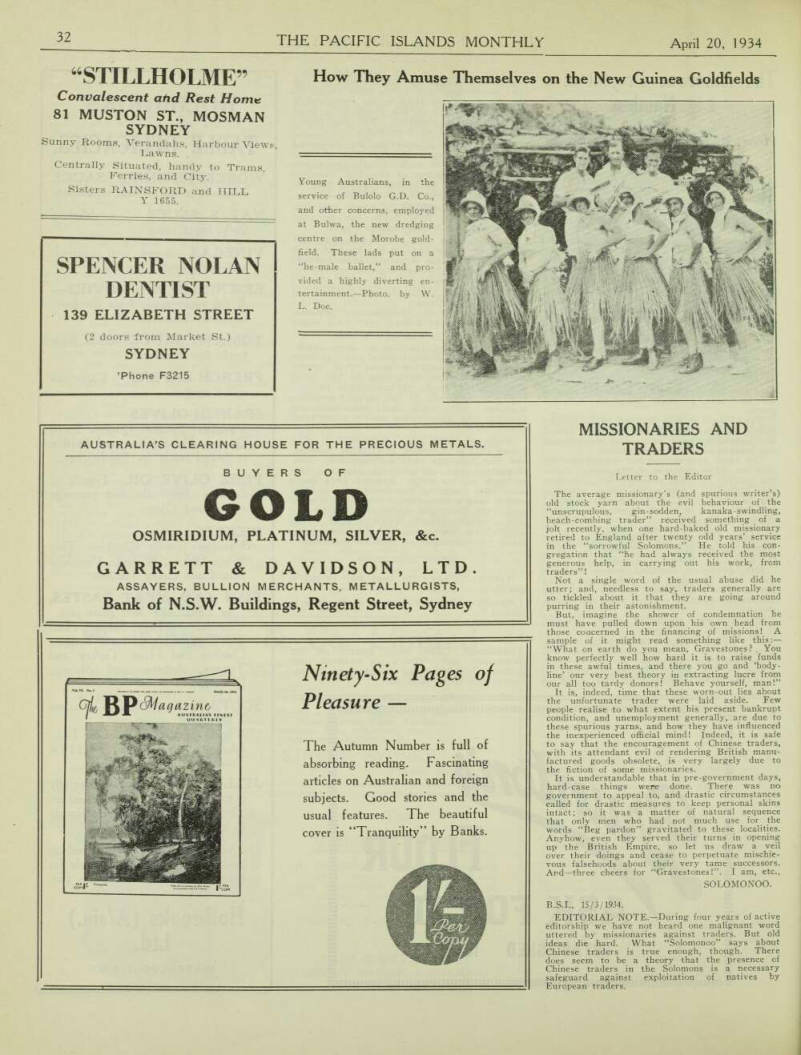
Young Australians, in the service of Bulolo G.D. Co., and other concerns, employed at Bulwa, the new dredging centre on the Morobe gold field. These lads put on a “he-male ballet,” and pro vided a highly diverting en tertainment.—Photo, by W.
L. Doe.
Missionaries And
Traders
Letter to the Editor The average missionary’s (and spurious writer’s) old stock yarn about the evil behaviour of the “unscrupulous, gin-sodden, kanaka-swindling, beach-combing trader” received something of a jolt recently, when one hard-baked old missionary retired to England after twenty odd years’ service in the “sorrowful Solomons.” He told his con gregation that “he had always received the most generous help, in carrying out his work, from traders”!
Not a single word of the usual ahuse did he utter; and, needless to say, traders generally are so tickled about it that they are going around purring in their astonishment.
But, imagine the shower of condemnation he must have pulled down upon his own head from those concerned in the financing of missions! A sample of it might read something like this:— “What on earth do you mean, Gravestones? . You know perfectly well how hard it is to raise funds in these awful times, and there you go and ‘body line’ our very best theory in extracting lucre from our all too tardy donors! Behave yourself, man!”
It is, indeed, time that these worn-out lies about the unfortunate trader were laid aside. Few people realise to what extent his present bankrupt condition, and unemployment generally, are due to these spurious yarns, and how they have influenced the inexperienced official mind! Indeed, it is safe to say that the encouragement of Chinese traders, with its attendant evil of rendering British manu factured goods obsolete, is very largely due to the fiction of some missionaries.
It is understandable that in pre-government days, hard-case things wene done. There was no government to appeal to, and drastic circumstances called for drastic measures to keep personal skins intact; so it was a matter of natural sequence that only men who had not much use for the words “Beg pardon” gravitated to these localities.
Anyhow, even they served their turns in opening up the British Empire, so let us draw a veil over their doings and cease to perpetuate mischie vous falsehoods about their very tame successors.
And—three cheers for “Gravestones!”. I am, etc.,
Solomonoo.
15 /3/1934.
EDITORIAL NOTE.—During four years of active editorship we have not heard one malignant word uttered by missionaries against traders. But old ideas die hard. What “Solomonoo” says about Chinese traders is true enough, though. There does seem to be a theory that the presence of Chinese traders in the Solomons is a necessary safeguard against exploitation of natives by European traders.
Discoveries In Central New
Guinea
Detzner, in 1914-18, Penetrated Region Traversed by Taylor and Leahy in 1933
By Mollie Lett.
When war broke out in 1914, Captain Hermann Detzner was on the mainland of New Guinea. For four years, he hid him self in the interior, and made repeated at tempts to break through into Dutch New Guinea (neutral territory).
He failed; but, in his failures, he trav ersed the great central plateaus and rich valleys of New Guinea, and discovered the remarkable and comparatively cultured peoples of that region. After the war, he wrote a book about his wanderings; but it was not translated into English, and what was known of Captain Detzner’s adven tures was regarded as fantastic.
The same region was penetrated last year by Messrs. Taylor and Leahy, as described in our December issue. Mrs. Lett, in this article, compares the reports by Mr. Taylor and Messrs. Leahy, and it now becomes apparent that this Purari-Ramu-Mt. Hagen region was penetrated and accurately de scribed by the lonely, wandering German officer 20 years ago.
The peculiar features of this people and country, described by Captain Detzner, are in many cases precisely the features which were commented upon and photographed by the Australian expedition last year.
THE remarkable explorations and discov eries made last year in the centre of the main island of New Guinea by Asst.- District-Officer Taylor, of the New Guinea Service, and the well-known Leahy broth ers, when they penetrated the Ramu-Purari region as far as Mt. Hagen, have undoubt edly solved one mystery of the interior.
Their discoveries have proved the “wild uninhabited interior” to be a rich agricul tural district of vast open grass valleys and plains, inhabited by large tribes of superior natives, with a definite culture of their own.
These discoveries are the more interest ing when it is realised that, apart from their interest to the two territories to-day, they clear for ever any doubt there may have been entertained over the explorations and discoveries of Captain Hermann Detz ner, when he wandered for four years, from the outbreak of war until peace was declared, in the wild interior of German New Guinea, in fruitless attempts to pene trate to the neutral territory of Dutch New Guinea, via the waters of the Sepik.
Twice, in his “Vier Yahre unter Kanni balen” (Four Years Among Cannibals), he describes in vivid detail the wide-open thickly-populated valleys and rich agri cultural districts he encountered by the head waters of the Purari, on the slopes of the Bismarck range and south-east and north-east of Mt. Hagen.
He refers to this region on page 55, when writing of his surveys patrol to trace the boundary line between the two territories in 1914. He then took observations from Mt. Joseph, and west of it, near east long itude 145, of the country ahead through which he hoped to penetrate to the Sepik.
He refers to it again on pages 180-1, when describing his desperate attempt to push through, in 1916, from Saruwaged (Sara) in the north-east, when he left his base camp among the Barrum early in June and travelled west, through the up per waters of the Markham and Ramu and across the Bismarck range, and west along its southern slopes towards Mt.
Hagen. Here Captain Detzner again de scribes in detail the rich agricultural dis trict and the superior type of native who lived in large numbers in the wide open valleys between the ranges.
Captain Detzner and his carriers were compelled to turn back on the slopes of Mt. Hagen. This was his farthest point west which he reached in middle Novem ber, 1916, six months after starting his journey. His carriers had reached the end
of their endurance, after the heart-break ing difficulties and privations of their long tramp through unknown country.
In 1916, there had been a drought on the southern mountains and the gardens of the district had suffered, and it was im possible to rely on the inhabitants for food.
Captain Detzner turned back and struck northwards, over the Bismarck ranges, and near the foot of Mt. Hagen, on the north-eastern slopes, he entered a thickly populated district, which had such an abundance of food as he had never seen before in New Guinea. The natives were of the same type that he had met further south. (continued on next page.)
It was too late to alter his plans. His carriers had lost heart, and their one desire was for home. So, after twelve days’ rest, the party commenced their long journey towards Saruwaged, turning south of the Kratke range and across the head waters of the Markham to the base camp at Bur rum, in the north-east.
When he turned back, at Mount Hagen, Captain Detzner made certain observations, and this is my translation of what he wrote: “Mt. Hagen, on whose slopes we stood, lay directly to the north-west of us, and more than 130 miles off lay the Sepik waterways, far beyond our reach.”
Captain Detzner describes his bitter dis appointment at having to turn back, after having penetrated so far inland, well over East Long. 15 into unknown country, never before visited by a white man. He estimated that Dutch New Guinea lay only 350 miles further ahead of him, to the west.
He describes how he hoped that some time later he would be given the satisfac tion of establishing the facts that the Bis marck Range and its continuation, Mt.
Hagen, form a portion—and the middle portion only—of the great main range and watershed which forms the backbone of the whole island; and that the head waters of the Purari flow from the southern slopes of the Bismarck Range and not, as the English maps showed, from a southern range running parallel to the Bismarcks near the boundary line between Papua and German New Guinea.
“I would like to establish the fact,” he continues, “that instead of encountering uninhabitable mountain wildernesses in this region I have discovered a rich agricul tural district of wide open valleys, inhabited by large tribes of a Semitic type, which may be taken to represent the original Papuan stock.”
In 1914, from the summit of Mt. Joseph (near the head waters of the Purari), which he describes as a miniature Mt. Law son, Captain Detzner obtained a clear view of the country ahead of him, to the north and north-west.
“As far as the eye could see,” he writes, “there stretched mountain ranges, inter sected by wide open cultivated valleys, extending far away into the German terri tory.”
The natives whom Captain Detzner met on his journey, eastward of Mt. Joseph, were of a different type to those he met later on, in 1916, further north-west.
The latter astonished him by the order liness and cleanliness of their villages and cultivated gardens, which were planted with taro, sweet potatoes and bananas. He describes them as farms, and their houses
as round, with cone-shaped roofs, built securely and neatly, to withstand time and weather.
Store Houses And Pig Styes.
Store houses and pig styes stood away from the main dwellings, and the walls of the stores were built of wide-meshed ma terial, to ensure ventilation. Their men grew beards, wore grass skirts and shaved their heads completely, save for a small tuft of hair which grew on top. They did not smoke and had not the slightest knowledge of the use of tobacco.
This tribe Detzner then took to be the original Papuans; and he was curious to know where, how and when these stone age savages had acquired their superior culture.
Captain Detzner’s wanderings in the in terior of New Guinea, from the time he received the news of the outbreak of war from Patrol-Officer Chisholm, near Mt.
Joseph, until the end, were a series of abortive efforts to penetrate to neutral ter ritory by land or by sea.
He made his first attempt in 1915, when he climbed the summits of the Saruwaged; and again in 1916 and 1917 he ventured forth, but only to be forced back again to his base camp in the mountains inland from Finschaven.
He describes his wanderings in detail and graphically, especially his ascent over the snowy heights of Saruwaged (4,200 meters), where, at over 14,000 ft., he found Edelweis growing in the ice-bound crevices of the summits, He gives an account of his wild scramble over the Bismarck Range. When on their way up, he and his carriers were forced to accept as their hosts for a night the raid ers of a massacred village. Dismembered corpses and smouldering ruins showed where the raiders had dealt out destruc tion.
He tells of the pitiful plight of his starv ing carriers, later on, as they forced their way forward through a drought-sticken area, in a frantic search for food.
He describes the wonders of the moun tain heights, where forget-me-nots, alpine roses and violets bloom; and the magnifi cence of the scenery over the gorges and valleys and the beauty of the swift flowing streams and cataracts which thundered down from the ranges. Also, he gives par ticulars of the natives and of the flora and fauna, wherever he camped, in his wander ings in the interior.
Although Captain Detzner says that the districts around the Purari headwaters contain a large population, it cannot be gathered from his writings that he would have estimated the population at 200,000 or 300,000, as Asst.-District Officer Taylor and the Leahy brothers did last year.
Seaplane Transport for
Territory Of New
Guinea
Seaplane Transport for the Administration
TENDERS will be received by the Sec retary, Prime Minister’s Department, Canberra, F.C.T., until Wednesday, 6th June, 1934, for the provision of Seaplane Transport for the Administration of the Territory of New Guinea. Tenders must be submitted on the forms provided for the purpose. The forms and full particu lars are obtainable from the Defence De partment Contracts Offices in the capital cities of the several States and the Prime Minister’s Department, Canberra, F.C.T.
Advertisements & other items, pp. 35-36 (2 items)
Fibrolite
BUILD WITH
ASBESTOS CEMENT SHEETS
By using this Economical, Fire Retardant and White Ant Proof building material tor External and Internal Walls and Ceilings, you can build a comfortable and durable Bungalow Home —AT LOW COST.! Supplied in big, sturdy building sheets in 44 handy stock sizes, "FIBROLITE'’ is easily and quickly erected. No waste. Less labour. No painting.
For full information, write for illustrated “Fibrolite” Booklet F.6—FREE AND POST FREE!
JAMES HARDIE & COY. LTD.
ASBESTOS HOUSE. YORK ST.. SYDNEY. N.S.W.
(Box 3935 V., G.P.O., Sydney)
So-called
“simple” remedies
are useless
in Tropic Skin Infection Half measures are valueless when it comes to dealing with Dhobie Itch, Toe Rot, Ringworm of the Nail, etc. Skin specialists regard these diseases as being amongst the most difficult skin complaints to treat successfully; a few years ago they were considered incurable. Recent laboratory tests, however, prove that Antinea Antiseptic Lotion, a combination of powerful germicidal oils, affords a highly successful treatment for Tropic Ringworm in all its forms. It is the one positive treatment; powerful enough to completely destroy the germs, yet harmless to the most tender skin.
Treatment with Antinea is simple. First wash the affected area and dry thoroughly.
Then paint Antinea on the skin, allowing it to dry on. Repeat this treatment every night and morning; within a short time every germ will be destroyed and the skin freed from infection.
An Island resident writes: "I have been suffering from Singapore Foot for the past 10 years. I think I have tried everything under the sun to cure this terrible disease without success until I was advised to try Antinea. I am now completely cured by using less than one bottle, and tender my thanks at being relieved from so distressing a malady.”
Antinea is obtainable at all branches of Burns Philp and Co., Ltd.; Morris Hedstrom and Co., Ltd. (Suva); A. J. Swann and Co., Ltd. (Suva); Brown and Jdske (Suva); Michelmore and Co. (Suva); W. R. Carpenter and Co., Ltd.
ANTINEA
ANTISEPTIC LOTION
COMMONWEALTH & DOMINION AGENCIES
LTD., 168 Day Street, Sydney, N.S.W. 4-94. in
Skin Infection
“Singapore Foot”
completely cured
with ANTINEA
Triple Quantity,
Small Size,
STEEL RAILS & RAILWAY EQUIPMENT
New and Good Second-Hand
RAILS, 14 lbs. to 100 lbs. per yard; also Portable Track, Trucks of all types, Wheels and Axles, Points and Crossings, Turntables, Locomotives, Bolts and Nuts, Dogspikes, etc. We also carry stocks of New and Used Mining and Industrial Machinery of all descriptions.
Send us your enquiries. Prompt attention.
J. E. TOOLE & COMPANY
Engineering Contractors, Machinery Merchants and Agents
70 Hunter Street, SYDNEY
Telegrams and Cables: “Tooles,” Sydney.
15 Hunter Street, Sydney
A CERTAIN
REMEDY FOR PILES
This preparation has been on the market for several months, and it has effected a Cure in every case in which it has been tried. Cases of Long Standing generally Cured within One Month, with one bottle only.
For External Use only Transparent and Stainless. Painless and Odourless. Hygienic and Healing.
NO INCURABLE CASE FOUND YET, Should
there be one, Money will be Refunded in Full.
PRICE: 5/- PER BOTTLE. Posted, securely packed, for 6/6 per bottle. Copies of Testimonials forwarded on request.
ROBERT BRUCE
Room 7, 2nd Floor,
15 Hunter Street, Sydney
A Sanctuary For Primitive Man
Recent Discoveries in Central New Guinea
The following article came as a letter, addressed to the editor of the Pacific Islands Monthly. The writer, Mr. James N. Hall, is a well-known and widely esteemed author, who is now a resident of Tahiti. His plea will tie warmly endorsed by everyone who has made a study of mankind in general, and of primitive races in particular.
MANY Pacific Islanders, beside myself, must have read, with the keenest in terest, the account, in your December issue, of the recent discoveries in Central New Guinea.
What is to be the future of this newly explored territory and of the people who inhabit it? I have a suggestion to make which will appeal neither to missionaries nor to the commercial exploiters; neverthe less, it is one deserving, I believe, the seri ous consideration of those who have the fortunes of New Guinea in their keeping.
The planet, Earth, is now all but com pletely known. Despite the occasional sanguine prophecies of the more romantic astronomers, it is likely to be the only planet mankind shall ever inhabit. There now remains on the surface of this globe a few small areas containing the remnants of primitive races which have not, thus far, been brought into subjection by one or another of the white races. Central New Guinea is one of these areas; and my suggestion is that it may be allowed to remain so.
Your comment upon the recent discov ery has an ominous ring from the the standpoint of those who feel as I do in this matter. You say: “From Australia’s point of-view, the discovery has two important aspects. First, this is a rich country of definite agricultural and pastoral value; second, the people are not primitive sav ages, but appear to be of a type superior to the bush ‘kanakas’ with a definite cul ture of their own.”
It is the first of these observations that has the ominous ring, for you appear to be thinking of the country and its people in terms of possible exploitation at the hands of white colonists.
What you might have said—what, in my opinion, you should have said—is some thing to the following effect: “From the point-of-view of mankind at large, this discovery is of the highest im portance. There has been found a primitive race, or, more likely, a mixture of races living in complete isolation from the rest of mankind.
What shall be done with these people whose numbers have been estimated at between two and three hundred thousand?
Shall we Christianize them, ‘civilize’ them, exploit and hybridize them as the white races have invariably done with such folk in similar situations all over the Pacific?
Or shall we, for once in the history of white overlordship, think first of the inter ests of the people themselves and spare them from any widespread contact with us?
“The results in the former case can be foretold with certainty. The results in the latter case might be, and, probably, wouild be, of the highest value. Civilized man has much to learn from primitive man, and opportunities for studying him in a pure state have all but disappeared.
“Let entrance into this newly-explored country be forever barred to all save a
small group of carefully-selected men— anthropologists, ethnologists, and the like — who shall be permitted to live among its people for the purpose of studying their language, customs, religious and social or ganization.
“We have sanctuaries for plant-life, bird life, animal-life; but never, thus far, has any nation been disinterested and far sighted enough to set aside a sanctuary for primitive man. It is to be hoped that the opportunity in Central New Guinea may not be lost.”
Were you to write or speak to this effect, the shout of approval that would arise from every part of the civilized world would more than drown the vehement and scan dalised protests of the missionaries, and those, yet more vehement, of the commer cial exploiters.
Advertisements & other items, p. 37 (1 item)
Arnotts
Sutton’s
Canned Vegetables
GREEN PEAS
in ½lb., 1lb. and 2lb. tins.
FRENCH BEANS
(sliced), in and 1 lb. tins.
Delicia Food Products
Co.
DANK STREET, WATERLOO,
N.S.W.
IDEAL for SAVOURIES
Made to break into three fingers of ideal size and shape, the perfect base for savoury items. They are new— different—delightful. Be wise, have a tin in the pantry.
ARNOTTS
FAMOUS
POPSO
CRAC KER
BISCUITS
A Fiji-Born Indian Defends
His People
Letter to the Editor
I HAVE just read the article of “John Bull” about Fiji Indians in your Feb ruary issue, and thought I should say something in defence.
You are quite right in saying that he is a little extreme in his views, and disre spectful of authority. But you also say that he knows Fiji intimately. Anybody who has read his article can easily tell why he wrote it. I think I am telling you the truth when I say that he hates and envies the Indians domiciled here.
That is the reason why he wrote such a rubbishy article.
He condemns the Governor and the British Government and says that the Fijians have been betrayed. This state ment is not true. When the Fijian people do not say out themselves that they have been betrayed, I wonder how did he ascer tain that. If you ask the Fijian how he js getting on, he will immediately reply and say that he is fine. The Fijians are the happiest people here. Everybody says that.
“John Bull” seems to know more about Fiji’s affairs than the Governor and the Legislative Council. Perhaps Fiji and the Fijians could live like kings under his guidance. When he takes charge of Fiji the first thing he will think of will be to clear the Indian coolies (as he calls us) out of this colony. Then, only, I suppose, he will be content with himself. Well, Mr. John Bull, why not ask the Colonial Office to elect you as the Governor of Fiji!
He says that the “Indians in Fiji are a problem and a curse, Australia and New Zealand are wise in preventing them from coming in. They breed like rabbits, and Fiji in a few years cannot and will not be able to support them. India does not want them. Where will they go?”
I never heard such nonsense before in all my life. We Fijian-born Indians can go to almost any part of the world and nobody can stop us. We are not coolies —we are free men born in Fiji. Even the people who originally came here as coolies are not called such.
We are just as good as anybody, and “John Bull” should know that by this time. India is our Motherland, and “John
Bull” is a damnable liar in saying that she (India) doesn’t want us back, Thousands of Indians have gone back to India. I myself have been to India, Cey lon, Australia, and New Zealand. Hundreds of Indians are going to India every year, Do you not know this?
Your correspondent thinks Fiji will not be able to support us in a few years’ time, since we “breed like rabbits.” Mr. John Bull, you will be just as good as Miss Katherine Mayo (the author of “Mother India”) if you carry on and write a book about all the worst things you can find out about the Indians. In fairness to yourself, I recommend you to read only “Unhappy India” (leave the other books aside) written by an Indian, and you will soon find out all about the white people, too. After reading this book I don’t think you will ever want to say anything wicked about the Indians again. See about your self first, in thought, words, and deeds, before you condemn another nation or race.
Mr. Editor, I wish you could make a trip to Fiji and go into the various prob lems affecting the people here. I think you should not publish such articles as “John Bull’s” as that article is too extreme and throws a wrong impression upon your readers of the “Pacific Islands Monthly.”
We are human beings, too, and made by the same God that made you. And what is more, our ancestors belonged to the same Aryan race as yourselves. Knowing all this, I can’t understand why we are still molested in a most unpleasant man ner. It is no use trying to tell somebody a story from the middle of a book. You will have to read from the beginning before you can understand the whole story, I hope that you will publish only articles that are good, and which would be appre ciated by all races alike, since this paper is read by all.
I am, etc.,
A Fiji-Born Indian.
Suva, Fiji, 17/3/’34.
EDITORIAL NOTE.—Another vigorously-written letter on the same subject, by J. A. Kirpal, of Suva, is held over, for publication in next issue, owing to lack of space.
Recipes For Islands
Bachelors
A LADY resident of Ocean Island, in response to the Cook Islands bach elor’s appeal for recipes, sends the fol lowing:— 1 large tin sardines. ½ pint of good white sauce (must be made with unsweetened tinned milk). 2 tablespoonfuls of Kraft’s grated cheese. ¼ teaspoonful of red cayenne pepper.
Salt to taste.
Mash sardines up well and add to the pint of white sauce, which must be kept hot.
Add grated cheese, red pepper and salt.
Stir all well together and place 1 tablespoonful of this mixture on each piece of hot buttered toast or fried bread.
Sprinkle the top with more cheese and a little chopped up parsley and serve hot. 1 tin of Norwegian Fish Balls, salt, half a lime, pepper.
Make a rich white sauce with unsweetened tinned milk.
Flavour with salt, pepper, juice of half a lime.
Add to this three hard-boiled eggs cut into slices, then add the fish balls (which have been well drained).
Stir all together, taking care not to break up the fish.
Heat up again and serve hot with sprigs of parsley. —From “Tabiang,” Ocean Island, Central Pacific.
Advertisements & other items, p. 38 (2 items)
Johnson
Outboard
Motors...
THE Johnson Outboard Motor can be attached to or detached from any boat in a few minutes. Each motor is sturdy, dependable and economical to operate. There is no need to fear underwater obstruction, the whole motor tilts up automatically should any underwater parts strike the bottom or an obstruction, making navigation in shallow, out of the way, spots practical and easy. Also, the motor may be manually tilted, raising the propeller above the bottom of the boat so that the craft can be run up on the beach without difficulty or damage. Nock & Kirby’s always carry a complete stock of spare parts.
Write or call for a FREE copy of our illustrated catalogue of Johnson Motors.
MODEL 0.8.65, 2½ H.P.
Sydney Price ... £37/10/- Ex Bond £21
MODEL A. 65, 4 H.P.
Sydney Price .. £62/10/- Ex Bond £39
MODEL K. 65, 8/9 H.P.
Sydney Price £75 Ex Bond £45
Nock & Kirby Ltd.
Postal Address:
BOX 68CC, G.P.O., SYDNEY
Capstan
CIGARETTES
CORK-TIPPED
OR PLAIN
CAPSTAN
NAVY CUT TOBACCO
Bullion Production Of Papua And
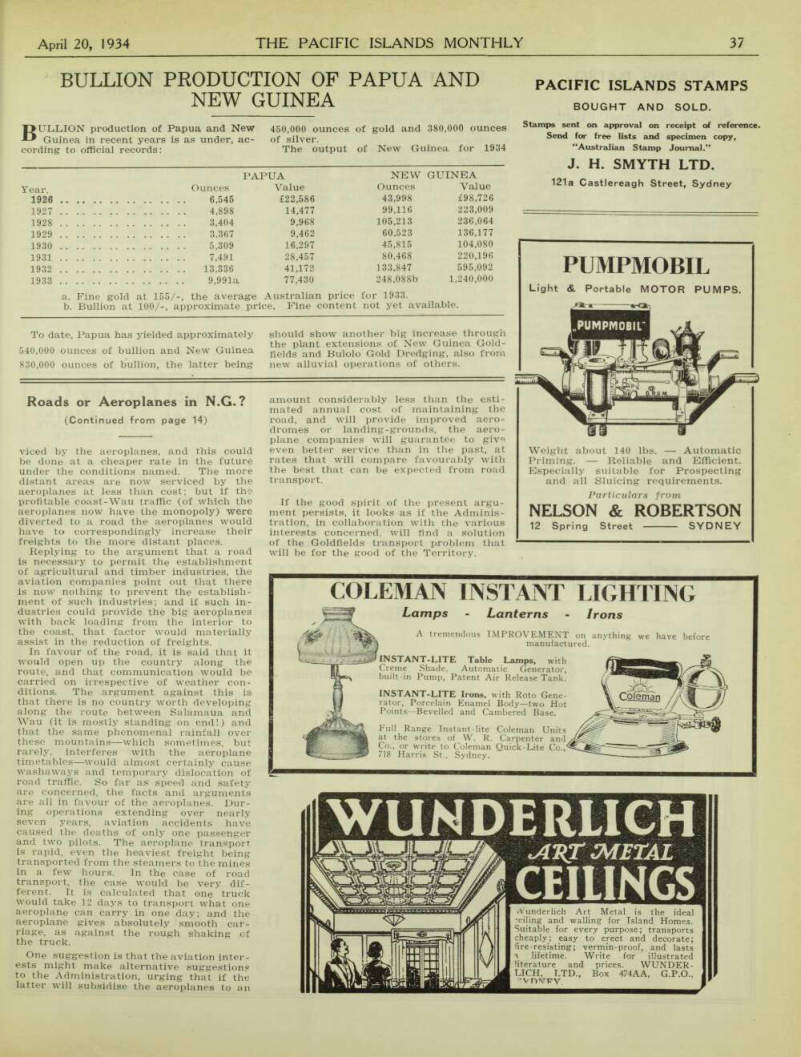
New Guinea
BULLION production of Papua and New Guinea in recent years is as under, ac cording to official records:
450,000 ounces of gold and 380,000 ounces of silver.
The output of New Guinea for 1934
To date, Papua has yielded approximately 540,000 ounces of bullion and New Guinea 830,000 ounces of bullion, the latter being
should show another big increase through the plant extensions of New Guinea Gold fields and Bulolo Go id Dredging, also from new alluvial operations of others.
Papua
New Guinea
Year.
Ounces Value Ounces Value 1926 6,545 £22,586 43,998 £98,726 1927 4,898 14,477 99,116 223,009 1928 3,404 9,968 105,213 236,064 1929 3,367 9,462 60,523 136,177 1930 5,309 16,297 45,815 104,080 1931 7,491 28,457 80,468 220,196 1932 13,336 41,172 133,847 595,092 1933 9,991a 77,430 248,088b 1,240,000 a. Fine gold at 155/-, the average Australian price for 1933. b. Bullion at 100/-, approximate price. Fine content not yet available.
Advertisements & other items, p. 39 (2 items)
37
April 20, 1934
THE PACIFIC ISLANDS MONTHLY
Roads or Aeroplanes in N.G. ? (Continued from page 14)
Pumpmobil
PACIFIC ISLANDS STAMPS
BOUGHT AND SOLD.
Stamps sent on approval on receipt of reference.
Send for free lists and specimen copy, “Australian Stamp Journal.’'
J. H. SMYTH LTD.
121 a Castlereagh Street, Sydney
PUMPMOBIL
Light & Portable MOTOR PUMPS.
Weight about 140 lbs. Automatic Priming. Reliable and Efficient.
Especially suitable for Prospecting and all Sluicing requirements.
Particulars from
NELSON & ROBERTSON
12 Spring Street SYDNEY
COLEMAN INSTANT LIGHTING
Lamps
Lanterns
Irons
A tremendous IMPROVEMENT on anything we have before manufactured.
INSTANT-LITE Table Lamps, with Creme Shade, Automatic Generator, built-in Pump, Patent Air Release Tank.
INSTANT-LITE Irons, with Roto Generator, Porcelain Enamel Body—two Hot Points—Bevelled and Cambered Base.
Full Range Instant-lite Coleman Units at the stores of W. R. Carpenter and Co., or write to Coleman Quick-Lite Co., 718 Harris St., Sydney.
Wunderlich Art Metal is the ideal veiling and walling for Island Homes.
Suitable for every purpose; transports cheaply; easy to erect and decorate; fire-resisting; vermin-proof, and lasts a lifetime. Write for illustrated literature and prices. WUNDER-
LICH, LTD., Box 474 AA, G.P.O.,
Islands Radio
Special Broadcast From Townsville
THE need for making wireless broad casting benefits available to residents of the Pacific territories was brought be fore the meeting of Pacific Administra tors in Canberra in March by the Minis ter-in-Charge of Island Territories.
Major Marr said that he regarded the matter as of first class importance. The possibility of utilising the Townsville broadcasting station as a means of dis tributing entertainment and news to Pa cific Islands residents was being explored by the Australian postal department. The department was examining not only the cost of increasing the transmitting power of the station and the value of the programme but also was enquiring into the whole question of reception in the Islands. It was hoped to evolve a prac ticable scheme.
This announcement will be welcomed by residents throughout the south and central Pacific. A large proportion of Pacific Islands residents already have purchased expensive receiving sets with a view of keeping in touch with Austra lia and New Zealand, but during a con siderable portion of the year their pur pose is defeated by exceptional static. It is believed that Townsville is so situated that it will give practically continuous service to Papua, New Guinea, Solomon Islands, New Hebrides, and New Cale donia; and if general conditions are satis factory it is likely that Fiji, Tonga and Samoa will also participate.
Beer—No Chemicals
One of the most interesting displays made at the Royal Easter Show in Syd ney was that in which Messrs. Tooth and Co., Ltd., demonstrated the process of brewing beer.
The whole operation was carried out in enormous glass vessels, and the interested observer was able to follow the series of interesting processes, from the as sembling of the material to the ferment ing, skimming, filtering, and storage of the liquor.
One of the strongest arguments against the drinking of modern beer is that quan tities of chemicals are used. This is a matter of importance to Islands residents who consume light beer and who, also, are obliged to consider their health. Those who inspected the exhibit under notice were given a definite assurance that only pure water, refined sugar, malt and hops were used in the production of Tooth’s beers.
Mt. Sisa Reconstruction
Mount Sisa Gold Fields (Papua), N.L., proposes to form a new company to acquire all the assets except 18,143 fully paid shares in Gold Mines of Papua Ltd., and to wind up the old company voluntarily. The new company will have a capital of £18,750, in 150,000 shares of 2/6 each, of which the present company will receive 54,430 fully paid shares, organisers and brokers will receive 15,570 fully paid shares, and 80,000 shares will be con tributing. Shareholders will have the right to underwrite a minimum parcel of 500 shares, for which they will receive per cent, in fully paid shares, together with a cash brokerage of 1d per share. After the registration of the new company the fully paid shares held in Gold Mines of Papua Ltd. will be distributed to the present shareholders in a proportion of one share for every 15 Mount Sisa shares held. Shareholders will also receive one fully paid share in the new company for every five shares held. —S.M. Herald.
Duction
Bulolo Dredge Pro
Production of the Nos. 1, 2 and 3 dredges of the Bulolo Gold Dredging Ltd., for February com pares with that of the previous periods as follows:
Period ended Dec. 31.
Jan. 31. **Feb. 28.
Nos. 1 and 2 dredges— Cubic yards .. 410,800 380,000 635,500 Bullion, oz. .. 10,076 10,304 8,636 Gold, fine oz. 6,680 6,832 5,814
Value—
Aust. currency *£50,100 t£ 58,072 f £49,419 Per cubic yard /29.27 / 36.67 /18.66 Working profit £A37,620 £A45,458 £A34,059 No. 3 dredge— Cubic yards .. 141,000 251,200 — Gold, fine oz. 405 1,621 — * At A £7/10/ per fine oz. tAt £A8/10/ per fine ounce. ** Nos. 1, 2, and, 3 dredges.
The yardage included 74,000 yards of the tailings of No. 1 dredge, which were dug in order to test their value. Dredges Nos. 1 and 2 were temporarily turned into lower valued ground on the eastern margin of the pay, and so away from the deeper gravels, the drilling of which is continuing with satisfactory results.
Construction on No. 4 dredge and the new 4000 horse-power hydro-electric plant is proceeding satisfactorily. The former will probably be in operation during July, and the latter should be completed about November.
Advertisements & other items, p. 40 (1 item)
City Convenience For Island Homes
Rabaul Carrying Co.
GENERAL FORWARDING
AGENTS CUSTOMS AGENTS,
INSURANCE STORAGE.
Transport Work and Forwarding Work of Every Description Undertaken.
Modern Transport Equipment.
Telephones: Radio Address: Rabaul 176 and 135. “Rabcarco.”
E. M. GRANTER, Manager.
CITY CONVENIENCE for ISLAND HOMES
Here’s Automatic Refrigeration
for every Homestead with an “OMNISTAT”-controlled cheap running Petrol Engine, The convenience, comfort and economy of automatic electric refrigeration can be yours even if you have no electric current supply, or have a lighting plant already fully loaded. For the past two summers OMNISTAT - controlled refrigerating plants, driven by water-cooled petrol engines, have been giving trouble-free service in N.S.W. and Queensland. The engine is started automatically whenever the temperature in the cool-room rises above a predetermined safepoint, and is stopped again when the temperature has been sufficiently reduced.
Write to-day for full particulars and prices, free of Australian Customs Duty.
DANGAR, GEDYE & CO.
LTD.
10-14 YOUNG STREET. SYDNEY.
Piracy Added To
Poaching
Report From New Guinea
From Our Own Correspondent.
Rabaul, Apl. 3.
Another report of Japanese poaching has been received from the Western Is lands.
Mr. S. C. Thompson, of Awinn, again sends word that recently a Japanese sampan anchored off his island, and the captain came ashore, while his crew busied themselves in denuding the reef of trochus-shell.
It is reported that the captain, while ashore, abused Mr. Thompson. In the vicinity of his house, the captain noticed some unbagged trochus; this he ordered his crew to bag up and place on board, which was done.
One of the chief complaints raised by the planters, who are subjected to this treatment from the Japanese, is that the poachers are cleaning the reefs of the small trochus, which it is illegal for planters to take.
New Guinea Goldfields
The monthly returns of production and estimated profits of New Guinea Goldfields, Ltd., are as follows:
Bullion, oz. — Dec.
Alluvial 2,412 Mill 1,900 Estimated profit- Alluvial £4,816 Mill 10,563 Fine gold.
Development—Location 3. West drive on No. 3 level reached fault zone at 368ft. Average value of ore in drift for 365ft. from No. 1 shaft 13.25dwt. gold and 15oz. silver over width of 28in.
Jan. Feb. 1,644 .. 2,005 1,941 .. *1,796 .. £7,200 ., £4,400 11,500 .. 11,850
An Islands Baptism
On Wednesday, April 4, the infant daughter of Mr. and Mrs. F. R. Isom, of the Melanesian Mis sion Press, B.S.I., was baptised at St. James’
Church, Sydney, by the Lord Bishop of Melanesia, who also acted as godfather. Miss I. C. Wench, of the Melanesian Mission, was one of the god mothers by proxy, and the other was Miss Kath leen Metcalfe, well known in Mission circles as the daughter of the late Dr. P. H. Metcalfe, for many years the beloved physician to the Mission at Norfolk Island. Many friends of the parents were present, including members of the A.B.M. staff and the Women’s Auxiliary.
After the ceremony the company adjourned to the Blue Tea Rooms in Rowe Street for a tea party kindly organised by Miss Wilmer Stephen and Miss Avory. The beautiful christening cake was inscribed “Margaret Mary, April 4, 1934,” and was given by the Women’s Auxiliary of the A.B.M.
The chairman of A.B.M. genially presided over the company, and expressed on behalf of those present every possible good wish to the baby and her parents, who were returning to the islands on April 7. Mrs. Isom briefly thanked the com pany for their great kindness.
Australian-Grown Rice
For the eight months ended 28th Feb ruary, 1934, the value of rice exported from Australia amounted to £77,828, as against £30,776 for the same period in the previous year.
Germany's Colonies
Radio messages report that the Berlin newspaper Deutsche Allgemeine Zeitung has published a leading article on the Daily Mail article by Lord Rothermere (principal shareholder of the paper) arguing for the return of Germany’s colo nies. It says that Britain would lose no thing by returning the colonies to Ger many, which is suffering for lack of raw material and want of room.
The chief Nazi newspaper prints three columns of the Rothermere article, with the headline, “Rothermere demands re turn of colonies to Germany.”
Advertisements & other items, p. 41 (1 item)
John Brush
JOURNALISM AND SHORT STORY WRITING
Pleasure and Profit Combined. Certain Money Makers.
LET US HELP YOU.
Prepare Attractive Manuscripts. £43 Paid for One Short Story. Inquiries Welcomed.
Metropolitan School of Journalism
(Special Department, Metropolitan Business College Ltd.) CHIEF-OF-STAFF: D. J. SHEARMAN, B.A., B.Sc., Dip.Ed (Syd. Uni.) “Wentworth Building” 6 Dailey Street SYDNEY
JOHN BRUSH
Specialists in Harness,
Saddlery,
Leather Coats & Riding Wear
The “Homestead”
Saddle
“THE OVERLAND”
Made to prevent the horse from rubbing Bridle off. ¾in 13/6 15/6 7/8in. 1in. 15/- 17/6 18/- 21/is built on a Galvanised Steel-plated Tree, and has forged Steel Stirrup Bars and Copper-plated Tacks, which will stand tropical conditions. The Seat is of oiled Kip Leather and Flaps of Bullock Hide. Super Quality. Fitted as illustrated £7/10/-.
371 George St,, Sydney .N.S.W.
432 QUEEN St.. BRISBANE, Queensland
The “Bonser”
Stock Whip
20/-, posted free.
Write for Our 56 Page
Catalogue.
The Super
"STATION
POLEY”
Built on similar lines to the Homestead. Is a Saddle also recommended by us for Island use. Black wax sewn with best fittings as illustrated. £7/10/-,
Riding Bridles
“THE STOCKMAN”
A Popular Bridle. ¾in 10/6 12/6 7/8in 12/6 14/6 1in 14/6 16/6
Appeal
O. F. Nelson To
His Treatment in N.Z. Arouses Protest
IT was briefly reported in our March issue that the High Court of Western Samoa on March 1 convicted Mr. O. F.
Nelson of three charges of sedition, and had sentenced him to eight months’ im prisonment and to exile from Samoa for ten years.
Mr. Nelson immediately lodged an ap peal against his conviction and sentence, and demanded that, pending the hearing of this appeal (which is to the Supreme Court in New Zealand) he should be al lowed his liberty on bail.
Mr. Nelson was not released, however.
The appeal apparently was referred to New Zealand, and the judge in Samoa refused to order a stay of execution of sentence. The Prime Minister of N.Z.
was asked to grant certain privileges to Mr. Nelson, but he refused to interfere with the authorities in Samoa.
Mr. Nelson thereupon was placed aboard the Maui Pomare in custody, at Apia, on March 9, and was sent to Wellington. He duly arrived at Lyttelton; and the next development is shown in the following paragraph, which appeared in the “Syd ney Morning Herald’’ on March 20.
“A vehement protest against his con veyance to prison in a ‘Black Maria’ was made by O. F. Nelson on his arrival at Lyttelton from Samoa, where he was re cently sentenced to eight months’ im prisonment on sedition charges. Nelson was being taken to Paparua prison, pend ing the hearing of his appeal. He de manded a taxi, and hailed one, but the police bundled him into the prison van, ignoring his protests.’’
This savage treatment of a man found guilty, not of a criminal offence, but of a serious political misdemeanour, caused a sharp reaction in New Zealand, where opinion, until then, had been generally in favour of the Government. From com ment in New Zealand newspapers and from letters which have been sent to this journal, we gather that many people held that Mr. Nelson was being treated with a degree of brutality which was justified neither by his condition, nor the circum stances of his conviction of sedition. The general argument was that, pending the hearing of his appeal, Mr. Nelson might at least have been spared the humiliation of incarceration in a common criminal prison.
We can add only that the stupid atti tude of the New Zealand Government in this matter is consistent with its unen viable and deplorable record in connec tion with the administration of Western Samoa. These people, it seems, can see no difference between a conviction for petty crime, and the conviction of a man for fighting for what he believes are his national rights. In the Dark Ages the two were on common ground. These are not the Dark Ages. Sedition, rightly, is a punishable offence. But a man who fights for what he believes are his na tional rights—even to the extent of plot ting against constituted authority—and loses, is not bankrupt of personal honour; and certainly is not a man to be thrown among criminals. We are not protesting against the sentence of imprisonment, which, in any event, is the subject of an appeal, and sub judice. But we do pro test most strongly against the practice of treating as a common criminal a man convicted of a political offence.
The Supreme Court of N.Z., on March 27, made an order for the release of Mr.
Nelson on bail, pending his appeal against convictions recorded in Samoa. The court also granted a stay of execution of the sentence of eight months’ imprisonment.
Nelson must comply with certain condi tions laid down by the Court. The hear ing of the appeal was fixed for April 19.
Position Sought
YOUNG MAN, married, with family, seeks position as working caretaker, or anything; carpenter, own tools; simple blacksmithing; knowledge book-keeping.
No objection to separation, isolation, or remoteness. Islands preferred.—R.
HONEY, Boundary St., Narrabri West,
N.S.W.
Blow At Copra
New American Tax
IN order to assist the lard and cotton-oil industries, the United States Govern ment proposes to tax coconut oil and sesame oil by £20 per ton. The tax is through the House of Representatives, but is being fought in the Senate.
If the tax operates, it will keep copra out of U.S.A., and between 400,000 and 500,000 tons of Philippines copra, which customarily goes annually to America, will be thrown upon the European mar ket.
EDITORIAL NOTE: The above was the posi tion, as reported from London on February 22.
On April 16, we telephoned the United States Consulate in Sydney and asked for later develop ments: but neither the Consulate nor the prin cipal Sydney firms handling copra knew what had been done with the proposed tax.
Advertisements & other items, p. 42 (2 items)
Modern Direct Wireless Services,
Use—
for Your Communications With Australia and Overseas.
DIRECT WIRELESS SERVICES are available for inter-communication between the Islands of the Pacific and for traffic between the Islands and Australia and overseas countries.
Services are now in operation between Papua and Sydney, New Guinea and Sydney, New Caledonia and Sydney, and Fiji and Sydney. Speedy, economical and efficient service to Australia and overseas. Route your traffic “Via the Wireless Service.”
For overseas traffic to Great Britain, North and South America, and all European countries, route your message via the Direct Australian
BEAM WIRELESS SERVICE
LODGE YOUR MESSAGES AT ANY
WIRELESS STATION OR ISLAND POST
OFFICE ROUTED “VIA WIRELESS.”
AMALGAMATED WIRELESS (A SIA) LIMITED
The Robert Bruce.
CERTAIN PILE REMEDY.
Has been tested and proved completely successful in scores of long-standing cases.
THE LABORATORY,
20 and 22 Napoleon Street, Sydney, March 14th, 1933
ROBERT BRUCE, Esq.
Dear Sir,—The formula of your pile cure submitted to me could have no effect other than beneficial. I gave your sample to a Client who had suffered many years, and before he had used half the bottle he reported himself completely cured.
Faithfully yours,
GROVE JOHNSON, F.C.S. (Lond.),
Analytical and Consulting Chemist.
Obtainable from the following Chemists:—W. G.
Cains, Ltd., 51 Pitt St., Sydney; McCredie’s Drug Stores, 3828 Pitt St., Sydney; M. N. Tomlin, 148 Blue’s Point Rd., Sydney; M. McCallum, 101 George St. West, Sydney; A. E. Sharpe, 197 Oxford St., Sydney; Redmond-Fuss, 665 George St., Sydney; Ward Smith, 62 Miller St., North Sydney; H. J. Parker, 94 William St., Sydney.
Notes From New Guinea
From Our Own Correspondent
RABAUL, April 2.
The Durour was successfully slipped at Carpenter’s Slipway recently, which proves that the construction is capable of carrying any average-sized vessel ply ing in these waters. The Durour’s gross tonnage is 817 and net 461 tons, while its length is 817 ft., with 36 ft. beam.
The latest tobacco tender accepted by the Administration, c.i.f. Rabaul, was from an American firm, and the rate was 40 1/8 cents per lb.
The total rainfall for February was 3.9 sin.—the second lowest on record. The lowest was 3.38 in. in February, 1921.
This dry season has brought with it a great deal of sickness.
Rabaul was shocked recently when Mr.
William Baker, a well-known planter of the Witu group, died from septicaemia.
Mr. Baker arrived in town only a few days before his death, and, while on his schooner, his arm was scratched.
This rapidly developed into blood-poison ing, and he passed away in the evening of March 5. He was buried in the Botanic Gardens, where Rev. H. Thompson read the service. He leaves a widow, to whom everyone extends sincere sympa thy. Mr. Baker was a member for sev eral years of the Papuan Public Service, and arrived here to take up Langu Plan tation in 1926.
Bullion exported from this Territory in January was 25,182 ounces, valued at ap proximately £ 129,788 (Australian currency).
There was a jolly cocktail party at the home of Mrs. Philip Coote, the wife of our local B.P. manager, on March 13, in honour of Mr. F. E. Furley, one of the Head Office officials, who has been visit ing New Guinea and Papua recently. Mr.
Furley returned to Sydney by the m.v.
Malaita.
Rev. J. F. Goldie, Chairman of the Methodist Mission Society in the British Solomons, arrived on the m.v. Malaita on March 16. Mr. Goldie praised Rabaul’s live Planters’ Association, which, he stated, was badly needed in the Solomon group, where there are many matters which require attention of such a body.
There was a luncheon party on the m.v.
Malaita on March 17 to mark the vessel’s first call at Rabaul on its present schedule. His Honour Mr. Justice Wan liss, Acting Administrator, was present, with a number of members of the Legis lative Council, and business and profes sional men.
Mr. B. B. Perriman, M.L.C., had a nar row escape when returning from town to his Toma residence. Near Ravuvu, his car struck a wandering pig on the main Kokopo Road; the impact damaged the steering apparatus, with the result that the car swerved off the road, and struck a coconut palm with such force that the car was telescoped. Save for scalp and facial lacerations, Mr. Perriman escaped uninjured. A native servant, who was also riding in the car, received a frac tured thigh. This accident has brought up the question of preventing pigs wan dering at random along the well-fre quented motor-roads of the Territory.
An “Aufwiedersehn” Dinner.
On March 12 a dinner was held at The Palms Restaurant, when a number of the friends of Mr. and Mrs. Mainka fore gathered to say “Aufwiedersehn,” prior to their departure for a lengthy holiday in Europe.
The majority of the 22 guests were old residents of the Territory. Many nice things were said of the departing couple, and their health was drunk many times.
Among those present were; Mr. and Mrs.
H. L. Clark, Mr. and Mrs. B. B. Perri man, Mr. and Mrs. E. P. Holmes, Mr. and Mrs. G. H. Murray, Mr. and Mrs. Rund nagel, Mr. and Mrs. Furter, Mr. and Mrs.
Gordon Thomas, Mr. and Mrs. Ahearn, Messrs. Wolff (who has been for over 42 years in the Territory), Kirchner, Uechtritz, and Paatzsch.
N.G. Goldfield Notes
Mr. Dave Lyall, Jnr., one of the early Edie Creek pioneers and certainly the youngest, is at present holidaying in Sydney. “Young Dave,’’ as he is popularly known to folk on “the fields,” walked in from Salamaua to the Creek when only 15 years of age.
Mr. J. Parer’s hotel, being built at Wau, is to be called “The Ritz.” Mr. Parer holds the record for the highest break at billiards in the Morobe district, so that there may be a few billiard tables shipped from the south to add to the big aerial transport cargoes of the future.
Miss “Jo.” Parer has left Wau and gone out to the “Black Cat” goldmine to stay with her brother, Bob, and his wife. Miss Parer was in New Guinea about six months, and has evidently succumbed to the lure of the tropics and the “gold veins.”
Mr. Jim Whittaker, of Bulolo, having just re covered from an illness, had the bad luck to get in the way of a falling plank on No. 4 Dredge. At present he is in bed with a broken leg.
Mr. de Latore, manager of New Guinea Goldfields, Edie Creek, returned to the Creek by the last “Macdhui.”
Mr. Shepherd, of Melbourne, has joined Mr.
Mick Leahy’s party on its way to Mt. Hagen. Mr.
Shepherd has been in many countries and this is his second trip to New Guinea. Exactly twelve months ago he made his first trip to New Guinea on behalf of the Parer brothers, who have a claim on the Watut.
Mrs. W. Dupain, of Port Moresby, who has been in Sydney for some time, has left her flat and taken a house at Hopetoun Avenue, Vaucluse, in preparation for her husband’s holiday. Mr. Dupain arrived in Sydney by the “Montoro.”
Mrs. Robert Dugan, who went south on last Macdhui, was very relieved to know that her husband was not murdered, when Captain Bernard McGrath lost his life. The uncertainty and sus pense were so nerve-wracking that Mrs. Dugan has been ordered a complete rest.
Miss Dot Blackley has returned to Rabaul after six months holiday south. She is the lady golf champion of Rabaul.
Another race meeting at Wau at Easter time provided festivities similar to those of Xmas and New Year. This second meeting of the Morobe Turf Club was a two-day affair with the committee’s slogan, “bigger, brighter, and better,” explaining in a nutshell that Wau would certainly go gay again. Mrs. Jim Stewart, popular proprie tress of the Bulolo Hotel, Wau, on behalf of the ladies of the district, challenged the Edie Creek cricket team to a match, with one stipulation— that body-line was barred. On the goldfields, both men and women work strenuously, but when play time comes along, just when it is needed, there is always plenty of amusement.
About nine months ago, visitors to Bulwa, the baby Bulolo, could see another of the company’s huge dredges being built. These visitors would be very surprised to learn that this dredge (No. 3) is now well on its way up to Bulolo, scooping up the gold-wash in bucket loads; and in its place yet another dredge (No. 4) is now under con struction. It all sounds like a dream of Midas.
Talkies in the wilds of New Guinea! Ultra modern progress! Bulolo Gold Dredging Co. are making negotiations to instal a talkie apparatus at Bulolo, the programme to be changed every week.
•S.L.
Advertisements & other items, p. 43 (1 item)
Emulsion
To win
your
fight
for health
Don’t wait until you feel ill, act before infection grips you. SCOTT’S Emulsion, the richest in anti-infective vitamins, maintains strength, protects the lungs and safeguards health. It nourishes, fortifies and sustains.
Scott’s
Emulsion
ENGINEERING & MINERS’ SUPPLIES
Engineers, Miners, Planters, etc. Get in touch with us for any of the following lines:— Brand Shovels — the best shovel made; Picks, Mattocks, Handles, Centrifugal Pumps, Petrol Engines, and Engines converted for Charcoal Gas. Belting and Pulleys, etc. Pipes and Valves; Truck Wheels and Trucks; Copra Flues and Screens; Oils for all purposes; Files and all Sundries. Write for Particulars and Prices.
A. B. SMITH & GLUYAS
61-65 Macarthur St., Ultimo, Sydney, N.S.W.
Buried Treasure
Reported Discovery in French Oceania
ON April 12, a press message went out from Tahiti to the Associated Press of America, reporting that an expedition had discovered £10,000,000 worth of pirate gold, buried under 18 feet of sand on one of the islands of the Tuamotu Archipel ago (east of Tahiti); that the French Gov ernment had placed a guard at the spot; and that the finders are now organising an engineering expedition to lift to the surface 25 tons of wedge-shaped gold ingots.
The announcement created a great stir in newspapers throughout the world.
Later information discounted the story that the actual treasure had been found; but some ground was given to the belief that an expedition had located an island in the Tuamotus which may be the place where was buried, over 100 years ago, the treasure removed from Lima, Peru, by the Roman Catholic Church when Peru re volted against Spain. The story goes that the treasure was taken away on a ship; that the crew seized the ship and treasure; that the ship was wrecked on one of the Tuamotus; and that the crew buried the treasure there. A dying sailor is supposed to have given someone a map, showing its location. A dozen expeditions have sought for it, in vain.
In this journal, in March, we published our Tahiti correspondent’s account of the arrival there of the latest expedition.
That party sailed from Tahiti on Feb ruary 22, and returned 25 days later, in the circumstances described below.
On April 13, the “Sydney Sun” inter viewed in Sydney a Mr, Sampson, appar ently a member of the expedition, who had just returned from Tahiti, and who was very reticent. He said, however, that he thought the expedition had located the treasure island, and he had come to Syd ney to buy sand-shifting machinery.
Treasure-Seekers
Happy
But Tahiti Is Left Guessing
From Our Own Correspondent PAPEETE, March 21.
THE treasure hunters, whose move ments were noted last month, have returned to Papeete after an absence of 25 days, and many wild stories are cur rent along the beach as to the result of the expedition.
The pessimists, with ever-present re grets concerning hard earned shekels sunk in previous wild-cat enterprises, are betting long odds against the success of this one. Certainly, there were no bars of gold or cases containing pieces of eight to gladden the eyes of the sightseers who gathered about the wharf when the schooner Gisborne drew alongside on Monday last, and nothing but a heap of miscellaneous equipment was dumped ashore.
Nevertheless, it was quite noticeable to everyone that the explorers all wore a happy expression, but whether this was due to the successful achievement of their object, or to anticipations of being once more able to lap up their favourite bever ages in the congenial environment of Bohler’s Bar, we are not yet able to dis close with any certainty.
The expedition was taken seriously
enough by the French Government, and two white gendarmes accompanied the party, but these will naturally give noth ing away except to those in authority above them. It is hard to suppress stories about treasure hunts, however, and we may expect that the truth about this latest venture will leak out sooner or later.
Boiling everything down to bedrock, we suspect that definite evidence as to the existence of this long-sought deposit of buried wealth has at last been discovered, but that more capital and expensive gear is needed for its salvage. The party is leaving for England by the next mail steamer and, it is stated, will return to the scene of operations in June. Good luck to them, anyhow!
Captain Eugen Mathy, who has been appointed representative in Australia of the Nord Deutscher Lloyd shipping line, arrived in Sydney recently by the Fran ken. He was formerly Chief Officer of the N.D.L. liner Berlin, which is engaged in the Atlantic service, and for the last 25 years he has followed his seafaring career. He is a man of attractive per sonality, and comes to Sydney with a highly commendable record of good ser vice with the big German company.
Papua’S Exports
Pt. Moresby, Mch. 31.
For the half-year ended December 31, 1933, the total value of the exports from the Territory was £130,521, The prin cipal items of export were: Gold £25,437 Rubber 32,100 Copra 23,814 Desiccated Coconut 25,733 Trocas 7,652 Coffee 3,537
Advertisements & other items, p. 44 (1 item)
Mary's
TENNIS
TROPICAL RESTRINGS AND GUT
CONSULT
L. A. WARD
WEST END SPORTS DEPOT,
8 GEORGE ST. WEST SYDNEY
TO ISLAND SHIPPERS AND MERCHANTS
Send Your Shipments, Both Inward and Outward, Through
DAWSON & ROW
CUSTOMS BROKERS, SHIPPING AND TRANSPORT, AND INSURANCE
AGENTS
REIBY CHAMBERS REIBY PLACE SYDNEY
Cargo Space Arranged to All Oversea Ports. Storage Space for All Kinds of Merchandise. Agents at All Interstate Ports. All References may be Made to the E.S. & A. Bank Ltd., George and King Sts., Sydney, N.S.W.
The Utmost Satisfaction ...
AUNT
MARY'S
PURE FOOD
Aunt Mary’s Pure Food Products ensure the utmost satisfaction to consumers. For thirty years the high quality and supreme excellence of these goods have been appreciated by Pacific Islanders. Specially manufactured and packed to meet Island conditions.
PRODUCTS
“DEFIANCE” Brand Canned Goods
The proprietors of Aunt Mary’s Pure Food Products also pack “Defiance”
Brand Canned Goods.
Hygienically prepared and hermetically sealed to withstand tropical heat, they are sure of appreciation.
These branded goods are of the highest quality standard, and are prepared and packed only by
PURE FOOD
MANUFACTURERS
TILLOCK & CO. LTD.
Kent and Liverpool Streets, SYDNEY, N.S.W
New Inter-Island
Service
From Tahiti Through French Oceania
From Our Own Correspondent PAPEETE, March 22.
THROUGH the medium of these notes it was stated, some time ago, that the Messageries Maritimes Company intended taking over the 600-tons steamer, “Ville de Papeete,” with a view to the inaugura tion of an inter-island service for French Oceania.
It will interest prospective visitors to Tahiti to learn that this vessel is now running on a regular timetable, and that it is now possible to visit many of the outer Islands of the Tuamotu, Austral, and Gambler Archipelagoes, without the vexatious delays and uncertainties inci dental to travelling on a trading schooner.
Undoubtedly, the “Ville de Papeete” will be a formidable competitor of the many privately-owned schooners operat ing in these waters, which in general have proved anything but a profitable invest ment for their owners, and we may ex pect to see their number gradually be coming less, as time goes on and it will no longer pay to keep them in repair.
But the graceful native-built cutters of the Tuamotus, which carry no engines, and whose owners avoid ship-yard ex penses by doing their own repairs, will continue to run to Papeete, loaded down to the rails with copra and other Tua motu’n produce.
From the point of view of the tourist, and the business man who is obliged to make periodical trips among these scat tered Islands, the new service is a wel come innovation.
The “Ville de Papeete”—which really belongs to the Compagne des Phosphates de l’Oceanie, and is at present only under charter to the Messageries Co. — makes a round trip through the Leeward Group every seven weeks (Raiatea, Hua hine, Borabora, etc.); and has two alter native itineraries through the Tuamotus and Gambiers, each every seven weeks, in the course of which 13 different islands are touched at regularly, and other places according to circumstances.
Tahitian Prince
Important Change in the Famous Pomare Family
From Our Own Correspondent.
Papeete, Feb. 20.
ANOTHER of the ancient Royal family of Tahiti —the famous Pomare dynasty— who ruled Tahiti from the days of Cap tain Cook until the islands were finally taken over as a French Colony, has passed away in the person of Prince Arii Aue-Te Vahitua-Patea Pomare, who died on January 9, 1934.
The deceased Prince was the eldest son of the celebrated Prince Terii Hinoi Atua, who died in 1917, and who, during his lifetime, was the recognised head of the Royal family. Prince Terii Hinoi was the son of Tuauira—better known as Prince Joinville—who was the younger brother of Pomare V., the last King of Tahiti.
With the cession of Tahiti and its de pendent islands to the French, the mon archy came virtually to an end, and the title lapsed with the death of the King.
But Prince Terii Hinoi had already been designated as the heir to the throne, and his successors have ever since been re garded as the legitimate heads of the family of Pomare.
Prince Arii Aue was a man of com manding presence, who in stature tow ered above all others in the islands; and he was built in proportion. He thus pos sessed in a high degree those distinguish ing characteristics of Tahitian aristoc racy, which were remarked upon by the early European explorers, and which re main to this day a mark of the highest and most ancient lineage.
The interment took place in the private cemetery maintained by the Royal family at Arue, and was attended by His Ex cellency the Governor of the Colony, many high officials, and a great concourse of Tahitians, who came to pay a last tribute to their esteemed High Chief and descendant of their ancient kings.
Speeches were made by H. E. The Gov ernor, and (in the Tahitian language) by Teriierooiterai, chief of the Papenoo dis
trict. The ceremony was conducted with military honours.
The surviving children of Prince Terii Hinoi Atua are: Prince Arii Paea (who has now become the head of the Pomare family), and Princess Tetua Nui Pomare, who is better known to Europeans as Ma dame Cowan. Prince Arii Paea has nine children —a promise that the direct Royal line will not become extinct, notwith standing the fact that the late Prince Arii Aue died without issue.
Cook Islanders in N.Z.
THE party of arikis and dancers who took part in the Waitangi Treaty Celebrations, returned last month, very pleased with their reception in N.Z.
At the Celebrations, one of the first acts of the Governor-General, Lord Bledisloe, was to bestow on Makea Tinerau the Order of the British Empire, which was granted him by the King last year.
Two of the boys obtained positions in the Government School of Maori Wood carving at Rotorua; and, according to reports, the girls received many proposals of marriage from the New Zealand Maoris. Up to date, none of these have been taken advantage of.
Advertisements & other items, p. 45 (2 items)
International Correspondence
That all jobs now call for
EXPERT KNOWLEDGE!
TO IGNORE THIS FACT IS
INVITING UNEMPLOYMENT
Do not lirt with DISASTER when you can acquire so easily, through the I C.S.,
THE I RAINING YOU MUST HAVE!
FOR YOUR OWN SAKE WRITE FOR THE FREE
ADVICE WE CAN GIVE YOU
THE I.C.S. ILLUSTRATION METHOD
MAKES HOME STUDY PRACTICAL
International Correspondence
Schools (Australasia) Ltd.
140 ELIZABETH STREET. SYDNEY
Sirs, —Please send me a free prospectus showin how I can succeed in the occupation I have marked Accountant (Inst Ex) Secretarial (Inst Ex) Com. Illustrator, Fashion Droning, Cari’tures & C’toons, Poster Drawing, Journalism, Short Slory Writing, Show Card Wriler, Salesman(any branch) Advert’r (any branch) Business M’gement, General Bookkeeper, Station Bookkeeper, Retail Management, Business Letters, Cenerai Education, Matriculation, Leaving Certificate, Intermediate, Nurses’ Entrance Examination, Shorthand-Typing, Dressmaking, Aeroplane Engin’r, Aeroplane Rigger, Aero. Designing, Motor Engineer, Diesel Engineer, Motor Mech. Exam.
Electrical Engineer Elec. Mech. Exam.
El. Wiremen’s Ex., Radio Engineering, Radio Servicing, Radio (Talkies) Building Contractor, Concrete Engin'r, Structural Eng’r.
Draughtsmanship (name which branch) Architect, Shire Engineer, Shire Overseer’s Examination, Mechanical Engin’r, Steam Certificates, Chemistry (Analy') (There are over 4,000,000 I.C.S. Students, over 100,000 of these being in Australasia).
ENQUIRIES COST NOTHING —POST NOW
Name Age Occupation.
Address
Skandia FULL DIESEL Engines
MARINE and STATIONARY
Instantaneous starting from cold—no hot bulb—low fuel and oil consumption.
MANUFACTURED IN SLOW AND HIGH SPEED TYPES Full Particulars from the Sole Agents:
NELSON & ROBERTSON
12 Spring Street, Sydney.
Cables: Ivan, Sydney.
Unique Wedding at Sea
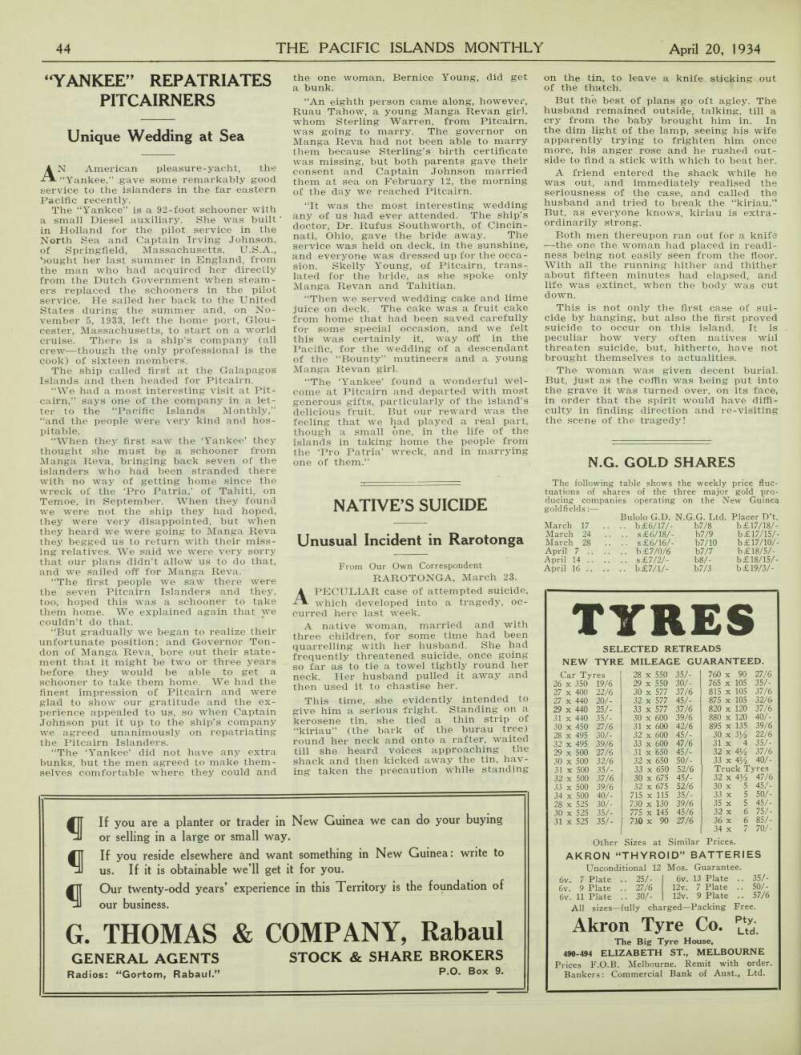
“Yankee” Repatriates
Pitcairners
AN American pleasure-yacht, the “Yankee,” gave some remarkably good service to the islanders in the far eastern Pacific recently.
The “Yankee” is a 92-foot schooner with a small Diesel auxiliary. She was built in Holland for the pilot service in the North Sea and Captain Irving Johnson, of Springfield, Massachusetts, U.S.A., bought her last summer in England, from the man who had acquired her directly from the Dutch Government when steam ers replaced the schooners in the pilot service. He sailed her back to the United States during the summer and, on No vember 5, 1933, left the home port, Glou cester, Massachusetts, to start on a world cruise. There is a ship’s company (all crew—though the only professional is the cook) of sixteen members.
The ship called first at the Galapagos Islands and then headed for Pitcairn.
“We had a most interesting visit at Pit cairn,” says one of the company in a let ter to the “Pacific Islands Monthly,”
“and the people were very kind and hos pitable.
“When they first saw the ‘Yankee’ they thought she must be a schooner from Manga Reva, bringing back seven of the islanders who had been stranded there with no way of getting home since the wreck of the ‘Pro Patria,’ of Tahiti, on Temoe, in September. When they found we were not the ship they had hoped, they were very disappointed, but when they heard we were going to Manga Reva they begged us to return with their miss ing relatives. We said we were very sorry that our plans didn’t allow us to do that, and we sailed off for Manga Reva, “The first people we saw there were the seven Pitcairn Islanders and they, too, hoped this was a schooner to take them home. We explained again that we couldn’t do that.
“But gradually we began to realize their unfortunate position; and Governor Ton don of Manga Reva, bore out their state ment that it might be two or three years before they would be able to get a schooner to take them home. We had the finest impression of Pitcairn and were glad to show our gratitude and the ex perience appealed to us, so when Captain Johnson put it up to the ship’s company we agreed unanimously on repatriating the Pitcairn Islanders.
“The ‘Yankee’ did not have any extra bunks, but the men agreed to make them selves comfortable where they could and
the one woman, Bernice Young, did get a bunk.
“An eighth person came along, however, Ruau Tahow, a young Manga Revan girl, whom Sterling Warren, from Pitcairn, was going to marry. The governor on Manga Reva had not been able to marry them because Sterling’s birth certificate was missing, but both parents gave their consent and Captain Johnson married them at sea on February 12, the morning of the day we reached Pitcairn.
“It was the most interesting wedding any of us had ever attended. The ship’s doctor, Dr. Rufus Southworth, of Cincin nati, Ohio, gave the bride away. The service was held on deck, in the sunshine, and everyone was dressed up for the occa sion. Skelly Young, of Pitcairn, trans lated for the bride, as she spoke only Manga Revan and Tahitian.
“Then we served wedding cake and lime juice on deck. The cake was a fruit cake from home that had been saved carefully for some special occasion, and we felt this was certainly it, way off in the Pacific, for the wedding of a descendant of the “Bounty” mutineers and a young Manga Revan girl.
“The ‘Yankee’ found a wonderful wel come at Pitcairn and departed with most generous gifts, particularly of the island’s delicious fruit. But our reward was the feeling that we had played a real part, though a small one, in the life of the islands in taking home the people from the ‘Pro Patria’ wreck, and in marrying one of them.”
Native’S Suicide
Unusual Incident in Rarotonga
From Our Own Correspondent
Rarotonga, March 23.
A PECULIAR case of attempted suicide, which developed into a tragedy, oc curred here last week.
A native woman, married and with three children, for some time had been quarrelling with her husband. She had frequently threatened suicide, once going so far as to tie a towel tightly round her neck. Her husband pulled it away and then used it to chastise her.
This time, she evidently intended to give him a serious fright. Standing on a kerosene tin, she tied a thin strip of “kiriau” (the bark of the burau tree) round her neck and onto a rafter, waited till she heard voices approaching the shack and then kicked away the tin, hav ing taken the precaution while standing
on the tin, to leave a knife sticking out of the thatch.
But the best of plans go oft agley. The husband remained outside, talking, till a cry from the baby brought him in. In the dim light of the lamp, seeing his wife apparently trying to frighten him once more, his anger rose and he rushed out side to find a stick with which to beat her.
A friend entered the shack while he was out, and immediately realised the seriousness of the case, and called the husband and tried to break the “kiriau.”
But, as everyone knows, kiriau is extra ordinarily strong.
Both men thereupon ran out for a knife —the one the woman had placed in readi ness being not easily seen from the floor.
With all the running hither and thither about fifteen minutes had elapsed, and life was extinct, when the body was cut down.
This is not only the first case of sui cide by hanging, but also the first proved suicide to occur on this island. It is peculiar how very often natives will threaten suicide, but, hitherto, have not brought themselves to actualities.
The woman was given decent burial.
But, just as the coffin was being put into the grave it was turned over, on its face, in order that the spirit would have diffi culty in finding direction and re-visiting the scene of the tragedy!
N.G. Gold Shares
The following table shows the weekly price fluc tuations of shares of the three major gold pro ducing companies operating on the New Guinea goldfields:—
Bulolo G.D. N.G.G. Ltd. Placer D’t.
March 17 ... b£6/17/- b7/8 b£17/18/- March 24 ... s£6/18/- b7/9 b£17/15/- March 28 ... s£6/16/- b7/10 b £17/10/- April 7 b £7/0/6 b7/7 b£18/5/- April 14 s£7/2/- b8/- b£ 18/15/- April 16 b£7/l/- b7/3 b£19/3/-
Advertisements & other items, p. 46 (2 items)
Tyres
SELECTED RETREADS
NEW TYRE MILEAGE GUARANTEED.
AKRON “THYROID” BATTERIES
Unconditional 12 Mos. Guarantee. 6v. 7 Plate .. 25/- I 6v. 13 Plate .. 35/- 6v. 9 Plate .. 27/6 12v. 7 Plate .. 50/- 6v. 11 Plate .. 30/- 12v. 9 Plate .. 57/6 All sizes—fully charged—Packing Free.
Akron Tyre Co.
The Big Tyre House,
490-494 ELIZABETH ST., MELBOURNE
Prices F. 0.B. Melbourne. Remit with order.
Bankers: Commercial Bank of Aust., Ltd.
G. Thomas & Company, Rabaul
If you are a planter or trader in New Guinea we can do your buying or selling in a large or small way.
If you reside elsewhere and want something in New Guinea: write to us. If it is obtainable we’ll get it for you.
Our twenty-odd years’ experience in this Territory is the foundation of our business.
G. THOMAS & COMPANY, Rabaul
GENERAL AGENTS STOCK & SHARE BROKERS
Radios: “Gortom, Rabaul." P.O. Box 9.
Market Quotations
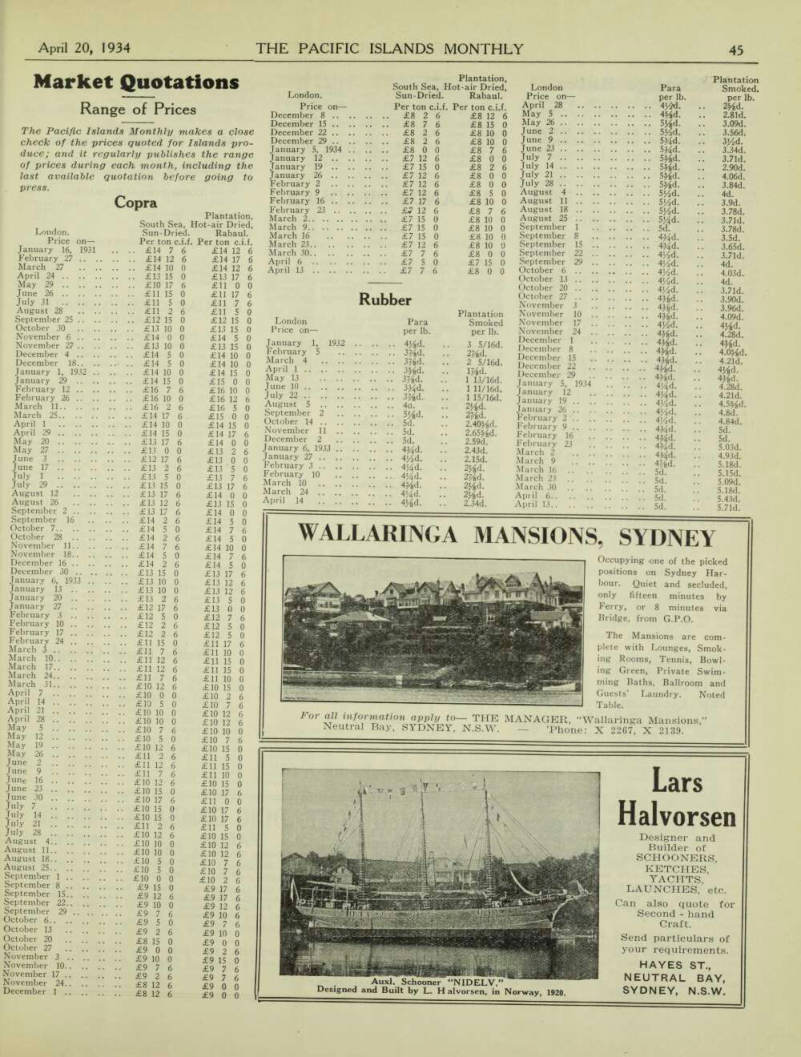
Range of Prices
The Pacific Islands Monthly makes a close check of the prices quoted for Islands pro duce; and it regularly publishes the range of prices during each month, including the last available quotation before going to press.
South Sea,
Plantation,
Hot-air Dried, London.
Sun-Dried Rabaul.
Price on — Per ton c.i.f. Per ton c.i.f.
December 8 . .. £8 2 6 £8 12 6 December 15 6 £8 15 0 December 22 . .. £8 2 6 £8 10 0 December 29 . .. £8 2 6 £8 10 0 January 5, 1934 .. . . .. £8 0 0 £8 7 6
January 12
. .. £7 12 6 £8 0 0 January 19 . .. £7 15 0 £8 2 6
January 26
. .. £7 12 6 £8 0 0 February 2 . .. £7 12 6 £8 0 0 February 9 . .. £7 12 6 £8 5 0
February 16
. .. £7 17 6 £8 10 0 February 23 . .. SJ 12 6 £8 7 6 March 2 0 £8 10 0 March 9 0 £8 10 0 March 16 . .. £7 15 0 £8 10 0 March 23 . .. £7 12 6 £8 10 0 March 30 . .. £7 7 6 £8 0 0 April 6 . .. £7 5 0 £7 15 0 April 13 .. £7 7 6 £8 0 0
Plantation London Para Smoked.
Price on — per lb. per lb.
April 28 .. .. A'/jd. .. 2Hd.
May 5 .. .. 454jd. .. 2.81d.
May 26 3.09d.
June 2 .. .. sy 2 d. 3.56d.
June 9 3'/ 2 d.
June 23 3.34d.
July 7 .. .. 5Hd. .. 3.7ld.
July 14 2.90d.
July 21 .. .. .. 4.06d.
July 28 3.84d.
August 4 .. .. S/ 2 d. .. 4d.
August 11 .. .. S^d. 3.9d.
August 18 3.78d. •J 7lrl August 25 September 1 .. .. 5dl 0./ IQ. 3.78d.
September 8 .. .. .. .. 4y 4 d. 3.5d.
September IS .. 3.65d.
September 22 .. .. 3.71d.
September 29 .. .. 4d.
October 6 4.03d.
October 13 4d.
October 20 3.71d. t 00/1 October 27 November 3 .. ..
O.Vuu.
3.96d.
November 10 .. . 4 09d' November 17 .. ..
W- 4.28d November 24 .. ..
December 1 December 8 ...
AHd.
A.Ohd.
4.21d. 4%d.
December 15 ...
December 22 , . ..
December 29 ...
January 5, 1934
January 12
.. .. 4'Ad. 4.28d. 4.21d.
January 19 . . .
January 26 .. .
4.8d.
February 2 4.84d February 9 Sd.
February 16 ...
February 23 ...
March 2 •• .. Ay 4 d. 5d. 4.93d.
Ioij
March 9 .. ..
March 16 March 23 4.700.
S.18d.
S.lSd. 5.09d.
March 30 ..
S,18d.
Apiil 6 5.43d.
April 13 5.71d.
Copra
Plantation, London.
South Sea, Hot-air Dried, Sun-Dried.
Rabaul.
Price on — Per ton c.i.f Per ton c.i.f.
January 16, 1931 .. .. £14 7 6 £14 12 6 February 27 .. .. .. .. £14 12 6 £14 17 6 March 27 .. .. £14 12 6 April 24 .. .. £13 15 0 £13 17 6
May 29
.. .. £10 17 6 £11 0 0 June 26 .. .. £11 15 0 £11 17 6 July 31 .. .. £11 5 0 £11 7 6 August 28 .. .. .. .. £11 2 6 £11 5 0 September 25 .. .. .. .. £12 15 0 £12 15 0 October 30 .. .. .. .. £13 10 0 £13 IS 0 November 6 .. .. .. £14 0 0 £14 5 0 November 27 .. .. .. .. £13 10 0 £13 15 0 December 4 .. .. .. .. £14 5 0 £14 10 0 December 18.. .. .. .. £14 5 0 £14 10 0 January 1, 1932 ..
January 29 .. .. .. .. £14 10 0 £14 15 0 .. .. £14 15 0 £15 0 0 February 12 .. .. .. .. £16 7 6 £16 10 0 February 26 .. .. .. .. £16 10 0 £16 12 6 March 11 .. .. £16 2 6 £16 5 0 March 25 .. .. £14 17 6 £15 0 0 April 1 .. .. £14 10 0 £14 15 0 April 29 .. .. £14 15 0 £14 17 6 £13 17 6 £14 0 0 £13 2 6 May 27 .. .. £13 0 0
June 3
.. .. £12 17 6 £13 0 0
June 17
.. .. £13 2 6 £13 5 0
July 1
.. .. £13 5 0 £13 7 6 July 29 £13 17 6 August 12 .. .. .. .. £13 17 6 £14 0 0 August 26 .. .. .. .. £13 12 6 £13 15 0 September 2 .. .. .. .. £13 17 6 £14 0 0
September 16
.. .. £14 2 6 £14 5 0 October 7 .. .. £14 5 0 £14 7 6 October 28 .. .. .. .. £14 2 6 £14 5 0 November 11.. .. .. .. £14 7 6 £14 10 0 November 18. . .. .. £14 5 0 £14 7 6 £14 5 0 December 16 .. .. .. £14 2 6 December 30 .. .. .. .. £13 15 0 £13 17 6 January 6, 1933 .. .. .. £13 10 0 £13 12 6 January 13 .. .. .. .. £13 10 0 £13 12 6 £13 5 0 January 20 .. .. .. .. £13 2 6 January 27 .. .. , .. .. £12 17 6 £13 0 0 February 3 .. ,. , £12 7 6
February 10 .. .. ,
£12 5 0
February 17
.. .. £12 2 6 £12 5 0
February 24
.. .. £11 15 0 £11 17 6 March 3 . .. £11 7 6 £11 10 0 March 10 £11 15 0 March 17 . .. £11 12 6 £11 15 0 March 24 £11 10 0 March 31 £10 15 0
April 7
£10 2 6 April 14 £10 7 6 April 21 £10 12 6 £10 12 6 April 28 £10 10 0 May 5 otlu 6 £10 10 0 May 12 £10 7 6 May 19 £10 15 0 P i 1 r a
May 26
£11 2 6 June 2 abll j U £11 150 June 9 Jun e 16 £11 10 0 £10 15 0 June 23 .. ..
June 30 • .. £10 15 0 • .. £10 17 6 £10 17 6 £11 0 0 July 7 £10 17 6 July 14 July 21 £10 17 6 £11 5 0
July 28
August 4
August 11 August 18 £10 15 0 £10 12 6 £10 12 6 £10 7 6 August 25
September 1 .. ..
£10 0 0 £9 15 0 £10 7 6 CIO o r September 8 September 15.. ..
September 22. . ..
September 29 .. ..
October 6 i lu 6 £9 17 6 £9 17 6 £9 12 6 £9 10 6 £9 7 6 October 13 .. .. £9 10 0
Co A A
October 20 .. .. £8 IS 0 October 27 .. u u
-Co O £
November 3 .. .
November 10 £9 15 0 £9 7 6 £9 7 6 £9 0 0 £9 0 0 November 17 .. £9 2 6 November 24 December 1 .. £8 12 6 .. £8 12 6
Rubber
London Price on — Para per lb.
Plantation Smoked per lb.
January 1, 1932 February 5 March 4 .. ..
April 1 May 13 .. ..
June 10 July 22 August 5 .. .. 4^d. 3Jid. 3**d. 3Hd. 3^d. 3 5/16d. .. 2&d. 2 5/16d. .. VAd. 1 13/16d. 1 ll/16d. 1 15/16d. .. 2Jid. .. 27Ad. 2.40^d.
September 2 October 14 .. 5^d. 5d.
November 11 .. 5d December 2 January 6, 1933 ..
January 27 ,. ..
February 3 .. ..
February 10 March 10 ., ..
March 24 .. .. 4/ 2 d. 4'Ad. 4{4d. 2.65f£d. 2.59d. 2.43d. 2.15d. • • 2%d. .. 2%d.
Ol /A April 14 .. .. 2.34d,
Advertisements & other items, p. 47 (1 item)
Halvorsen
WALLARINGA MANSIONS, SYDNEY
Occupying one of the picked positions on Sydney Harbour. Quiet and secluded, only fifteen minutes by Ferry, or 8 minutes via Bridge, from G.P.O.
The Mansions are complete with Lounges, Smoking Rooms, Tennis, Bowling Green, Private Swimming Baths, Ballroom and Guests’ Laundry. Noted Table.
For all information apply to— THE MANAGER, “Wallaringa Mansions, Neutral Bay, SYDNEY, N.S.W. ’Phone: X 2267, X 2139.
Auxl. Schooner “NIDELV."
Designed and Built by L. Halvorsen, in Norway, 1920.
Lars
Halvorsen
Designer and Builder of
SCHOONERS,
KETCHES,
YACHTS,
LAUNCHES, etc.
Can also quote for Second - hand Craft.
Send particulars of your requirements.
HAYES ST.,
NEUTRAL BAY,
SYDNEY, N.S.W.
Exchange Rates
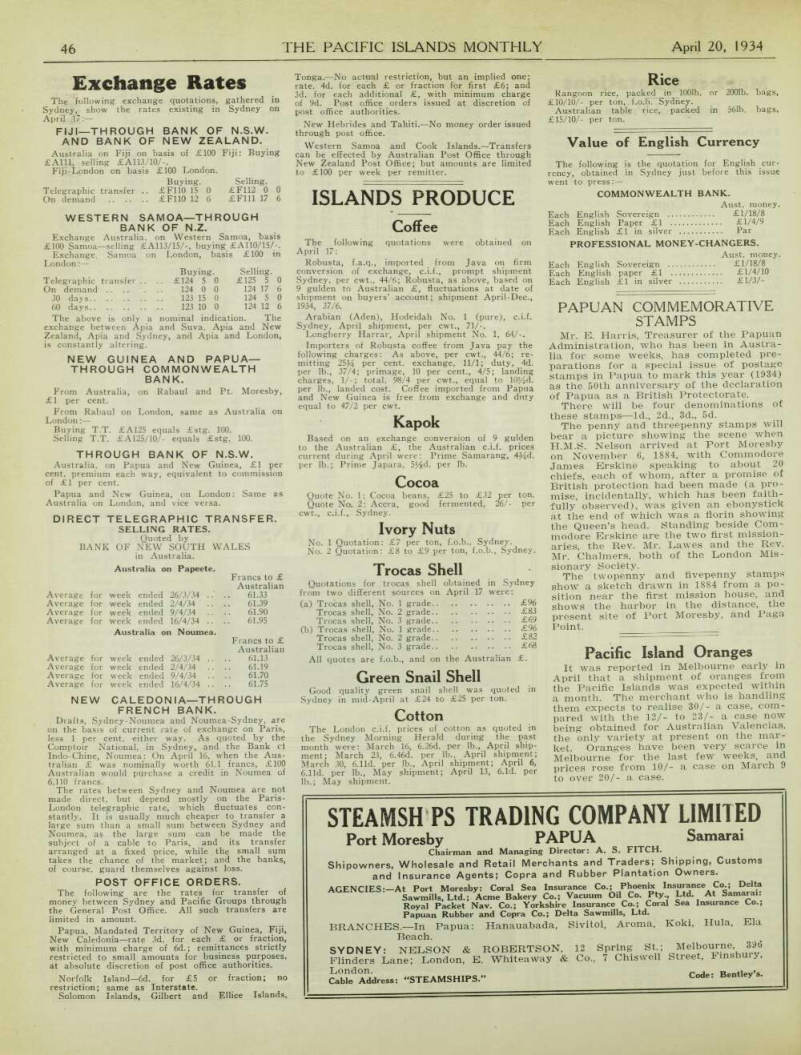
The following exchange quotations, gathered in Sydney, show the rates existing in Sydney on April 17: —
Fiji-Through Bank Of N.S.W.
And Bank Of New Zealand.
Australia on Fiji on basis of £100 Fiji: Buying £A111, selling £A113/10/-.
Fiji-London on basis £100 London.
Western Samoa—Through
Bank Of N.Z.
Exchange Australia, on Western Samoa, basis £100 Samoa —selling £A113/15/-, buying £A110/15/-.
Exchange. Samoa on London, basis £100 in London: —
The above is only a nominal indication. The exchange between Apia and Suva, Apia and New Zealand, Apia and Sydney, and Apia and London, is constantly altering.
New Guinea And Papua
Through Commonwealth
Bank.
From Australia, on Rabaul and Pt. Moresby, £1 per cent.
From Rabaul on London, same as Australia on London:— Buying T.T. £A125 equals £stg. 100.
Selling T.T. £A125/10/- equals £stg. 100.
Through Bank Of N.S.W.
Australia, on Papua and New Guinea, £1 per cent, premium each way, equivalent to commission of £1 per cent.
Papua and New Guinea, on London: Same as Australia on London, and vice versa.
Direct Telegraphic Transfer.
Selling Rates.
Quoted by
Bank Of New South Wales
in Australia.
New Caledonia—Through
French Bank.
Drafts, Sydney-Noumea and Noumea-Sydney, are on the basis of current rate of exchange on Paris, less 1 per cent, either way. As quoted by the Comptoir National, in Sydney, and the Bank cf Indo-Chine, Noumea: On April 16, when the Aus tralian £ was nominally worth 61.1 francs, £100 Australian would purchase a credit in Noumea of 6,110 francs.
The rates between Sydney and Noumea are not made direct, but depend mostly on the Paris- London telegraphic rate, which fluctuates con stantly. It is usually much cheaper to transfer a large sum than a small sum between Sydney and Noumea, as the large sum can be made the subject of a cable to Paris, and its transfer arranged at a fixed price, while the small sum takes the chance of the market; and the banks, of course, guard themselves against loss.
Post Office Orders.
The following are the rates for transfer of money between Sydney and Pacific Groups through the General Post Office. All such transfers are limited in amount.
Papua, Mandated Territory of New Guinea, Fiji, New Caledonia —rate 3d. for each £ or fraction, with minimum charge of 6d.; remittances strictly restricted to small amounts for business purposes, at absolute discretion of post office authorities.
Norfolk Island —6d. for £5 or fraction; no restriction; same as Interstate.
Solomon Islands, Gilbert and Ellice Islands.
Tonga.—No actual restriction, but an implied one; rate, 4d. for each £ or fraction for first £6; and 3d. for each additional £, with minimum charge of 9d. Post office orders issued at discretion of post office authorities.
New Hebrides and Tahiti.—No money order issued through post office.
Western Samoa and Cook Islands.—Transfers can be effected by Australian Post Office through New Zealand Post Office; but amounts are limited to £100 per week per remitter.
Buying. Selling.
Telegraphic transfer .. £F110 15 0 £F112 0 0 On demand £F110 12 6 £F111 17 6
Buying. Selling.
Telegraphic transfer .. .. £124 5 0 £125 5 0 On demand 124 0 0 124 17 6 30 days 123 15 0 124 5 0 60 days 123 10 0 124 12 6
Average for week ended 26/3/34 .. 61.33 Australia on Papeete.
Francs to £ Australian Average for week ended 2/4/34 .. 61.39 Average for week ended 9/4/34 .. 61.90 Average for week ended 16/4/34 .. 61.95 Average for week ended 26/3/34 .. 61.13 Australia on Noumea.
Francs to £ Australian Average for week ended 2/4/34 .. 61.19 Average for week ended 9/4/34 .. 61.70 Average for week ended 16/4/34 .. 61.75
Ivory Nuts
Islands Produce
Coffee
The following quotations were obtained on April 17: Robusta, f.a.q., imported from Java on firm conversion of exchange, c.i.f., prompt shipment Sydney, per cwt., 44/6; Robusta, as above, based on 9 gulden to Australian £, fluctuations at date of shipment on buyers’ account; shipment April-Dee., 1934, 37/6.
Arabian (Aden), Hodeidah No. 1 (pure), c.i.f.
Sydney, April shipment, per cwt., 71/-.
Longberry Harrar, April shipment No. 1, 64/-.
Importers of Robusta coffee from Java pay the following charges: As above, per cwt., 44/6; re mitting 2554 per cent, exchange, 11/1; duty, 4d. per lb., 37/4; primage, 10 per cent., 4/5; landing charges, 1/ -; total, 98/4 per cwt., equal to 10y 2 d. per lb., landed cost. Coffee imported from Papua and New Guinea is free from exchange and duty equal to 47/2 per cwt.
Kapok
Based on an exchange conversion of 9 gulden to the Australian £, the Australian c.i.f. prices current during April were: Prime Samarang, 424 d. per lb.; Prime Japara, per lb.
Cocoa
Quote No. 1; Cocoa beans, £25 to £32 per ton.
Quote Not 2: Accra, good fermented, 26/- per cwt., c.i.f., Sydney.
Ivory Nuts
No. 1 Quotation: £7 per ton, f.o.b., Sydney.
No. 2 Quotation: £8 to £9 per ton, f.o.b., Sydney.
Trocas Shell
Quotations for trocas shell obtained in Sydney from two different sources on April 17 were: (a) Trocas shell, No. 1 grade £96 Trocas shell, No. 2 grade £B3 Trocas shell. No. 3 grade £69 (b) Trocas shell, No. 1 grade.. £96 Trocas shell, No. 2 grade £B2 Trocas shell, No. 3 grade £6B All quotes are f.o.b., and on the Australian £.
Green Snail Shell
Good quality green snail shell was quoted in Sydney in mid-April at £24 to £25 per ton.
Cotton
The London c.i.f. prices of cotton as quoted in the Sydney Morning Herald during the past month were: March 16, 6.26 d. per lb., April ship ment; March 23, 6.46 d. per lb.. April shipment; March 30, 6.11 d. per lb., April shipment; April 6, 6.11 d. per lb., May shipment; April 13, 6.1 d. per lb.; May shipment.
Rice
Rangoon rice, packed in 100lb. or 200lb. bags, £10/10/- per ton, f.o.b. Sydney.
Australian table rice, packed in 561 b. bags, £15/10/- per ton.
Value of English Currency
The following is the quotation for English cur rency, obtained in Sydney just before this issue went to press: —
Commonwealth Bank.
Aust. money.
Each English Sovereign £1/18/8 Each English Paper £1 £1/4/9 Each English £1 in silver Par
Professional Money-Changers.
Aust. money, Each English Sovereign £1/18/8 Each English paper £1 £1/4/10 Each English £1 in silver £1/3/-
Papuan Commemorative
Stamps
Mr. E. Harris, Treasurer of the Papuan Administration, who has been in Austra lia for some weeks, has completed pre parations for a special issue of postage stamps in Papua to mark this year (1934) as the 50th anniversary of the declaration of Papua as a British Protectorate.
There will be four denominations of these stamps—1d., 2d., 3d., sd.
The penny and threepenny stamps will bear a picture showing the scene when H.M.S. Nelson arrived at Port Moresby on November 6, 1884, with Commodore James Erskine speaking to about 20 chiefs, each of whom, after a promise of British protection had been made (a pro mise, incidentally, which has been faith fully observed), was given an ebonystick at the end of which was a florin showing the Queen’s head. Standing beside Com modore Erskine are the two first mission aries, the Rev. Mr. Lawes and the Rev.
Mr. Chalmers, both of the London Mis sionary Society.
The twopenny and fivepenny stamps show a sketch drawn in 1884 from a po sition near the first mission house, and shows the harbor in the distance, the present site of Port Moresby, and Paga Point.
Pacific Island Oranges
It was reported in Melbourne early in April that a shipment of oranges from the Pacific Islands was expected within a month. The merchant who is handling them expects to realise 30/- a case, com pared with the 12/- to 23/- a case now being obtained for Australian Valencias, the only variety at present on the mar ket. Oranges have been very scarce in Melbourne for the last few weeks, and prices rose from 10/- a case on March 9 to over 20/- a case.
Advertisements & other items, p. 48 (1 item)
Port Moresby PAPUA Samarai
STEAMSHiPS TRADING COMPANY LIMITED
Chairman and Managing Director: A. S. FITCH.
Shipowners, Wholesale and Retail Merchants and Traders; Shipping, Customs and Insurance Agents; Copra and Rubber Plantation Owners.
AGENCIES:—At Port Moresby: Coral Sea Insurance Co.; Phoenix durance Co.; Delta Sawmills, Ltd.; Acme Bakery Co.; Vacuum Oil Co. Pty., Ltd. At Samarai.
Royal Packet Nav. Co.; Yorkshire Insurance Co.; Coral Sea Insurance Co.; Papuan Rubber and Copra Co.; Delta Sawmills, Ltd.
BRANCHES. —In Papua: Hanauabada, Sivitoi, Aroma, Koki, Hula, Ela Beach.
SYDNEY: NELSON & ROBERTSON, 12
Flinders Lane; London, E. Whiteaway & Co., London.
Cable Address: “STEAMSHIPS.”
Spring St.; Melbourne, 390 7 Chiswell Street, Finsbury, Code: Bentley’s.
Shipping Services in the Pacific
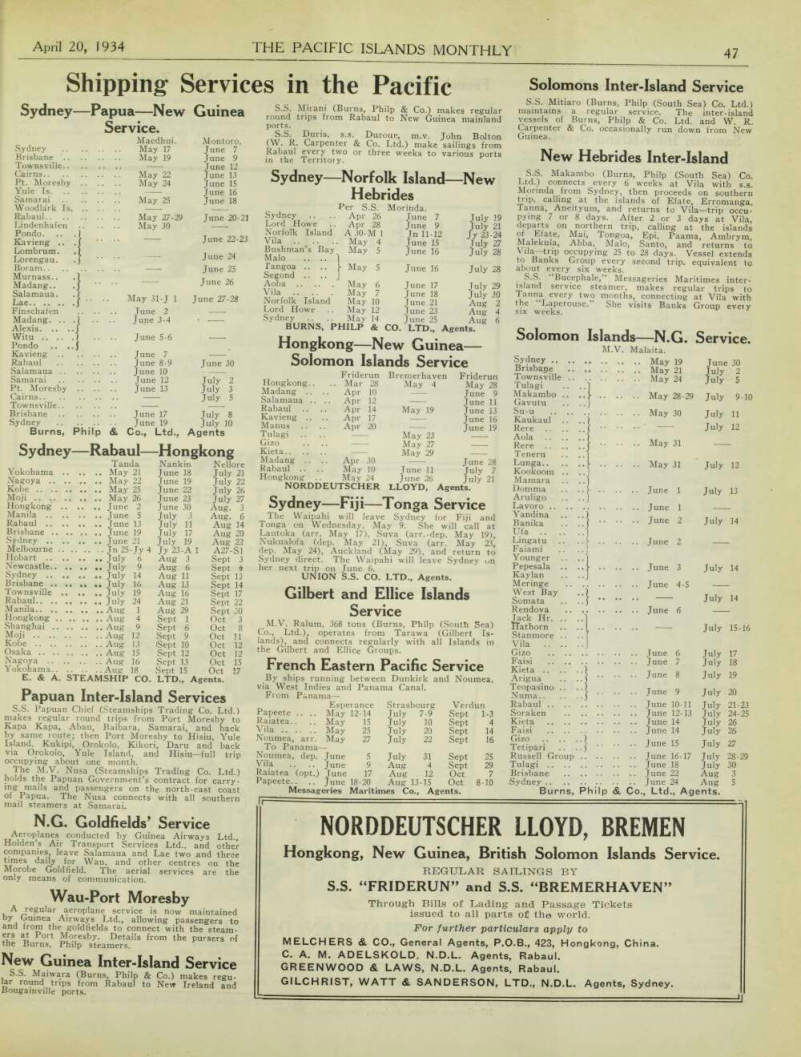
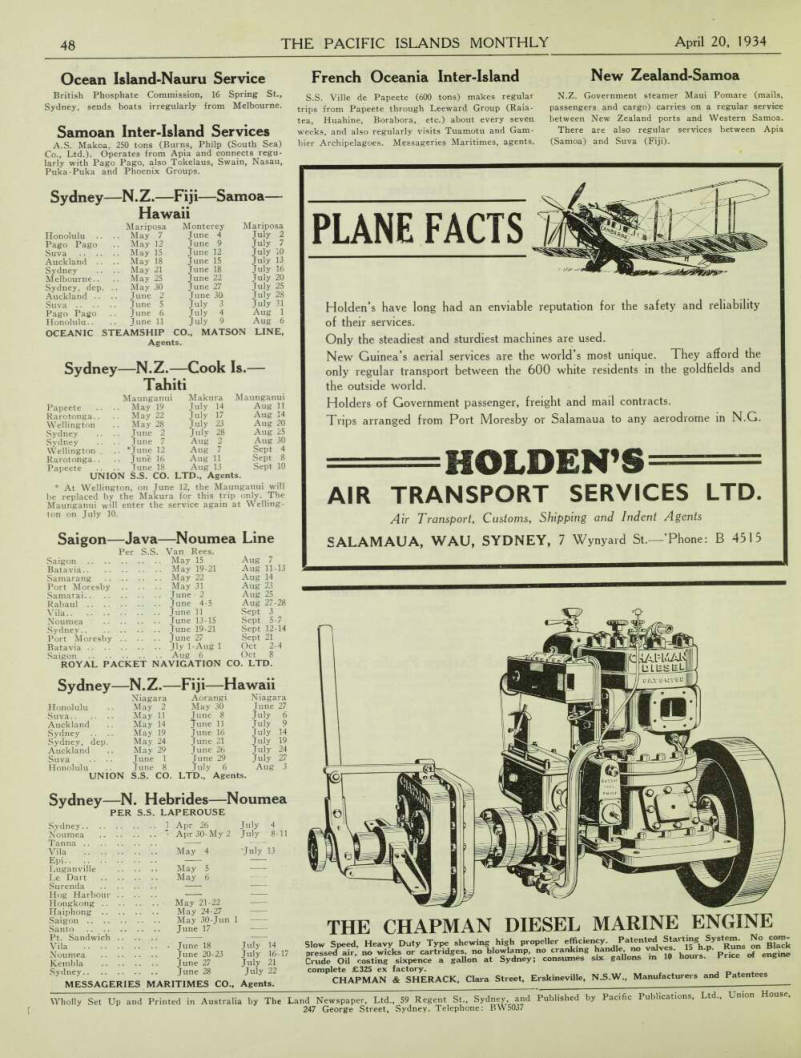
Sydney—Papua—New Guinea Service.
Sydney—Rabaul—Hongkong
Papuan Inter-Island Services
S.S. Papuan Chief (Steamships Trading Co. Ltd.) makes regular round trips from Port Moresby to Kapa Kapa, Abau, Baibara, Samarai, and back by same route; then Port Moresby to Hisiu, Yule Island, Kukipi, Orokolo, Kikori, Daru and back via Orokolo, Yule Island, and Hisiu—full trip occupying about one month.
The M.V. Nusa (Steamships Trading Co. Ltd.) holds the Papuan Government’s contract for carry ing mails and passengers on the north-east coast of Papua. The Nusa connects with all southern mail steamers at Samarai.
N.G. Goldfields’ Service
Aeroplanes conducted by Guinea Airways Ltd., Holden s Air Transport Services Ltd., and other companies, leave Salamaua and Lae two and three times daily for Wau, and other centres on the Morobe Goldfield. The aerial services are the only means of communication.
Wau-Port Moresby
A regular aeroplane service is now maintained by Guinea Airways Ltd., allowing passengers to and from the goldfields to connect with the steam- Port Moresby. Details from the pursers of the Burns, Philp steamers.
New Guinea Inter-Island Service
S.S. Maiwara (Burns, Philp & Co.) makes regular round trips from Rabaul to New Ireland and Bougainville ports.
S.S. Mirani (Burns, Philp & Co.) makes regular round trips from Rabaul to New Guinea mainland ports.
S.S. Duris, s.s. Durour, m.v. John Bolton (W. R. Carpenter & Co. Ltd.) make sailings from Rabaul every two or three weeks to various ports in the Territory.
Sydney—Norfolk Island—New
Hebrides
Hongkong—New Guinea— Solomon Islands Service
Sydney—Fiji—Tonga Service
The Waipahi will leave Sydney for Fiji and Tonga on Wednesday, May 9. She will call at Lautoka (arr. May 17), Suva (arr.-dep. May 19), Nukualofa (dep. May 21), Suva (arr. May 23, dep. May 24), Auckland (May 29), and return to Sydney direct. The Waipahi will leave Sydney un her next trip on June 6.
Union S.S. Co. Ltd., Agents.
Gilbert and Ellice Islands
Service
M.V. Ralum, 368 tons (Burns, Philp (South Sea) Co., Ltd.), operates from Tarawa (Gilbert Is lands), and connects regularly with all Islands in the Gilbert and Ellice Groups.
French Eastern Pacific Service
By ships running between Dunkirk and Noumea, via West Indies and Panama Canal.
From Panama—
Solomons Inter-Island Service
S.S. Mitiaro (Burns, Philp (South Sea) Co. Ltd.) maintains a regular service. The inter-island vessels of Burns, Phijp & Co. Ltd. and W. R.
Carpenter & Co. occasionally run down from New Guinea.
New Hebrides Inter-Island
S.S. Makambo (Burns, Philp (South Sea) Co.
Ltd.) connects every 6 weeks at Vila with s.s.
Monnda from Sydney, then proceeds on southern trip, calling at the islands of Efate, Erromanga, Tanna, Aneityum, and returns to Vila—trip occu pying 7 or 8 days. After 2 or 3 days at Vila, departs on northern trip, calling at the islands of Efate, Mai, Tongoa, Epi, Paama, Ambrym, Malekula, Abba, Malo, Santo, and returns to Vila—trip occupying 25 to 28 days. Vessel extends to Banks Group every second trip, equivalent to about every six weeks.
S.S. “Bucephale,” Messageries Maritimes interisland service steamer, makes regular trips to Tanna every two months, connecting at Vila with the “Laperouse.” She visits Banks Group every six weeks.
Solomon Islands—N.G. Service.
Macdhui.
Montoro.
Sydney June 7 Brisbane June 9 Townsville..
June 12 Cairns..
May 22 June 13 Pt. Moresby Yule Is. ..
May 24 June 15 June 16 June 18 Samarai Woodlark Is.
May 25 Rabaul..
May 27-29 June 20-21 Lindenhafen Pondo.
May 30 — Kavieng .. .
Lombrum.
June 22-23 Lorengau.
June 24 Boram..
Murnass..
June 25 Madang..
June 26 Salamaua.
Lae May 31-J 1 June 27-28 Finschafen Madang Alexis June 2 June 3-4 Witu Pondo June 5-6 — Kavieng ..
Rabaul June 8-9 June 30 Salamaua ..
Samarai July 2 Pt. Moresby .
July 3 Cairns.. — July 5 Townsville..
Brisbane July 8 Sydney July 10 Burns, Philp & Co., Ltd., Agents
Tanda Nankin Nellore Yokohama June 18 July 21 July 22 Nagoya ..
June 19 Kobe .. ..
June 22 July 26 Moji .. ..
June 23 July 27 Hongkong .
June 30 Aug. 3 Manila ..
Rabaul ..
July 3 July 11 Aug. 6 Aug 14 Brisbane ..
July 17 Aug 20 Sydney ..
July 19 Aug 22 Melbourne .
Jy 23-A 1 A27-S1 Hobart ..
Aug 3 Sept 3 Newcastle..
Aug 6 Sept 6 Sydney ..
Aug 11 Sept 12 Brisbane ..
Aug 13 Sept 14 Townsville .
Aug 16 Sept 17 Rabaul.. ..
Aug 21 Sept 22 Manila.. ..
Aug 29 Sept 30 Hongkong ..
Sept 1 Oct 3 Shanghai ..
Sept 6 Oct 8 Moji .. ..
Sept 9 Oct 11 Kobe .. ..
Sept 10 Oct 12 Osaka .. ..
Sept 12 Oct 12 Nagoya ..
Sept 13 Oct 15 Yokohama..
Aug 18 Sept 15 Oct 17 E. & A. STEAMSHIP CO. LTD., Agents.
Sydney Per S.S. Morinda.
Apr 26 June 7 July 19 Lord Howe Apr 28 June 9 July 21 Norfolk Island A 30-M 1 Jn 11-12 Jy 23-24 Vila . May 4 June 15 July 27 Bushman’s Bay Malo ..
May 5 June 16 July 28 Tangoa .. ..
Segond ..
May 5 June 16 July 28 Aoba Vila May 6 May 7 June 17 June 18 July 29 July 30 Norfolk Island May 10 June 21 Aug 2 Lord Howe May 12 June 23 Aug 4 Sydney May 14 June 25 Aug 6
Burns, Philp & Co. Ltd., Agents.
Friderun Bremerhaven Friderun Hongkong.. .. Mar 28 May 4 May 28 Madang ..
Apr 10 — June 9 Salamaua .. .. Apr 12 June 11 Rabaul Apr 14 May 19 June 13 Kavieng .. .
Apr 17 June 16 Manus Apr 20 June 19 Tulagi Gizo May 23 May 27 Kieta — May 29 Madang ..
Apr 30 June 28 Rabaul ..
May 10 June 11 July 7 Hongkong ..
May 24 June 26 Tulv 21
Norddeutscher Lloyd, Agents.
Esperance Strasbourg Verdun Papeete .. ..
May 12-14 July 7-9 Sept 1-3 Raiatea..
May 15 July 10 Sept 4 Vila May 25 July 20 Sept 14 Noumea, arr.
May 27 July 22 Sept 16 To Panama- Noumea, dep.
June 5 July 31 Sept 25 Vila June 9 Aug 4 Sept 29 Raiatea (opt.) June 17 Aug 12 Oct 7 Papeete..
June 18-20 Aug 13-15 Oct 8-10 Messageries Maritimes Co., Agents.
Sydney Brisbane .. .
Townsville ..
Tulagi .. ..
Makambo ..
Gavutu Su-u M.V. Malaita.
Kaukaul .. ..
Rere Aola Rere Teneru ..
Lunga Kookoom .. ,.
Mamara Domma .. ..
Aruligo .. ..
Lavoro Yandina .. ..
Banika .. ..
Ufa Lingatu Faiami Younger .. ..
Pepesala .. ..
Kaylan ..
Meringe June 2 July 14 West Bay Somata Rendova Jack Hr Hathorn .. ..
Stanmore Vila July 15-16 Gizo Faisi limp 7 Tiilv 18 Kieta June 8 July 19 June 9 July 20 Tune lfl-11 Tulv 91.7?
Arigua Teopasino ..
Numa Rabaul Soraken June 12-13 July 24-25 Kieta .. June 14 July 26 Faisi June 14 July 26 Tetipari " "I J""* 15 » Russell Group June 16-17 July 28-29 Tulagi June 18 July 30 Brisbane June 22 Aug 3 Sydney June 24 Aug 5 Burns, Philp & Co., Ltd., Agents.
Ocean Island-Nauru Service
British Phosphate Commission, 16 Spring St., Sydney, sends boats irregularly from Melbourne.
Samoan Inter-Island Services
A.S. Makoa, 250 tons (Burns, Philp (South Sea) Co., Ltd.). Operates from Apia and connects regu larly with Pago Pago, also Tokelaus, Swain, Nasau, Puka-Puka and Phoenix Groups.
Sydney—N.Z.—Fiji—Samoa—
Hawaii
Sydney—N.Z.—Cook Is. — Tahiti
Saigon—Java—Noumea Line
Sydney—N.Z.—Fiji—Hawaii
Sydney—N. Hebrides —Noumea
Per S.S. Laperouse
French Oceania Inter-Island
S.S. Ville de Papeete (600 tons) makes regular trips from Papeete through Leeward Group (Raia tea, Huahine, Borabora, etc.) about every seven weeks, and also regularly visits Tuamotu and Gam bier Archipelagoes. Messageries Maritimes, agents.
New Zealand-Samoa
N.Z. Government steamer Maui Pomare (mails, passengers and cargo) carries on a regular service between New Zealand ports and Western Samoa.
There are also regular services between Apia (Samoa) and Suva (Fiji).
Mariposa Monterey Mariposa Honolulu .. May 7 June 4 July 2 Pago Pago .. May 12 June 9 July 7 Suva .. .
June 12 July 10 Auckland .. May 18 June 15 July 13 Sydney .. May 21 June 18 July 16 Melbourne.. .. May 25 June 22 July 20 Sydney, dep . .. May 30 June 27 July 25 Auckland ..
June 2 June 30 July 28 Suva .. ..
July 3 July 31 Pago Pago June 6 July 4 Aug 1 Honolulu.. .. June 11 July 9 Aug 6
Oceanic Steamship Co., Matson Line,
Agents.
Maunganui Makura Maunganui Papeete May 19 July 14 Aug 11 Rarotonga..
May 22 July 17 Aug 14 Wellington May 28 July 23 Aug 20 Sydney June 2 July 28 Aug 25 Sydney June 7 Aug 2 Aug 30 Wellington *June 12 Aug 7 Sept 4 Rarotonga..
June 16 Aug 11 Sept 8 Papeete Tune 18 Aug 13 Sept 10
Union S.S. Co. Ltd., Agents.
* At Wellington, on June 12, the Maunganui will be replaced by the Makura for this trip only. The Maunganui will enter the service again at Wellington on July 10.
Per S.S. Van Rees.
Saigon .. May 15 Aug 7 Batavia .. May 19-21 Aug 11-13 Samarang .. May 22 Aug 14 Port Moresby .. .. .. May 31 Aug 23 Samarai Aug 25 Rabaul Aug 27-28 Vila Sept 3 Noumea Sept 5-7 Sydney .. June 19-21 Sept 12-14 Port Moresby .. .. June 27 Sept 21 Batavia .. Jlyl-Augl Oct 2-4 Saigon Oct 8
Royal Packet Navigation Co. Ltd.
Niagara Aorangi Niagara Honolulu .. May 2 May 30 June 27 Suva May 11 June 8 July 6 Auckland .. May 14 June 11 July 9 Sydney .. .. May 19 June 16 July 14 Sydney, dep. May 24 June 21 July 19 Auckland .. May 29 June 26 July 24 Suva .. June 1 June 29 July 27 Honolulu .. June 8 July 6 Aug 3
Union S.S. Co. Ltd., Agents.
Sydney July 4 Noumea .. ' Apr 30-My 2 July 8-11 Tanna — — Vila July 13 Epi . . — Luganville .. .. .. May 5 — Le Dart — Surenda . . — Hog Harbour .. .. — — Hongkong .. May 21-22 — Haiphong May 24-27 — Saigon May 30-Jun 1 Santo ..
June 17 Pt. Sandwich .. — — Vila July 14 Noumea July 16-17 Kembla July 21 Sydney July 22
Messageries Maritimes Co., Agents.
Advertisements & other items, pp. 49-52 (2 items)
Norddeutscher Lloyd, Bremen
Hongkong, New Guinea, British Solomon Islands Service.
REGULAR SAILINGS BY
S.S. “FRIDERUN” and S.S. “BREMERHAVEN”
Through Bills of Lading and Passage Tickets issued to all parts of the world.
For further particulars apply to MELCHERS & CO., General Agents, P.O.B., 423, Hongkong, China.
C. A. M. ADELSKOLD, N.D.L. Agents, Rabaul.
GREENWOOD & LAWS, N.D.L. Agents, Rabaul.
GILCHRIST, WATT & SANDERSON, LTD., N.D.L. Agents, Sydney.
PLANE FACTS
Holden’s have long had an enviable reputation for the safety and reliability of their services.
Only the steadiest and sturdiest machines are used.
New Guinea’s aerial services are the world’s most unique. They afford the only regular transport between the 600 white residents in the goldfields and the outside world.
Holders of Government passenger, freight and mail contracts.
Trips arranged from Port Moresby or Salamaua to any aerodrome in N.G.
HOLDEN’S
AIR TRANSPORT SERVICES LTD.
Air Transport, Customs, Shipping and Indent Agents SALAMAUA, WAU, SYDNEY, 7 Wynyard St.—’Phone: B 4515
THE CHAPMAN DIESEL MARINE ENGINE
Slow Speed, Heavy Duty Type shewing high propeller efficiency. Patented Starting System. No compressed air, no wicks or cartridges, no blowlamp, no cranking handle no vv • ,p ' p rice 0 f engine Crude Oil costing sixpence a gallon at Sydney; consumes six gallons in complete £325 ex factory.
CHAPMAN & SHERACK, Clara Street, Erskineville, N.S.W., Manufacturers and Patentees
A Unique Aerial Transport Service
Three of the Large Trimotored Aeroplanes, operated by Guinea Airdays Ltd., on Bulolo Aerodrome, in the heart of the New Guinea Mountains.
BELOW: Giant wheel with a diameter of over 6½ feet for one of the Bulolo Gold Dredging Company’s dredges. It is bolted securely inside the cabin of a G31 tri-motored Junker for transport to the goldfields. The balance of the load was made up with hundred pound bags of rice.
AERIAL Transport made possible the development of the great Gold Industry of New Guinea. The presence of Rich Gold was proved in 1926, but the Problem was Communication. Morobe was guarded by dense jungle and precipitous mountains. A road could not be built, except at enormous, crippling cost.
Guinea Airways Ltd. launched its unique aerial service seven years ago, with one machine and a handful of men. To-day, it operates a fleet of modern aeroplanes, and employs large European and native staffs. Its machines, running on regular schedules, have carried men, machinery, dredges, building material, foodstuffs, motor-trucks, livestock, over the mountains of New Guinea, without accident and without delay.
31 Aerodromes
MARAWASSA
NADZAB
PORT
MORESBY*
PURARI
RAMU
SALAMAUA
SANGAN
SUNSHINE
SURPRISE CK.
UP. WATUT
WAGAU
WAHGI
WAMPIT
WAU
ZENAG
WARONA
In Papua.
BABUAP
BAPI
BULOLO
BULWA
Gabanziz
GARINA
JUNI
KAJABIT
KIDJURA
KOKODA*
KABUNA*
LAE
MT. HAGEN
MARILINAN
MENYAMYA
Two years ago, there were not a dozen landing-grounds on the goldfields. To-day, there are over 30. Prospectors are constantly opening new country. New enterprises are being launched. No sooner is a new camp established, than a new landing-ground is cleared, and Guinea Airways machines provide communication.
Travellers may leave the steamer at Port Moresby, fly across to Morobe (time of journey, 1h. 45min.) and spend 9 days in the Goldfield centres before rejoining steamer at Lae for Rabaul.
Or, after visiting Rabaul, they may disembark at Salamaua or Lae, spend several days on the Goldfield, and fly to Pt. Moresby to rejoin the steamer.
All information from Pursers on the Steamers.
GUINEA AIRWAYS Ltd
LAE - SALAMAUA
You men need a bottle of KB at dusk ... there’s stimulation in every glass!
48
April 20, 1934
THE PACIFIC ISLANDS MONTHLY
Wholly Set Up and Printed in Australia by The Land Newspaper, Ltd., 59 Regent St., Sydney, and Published by Pacific Publications, Ltd., Union House. 247 George Street, Sydney. Telephone: 8W5037