Was Found
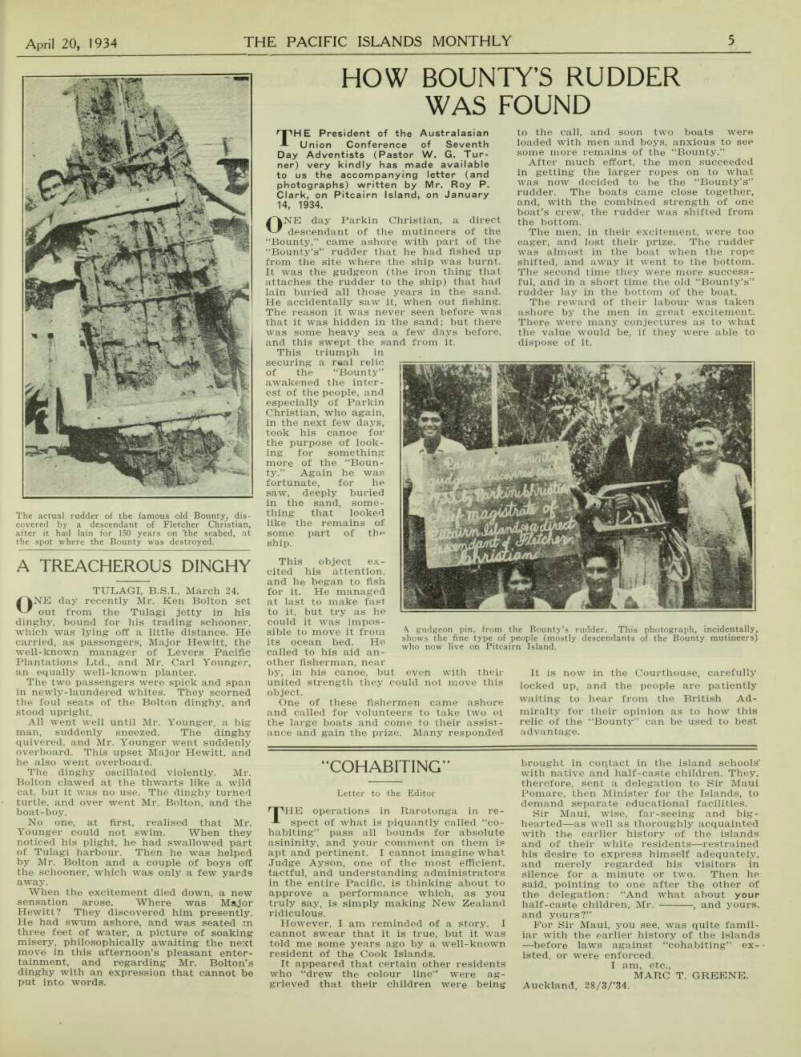
How Bounty’S Rudder
THE President of the Australasian Union Conference of Seventh Day Adventists (Pastor W. G. Turner) very kindly has made available to us the accompanying letter (and photographs) written by Mr. Roy P.
Clark, on Pitcairn Island, on January 14, 1934.
ONE day Parkin Christian, a direct descendant of the mutineers of the “Bounty,” came ashore with part of the “Bounty’s” rudder that he had fished up from the site where the ship was burnt.
It was the gudgeon (the iron thing that attaches the rudder to the ship) that had lain buried all those years in the sand.
He accidentally saw it, when out fishing.
The reason it was never seen before was that it was hidden in the sand; but there was some heavy sea a few days before. and this swept the sand from it.
This triumph in
securing a real relic of the “Bounty” awakened the inter est of the people, and especially of Parkin Christian, who again, in the next few days, took his canoe for the purpose of look ing for something more of the “Boun ty.” Again he was fortunate, for he saw, deeply buried in the sand, some thing that looked like the remains of some part of the ship.
This object ex cited his attention, and he began to fish for it. He managed at last to make fast to it, but try as he could it was impos sible to move it from its ocean bed. He called to his aid an other fisherman, near
by, in his canoe, but even with their united strength they could not move this object.
One of these fishermen came ashore and called for volunteers to take two of the large boats and come to their assistance and gain the prize. Many responded
to the call, and soon two boats were loaded with men and boys, anxious to see some more remains of the “Bounty.”
After much effort, the men succeeded in getting the larger ropes on to what was now decided to be the “Bounty's” rudder. The boats came close together, and, with the combined strength of one boat’s crew, the rudder was shifted from the bottom.
The men, in their excitement, were too eager, and lost their prize. The rudder was almost in the boat when the rope shifted, and away it went to the bottom.
The second time they were more success ful, and in a short time the old “Bounty’s” rudder lay in the bottom of the boat.
The reward of their labour was taken ashore by the men in great excitement, There were many conjectures as to what the value would be, if they were able to dispose of it.
It is now in the Courthouse, carefully locked up, and the people are patiently waiting to hear from the British Ad miralty for their opinion as to how this relic of the “Bounty” can be used to best advantage.
A gudgeon pin, from the Bounty’s rudder. This photograph, incidentally, shows the fine type of people (mostly descendants of the Bounty mutineers) who now live on Pitcairn Island.