Conditions In French Oceania
p. 34 · Read in the full issue
New Governor Gives Inspiring Lead
From Our Own Correspondent, PAPEETE, February 2.
THE first session of the Financial and Economic Delegation was opened re cently by His Excellency Governor Mon tagne.
This body, which acts mainly in a con sultative and advisory capacity, but has the power of veto over projected expendi tures which are not obligatory, was organised recently to assist the local Ad ministration in finding solutions for many pressing problems which present them selves during this critical period in the history of the Colony.
In presenting the Budget for 1934 Mon sieur Montagne said that since his arrival in Tahiti in June last he had made a close study of those economic and budgetary questions, the rapid solution of which was of the first importance to the future of the Colony. Everywhere he had travelled in the pursuit of his investigations, in Tahiti, in the Leeward Group, and in the Tuamoto Archipelago, he had been assist ed with the same fine spirit of loyal co operation.
The estimated Administrative revenue for 1934 was placed at 15,400,000 francs, the same as 1933, and the estimated ex penditure at the same figure, but it was considered as highly improbable that this amount would all be utilised. Discussing the deficit accumulated during the years 1931 and 1933, which totalled over 7,000,000 francs, Monsieur Montagne said that, on the proposition of the Minister for the Colonies, the Home Parliament had voted 5,490,000 francs towards its diminution.
Taking the figures for 1913 —the only normal year during the period covered by his studies —as a basis for comparison of Administrative expenses, His Excellency found that the ratio of increase for 1931 worked out at 7.30, and for 1934 (esti mated) 5.83; the latter figure being not very much in excess of 1913 when the depreciated value of the franc was taken into account. He considered that the re
duction achieved during the past three years represented a very real effort to wards the readjustment of expenses to meet diminished resources, and that the figures revealed a situation which might be regarded with envy by many other countries.
In the very admirable portion of his speech dealing with education and pub lic health Monsieur Montagne held out no hope of reduction in the amounts allo cated for these important services. He took a lofty view of their duties towards the Polynesian natives, who were so very dear to France. Such redoubtable enemies as leprosy, tuberculosis and elephantitis, would not yield to the magic of vain speeches; they must be prepared for a long and arduous struggle. He had al ready arranged that women born in the Colony should in future be admitted free into the Maternity Hospital at Papeete, and planned to have two more institutions of the same sort working in 1934, one in Moorea, and the other in Borabora. The attention of the Home Government had already been directed towards this ques tion of public health, and the financial aid necessary for the mobilisation of their protective forces against disease, and he was inclined to believe that the matter would now be taken up as one of national importance.
After discussing the trade statistics of the Colony for 1933, and the copra bonus now in operation—matters which have already been commented upon in these notes —Monsieur Montagne said that he would not fail to acquaint the Home Government with the special conditions which were responsible for a relatively high Administrative expense; the disper sal of the islands over an enormous area of ocean, the sparsity and numerical un importance of the population, and the great distance from France and from other great political and commercial centres of the world.
With the object of improving the grade of cattle in the Colony, and ensuring a better supply of fresh milk, Monsieur Montagne said that the Administration were importing animals from the best obtainable breeds, and would establish a stud service in the experimental gardens at Mamao. Of interest also to landowners was the announcement of the opening of the “Credit Mutuel Agricole,” which, in the absence of a land or mortgage bank, would encourage co-operation and assist small proprietors in the development of their enterprises.
Monsieur Montagne considered that the geographical situation of Tahiti midway between the Panama Canal and Australia gave it a unique value from a tourist
standpoint, and he fully realised the im portant role played by international tourism in the prosperity of the Colony, and of Papeete in particular. As with other industries, the equipment necessary for the expansion of the tourist industry within these beautiful islands must be augmented and improved by continuous effort, persevering, prudent, and French, and he advocated supporting the propa ganda of the Tourist Association in order that our little Capital might become favourably known as the centre of tourism. (A special Commission, working in conjunction with the Tourist Associa tion, has since been appointed, and is charged with the duty of establishing a plan of touristic improvements to be undertaken during 1934.)
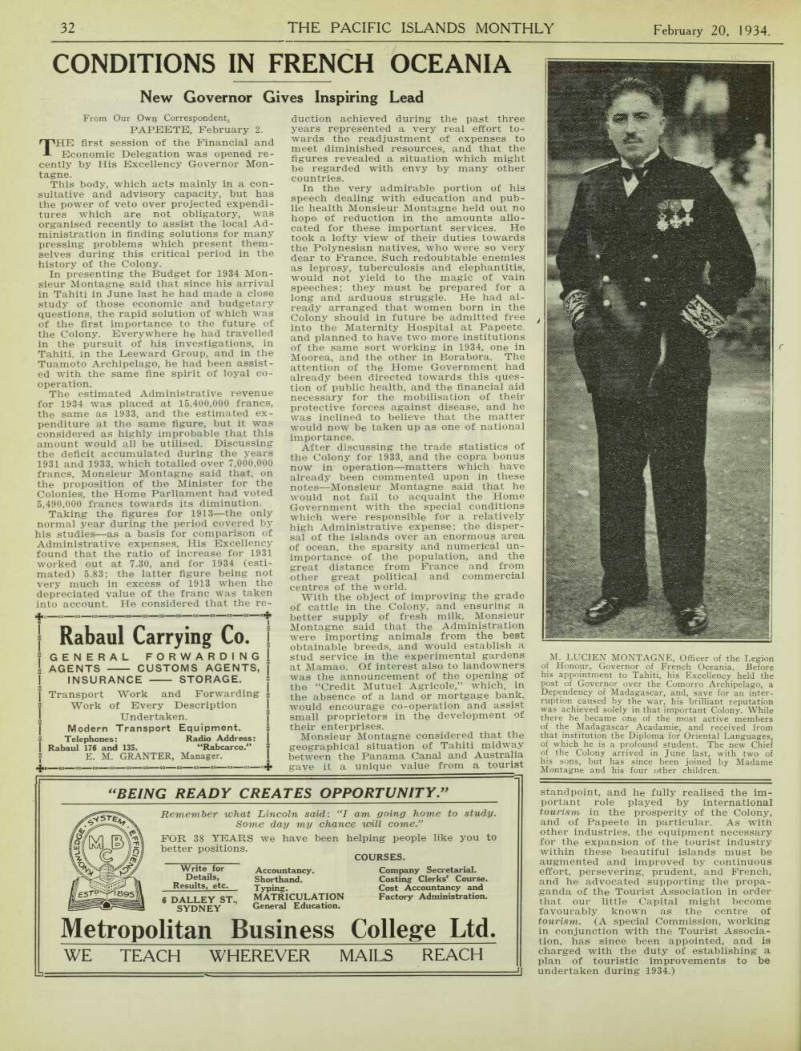
M. LUCIEN MONTAGNE, Officer of the Legion of Honour, Governor of French Oceania. Before his appointment to Tahiti, his Excellency held the post of Governor over the Comorro Archipelago, a Dependency of Madagascar, and, save for an inter ruption caused by the war, his brilliant reputation was achieved solely in that important Colony. While there he became one of the most active members of the Madagascar Acadamie, and received from that institution the Diploma for Oriental Languages, of which he is a profound student. The new Chief of the Colony arrived in June last, with two of his sons, but has since been joined by Madame Montagne and his four other children.