Mr. O. F. Nelson In Reply
pp. 23-24 · Read in the full issue
Letter to the Editor
YOUR editorial references to the situation in Western Samoa and to my self, in your issue of December 21, 1933, need correction in many places, for which I trust you will allow me space.
Your long commentary (page 31) under the caption “Mr. Nelson and Mr. Greene” throws a very prejudicial light on the letters written by me to Mr. Greene, in the effort to correct the wrong impres sions likely to be made on the public mind by his abusive remarks about me in his reports to the American and New Zealand press. The very manner and language adopted by Mr. Greene towards me in those reports must cause every un biassed person to feel that they could not but have been prompted by motives other than just to give his readers a fair view of the unhappy situation in Samoa.
His rather extreme resentment of what he called gross “discourtesy,” because two Mau chiefs and I did not return his casual calls, must show this. No such resentment was shown when Mr. Greene called on my office and my home in Auck land several times, without the least suggestion that he expected me to return any of his calls. I have not heard of the others he called on here having returned his call. I did not invite him to call at my home here, because I felt such might prejudice his position with the Adminis tration.
I wrote him a personal letter of protest against his first letter to an Auckland newspaper from here. He replied to say that he positively refused to have a con troversy with me through the post. I therefore published my next letter to him in regard to the “S.P. Chronicle” article.
You now say that article was not unduly offensive. But you say that my “attacks on Mr. Greene have been hysterical, savage and unbalanced.” You say nothing about my challenge, which Mr. Greene did not take up, nor of the sinister sugges tions in his articles of how to deal with the situation which the Government have now followed.
I suggested the Fono (conference) with the Administrator to the Samoans. The Administrator did not “flatly” refuse to meet me with the Samoans when my name was first mentioned. The Samoans well remember my participation in simi lar Fonos on previous occasions with the expressed approval of former Adminis trators. So soon as I learnt of the Ad ministrator’s objection to my presence at the Fono, I earnestly advised the Samoans to hold the conference without me. When they refused to hear of this, I definitely urged them the second time.
They persisted, and the Administrator then cancelled the Fono he had agreed to,
though the Samoans had complied with all his original demands. You now say that my attitude towards Mr. Greene proves that I was “the very last man who should be admitted to such a conference.”
Why?
In your leading editorial of the same issue (page 3, paragraph 4), you refer to “the period between 1923 and 1930, when the Administrators placed in Samoa by the New Zealand Government created a very unfortunate and undesirable condition of affairs ” In the last paragraph of that editorial, you referred to me as “the outstanding victim of the dis-
credited Administrations which New Zealand established in the Territory be tween 1923 and 1930.” You have only to read the report of the Samoa Royal Com mission, 1927, to find that the Govern ment’s purpose was to show that whereas serious blunders might have been made by former Administrators, the advent of General Richardson in March, 1923, was the beginning of better times all round for Samoa; that the good progress, ad vancement and happiness of all the in habitants of the Territory were only dis turbed by the appearance of the “lying prophet” in September, 1926. He told the Royal Commission that he referred to me as “the lying prophet.” He had, however, often sought my advice and assistance on Samoan affairs before that.
General Richardson was replaced by Colonel Allen in April, 1928, so he must bear some of the blame for “the period of 1923 to 1930,” Col. Allen has been knighted for his services in Samoa. You now say that the appointment of General Hart to Samoa proves “a change of heart in Wellington regarding Samoan affairs.”
You refer to the present Administrator as “a man with a better understanding of Samoan character and with genuine de sire to reconcile the differences between the Administration and the Mau.” That has been said of every new Administrator who ever came to Samoa, but the trouble persisted simply because not one of them was allowed to satisfy the grievances of the Samoans. These were allowed to in crease very materially.
You support the present actions of the Administration and think they will settle
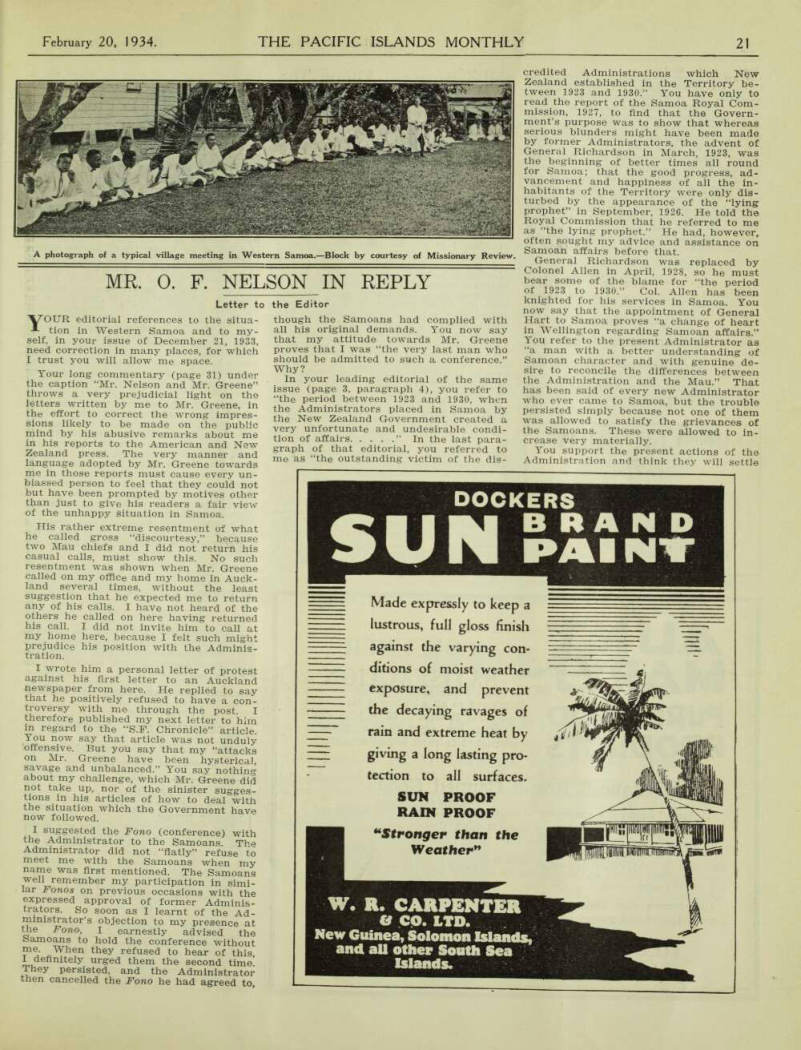
A photograph of a typical village meeting in Western Samoa.—Block by courtesy of Missionary Review.
the trouble and break up the Mau. That is not consistent with your previous sug gestions that nothing will bring a per manent settlement about except a round table conference on equal status. That is what the Samoans have been asking for since my return from exile. The Mau will not break up otherwise.
You express the “hope that the New Zealand Government, in the case of Mr.
Nelson, and for the sake of British pres tige in the South Seas, will be generous” as “it can afford to be.” I have never pleaded for generosity for the Samoans or myself, and expect none. All we have asked for, and still ask for, is common justice. When that will be allowed by the Mandatory is the main question.
I am, etc.,
O. F. Nelson (Taisi).
“Tuaefu,”
Samoa. 19/l/’34., Mr. Newrich (touring in his new car): “Where are we now?”
Chauffeur: “Half-way between Paris and Marseilles, sir.”
Mr. Newrich: “Don’t bother me with niggling little details. What country are we in?”