Germany And The Mau
pp. 21-22 · Read in the full issue
How Shrewd Dr. Solf Avoided Samoan Rising in 1908
From Our Samoan Correspondent.
CONSIDERING the recent startling events in Samoa and the strong action the New Zealand Administration has undertaken against the “Mau” Move ment, reminiscences of Dr. Solf, the first German Governor of Samoa, and later a member of the German Cabinet, which were recently published in the German press, are of special interest.
Dr. Solf, under the heading of “Thun derstorm over Samoa,” relates the facts of the attempted uprising of the high chief Lemati in 1908, and the means by which this uprising was successfully sup pressed, with the help of the German Navy.
It was during a severe illness of the “grand old man of Samoa — Mataafa, the highest chief, respected and obeyed by all the Samoan factions. As he was ex pected to die hourly, the question of his successor was ventilated, and all the fac tions had their candidates ready to pre sent to the Imperial German Government.
The real rulers of the Samoan people were the Association of Chief Spokesmen—the Fumua and Pule, the king-makers, who at the same time were also responsible for and guilty of continuous unrest and fighting in the country. Dr. Solf had tried to abolish their rulership, but this revolutionary change could hardly be brought about by a stroke of the pen.
The leading representative of Pule, the “highest spokesman chief” (tulafale), Lauati, in the name of the Pule and Fumua, promised his support and finan cial assistance to the various candidates for kingship. Addressing the masses of the Samoans—politically indifferent and ignorant—in vigorous speeches, he at tacked the payment of a poll tax to the Imperial Government as lowering tne Samoans’ self-respect and aiming to have young Samoans do coolies’ work, like Chinamen . . .
Lauati, by his eloquence and his high standing, reached his aim—a large ma jority of Samoans supported him. In a grand and impressive meeting the de mands of the Samoans were to be formu lated and presented to the Governor, Dr.
Solf. Nothing was known about Lauati’s intentions after his demands were re fused. Apparently the future did not worry him. He would have resisted an order to go home to Savaii—his own island—and perhaps open revolt would have followed.
Dr. Solf, aware of the dangers of the situation, now took action. The demon stration meeting was forbidden, the natives prohibited from visiting Apia, the capital and seat of Government.
These measures seemed to invite Lauati to come out into the open. With two large parties, Lauati came to Apia, at the same time sending agents all over the islands to induce people to disobedience, and recruiting adherents for the “pat motu-Samoans” Movement the first Samoan “Mau.”
Dr. Solf went himself to Savaii, Lauati’s tribal seat, where his power and influence were paramount. Dr, Solf had no mili tary and police force at his disposal, and could not hope to force developments.
Diplomacy was the watchword of the hour! So Dr. Solf made a speech on the common (malae) to the assembled
Samoans, trying to bring them back to reason and to effect a peaceful settlement of the pending conflict. He summoned Lauati to appear before him.
But Lauati, to demonstrate his power, mobilised all Savaii, and arrived this time with a force of 25 large boats. Solf wrote —“I have invited only yourself, and shall see only yourself.”
Lauati replied—“My men have come with me, to say a last ‘tofa’ (farewell) to me, in case I shall be deported or hanged” . . .
Alarming reports came to hand. Black painted Samoans were approaching Apia with war-knives and in war-like mood.
They could have pillaged Apia within a few hours. Lauati was reported to have gathered his warriors at Vasusu, at the very gates of Apia.
Dr. Solf hastened to fetch Mataafa, just recovered from his illness, and took him in his carriage to Vasusu, accom panied only by his A.D.C. and an inter preter, to see Lauati. Not a minute was
to be lost, to save the dangerous situation.
At Vasusu, Lauati came out to welcome the Governor, who ignored his out stretched hand.
“The Samoans spoil everything,” said Lauati.
“No,” Dr. Solf replied, “It is you who are spoiling the Samoans.”
At the Vasusu meeting-house scenes of dramatic force were enacted. A debate of extraordinary intensity occurred be tween two adversaries of surpassing elo quence—Dr. Solf and Lauati. Both ad dressed the meeting, and Lauati’s speech —according to Dr. Solf —was a master piece of colourful and flowery Samoan rhetoric and diplomacy.
The scene ended in conciliation all round —between Dr. Solf, Mataafa, and Lauati, the latter promising obedience, if he would be pardoned. To all outward appearances the game was won.
But the same day a new report reached Dr. Solf. The chiefs of the Tumua party had asked the Imperial Government for rifles—to capture Lauati and chase off his men. Dr. Solf, refusing their request, was relieved to find that a strong opposi tion against Lauati had arisen among the Samoans.
Lauati had not gone to Savaii, but to Manovno, the island allied to him. The news reaching Apia grew alarming. The Tumua Party had taken the war path; its warriors were on the way to Apia to
obtain rifles and start the fight against Lauati.
Dr. Solf gave strict orders to keep the peace. The war fever had infected even the German and other European settlers.
A spark might now explode the powder cask. Dr. Solf at once took up communi cation with his Government in Berlin, and despatched a cable, asking for the assistance of three warships, to be sent as quickly as possible.
Five weeks of anxious waiting fol lowed—then at last came a cable—the warships should arrive in another fort night. Dr. Solf pursued a waiting policy —he avoided all measures and steps by which the Samoans might be driven to sudden decisions, and left them to wonder at the strange inactivity of the Govern ment.
At last S.M.S. “Leipzig,” “Ariona,” and
“Jaguar,” with the tender “Titania,” arrived off Apia. It was high time, now, to act decisively. The loyal chiefs could not prevent the outbreak of hostilities any longer—it was expected any minute now.
But the arrival of the warships changed the situation. The German Admiral, Cooper, informed by Dr. Solf of the situa tion, was with difficulty persuaded to de lay warlike actions and use diplomacy, as Dr. Solf desired. A proclamation was printed, requesting Lauati and other rebels to surrender within eight days.
Three days after the issue of the proc lamation the reply came—the rebels re fused to obey and prepared, with their adherents, to flee to the bush. Informa tion came to hand, furthermore, that already large quantities of provisions were taken to the bush.
A new fono (general meeting) of Samoans decided by a majority, com prised of Lauati’s adherents, not to give in, but to fight.
But now the missions acted. They induced a number of the leaders to sur render peacefully, and their defection left only Lauati and his closest friends and relations in favour of a bush war. In any case, a bush war was a most un pleasant prospect to the Government — meaning a blockade for an indefinite period and the necessity to order larger military forces from Germany. This had to be avoided.
But the ultimatum expired, and no Lauati had appeared. Admiral Cooper sent the “Titania” and “Ariona” to Savaii, Lauati’s island home. On board was Dr.
Solf. When two hours from Apia a sig nal mate rushed up to Dr. Solf with a message from the “Leipzig.” It read: “Have Lauati and five chiefs on board.”
Lauati had surrendered after all!
The worry and excitement of the last weeks disappeared magically. An import ant step forward in the peaceful develop ment of the Protectorate had been taken.
Lauati and nine of his chiefly followers were banned and deported to the island of Saipan.
Doubtless the success and the bloodless solution of the difficult political problem were mainly due to the masterful diplo macy and skilful strategy of Dr. Solf, who had a wonderful knowledge of the native psychology and was able to fight the Samoans with their own weapons, and beat them at the game.
The New Zealand Administration —20
years later—could well have taken a leaf from the pages of the history of German administration in Samoa. Then a struggle, which might have lasted only weeks, would not have grown into a protracted disturbance of as many years, and an immense amount of trouble and expense would have been saved.
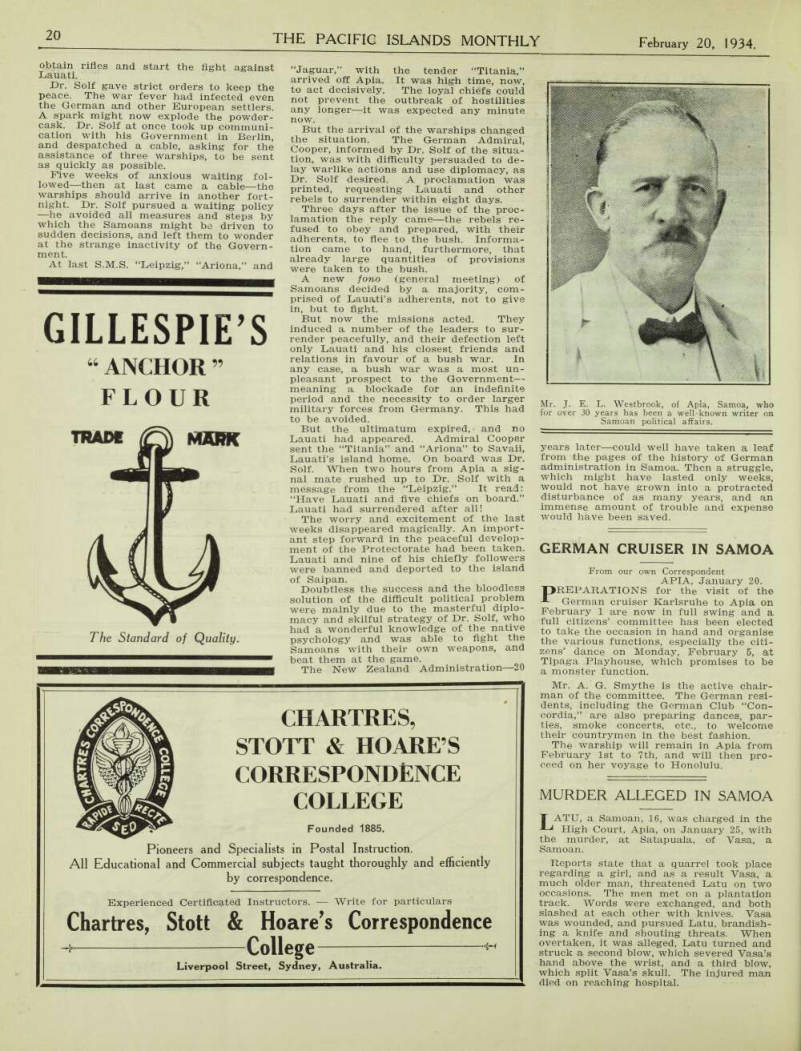
Mr. J. E. L. Westbrook, of Apia, Samoa, who for over 30 years has been a well-known writer on Samoan political affairs.