Japanese Poachers Fired On
p. 26 · Read in the full issue
Stirring Incident at Isolated New Guinea Plantation
THE methods employed by Japanese trocas poachers, and their attitude towards the European occupiers of the Islands concerned, are described in the following letter written by Mr. S. C. Thompson, of Awinn Plantation, Awinn Island, Ninigo Group, Mandated Territory of New Guinea, to the Editor of the “Pacific Islands Monthly.” The Ninigo Group lies off the northern coast of New Guinea, 150 miles due north of the mouth of the Sepik River.
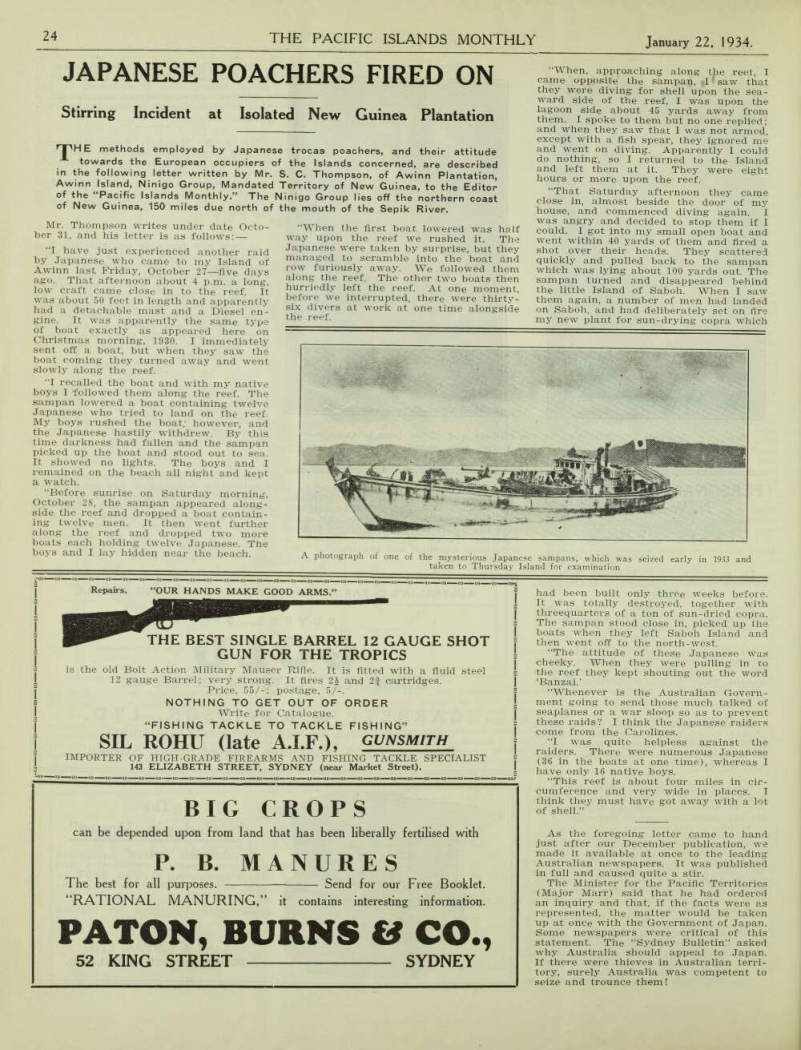
Mr. Thompson writes under date Octo ber 31, and his letter is as follows; “I have just experienced another raid by Japanese who came to my Island of Awinn last Friday, October 27 —five days ago. That afternoon about 4 p.m. a long, low craft came close in to the reef. It was about 50 feet in length and apparently had a detachable mast and a Diesel en gine. It was apparently the same type of boat exactly as appeared here on Christmas morning, 1930. I immediately sent off a boat, but when they saw the boat coming they turned away and went slowly along the reef.
“I recalled the boat and with my native boys I followed them along the reef. The sampan lowered a boat containing twelve Japanese who tried to land on the reef.
My boys rushed the boat; however, and the Japanese hastily withdrew. By this time darkness had fallen and the sampan picked up the boat and stood out to sea.
It showed no lights. The boys and I remained on the beach all night and kept a watch.
“Before sunrise on Saturday morning, October 28, the sampan appeared along side the reef and dropped a boat contain ing twelve men. It then went further along the reef and dropped two more boats each holding twelve Japanese. The boys and I lay hidden near the beach.
“When the first boat lowered was half way upon the reef we rushed it. The Japanese were taken by surprise, but they managed to scramble into the boat and row furiously away. We followed them along the reef. The other two boats then hurriedly left the reef. At one moment, before we interrupted, there were thirty six divers at work at one time alongside the reef.
“When, approaching along the reel, I came opposite the sampan, I saw that they were diving for shell upon the sea ward side of the reef, I was upon the lagoon side about 45 yards away from them. I spoke to them but no one replied; and when they saw that I was not armed, except with a fish spear, they ignored me and went on diving. Apparently I could do nothing, so I returned to the Island and left them at it. They were eight hours or more upon the reef.
“That Saturday afternoon they came close in, almost beside the door of my house, and commenced diving again. I was angry and decided to stop them if I could. I got into my small open boat and went within 40 yards of them and fired a shot over their heads. They scattered quickly and pulled back to the sampan which was lying about 100 yards out. The sampan turned and disappeared behind the little Island of Saboh. When I saw them again, a number of men had landed on Saboh, and had deliberately set on fire my new plant for sun-drying copra which
had been built only three weeks before.
It was totally destroyed, together with threequarters of a ton of sun-dried copra.
The sampan stood close in, picked up the boats when they left Saboh Island and then went oft to the north-west.
“The attitude of these Japanese was cheeky. When they were pulling in to the reef they kept shouting out the word ‘Banzai.’
“Whenever is the Australian Govern ment going to send those much talked of seaplanes or a war sloop so as to prevent these raids? I think the Japanese raiders come from the Carolines.
“I was quite helpless against the raiders. There were numerous Japanese (36 in the boats at one time), whereas I have only 16 native boys.
“This reef is about four miles in cir cumference and very wide in places. I think they must have got away with a lot of shell.”
As the foregoing letter came to hand just after our December publication, we made it available at once to the leading Australian newspapers. It was published in full and caused quite a stir.
The Minister for the Pacific Territories (Major Marr) said that he had ordered an inquiry and that, if the facts were as represented, the matter would be taken up at once with the Government of Japan.
Some newspapers were critical of this statement. The “Sydney Bulletin” asked why Australia should appeal to Japan.
If there were thieves in Australian terri tory, surely Australia was competent to seize and trounce them!
A photograph of one of the mysterious Japanese sampans, which was seized early in 1933 and taken to Thursday Island for examination.