Discoveries In New Guinea
p. 24 · Read in the full issue
MUCH interest has been shown in the article and photographs published in the December issue of this journal, de scribing—for the first time —the newly discovered peoples and territory in Cen tral New Guinea visited recently by Mr.
Taylor, A.D.O., and Messrs. D. and M.
Leahy.
In this connection, it is worth recalling
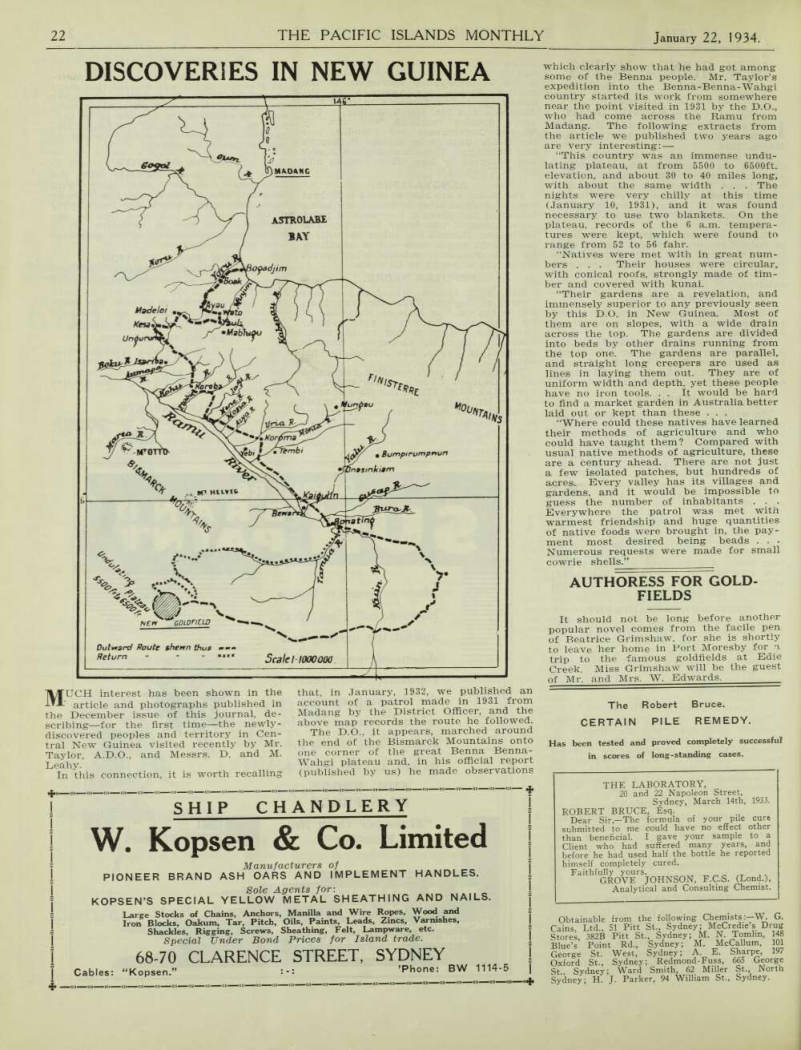
that, in January, 1932, we published an account of a patrol made in 1931 from Madang by the District Officer, and the above map records the route he followed.
The D. O., it appears, marched around the end of the Bismarck Mountains onto one corner of the great Benna Benna- Wahgi plateau and, in his official report (published by us) he made observations
which clearly show that he had got among some of the Benna people. Mr. Taylor’s expedition into the Benna-Benna-Wahgi country started its work from somewhere near the point visited in 1931 by the D. O., who had come across the Ramu from Madang. The following extracts from the article we published two years ago are very interesting: “This country was an immense undu lating plateau, at from 5500 to 6500 ft. elevation, and about 30 to 40 miles long, with about the same width . . . The nights were very chilly at this time (January 10, 1931), and it was found necessary to use two blankets. On the plateau, records of the 6 a.m. tempera tures were kept, which were found to range from 52 to 56 fahr.
“Natives were met with in great num bers . . . Their houses were circular, with conical roofs, strongly made of tim ber and covered with kunai.
“Their gardens are a revelation, and immensely superior to any previously seen by this D.O. in New Guinea. Most of them are on slopes, with a wide drain across the top. The gardens are divided into beds by other drains running from the top one. The gardens are parallel, and straight long creepers are used as lines in laying them out. They are of uniform width and depth, yet these people have no iron tools. . . It would be hard to find a market garden in Australia better laid out or kept than these . . .
“Where could these natives have learned their methods of agriculture and who could have taught them? Compared with usual native methods of agriculture, these are a century ahead. There are not just a few isolated patches, but hundreds of acres. Every valley has its villages and gardens, and it would be impossible to guess the number of inhabitants . . .
Everywhere the patrol was met with warmest friendship and huge quantities of native foods were brought in, the pay ment most desired being beads . . - Numerous requests were made for small cowrie shells.”