Indian Agitators
p. 36 · Read in the full issue
“Common Roll” Problem in Fiji.
GUARDED but very interesting reference to the Common Roll problem in Fiji was made by Sir Henry Milne Scott, of Suva, in an address at the Millions Club, Sydney, on December 11.
Sir Henry briefly described the position existing in Fiji—the attempt to provide in the Legislative Council, through com munal rolls, adequate representation for 5,000 Europeans, 90,000 Fijians, and 70,000 Indians, while ensuring that the control of the Colony by Europeans should not be interfered with. He indicated that while the majority of Indians are satisfied with present conditions, there is a minority which conducts a ceaseless agitation for the Common Roll —that is, that an Indian shall have the same voting power as a European.
Sir Henry expressed his opinion that the present system is as near to the ideal as practical considerations will permit—a view that will be heartily endorsed by every intelligent observer. But he gave a hint, also, that the British Colonial Office is under constant pressure from the India Office to give greater political concessions to those Indian agitators in Fiji, and that there is always a danger that a very dif
ficult situation will develop in this Crown Colony.
It is to be hoped that the Fiji Govern ment will hold staunchly to the policy which has worked so admirably up to the present and brought Fiji into its present satisfactory condition. It may be that the time has come for very plain speaking— when the Indian agitators must be told that as a matter of practical politics, based on scientific fact, Indians in any part of the British Empire cannot expect to be given a franchise equal to that of the British themselves. A firm line should be taken in Fiji. If these agitating Indians are dissatisfied with the conditions there they should be promptly shipped back to India. Under such conditions the nuisance would very soon disappear.
Some tar and a few feathers might also be provided for some of the dreamy ideal ists who ignore ethnographical facts and persuade our coloured friends that, in the science of Government, all men may be regarded as equal.
Mr. Grand, new manager at Norfolk Island, for Messrs. Burns, Philp (South Seas) Co., Ltd., is winning golden opinions for his kindness and courtesy, allied to keen business ability (says our N.I. cor respondent). Madame, born and brought up in Paris, is a tower of strength on the social side —bringing gaiety and laughter into any party with her quick wit and pretty broken English, They are a real addition to the island.
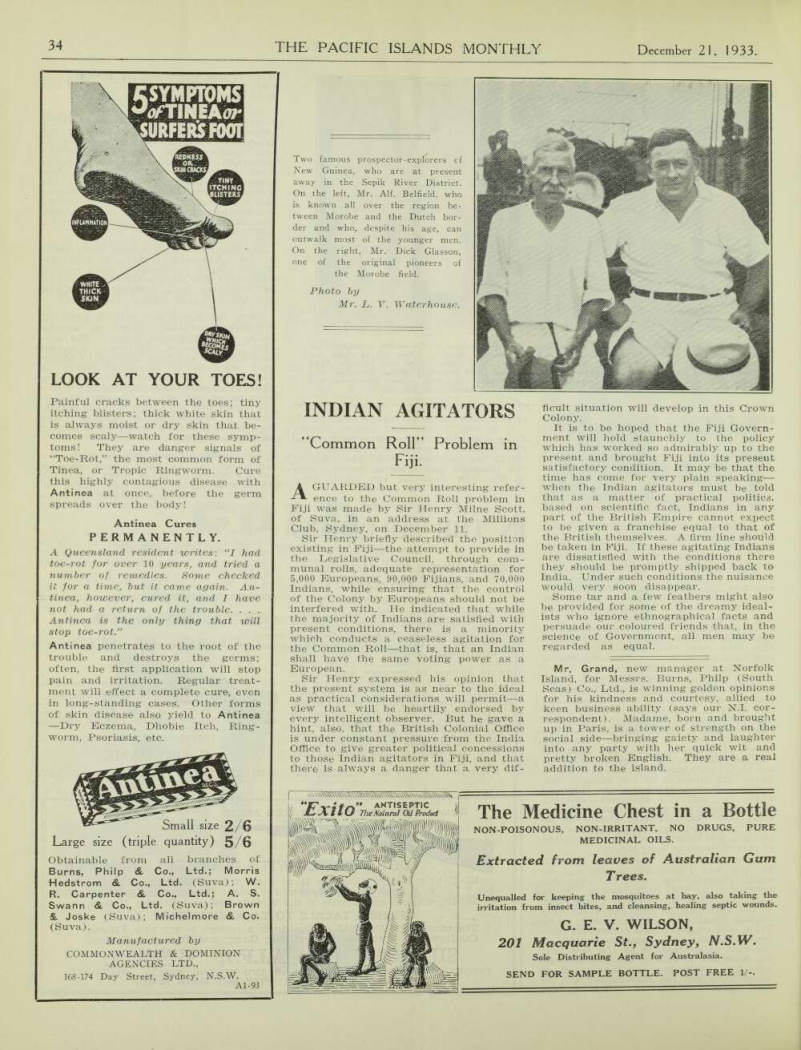
Two famous prospector-explorers of New Guinea, who are at present away in the Sepik River District.
On the left, Mr. Alf. Belfield, who is known all over the region be tween Morobe and the Dutch bor der and who, despite his age, can outwalk most of the younger men.
On the right, Mr. Dick Glasson, one of the original pioneers of the Morobe field.
Photo by Mr. L. V. Waterhouse.