French Copra Tax
p. 32 · Read in the full issue
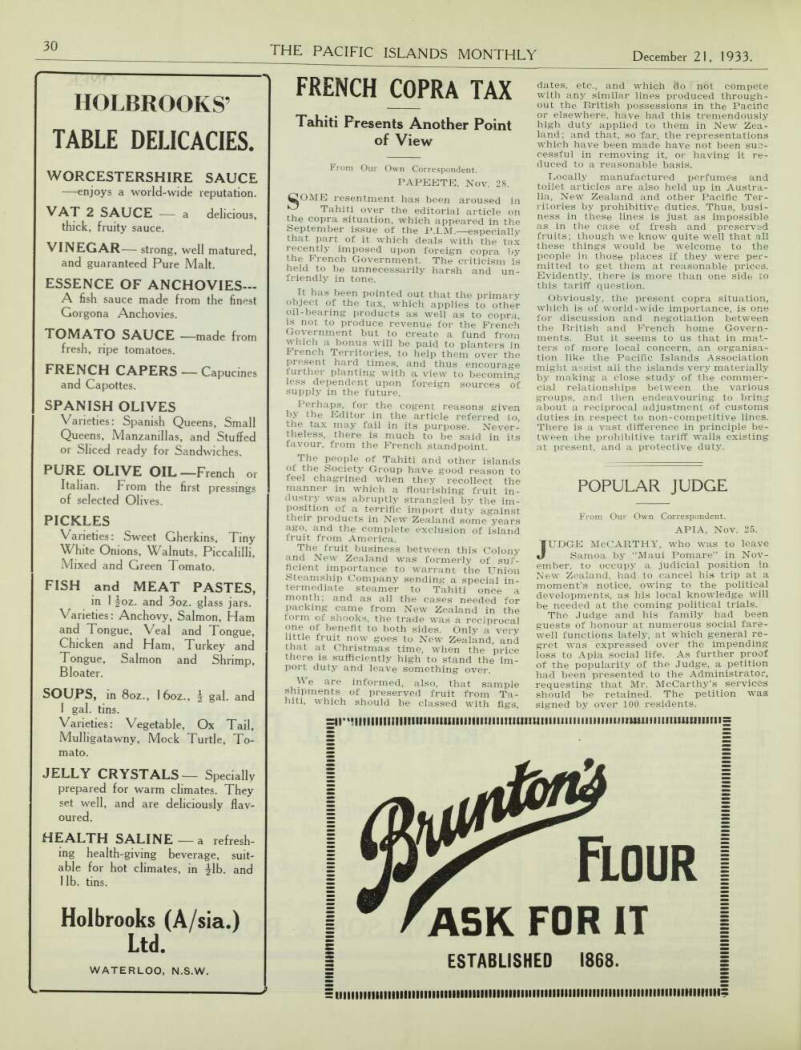
Tahiti Presents Another Point of View
From Our Own Correspondent.
Papeete, Nov. 28.
Some resentment has been aroused in Tahiti over the editorial article on the copra situation, which appeared in the September issue of the P.I.M.—especially that part of it which deals with the tax recently imposed upon foreign copra by the French Government. The criticism is held to be unnecessarily harsh and un friendly in tone.
It has been pointed out that the primary object of the tax, which applies to other oil-bearing products as well as to copra, is not to produce revenue for the French Government but to create a fund from which a bonus will be paid to planters in French Territories, to help them over the present hard times, and thus encourage further planting with a view to becoming less dependent upon foreign sources of supply in the future.
Perhaps, for the cogent reasons given by the Editor in the article referred to, the tax may fail in its purpose. Never theless, there is much to be said in its favour, from the French standpoint.
The people of Tahiti and other islands of the Society Group have good reason to feel chagrined when they recollect the manner in which a flourishing fruit in dustry was abruptly strangled by the im position of a terrific import duty against their products in New Zealand some years ago, and the complete exclusion of island fruit from America.
The fruit business between this Colony and New Zealand was formerly of suf ficient importance to warrant the Union Steamship Company sending a special in termediate steamer to Tahiti once a month; and as all the cases needed for packing came from New Zealand in the form of shooks, the trade was a reciprocal one of benefit to both sides. Only a very little fruit now goes to New Zealand, and that at Christmas time, when the price there is sufficiently high to stand the im port duty and leave something over, W e are informed, also, that sample shipments of preserved fruit from Ta hiti, which should be classed with figs,
dates, etc., and which do not compete with any similar lines produced through out the British possessions in the Pacific or elsewhere, have had this tremendously high duty applied to them in New Zea land; and that, so far, the representations which have been made have not been suc cessful in removing it, or having it re duced to a reasonable basis.
Locally manufactured perfumes and toilet articles are also held up in Austra lia, New Zealand and other Pacific Ter ritories by prohibitive duties. Thus, busi ness in these lines is just as impossible as in the case of fresh and preserved fruits; though we know quite well that all these things would be welcome to the people in those places if they were per mitted to get them at reasonable prices.
Evidently, there is more than one side to this tariff question.
Obviously, the present copra situation, which is of world-wide importance, is one for discussion and negotiation between the British and French home Govern ments. But it seems to us that in mat ters of more local concern, an organisa tion like the Pacific Islands Association might assist all the islands very materially by making a close study of the commer cial relationships between the various groups, and then endeavouring to bring about a reciprocal adjustment of customs duties in respect to non-competitive lines.
There is a vast difference in principle be tween the prohibitive tariff walls existing at present, and a protective duty.