Discoveries In New Guinea
pp. 13-17 · Read in the full issue
Centre of Main Island is Rich, Temperate Densely Populated Plateau
ONE of the most interesting geographical and ethnographical discoveries of recent years has been recorded recently in New Guinea; but has been announced with such modesty by the New Guinea Administration that neither the newspapers nor the general public have awakened yet to its importance.
Put in briefest fashion, the discovery amounts to this: In the hitherto unexplored centre of the great island of New Guinea, where it was assumed that there was simply a continuation of the precipitous mountains and miasmic jungles of the coastal districts, a large plateau of great fertility has been found. It is a wide expanse of rolling uplands, enjoying a temperate climate, and densely populated by a race, or races, or skilled agriculturists, whose existence was hitherto only vaguely suspected.
IT may be remembered that, in the Commonwealth Parliament a few weeks ago, the Minister in charge of Islands Territories, Major Marr, announced that Administration officials definitely had proved the existence of between 200,000 and 300,000 “new” inhabitants, in the hitherto unknown region in the centre of New Guinea, westward of the Morobe Goldfield. To the “Pacific Islands Monthly” has been accorded the privilege of publishing the first authentic account of this new country.
From Australia’s point of view, the dis covery has two important aspects. First, this is a rich country of definite agricul tural and pastoral value; second, the people are not primitive savages, but ap pear to be of a type superior to the bush “kanakas,” with a definite culture of their own.
Another important fact has been estab lished. Westward of this new country, there is another great region of similar character, lying between Mount Hagen and the Dutch border. It has not yet been penetrated by Europeans; but glimpses from lofty Mount Hagen (12,500 feet) and from an aeroplane which recently made a quick reconnaisance, show wide, rich up lands which have been developed agricul turally, and which apparently also carry a dense native population.
The first exploration of this new coun try (which, for convenience, is called the Benna Benna-Wahgi region) was carried out between March and July, of this year, by two expeditions, which joined and operated together for their mutual assist ance. One was under the direction of the New Guinea Administration, and was led by Assistant District Officer J. L. Taylor.
The other was fitted out by gold-mining interests, and was led by Messrs. M. J. and D. J. Leahy, two young Australians whose exploration work in New Guinea already has made them famous. Mr. Tay lor’s job was exploration, pure and simple; the Messrs. Leahy, of course, were prospecting for gold. Mr. Taylor was ac companied by Mr. Spinks, a surveyor.
Mr. Taylor and the Leahy Brothers ar rived in Sydney in November, having come directly out of the new country, and they were induced to give a lecture, illus trated with their own photographs and films, before the Anthropological Society of New South Wales. It was one of the most fascinating stories ever told to that learned body. Newspaper reporters were present: yet the explorers’ story was dis missed in a few words. None recognised that they were being told about one of
the last remaining bits of the unexplored world.
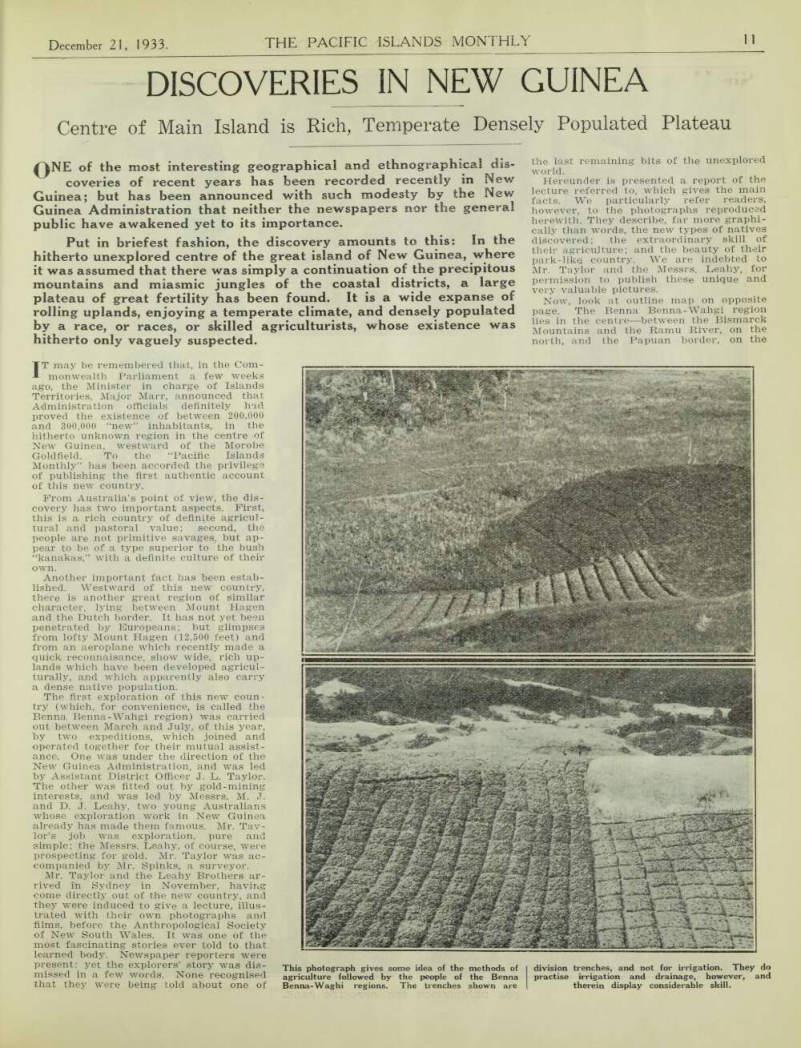
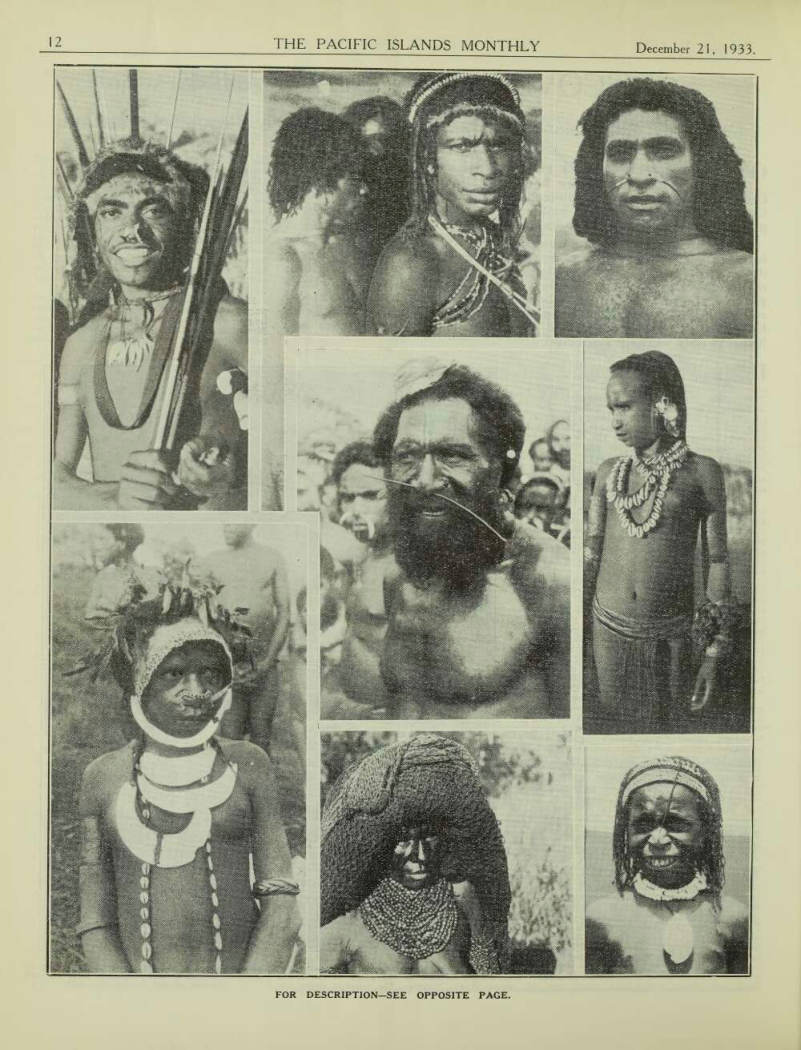
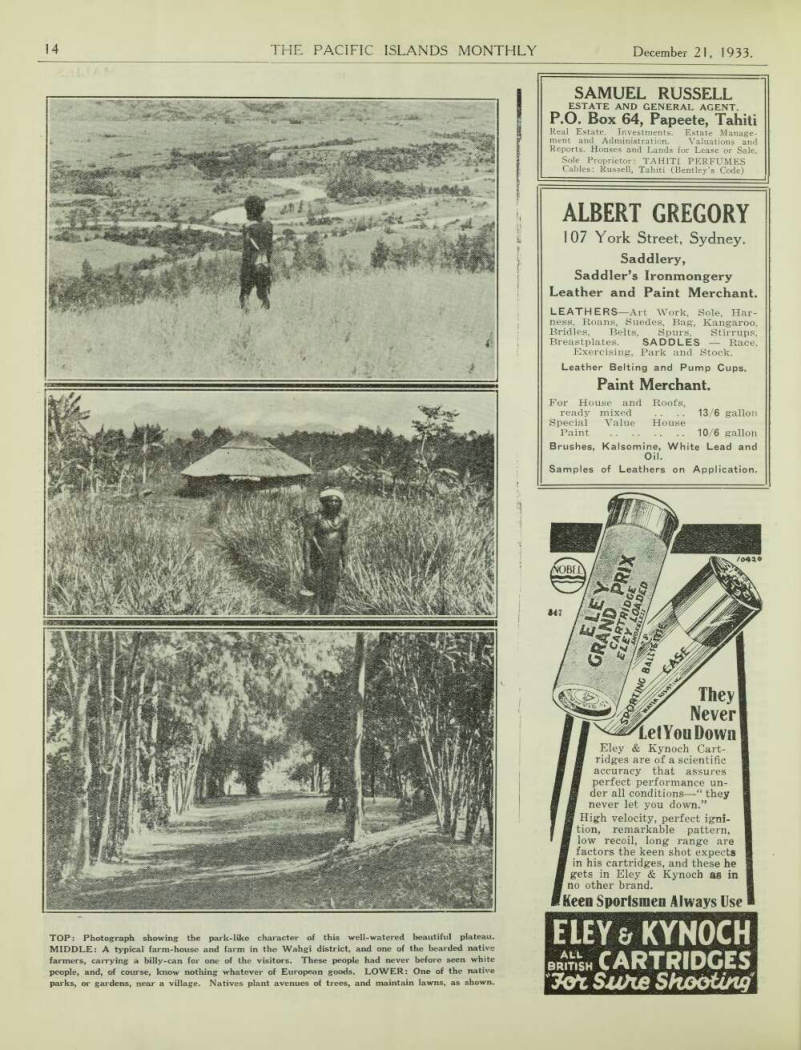
Hereunder is presented a report of the lecture referred to, which gives the main facts. We particularly refer readers, however, to the photographs reproduced herewith. They describe, far more graphi cally than words, the new types of natives discovered: the extraordinary skill of their agriculture; and the beauty of their park-like country. We are indebted to Mr. Taylor and the Messrs. Leahy, for permission to publish these unique and very valuable pictures.
Now, look at outline map on opposite page. The Benna Benna-Wahgi region lies in the centre —between the Bismarck Mountains and the Ramu River, on the north, and the Papuan border, on the
This photograph gives some idea of the methods of agriculture followed by the people of the Benna Benna-Waghi regions. The trenches shown are
division trenches, and not for irrigation. They do practise irrigation and drainage, however, and therein display considerable skill.
For Description—See Opposite Page.
south; and it extends from the head waters of the Markham River, and the Purari, in the east, across to Mount Hagen, in the west.
The combined parties, making a line of about 100, assembled in March at Benna Benna, near the Purari River, where there was a landing ground for aeroplanes. On March 27, 1933, the leaders were taken for a flight over the country to the west ward by Pilot O’Dea in a Holden aero plane, and so got a general idea of its features. They noted everywhere an abundance of native foodstuffs, which solved one of their main problems.
Magnificent Natural Park The expedition left next day, and marched slowly for 70 miles through a region of open grass valleys, with a very extensive river system—“probably that of the Purari, one of the largest rivers in.
New Guinea, which eventually flows southward into Papua, and empties into the Gulf of Papua.” It is worth noting that even very recent maps fail to show the Purari extending beyond the northern boundary of Papua.
The principal valley, as they worked northwestward from Benna Benna, was that of the Wahgi. It was some 5000 feet above sea-level, 60 miles long and 20 to 30 miles across. High, timbered ranges, on either side, rose to 14,000 feet, and
On the opposite page is a selection from the explorers’ photographs of the people of the Benna Benna and Wahgi districts, clearly showing the interesting types met with. The Benna Benna generally are clean-shaven—the Wahgi bearded.
Some of the faces are strikingly Phoenician in character; others show the Papuan, or negroid influence. The eagerness for personal adornment is demonstrated. Wealth, on these distant uplands, is measured by sea-shells. “Cowrie are shillings— the crescent-shaped shell ornaments are sovereigns.”
formed the boundaries of this magnificent natural park.
“When first seen, this great valley seemed illimitable, with an endless, tor tuous stream the Waghi flowing through its great grass plains and high terraces. Here and there park-like plan tations of casuarina dotted the pale-green landscape, and made a beautiful setting beneath the towering, timbered ranges of the mighty Bismarcks.
“The valley has a temperate climate, the temperature varying between 52 and 75 degrees Fahr.”
Seventy miles north-west of Benna Benna, the party prepared a landing ground and a Guinea Airways aeroplane came out to them, with Mr. Grabowsky as pilot.
In mid-April, the party pushed on for another 25 miles, to where the head waters of the Wahgi divided, and the country changed.
“A wide expanse of rolling downs ap peared before us. These downs, grass covered and volcanic in origin, extend for some 20 miles westerly, to the base of a high mountain block, apparently Mt.
Hagen. To the north and south the coun try falls away quickly to the Yuat Valley (a tributary of the Sepik) on one hand: and the Nebyer (a head water of the Purari) on the other.”
A base camp was established ten miles east of Mt. Hagen; a landing-ground for aeroplanes was cleared; and exploration work, which is the subject of a detailed official report, was carried out during May, June, July and August, Mt. Hagen was climbed, and a glimpse obtained of a great, unknown plateau to the west ward.
Mr. M. Leahy estimated that there were 300,000 natives living in the region be tween the Purari and Mt. Hagen. Mr.
Taylor thought they would number “over 200,000.” Both agreed that there was an even greater population westward of Mt.
Hagen.
Two Great Tribes.
“The people of the area from Benna Benna to Mt. Hagen appear to be of two great and distinct tribes,” said Mr. Tay lor, in the course of his lecture, “though mid-way between those places there is a noticeable merging of the two peoples.
The first may be called the Benna Benna, their correct tribal name being as yet un known, and are a very numerous people who live in villages of from 20 to 100 small circular houses.
“They are a handsome race, well-built and of medium height, with a highly de veloped sense of decoration. They delight in ornamenting themselves with leaves and flowers. They are clean-shaven.
“Generally, their excellent sweet potato gardens and their cultivation of corn, sugar and cucumbers, their eagerness to get seeds of any kind, connote them to be agriculturists of a high order, for New Guinea.
“The bow and arrow is the principal weapon, and war would appear to be more or less continuous, though more general in the dry than in the wet seasons.
The Wahgis—Farmers.
“The second, who may be called the Wahgi people, are also very numerous, but live in small farm-houses, oblong in shape, and quite separate from one an other. There are no villages. They are not as good agriculturists as the Benna Benna people, but make extremely well designed gardens, which are laid out in squares, with mathematical precision.
One sees the gardens in all stages of growth, from the reddish brown of the new-tilled earth to the bright green of the sweet potato plant at maturity; whilst the country, for miles, bears the imprints of ancient gardens, showing how inten sively the native race has cultivated the area throughout successive generations.
“The Wahgi people are well-built, good looking; some reach 5 ft. 9 ins., and are nearly all bearded. Their weapon is the spear; and it would appear that though war plays a prominent part in their life, it is not quite so general as with the Benna Benna. This, of course, is open to correction.
“With only one exception the patrol was received without hostility. Weapons were seldom seen, and we were regarded in awe, as something ghostly or super natural.”
“The exception was near the Wahgi landing-ground. Here the people, pro bably one of the finest types in New Guinea, and who, by their uniformity of stature and fine physique, look as if they had been bred eugenically, met us with spears raised in an attempt to prevent us entering their country. After some par leying, the spears were put down and friendly relations established.
“For New Guinea, the density of the population of the area between Benna Benna and Mt. Hagen is remarkable. It is impossible to give a reliable estimate at this juncture, but it was noticed that wherever the patrol had occasion to halt along the track for as long as 30 minutes, not less than 1,000 natives gathered round us.
“Both tribes are probably of non- Melanesian origin, but more work must be done among these people before that can be stated definitely.
Evidence of Culture.
“A noticeable feature of the Mt. Hagen area are beautiful, park-like enclosures, planted with ornamental trees and shrubs, which surround a well-kept lawn of fine grass. These enclosures are used in connection with the ceremonial life of the people.
“Another is the high degree of art and skill with which stone axes are made.
The battle axes are particularly fine, being made of grey or blue stone of fine texture and highly polished. Where these
TOP: Photograph showing the park-like character of this well-watered beautiful plateau.
MIDDLE: A typical farm-house and farm in the Wahgi district, and one of the bearded native farmers, carrying a billy-can for one of the visitors. These people had never before seen white people, and, of course, know nothing whatever of European goods. LOWER: One of the native parks, or gardens, near a village. Natives plant avenues of trees, and maintain lawns, as shown.
axes exist, steel had never penetrated, it not being required, and I had the greatest difficulty to induce natives to accept steel tomahawks and steel knives in payment for food.
Geographical Features.
“In May and June two trips were made down the Yuat headwaters, and a point about 30 miles distant from the base camp and only 1,100 ft. above sea-level was reached. The mountain Jagagorn, 9,400 ft., was climbed, and the summit reached for the purpose of observing the sur rounding country. Several thousand na tives were seen, though the population diminished rapidly towards the lower altitudes.
“In July, Mt. Hagen was climbed, and the summit reached at 12,500 ft. above sea level. Several small lakes were ob served at the summit, and the flora con sisted of mosses, lichens, alpine grasses and flowers characteristic of high alti tudes in New Guinea.
“The lowest temperature decorded dur ing two nights spent on the summit was 33 degrees Fahr. In August, a journey was also made about 30 miles south of the base camp, to Papuan territory, and much new ground and many new natives were visited.
“It is reasonably certain that the Wahgi, and all the rivers running south from the Bismarcks, eventually join the Purari, the great Papuan river which enters the sea in the Gulf of Papua; and it is definitely established that the main range, which was hitherto believed to be a backbone of high, forest-clad, unin habited mountains, is a cartographic myth, and in its place we have beautiful
grass uplands which will, I think, prove to be the best and most important part of New Guinea of the future.”
In reply to questions, Mr. Taylor said that these native peoples were compara tively free from disease, and there ap peared to be no fever. They were not chewers of betel nut —note the flash of white teeth in the smiling faces in the photographs. There were practically no animals in the region, except countless domestic pigs. He thought some canni balism was practised by the bow-and arrow (Benna Benna) people, but not by the spear (Wahgi) people. It was a coun try admirably suited to European agri culture —if there was any room for Euro peans: it was very thickly settled now.
The work of the patrol was made easier by the co-operation of the aeroplanes, which maintained regular communication with the base camp.