Tropicalities
pp. 10-11 · Read in the full issue
THERE are no blessings being called down in these days in Tahiti upon the name of President Roose velt. Ten or twelve years ago, when France was off the gold standard, Tahiti became a favorite place of residence, and there were established there large colonies of British and Ameri cans. Life in Tahiti in those days was very cheap, as well as very pleasant. But all that has changed. France is on the gold standard, and Britain and America are off it. Life there is still very pleasant, but it is no longer cheap. The British colony began to break up more than a year ago; but the Americans were able to hold on comfortably enough so long as the United States dollar held its relation ship to gold. In the last few weeks, how ever, the American dollar is further off gold than is the pound sterling, and the effect on the American colony at Tahiti has been very depressing. A few have made tentative arrangements to get away to the U.S.A., and others are making plans.
It seems likely that so long as the present exchange position continues—which is so long as France remains on the gold standard—the Tahitian tourist traffic will suffer considerably, * * * MY first voyage to sea as a boy was to the Islands (writes Captain E. C. Vel lenoweth, of Mauke, Cook Island). Since then, I have been many times to the Islands, from the Solomons to Tahiti, as sailor, officer, and Master. I have also spent over eight years as Resident Agent in the Cook Islands, under the New Zealand Government; and I consider three parts of the books written on Island life should not be published—or, if published they should be marked in large print as “Fiction.” Some years ago I read “Life and Laughter in the Solomon Islands,” and I thought it one of the best Island books I had read, and I still think so. * * * THE Fijian trade statement for the nine months ended 30th September last shows the same old Fijian story—a huge excess of exports over imports.
Here is the comparative table for the period: Nine months ended Imports. Exports. £ £ 30th Sept., 1932 589,036 1,075,425 „ 1933 778,350 1,188,710 Sugar, copra and bananas are about the same as in 1932; but the movement in trocas shell is interesting. In 1932, 221 tons, worth £9,929, were exported. This year, the export for the period is 295 tons, but the value is shown at £15,783.
If only the value of copra would move along like that, there would be a silver lining to the 1933 Christmas in the South Seas. * * * A REQUEST made in 1931 to the High Commissioner for the Western Paci fic, when he was making a tour of the Ellice Islands, has had results. Native deputations asked that certain of those beautiful islands should be made more accessible to small ships by the blasting of boat-passages through the encircling coral reefs. During 1931-32, work was begun. Four Ellice Islanders were train ed to direct blasting operations, and boat passages have now been opened into the
lagoons of the islands of Vaitupu and Nui. The work of boring the holes for the charges, and of removing the debris, was carried out by voluntary native labour. * * * A FEW New Guinea planters, faced with the ruinous price of copra, have been able to keep the wolf at bay with cocoa.
At the end of 1932 there were in New Guinea some 2,000 acres planted with cocoa, and about 750 acres were bearing.
Practically the whole of this cocoa enter prise was on the mainland of New Britain.
The yield last year represented 92 tons; and as the price of cocoa held up very well until recent months, and there is a Commonwealth bounty of £11 per ton on its production, some of the New Guinea planters were able to gather in a consid erable supplementary income. Even in recent weeks New Guinea cocoa-bean producers have been obtaining £37 per ton for their product in Sydney—to which, of course, has to be added the bounty. A good many planters are seeking an alter native crop in coffee, but cocoa seems to hold its place more confidently in the world market, and should be worth the consideration of most planters. Western Samoa is the biggest producer of cocoa in that part of the Pacific that lies south of the equator. * * * AUSTRALIAN newspapers have been giving much space lately to a new device introduced by Amalgamated Wire less, Ltd., for use in New Guinea and other remote places where transmission by radio often is urgently necessary, but difficult to arrange, owing to lack of mo tive power. A.W.A. has now produced a gadget something like a bicycle; but, where the wheels should be, there is sim ply a device for driving a generator which, in its turn, provides the necessary power for transmitting radio messages over any thing up to 400 miles. A “coon” sits on the bicycle frame and pedals for dear life; and the operator is then able to maintain two-way working with a coastal station — so long as the “coon” keeps on pedalling!
The new equipment is easily carried and will be of great value to patrols and pros pecting parties in remote places. * * * A DEPARTMENTAL manager in one of the Sydney stores, which makes a speciality of supplying Islands orders, is held in high esteem throughout the South Pacific because of the trouble he takes to attend to all the requests of his numerous correspondents, no matter how fantastic some of them may be. They ask him for everything, from needles to anchors. “I think that Ramage would parcel up and forward a wife if I asked him,’ said a grateful Solomon Islands planter, in a letter to the editor of this journal. * * * THE people in the more fortunate is lands of New Guinea and Papua learn with surprise that the Samoan Government is still imposing an export tax of 20/- per ton on copra; although copra at £8/12/6, c.i.f., London, does not pay the cost of production and transport.
The export duty on copra has been prac tically abandoned in all the islands of the Western Pacific. Still, one supposes that the Samoan Administrator must get revenue from somewhere —he has not got
a flourishing sugar industry like that of Fiji, to tax, nor can he depend on rich gold royalties, after the manner of the lucky Administrator of New Guinea. In cidentally, it looks as if Fiji, also, will soon be able to add substantial gold roy alties to its already substantial revenues. * * * LARGE pestles and mortars, of an ancient type, dug up in New Guinea, are one of the mysteries of the Territory.
Assistant District Officer, J. L. Taylor, in an address to the Anthropological Soci ety of New South Wales, on November 30, mentioned the discovery of those strange things, when describing his re cent patrol beyond the Ramu. Mr. E. W.
P. Chinnery, Director of District Ser vices in New Guinea, in a recent lecture in Melbourne, said: “Altogether beyond the bounds of accurate explanation are the large pestles and mortars found 20 feet below the surface on the goldfields, but the deduction may be not unfairly drawn that they are relics of a forgotten people, who delved here for gold in these inhospitable, jungle-clad mountains, even as the white man is doing to-day. Bits of pottery are dug up here and there of a type not remotely resembling anything produced by the natives to-day, and bearing a strong and utterly mysterious affinity with ancient Greece. Head hunt ing and cannibalism are still not entirely extinguished, and sorcery still kills its victims swiftly and unerringly.”
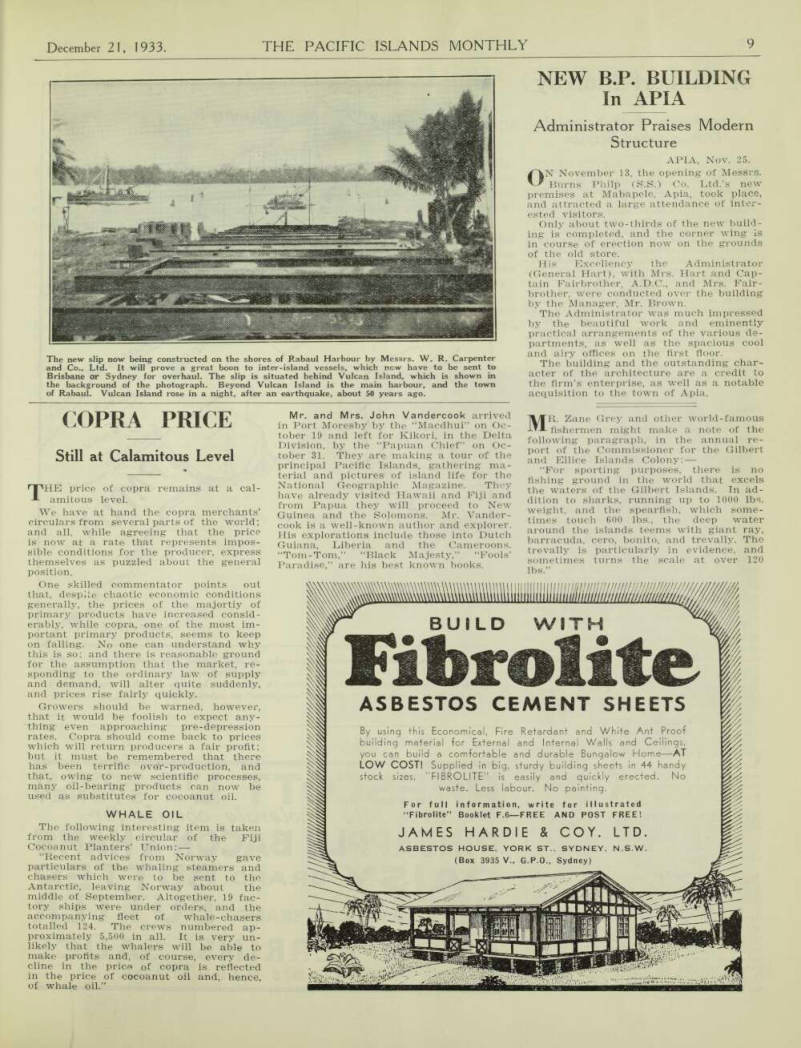
The new slip now being constructed on the shores of Rabaul Harbour by Messrs. W. R. Carpenter and Co., Ltd. It will prove a great boon to inter-island vessels, which now have to be sent to Brisbane or Sydney for overhaul. The slip is situated behind Vulcan Island, which is shown in the background of the photograph. Beyond Vulcan Island is the main harbour, and the town of Rabaul. Vulcan Island rose in a night, after an earthquake, about 50 years ago.