The Double Event
By Rev. Harold Short
LEPEI loved himself; then the graceful brown girl, Geno; then his new canoe, carved dangerously thin, and his dog.
The craft could not respond, Geno would not, and when his dog did, by jump ing on the upturned bottom of the boat, Lepei lifted up his voice and whooped.
The dog fled. Life lacked resilience for Lepei.
He blatantly challenged everything of similar sail area afloat to race his canoe.
Only Raula responded to that, and adzed his dug-out to the marrow.
Raula was another devotee whose wor ship got little more notice from Geno than came from wooden gods. However, when he told her of the contest she thrill ed him and shocked the rest by announc ing that she would marry the winner.
One could not believe that the idea emanated from sporting instinct in a Papuan; it probably came from a maga zine story interpreted by a Mission teacher.
Yarns about taking down white men gave pride of place in the village to dis cussion of the race and its prize. Bets were made in arm-shells, ramis, pigs and wives.
On the night before the contest argu ments languished later than usual. The beach fires died down before the people sauntered to their huts over the sea.
The last two to rise moved off well behind the others.
“Sedira,” said one, the fattest man of the village, “why do people want to go fast? There is plenty of time to get any where.”
“Yes,” said his pal, a small thin man with bandy legs; “I don’t like to see people running. It is better to rest. Let us sit here.”
He sat on an upturned canoe covered with coconut fronds. The fat man re clined beside him and, simultaneously, there was a quick crack of timber.
The thin man pushed back the dying palms to get a more even seat, and then realised that they were sitting on Lepei’s racing canoe!
“You broke it,” he said simply to his fat friend, “but I won’t say anything.
Now we can have a good sleep; we won’t have to get up early to see the race.”
The two lurched away in the gloom. * * * Lepei rose before the sun and went to launch his canoe. He saw the scattered branches: then an eastern gleam revealed the crack. As Lepei glared the canoe moved! It turned oyer and a pig, Raula’s pet, arose grunting from the furrowed sand.
In a few seconds Lepei was paddling another canoe toward Raula’s marine residence. Everyone there was asleep— until Lepei entered. Raula was not. Ex cited voices opined that he had run into the grass with someone.
Lepei slid down the steps and paddled to the hut of Geno. She was absent. No one knew where she was. Lepei shouted that he did, as he furiously sculled to the beach.
He saw Raula’s canoe, keel up, and made a running jump. His feet went through its bottom and his head hit the sand. Raula was revealed with the stare of the rudely awakened, as the wreck heeled over.
Incredibly quickly, he was on top of the tangled Lepei and strange wild words mingled with shouts from over the sea.
Canoes sped beachwards and before Le pei’s feet were free a jabbering circle en couraged the wrestlers.
When the village constable arrived — buckling his official belt above his big bare stomach—bloody brown noses, gog gling eyes, wide shouting mouths, and waving arms surrounded him. Shrieked recriminations and denials flashed and clashed until the social structure of Keru hula village seemed destroyed beyond re pair.
From the heart of the hubbub two bandy legs balanced on Raula’s boat; dramati cally uplifted arms and a squeaky voice surprised the crowd into silence.
Raula’s garden canoe, containing a very fat man, was coming ashore. The occu pant, seeing the platform manner of the bandy man, assumed —possibly wrongly— that his pal was going to give evidence against him.
The fat man stood in the canoe and broke the sudden stillness by shouting: “He’s a liar! He sat down first and cracked it!”
That sentence seemed to reveal all — just as a ripe breadfruit shot from a tree and hit Lepei on the head. He turned so angrily toward Bandy that the bow legs swung round and began to whirl at a splendid speed along the eastern beach.
Lepei started in pursuit.
The fat man thought that the move ment was toward him, and smashed the outrigger in a wild jump ashore. He dis entangled himself and began a rolling but rapid run westward. Raula, eager for anyone’s gore, rushed after him.
An ancient enthusiasm reclaimed a people bored by canoe races, and modern prohibition of man-hunts.
Hundreds of eyes pivoted rapidly right and left to miss none of this glorious
double event. The quaint style of two contestants was forgotten in the tragic in tensity of the four. The beach stretched far, but soon the runners were out of sight.
Partisans were dividing to follow their particular fancies when a new excitement descended.
From among Passiflora drapings on a breadfruit tree slid a laughing girl and a slim youth. Both had grass-seeds in their hair.
One was Geno, the fictitious prize of the abandoned aquatic race and the real starter of the two land handicaps, I always thought she intended to marry that slim chap, although Papuans their amours so thoroughly; but I had hoped that she was one of the few Papuans learning to play the game When the four bruised runners tottered home they expressed, differently but very emphatically, the same disappointment in Geno. Their common standard for the conduct of women drew them into a fel lowship as deep as their animosity to Geno and her slim spouse, both of which continue even until now.
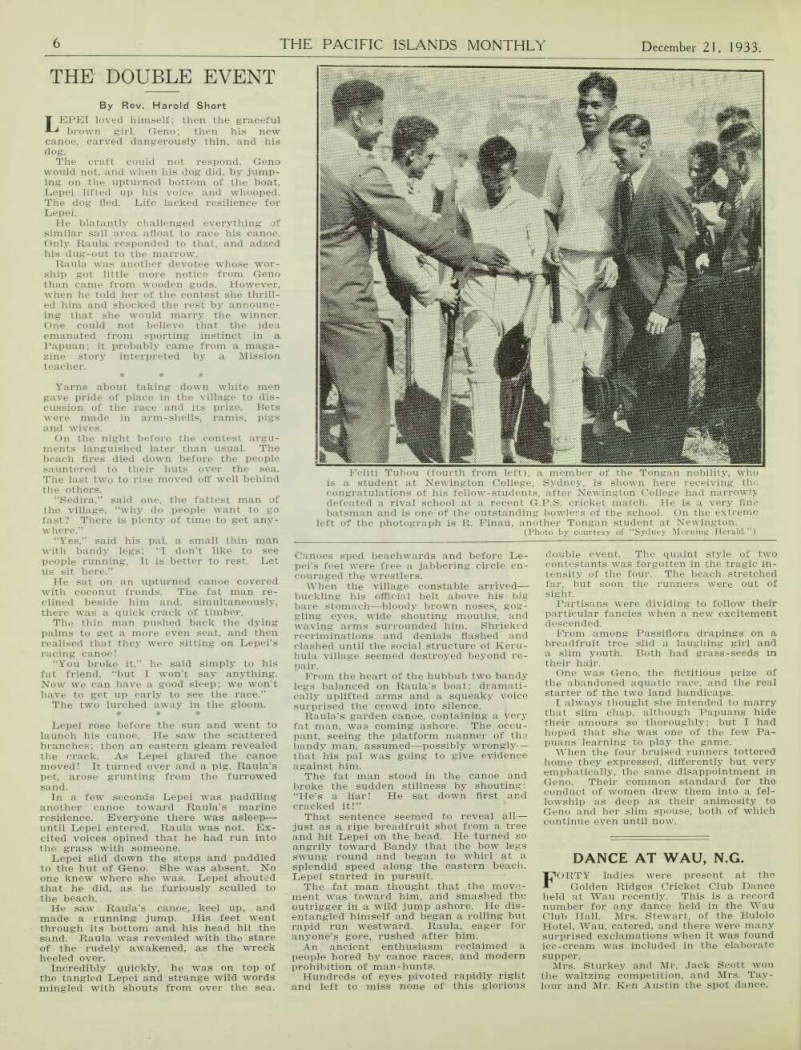
Feliti Tubou (fourth from left), a member of the Tongan nobility, who is a student at Newington College, Sydney, is shown here receiving the congratulations of his fellow-students, after Newington College had narrowly defeated a rival school at a recent G.P.S. cricket match. He is a very fine batsman and is one of the outstanding bowlers of the school. On the extreme left of the photograph is R. Finau, another Tongan student at Newington. (Photo by courtesy of “Sydney Morning Herald.”)