Suppression Of Samoan Mau
pp. 5-6 · Read in the full issue
DURING the past few weeks another chapter has been added to the chequered history of Western Samoa. The heavy hand of the Administration—which is the New Zealand Government acting under mandatory authority from the League of Nations—has fallen upon the Mau; and, on present appearances, finis has been written to that nationalistic or ganisation of Samoan natives, which came into being seven years ago.
Mr. O. F. Nelson and a number of leading native chiefs of the Mau organisa tion (the fragmentary news radiograms do not indicate the exact number) have been arrested on charges of sedition, &c., and a number have been convicted and sen tenced to punishment which, in some cases, is imprisonment.
The move against the Mau and the Mau leaders has not been attended by disorder or even by any serious excitation of public opinion. That is very signifi cant. A year ago, such a development unquestionably would have been resisted
by force, and publicists outside of Samoa and New Zealand would have been mostly, and aggressively, against the Ad ministration. But much has happened during the last twelve months to swing the sympathies of well-informed people in support of the Administration and against the Mau.
In the period between 1923 and 1930, the Administrators placed in Samoa by the New Zealand Government created a very unfortunate and undesirable condi tion of affairs. They supplied the spirited Samoa people with innumerable causes for dissatisfaction, and passive resistance of authority; and the New Zealand authorities retaliated in swashbuckling fashion by attempting to crush the angry and vociferous natives, and by summarily removing their leaders from the Territory.
Mr. O. F. Nelson, the acknowledged leader of the Mau—the talented son of a Scandinavian officer and a Samoan chief tainess—was banished for five years. He spent most of that period in Auckland,
directing a ceaseless, bitter propaganda against the N.Z. Administration in Samoa. The savagery that informed his campaign alienated the sympathy of many people; but the genuine grievances of the Samoan people were recognised by lovers of liberty all over the world, and Mr.
Nelson, in consequence, received a remark able amount of support and encourage ment.
In 1930, there seemed to be a change of heart in Wellington regarding Samoan affairs; and the N.Z. Government sent to Apia, in the person of Brigadier-General
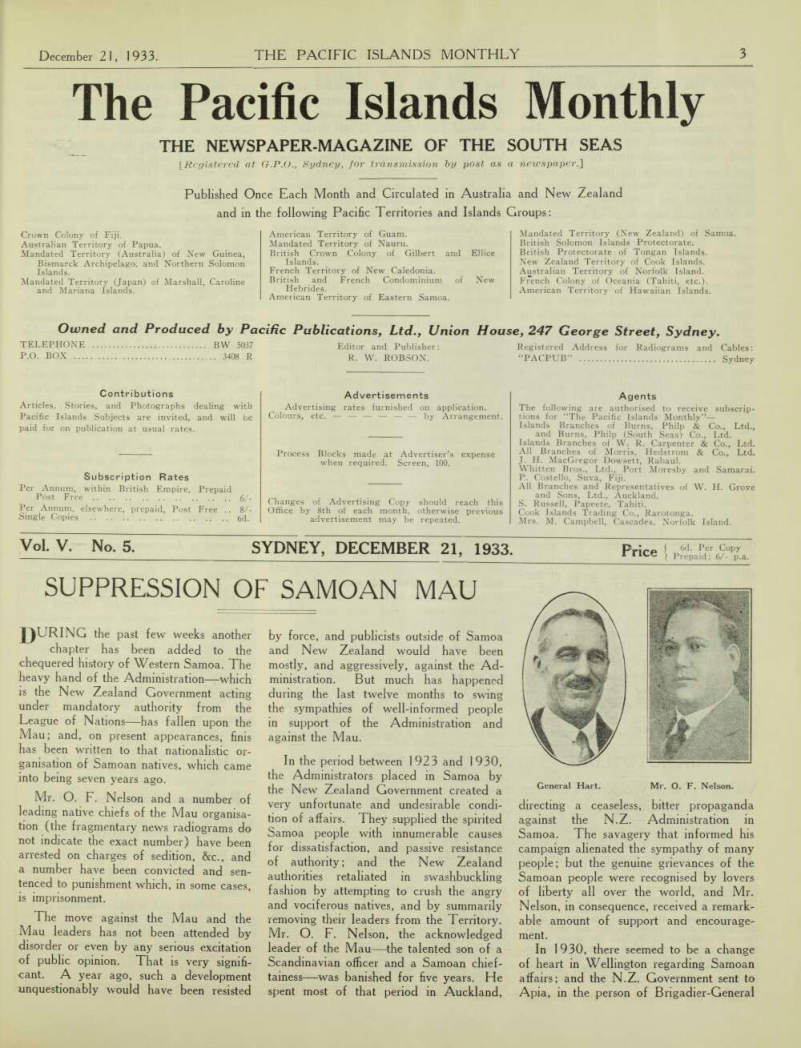
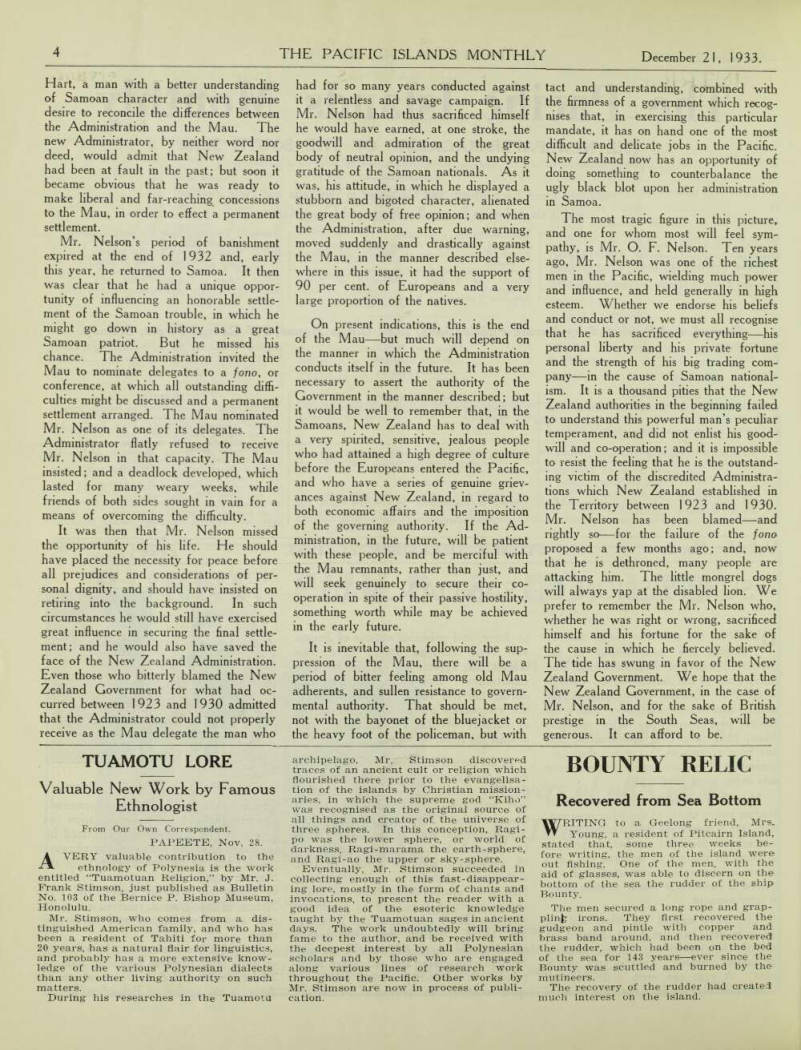
Mr. O. F. Nelson.
General Hart.
Hart, a man with a better understanding of Samoan character and with genuine desire to reconcile the differences between the Administration and the Mau. The new Administrator, by neither word nor deed, would admit that New Zealand had been at fault in the past; but soon it became obvious that he was ready to make liberal and far-reaching concessions to the Mau, in order to effect a permanent settlement.
Mr. Nelson’s period of banishment expired at the end of 1932 and, early this year, he returned to Samoa. It then was clear that he had a unique oppor tunity of influencing an honorable settle ment of the Samoan trouble, in which he might go down in history as a great Samoan patriot. But he missed his chance. The Administration invited the Mau to nominate delegates to a fono, or conference, at which all outstanding diffi culties might be discussed and a permanent settlement arranged. The Mau nominated Mr, Nelson as one of its delegates. The Administrator flatly refused to receive Mr. Nelson in that capacity. The Mau insisted; and a deadlock developed, which lasted for many weary weeks, while friends of both sides sought in vain for a means of overcoming the difficulty.
It was then that Mr. Nelson missed the opportunity of his life. He should have placed the necessity for peace before all prejudices and considerations of per sonal dignity, and should have insisted on retiring into the background. In such circumstances he would still have exercised great influence in securing the final settle ment; and he would also have saved the face of the New Zealand Administration.
Even those who bitterly blamed the New Zealand Government for what had oc curred between 1923 and 1930 admitted that the Administrator could not properly receive as the Mau delegate the man who
had for so many years conducted against it a relentless and savage campaign. If Mr. Nelson had thus sacrificed himself he would have earned, at one stroke, the goodwill and admiration of the great body of neutral opinion, and the undying gratitude of the Samoan nationals. As it was, his attitude, in which he displayed a stubborn and bigoted character, alienated the great body of free opinion; and when the Administration, after due warning, moved suddenly and drastically against the Mau, in the manner described else where in this issue, it had the support of 90 per cent, of Europeans and a very large proportion of the natives.
On present indications, this is the end of the Mau—but much will depend on the manner in which the Administration conducts itself in the future. It has been necessary to assert the authority of the Government in the manner described; but it would be well to remember that, in the Samoans, New Zealand has to deal with a very spirited, sensitive, jealous people who had attained a high degree of culture before the Europeans entered the Pacific, and who have a series of genuine griev ances against New Zealand, in regard to both economic affairs and the imposition of the governing authority. If the Ad ministration, in the future, will be patient with these people, and be merciful with the Mau remnants, rather than just, and will seek genuinely to secure their co operation in spite of their passive hostility, something worth while may be achieved in the early future.
It is inevitable that, following the sup pression of the Mau, there will be a period of bitter feeling among old Mau adherents, and sullen resistance to govern mental authority. That should be met, not with the bayonet of the bluejacket or the heavy foot of the policeman, but with
tact and understanding, combined with the firmness of a government which recog nises that, in exercising this particular mandate, it has on hand one of the most difficult and delicate jobs in the Pacific.
New Zealand now has an opportunity of doing something to counterbalance the ugly black blot upon her administration in Samoa.
The most tragic figure in this picture, and one for whom most will feel sym pathy, is Mr. O. F. Nelson. Ten years ago, Mr. Nelson was one of the richest men in the Pacific, wielding much power and influence, and held generally in high esteem. Whether we endorse his beliefs and conduct or not, we must all recognise that he has sacrificed everything—his personal liberty and his private fortune and the strength of his big trading com pany—in the cause of Samoan national ism. It is a thousand pities that the New Zealand authorities in the beginning failed to understand this powerful man’s peculiar temperament, and did not enlist his good will and co-operation; and it is impossible to resist the feeling that he is the outstand ing victim of the discredited Administra tions which New Zealand established in the Territory between 1923 and 1930.
Mr. Nelson has been blamed—and rightly so—for the failure of the fono proposed a few months ago; and, now that he is dethroned, many people are attacking him. The little mongrel dogs will always yap at the disabled lion. We prefer to remember the Mr. Nelson who, whether he was right or wrong, sacrificed himself and his fortune for the sake of the cause in which he fiercely believed.
The tide has swung in favor of the New Zealand Government. We hope that the New Zealand Government, in the case of Mr. Nelson, and for the sake of British prestige in the South Seas, will be generous. It can afford to be.