New Hebrides.
p. 35 · Read in the full issue
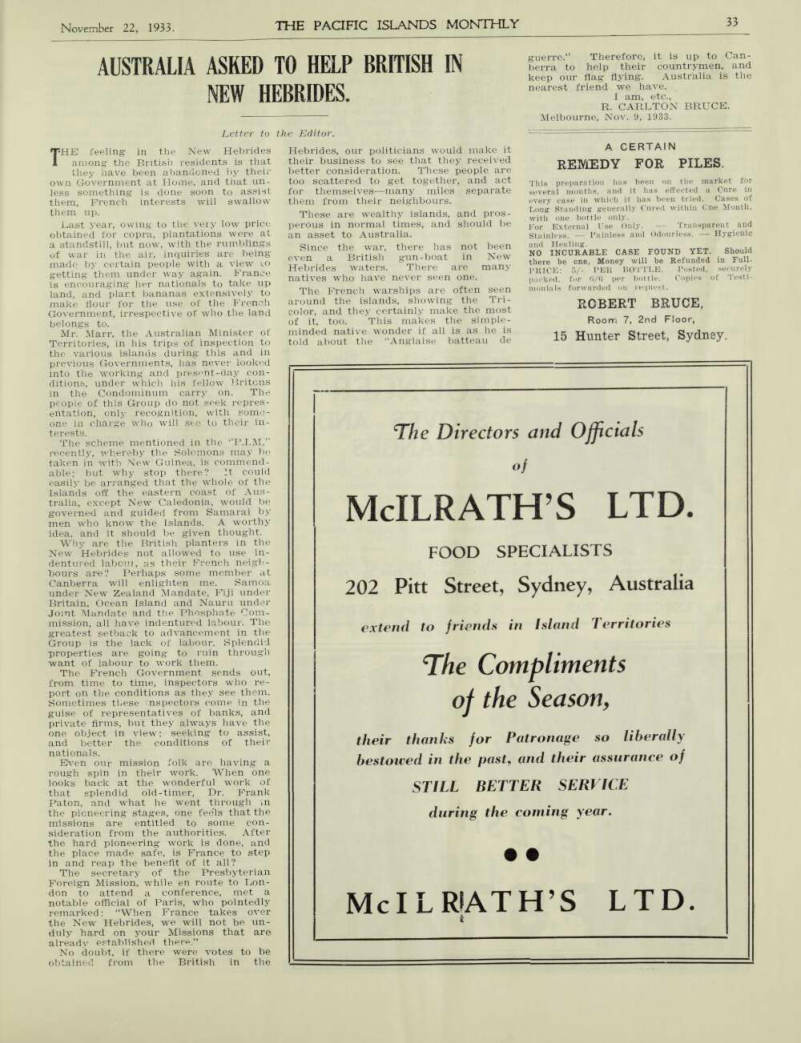
Australia Asked To Help British In
Letter to the Editor.
THE feeling in the New Hebrides among the British residents is that they have been abandoned by their own Government at Home, and that un less something is done soon to assist them, French interests will swallow them up.
East year, owing to the very low price obtained for copra, plantations were at a standstill, but now, with the rumblings of war in the air, inquiries are being made by certain people with a view 10 getting them under way again. France is encouraging her nationals to take up land, and plant bananas extensively to make flour for the use of the French Government, irrespective of who the land belongs to.
Mr. Marr, the Australian Minister of Territories, in his trips of inspection to the various islands during this and in previous Governments, has never looked into the working and present-day con ditions, under which his fellow Britons in the Condominum carry on. The people of this Group do not seek repres entation, only recognition, with some one in charge who will see to their in terests.
The scheme mentioned in the “P.I.M.” recently, whereby the Solomons may be taken in with New Guinea, is commend able; but why stop there? It could easily be arranged that the whole of the Islands off the eastern coast of Aus tralia, except New Caledonia, would be governed and guided from Samarai by men who know the Islands. A worthy idea, and it should be given thought.
Why are the British planters in the New Hebrides not allowed to use in dentured labour, as their French neigh bours are? Perhaps some member at Canberra will enlighten me. Samoa under New Zealand Mandate, Fiji under Britain, Ocean Island and Nauru under Joint Mandate and the Phosphate Com mission, all have indentured labour. The greatest setback to advancement in the Group is the lack of labour. Splendid properties are going to ruin through want of labour to work them.
The French Government sends out, from time to time, inspectors who re port on the conditions as they see them.
Sometimes these inspectors come in the guise of representatives of banks, and private firms, but they always have the one object in view: seeking to assist, and better the conditions of their nationals.
Even our mission folk are having a rough spin in their work. When one looks back at the wonderful work of that splendid old-timer, Dr. Frank Paton, and what he went through in the pioneering stages, one feels that the missions are entitled to some con sideration from the authorities. After the hard pioneering work is done, and the place made safe, is France to step in and reap the benefit of it all?
The secretary of the Presbyterian Foreign Mission, while en route to Lon don to attend a conference, met a notable official of Paris, who pointedly remarked: “When France takes over the New Hebrides, we will not be un duly hard on your Missions that are already established there.”
No doubt, if there were votes to be obtained from the British in the
Hebrides, our politicians would make it their business to see that they received better consideration. These people are too scattered to get together, and act for themselves—many miles separate them from their neighbours.
These are wealthy islands, and pros perous in normal times, and should be an asset to Australia.
Since the war, there has not been even a British gun-boat in New Hebrides waters. There are many natives who have never seen one.
The French warships are often seen around the islands, showing the Tri color, and they certainly make the most of it, too. This makes the simple minded native wonder if all is as he is told about the “Anglaise batteau de
guerre.” Therefore, it is up to Can berra to help their countrymen, and keep our flag flying. Australia is the nearest friend we have, I am, etc.,
R. Carlton Bruce.
Melbourne, Nov. 9, 1933.