Radio-Station Servants
p. 34 · Read in the full issue
How Bush Kanakas Become
SOME surprising talent has been dis covered among the natives of New Guinea and Papua by the officers at the A.W.A. radio stations.
A.W.A. has eight wireless stations in the Mandated Territory and two in Pa pua. Native “boys”—a boy’s age might be anything up to 80 —are employed to assist the wireless operators. Usually they are savages, straight out of the bush, untouched by the influence of the white man. Some may have been can nibals, though they usually deny any such allegation. At the wireless stations they are set to work cleaning up the grounds. They learn to start the oil engines, grease and clean the plant, and even drive motor cars. To the island native, a radio station is known as “house talk-talk”.
At the order of the operator: “You make him savee,” the boy starts up the engine. Probably, a new recruit takes fright when he first hears an internal combustion engine come to life, and runs off into the bush. But in time they be come domesticated, and may be em ployed in delivering messages, or even on small carpentering jobs.
At Moresby and Samarai stations, na
tive boys have been found who are ef ficient at clerical work. But these na tives were educated by the missionaries; they speak good English and write bet ter than most white men.
The average native, however, has no initiative. He never thinks of anything for himself. Give him a radiogram to Mr. Tom Jones, and there is no chance of his handing it to Mrs. Jones, in the event of her husband being away from home. This characteristic certainly pre vents a message falling into wrong hands; and the boy does not mind mak ing the trip over and over again, if need be. Usually, it is found easiest to give a boy the native name for the per
son addressed. There might be two Mr.
Jones, but only one of that name would be known to the natives as, say, “Woo dooma,” which translated is “long tom fish”.
Thus, the New Guinea native has a place in the wireless industry. But there seems no way of curing him of the in corrigible habit of chewing betel-nut.
He chews and chews and chews, until at times he goes completely silly.
The foregoing refers, of course, to sta tions operated in the Islands by Amal gamated Wireless, Ltd., which are mostly in Melanesia. There is a very different tale to tell, so far as the Poly nesian section of the Pacific is con cerned. Polynesian youths have been trained to become quite efficient radio operators—New Zealand administrators have commented on this interesting fact in annual reports relating to Western Samoa and the Cook Islands. Isolated stations have been placed wholly in charge of Polynesians.
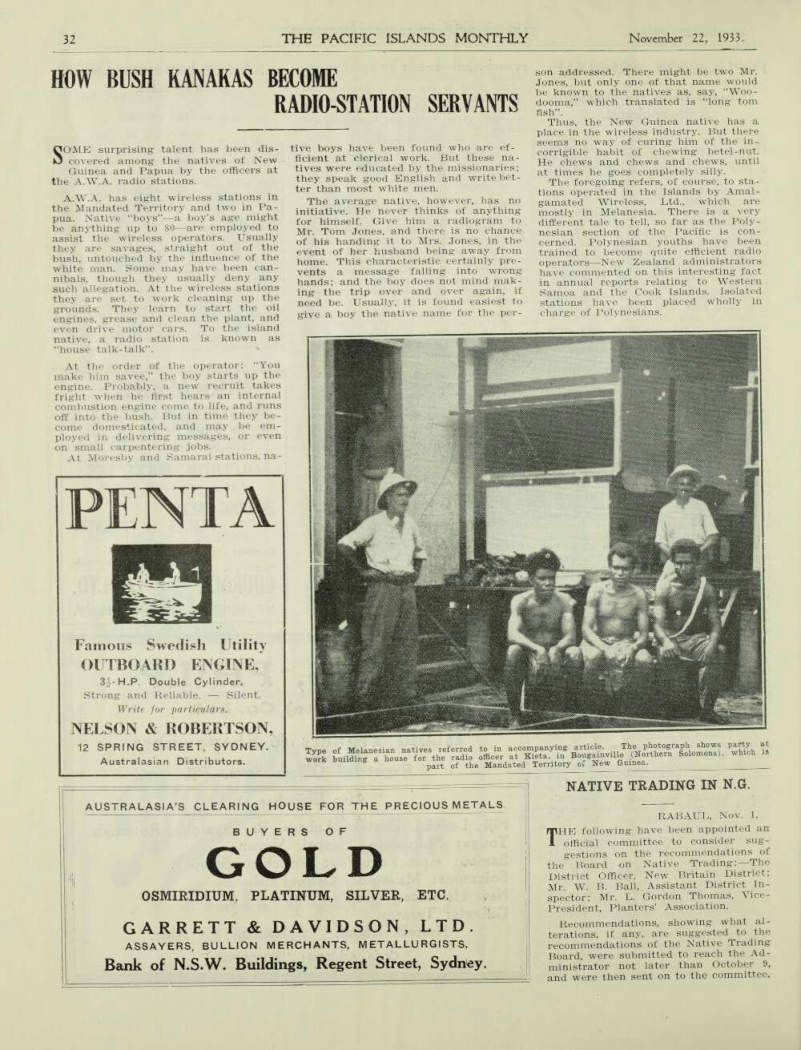
Type of Melanesian natives referred ot in accompanying article. The photograph shows party at work building a house for the radio officer at Kieta, in Bougainvillw (Nothern Solomons), which is part of the Mandated Territory of New Guinea.