Copra And World Exchange
pp. 5-6 · Read in the full issue
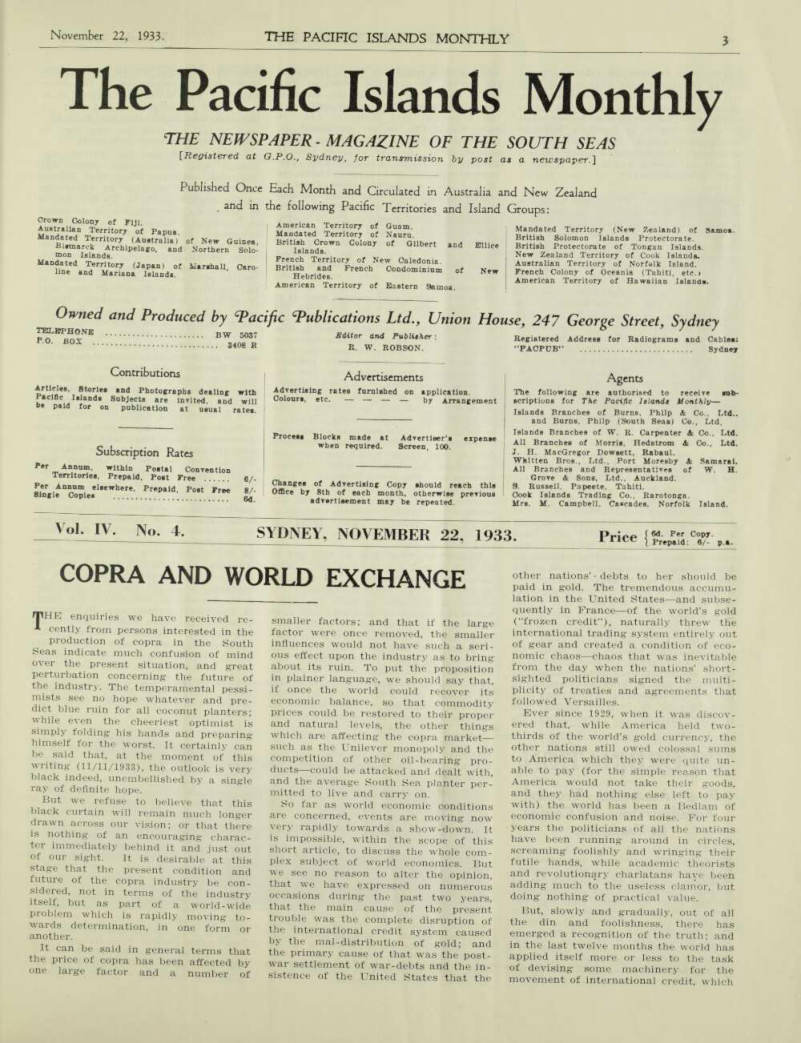
THE enquiries we have received re cently from persons interested in the production of copra in the South Seas indicate much confusion of mind over the present situation, and great perturbation concerning the future of the industry. The temperamental pessi mists see no hope whatever and pre dict blue ruin for all coconut planters; while even the cheeriest optimist is simply folding his hands and preparing himself for the worst. It certainly can be said that, at the moment of this writing (11/11/1933), the outlook is very black indeed, unembellished by a single ray of definite hope.
But we refuse to believe that this black curtain will remain much longer drawn across our vision; or that there is nothing of an encouraging charac ter immediately behind it and just out of our sight. It is desirable at this stage that the present condition and future of the copra industry be con sidered, not in terms of the industry itself, but as part of a world-wide problem which is rapidly moving to wards determination, in one form or another.
It can be said in general terms that the price of copra has been affected by one large factor and a number of
smaller factors; and that if the large factor were once removed, the smaller influences would not have such a seri ous effect upon the industry as to bring about its ruin. To put the proposition in plainer language, we should say that, if once the world could recover its economic balance, so that commodity prices could be restored to their proper and natural levels, the other things which are affecting the copra market— such as the Unilever monopoly and the competition of other oil-bearing pro ducts—could be attacked and dealt with, and the average South Sea planter per mitted to live and carry on.
So far as world economic conditions are concerned, events are moving now very rapidly towards a show-down. It is impossible, within the scope of this short article, to discuss the whole com plex subject of world economics. But we see no reason to alter the opinion, that we have expressed on numerous occasions during the past two years, that the main cause of the present trouble was the complete disruption of the international credit system caused by the mal-distribution of gold; and the primary cause of that was the post war settlement of war-debts and the in sistence of the United States that the
other nations’ debts to her should be paid in gold. The tremendous accumu lation in the United States —and subse quently in France —of the world’s gold (“frozen credit”), naturally threw the international trading system entirely out of gear and created a condition of eco nomic chaos —chaos that was inevitable from the day when the nations’ short sighted politicians signed the multi plicity of treaties and agreements that followed Versailles.
Ever since 1929, when it was discov ered that, while America held two thirds of the world’s gold currency, the other nations still owed colossal sums to America which they were quite un able to pay (for the simple reason that America would not take their goods, and they had nothing else left to pay with) the world has been a Bedlam of economic confusion and noise. For four years the politicians of all the nations have been running around in circles, screaming foolishly and wringing their futile hands, while academic theorists and revolutionary charlatans have been adding much to the useless clamor, but doing nothing of practical value.
But, slowly and gradually, out of all the din and foolishness, there has emerged a recognition of the truth; and in the last twelve months the world has applied itself more or less to the task of devising some machinery for the movement of international credit, which
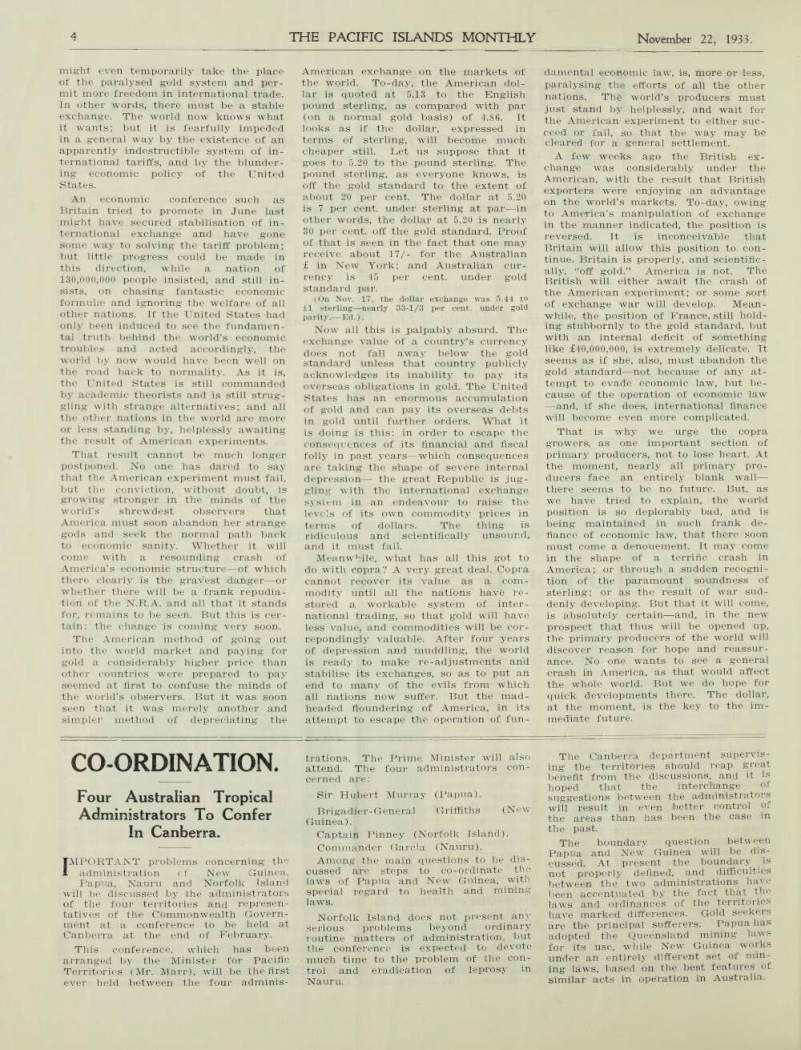
might even temporarily take the place of the paralysed gold system and per mit more freedom in international trade.
In other words, there must be a stable exchange. The world now knows what it wants; but it is fearfully impeded in a general way by the existence of an apparently indestructible system of in ternational tariffs, and by the blunder ing economic policy of the United States.
An economic conference such as Britain tried to promote in June last might have secured stabilisation of in ternational exchange and have gone some way to solving the tariff problem; but little progress could be made in this direction, while a nation of 130,000,000 people insisted, and still in sists, on chasing fantastic economic formulae and ignoring the welfare of all other nations. If the United States had only been induced to see the fundamen tal truth behind the world’s economic troubles and acted accordingly, the world by now would have been well on the road back to normality. As it is, the United States is still commanded by academic theorists and is still strug gling with strange alternatives; and all the other nations in the world are more or less standing by, helplessly awaiting the result of American experiments.
That result cannot be much longer postponed. No one has dared to say that the American experiment must fail, but the conviction, without doubt, is growing stronger in the minds of the world’s shrewdest observers that America must soon abandon her strange gods and seek the normal path back to economic sanity. Whether it will come with a resounding crash of America’s economic structure —of which there clearly is the gravest danger—or whether there will be a frank repudia tion of the N.R.A. and all that it stands for, remains to be seen. But this is cer tain: the change is coming very soon.
The American method of going out into the world market and paying for gold a considerably higher price than other countries were prepared to pay seemed at first to confuse the minds of the world’s observers. But it was soon seen that it was merely another and simpler method of depreciating the
American exchange on the markets of the world. To-day, the American dol lar is quoted at 5.13 to the English pound sterling, as compared with par (on a normal gold basis) of 4.86. It looks as if the dollar, expressed in terms of sterling, will become much cheaper still. Let us suppose that it goes to 5.20 to the pound sterling. The pound sterling, as everyone knows, is off the gold standard to the extent of about 20 per cent. The dollar at 5.20 is 7 per cent, under sterling at par—in other words, the dollar at 5.20 is nearly 30 per cent, off the gold standard. Proof of that is seen in the fact that one may receive about 17/- for the Australian £ in New York; and Australian cur rency is 45 per cent, under gold standard par. (On Nov. 17, the dollar exchange was 5.44 to fl sterling—nearly 33-1/3 per cent, under gold parity.—Ed.).
Now all this is palpably absurd. The exchange value of a country’s currency does not fall away below the gold standard unless that country publicly acknowledges its inability to pay its overseas obligations in gold. The United States has an enormous accumulation of gold and can pay its overseas debts in gold until further orders. What it is doing is this: in order to escape the consequences of its financial and fiscal folly in past years—which consequences are taking the shape of severe internal depression— the great Republic is jug gling with the international exchange system in an endeavour to raise the levels of its own commodity prices in terms of dollars. The thing is ridiculous and scientifically unsound, and it must fail.
Meanwhile, what has all this got to do with copra? A very great deal. Copra cannot recover its value as a com modity until all the nations have re stored a workable system of inter national trading, so that gold will have less value, and commodities will be cor repondingly valuable. After four years of depression and muddling, the world is ready to make re-adjustments and stabilise its exchanges, so as to put an end to many of the evils from which all nations now suffer. But the mad headed floundering of America, in its attempt to escape the operation of fun
damental economic law, is, more or less, paralysing the efforts of all the other nations. The world’s producers must just stand by helplessly, and wait for the American experiment to either suc ceed or fail, so that the way may be cleared for a general settlement.
A few weeks ago the British ex change was considerably under the American, with the result that British exporters were enjoying an advantage on the world’s markets. To-day, owing to America’s manipulation of exchange in the manner indicated, the position is reversed. It is inconceivable that Britain will allow this position to con tinue. Britain is properly, and scientific ally, “off gold.” America is not. The British will either await the crash of the American experiment; or some sort of exchange war will develop. Mean while, the position of France, still hold ing stubbornly to the gold standard, but with an internal deficit of something like £40,000,000, is extremely delicate. It seems as if she, also, must abandon the gold standard —not because of any at tempt to evade economic law, but be cause of the operation of economic law —and, if she does, international finance will become even more complicated.
That is why we urge the copra growers, as one important section of primary producers, not to lose heart. At the moment, nearly all primary pro ducers face an entirely blank wall — there seems to be no future. But, as we have tried to explain, the world position is so deplorably bad, and is being maintained in such frank de fiance of economic law, that there soon must come a denouement. It may come in the shape of a terrific crash in America; or through a sudden recogni tion of the paramount soundness of sterling; or as the result of war sud denly developing. But that it will come, is absolutely certain —and, in the new prospect that thus will be opened up, the primary producers of the world will discover reason for hope and reassur ance. No one wants to see a general crash in America, as that would affect the whole world. But we do hope for quick developments there. The dollar, at the moment, is the key to the im mediate future.