Larkin Case: Plea For Review.
p. 45 · Read in the full issue
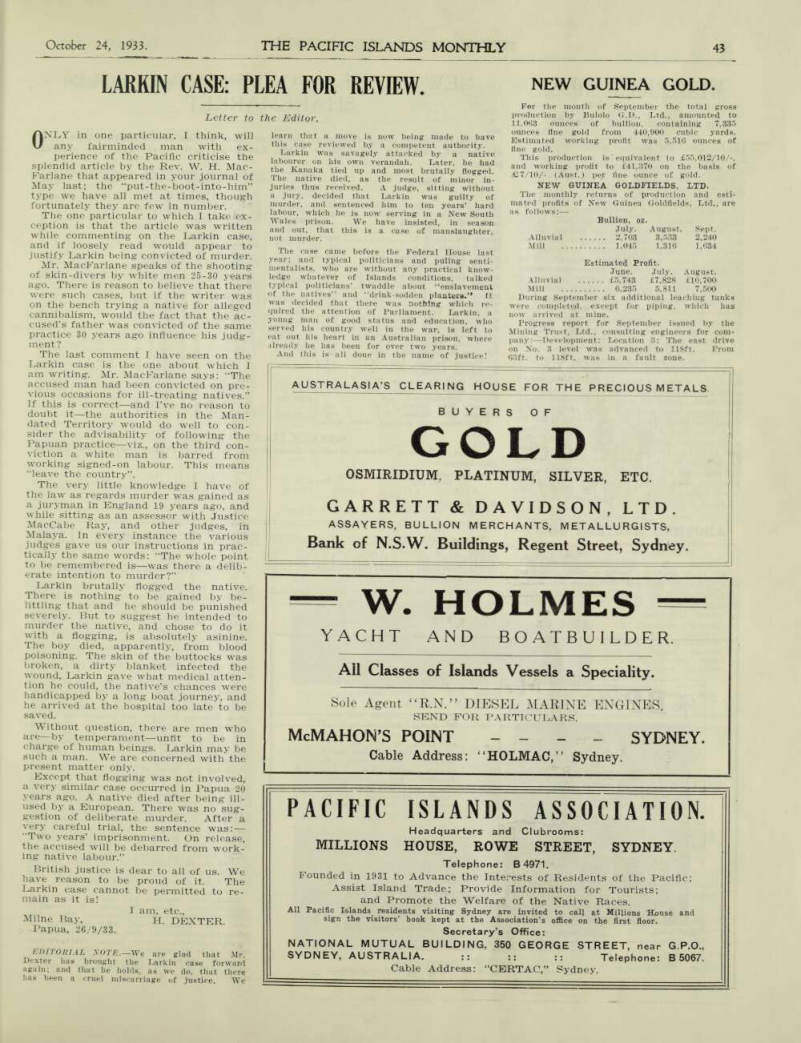
Letter to the Editor.
ONLY in one particular, I think, will any fairminded man with ex perience of the Pacific criticise the splendid article by the Rev. W. H. Mac- Farlane that appeared in your journal of May last; the “put-the-boot-into-him” type we have all met at times, though fortunately they are few in number.
The one particular to which I take ex ception is that the article was written while commenting on the Larkin case, and if loosely read would appear to justify Larkin being convicted of murder.
Mr. MacFarlane speaks of the shooting of skin-divers by white men 25-30 years ago. There is reason to believe that there were such cases, but if the writer was on the bench trying a native for alleged cannibalism, would the fact that the ac cused’s father was convicted of the same practice 30 years ago influence his judg ment?
The last comment I have seen on the Larkin case is the one about which I am writing. Mr. MacFarlane says: “The accused man had been convicted on pre vious occasions for ill-treating natives.”
If this is correct —and I’ve no reason to doubt it —the authorities in the Man dated Territory would do well to con sider the advisability of following the Papuan practice—viz., on the third con viction a white man is barred from working signed-on labour. This means “leave the country”.
The very little knowledge I have of the law as regards murder was gained as a juryman in England 19 years ago, and while sitting as an assessor with Justice MacCabe Ray, and other judges, in Malaya. In every instance the various judges gave us our instructions in prac tically the same words: “The whole point to be remembered is—was there a delib erate intention to murder?”
Larkin brutally flogged the native.
There is nothing to be gained by be littling that and he should be punished severely. But to suggest he intended to murder the native, and chose to do it with a flogging, is absolutely asinine.
The boy died, apparently, from blood poisoning. The skin of the buttocks was broken, a dirty blanket infected the wound, Larkin gave what medical atten tion he could, the native’s chances were handicapped by a long boat journey, and he arrived at the hospital too late to be saved.
Without question, there are men who are—by temperament—unfit to be in charge of human beings. Larkin may be such a man. We are concerned with the present matter only.
Except that flogging was not involved, a very similar case occurred in Papua 20 years ago. A native died after being ill used by a European. There was no sug gestion of deliberate murder. After a very careful trial, the sentence was: “Two years’ imprisonment. On release, the accused will be debarred from work ing native labour.”
British justice is dear to all of us. We have reason to be proud of it. The Larkin case cannot be permitted to re main as it is!
I am, etc.,
H. Dexter.
Milne Bay, Papua, 26/9/33.
EDITORIAL NOTE.— We are glad that Mr.
Dexter has brought the Larkin case forward again; and that he holds, as we do, that there has been a cruel miscarriage of justice. We
learn that a move is now being made to have this case reviewed by a competent authority.
Larkin was savagely attacked by a native labourer on his own verandah. Later, he had the Kanaka tied up and most brutally flogged.
The native died, as the result of minor in juries thus received. A judge, sitting without a jury, decided that Larkin was guilty of murder, and sentenced him to ten years’ hard labour, which he is now serving in a New South Wales prison. We have insisted, in season and out, that this is a case of manslaughter, not murder.
The case came before the Federal House last year; and typical politicians and puling senti mentalists, who are without any practical know ledge whatever of Islands conditions, talked typical politicians’ twaddle about “enslavement of the natives” and “drink-sodden planters." It was decided that there was nothing which re quired the attention of Parliament. Larkin, a young man of good status and education, who served his country well in the war, is left to eat out his heart in an Australian prison, where already he has been for over two years.
And this is all done in the name of justice!