Norfolk Island
p. 34 · Read in the full issue
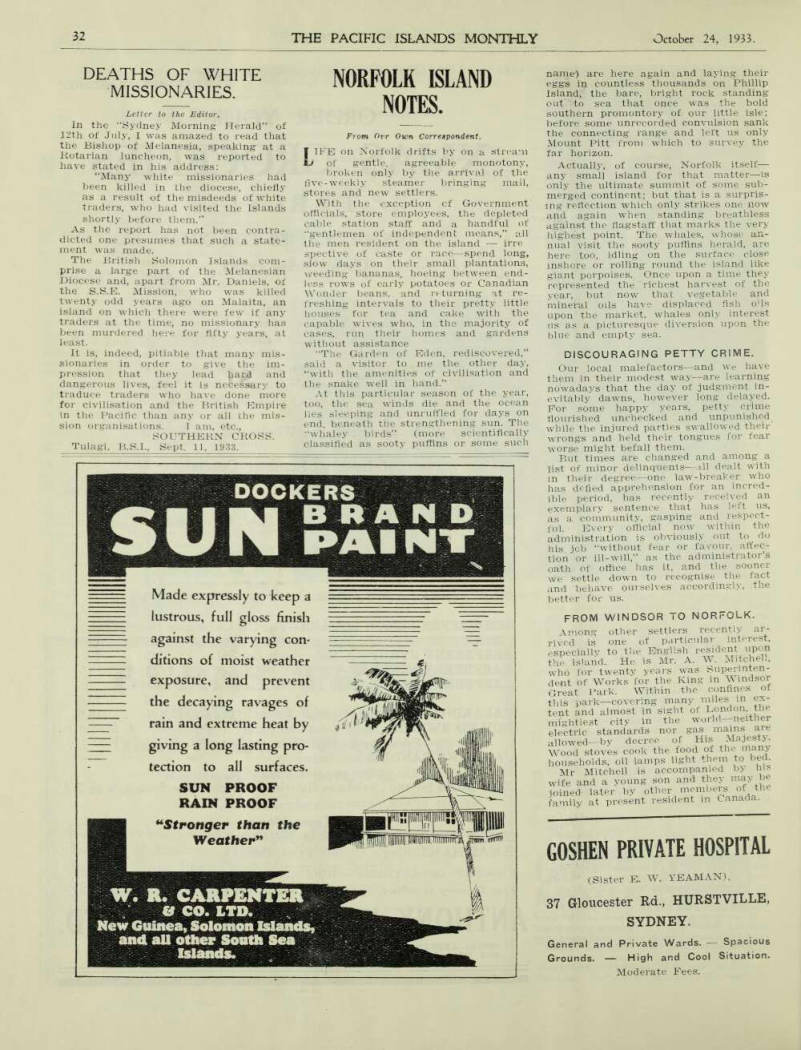
Notes.
From Our Own Correspondent.
LIFE on Norfolk drifts by on a stream of gentle, agreeable monotony, broken only by the arrival of the five-weekly steamer bringing mail, stores and new settlers.
With the exception of Government officials, store employees, the depleted cable station staff and a handful of “gentlemen of independent means,” till the men resident on the island irrespective of caste or race—spend long, slow days on their small plantations, weeding bananas, hoeing between end less rows of early potatoes or Canadian Wonder beans, and returning at re freshing intervals to their pretty little houses for tea and cake with the capable wives who, in the majority of cases, run their homes and gardens without assistance “The Garden of Eden, rediscovered,” said a visitor to me the other day, “with the amenities of civilisation and the snake well in hand.”
At this particular season of the year, too, the sea winds die and the ocean lies sleeping and unruffled for days on end, beneath the strengthening sun. The “whaley birds” (more scientifically classified as sooty puffins or some such
name) are here again and laying their eggs in countless thousands on Phillip Island, the bare, bright rock standing out to sea that once was the bold southern promontory of our little isle; before some unrecorded convulsion sank the connecting range and left us only Mount Pitt from which to survey the far horizon.
Actually, of course, Norfolk itself — any small island for that matter —is only the ultimate summit of some sub merged continent; but that is a surpris ing reflection which only strikes one now and again when standing breathless against the flagstaff that marks the very highest point. The whales, whose an nual visit the sooty puffins herald, are here too, idling on the surface close inshore or rolling round the island like giant porpoises. Once upon a time they represented the richest harvest of the year, but now that vegetable and mineral oils have displaced fish oils upon the market, whales only interest us as a picturesque diversion upon the blue and empty sea.
Discouraging Petty Crime.
Our local malefactors —and we have them in their modest way—are learning nowadays that the day of judgment in evitably dawns, however long delayed.
For some happy years, petty crime flourished unchecked and unpunished while the injured parties swallowed their wrongs and held their tongues for fear worse might befall them.
But times are changed and among a list of minor delinquents—all dealt with in their degree—one law-breaker who has defied apprehension for an incred ible period, has recently received an exemplary sentence that has left us, as a community, gasping and respect ful. Every official now within the administration is obviously out to do his job “without fear or favour, affec tion or ill-will,” as the administrator’s oath of office has it, and the sooner we settle down to recognise the fact and behave ourselves accordingly, the better for us.
From Windsor To Norfolk.
Among other settlers recently ar rived is one of particular interest, especially to the English resident upon the island. He is Mr. A. W. Mitchell, who for twenty years was Superinten dent of Works for the King in Windsor Great Park. Within the confines of this park—covering many miles in ex tent and almost in sight of London the mightiest city in the world—neither electric standards nor gas mains are allowed— by decree of His Majesty.
Wood stoves cook the food of the many households, oil lamps light them to bed.
Mr Mitchell is accompanied by his wife and a young son and they may be joined later by other members of the family at present resident in Canada.