Old-Time Cannibal Tells His Story
pp. 25-26 · Read in the full issue
How Mugarra and his Father Killed and Ate a German.
(Miss A. Gwen Evans, a young girl who lives on her father’s plantation near Buka Passage,
Bougainville, Mandated Territory
of New Guinea, has written for “The Pacific Islands Monthly’’ this most interesting account of her interview with an old cannibal chief. Miss Evans speaks the native languages
fluently.)
MUGARRA is the last of his tribe. He is one of the only remaining hereditary chiefs on the Island of Buka, in the Northern Solomons (part of Mandated Territory of New Guinea).
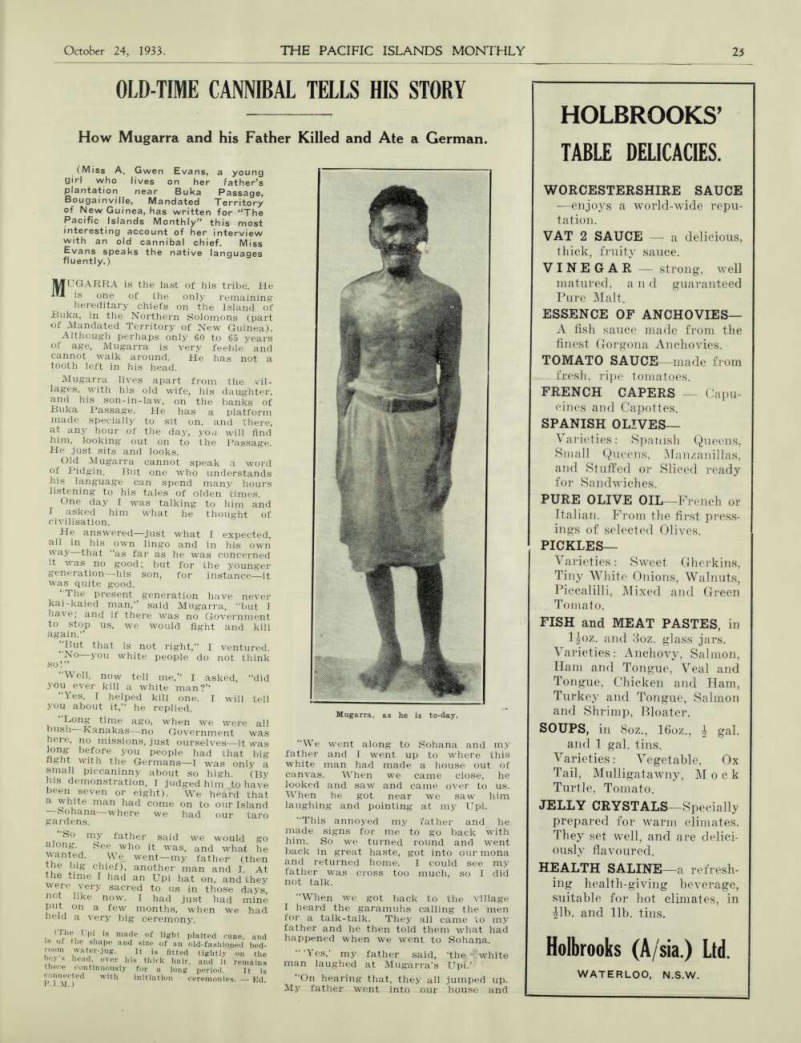
Although perhaps only 60 to 65 years of age, Mugarra is very feeble and cannot walk around. He has not a tooth left in his head.
Mugarra lives apart from the vil lages, with his old wife, his daughter, and his son-in-law, on the banks of Buka Passage. He has a platform made specially to sit on, and there, at any hour of the day, you will find him, looking out on to the Passage.
He just sits and looks.
Old Mugarra cannot speak a word of Pidgin. But one who understands his language can spend many hours listening to his tales of olden times.
One day I was talking to him and I asked him what he thought of civilisation.
He answered—just what I expected, all in his lingo and in his own that “as far as he was concerned it was no good; but for the younger generation—his son, for instance—it was quite good.
“The present generation have never kai-kaied man,’’ said Mugarra, “but I have; and if there was no Government to stop us, we would fight and kill again.’’ ‘‘But that is not right,” I ventured.
“No—you white people do not think so!”
“Well, now tell me,” I asked, “did you ever kill a white man?”
“Yes, I helped kill one. I will tell you about it,” he replied, “Long time ago, when we were all bush Kanakas—no Government was here, no missions, just ourselves—it was long before you people had that big fight with the Germans—I was only a small piccaninny about so high. (By his demonstration, I judged him to have been seven or eight). We heard that a white man had come on to our Island —Sohana— where we had our taro gardens.
So my father said we would go along. See who it was, and what he wanted. We went—my father (then the big chief), another man and I. At the time I had an Upi hat on, and they were very sacred to us in those days, not like now. I had just had mine put on a few months, when we had held a very big ceremony. (The Upi is made of light plaited cane, and is of the shape and size of an old-fashioned bed room water-jug. It is fitted tightly on the boy's head, over his thick hair, and it remains there continuously for a long period. It is connected with initiation ceremonies. — Ed.
P.I.M.)
“We went along to Sohana and my father and I went up to where this white man had made a house out of canvas. When we came close, he looked and saw and came over to us.
When he got near we saw him laughing and pointing at my Upi.
“This annoyed my father and he made signs for me to go back with him. So we turned round and went back in great haste, got into our mona and returned home. I could see my father was cross too much, so I did not talk.
“When we got back to the village I heard the garamuhs calling the men for a talk-talk. They all came to my father and he then told them what had happened when we went to Sohana.
“ ‘Yes,’ my father said, ‘the white man laughed at Mugarra’s Upi.’
“On hearing that, they all jumped up.
My father went into our house and
Mugarra, as he is to-day.
came out with spears and an old stone axe, the other natives all doing the same. The chief then beckoned me along with him and off we went up to ‘Sohana’ again, where the white man was.
“My father went up to him and chopped him with his axe and I threw a spear at him, just like my father had shown me to do. While my father was cutting the white man with the axe, he said, ‘No more will you laugh at Mugarra’s Upi!’
“Later, we kai-kaied him, and that was when I tasted white man for the first and last time.
“This master we killed was a Ger man and he came out here and was going to try and sell axes and knives and other things to us. But he laughed at my Upi hat, so we killed and kai-kaied him.
“No more white masters came for a long time after, and we used to fight with all the Kanakas from Seleo (Bougainville) and we always kai kaied them. Then the Kiaps (District Officers) came and the missions, so we could not kill any more. You came a long time after. We were no more bush-Kanakas,” he added.
Mugarra at one time owned most of the land around Buka Passage. It all belonged in the first place to his father.
“Now, when I die, if my son be comes the chief, he will not be like me,” said Mugarra; “he is civilised.
But I think old times were the best, when we could do as we liked and kill as we liked.”
It is interesting to note that Sohana, where this massacre took place, is now the seat of the Government in Buka Passage.