How Cook Islands Became British
pp. 19-20 · Read in the full issue
Memorable Incident of a Home-made Flag.
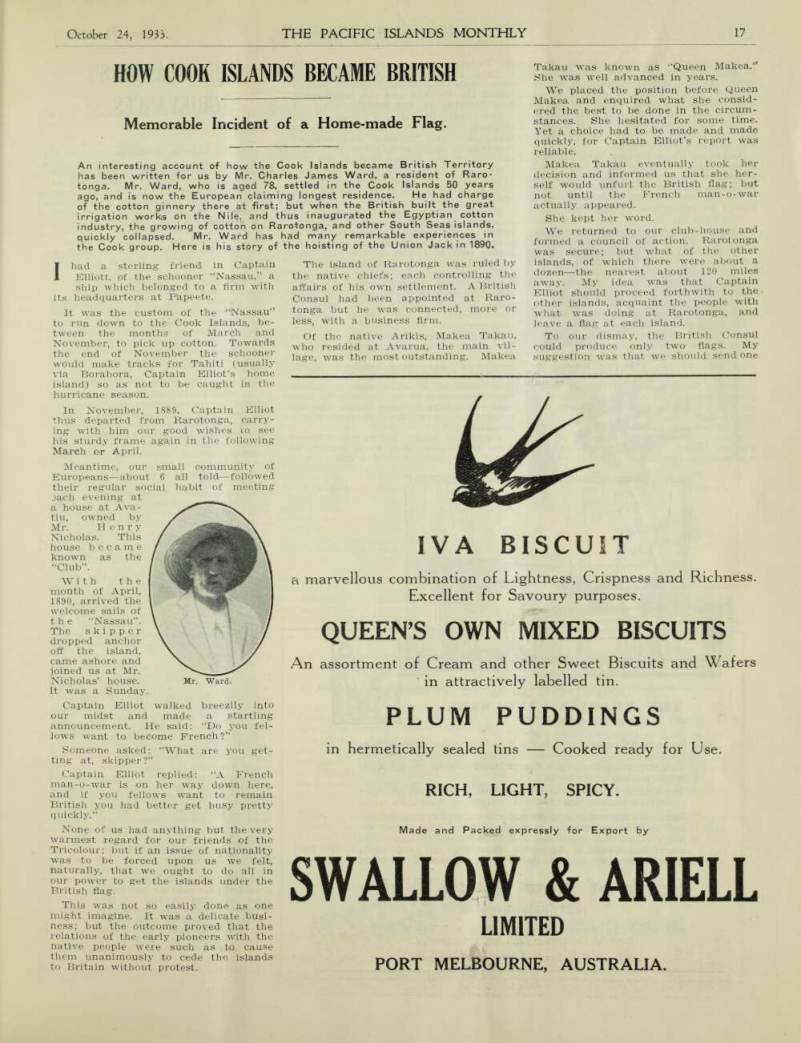
An interesting account of how the Cook Islands became British Territory has been written for us by Mr. Charles James Ward, a resident of Raro tonga. Mr. Ward, who is aged 78, settled in the Cook Islands 50 years ago, and is now the European claiming longest residence. He had charge of the cotton ginnery there at first; but when the British built the great irrigation works on the Nile, and thus inaugurated the Egyptian cotton industry, the growing of cotton on Rarotonga, and other South Seas islands, quickly collapsed. Mr. Ward has had many remarkable experiences in the Cook group. Here is his story of the hoisting of the Union Jack in 1890.
I had a sterling friend in Captain Elliott, of the schooner “Nassau,” a ship which belonged to a firm with its headquarters at Papeete.
It was the custom of the “Nassau” to run down to the Cook Islands, be tween the months of March and November, to pick up cotton. Towards the end of November the schooner would make tracks for Tahiti (usually via Borabora, Captain Elliot’s home island) so as not to be caught in the hurricane season.
In November, 1889, Captain Elliot thus departed from Rarotonga, carry ing with him our good wishes to see his sturdy frame again in the following March or April.
Meantime, our small community of Europeans—about 6 all told—followed their regular social habit of meeting
each evening at a house at Ava tiu, owned by Mr. Henry Nicholas. This house became known as the “Club”.
With the month of April, 1890, arrived the welcome sails of the “Nassau”.
The skipper dropped anchor off the island, came ashore and joined us at Mr.
Nicholas’ house.
It was a Sunday.
Captain Elliot walked breezily into our midst and made a startling announcement. He said: “Do you fel lows want to become French?”
Someone asked: “What are you get ting at, skipper?”
Captain Elliot replied: “A French man-o-war is on her way down here, and if you fellows want to remain British you had better get busy pretty quickly.”
None of us had anything but the very warmest regard for our friends of the Tricolour: but if an issue of nationality was to be forced upon us we felt, naturally, that we ought to do all in our power to get the islands under the British flag.
This was not so easily done as one might imagine. It was a delicate busi ness; but the outcome proved that the relations of the early pioneers with the native people were such as to cause them unanimously to cede the islands to Britain without protest.
The island of Rarotonga was ruled by the native chiefs; each controlling the affairs of his own settlement. A British Consul had been appointed at Raro tonga but he was connected, more or less, with a business firm.
Of the native Arikis, Makea Takau, who resided at Avarua, the main vil lage, was the most outstanding. Makea
Takau was known as “Queen Makea.”
She was well advanced in years.
We placed the position before Queen Makea and enquired what she consid ered the best to be done in the circum stances. She hesitated for some time.
Yet a choice had to be made and made quickly, for Captain Elliot’s report was reliable.
Makea Takau eventually took her decision and informed us that she her self would unfurl the British flag; but not until the French man-o-war actually appeared.
She kept her word.
We returned to our club-house and formed a council of action. Rarotonga was secure; but what of the other islands, of which there were about a dozen —the nearest about 120 miles away. My idea was that Captain Elliot should proceed forthwith to the other islands, acquaint the people with what was doing at Rarotonga, and leave a flag at each island.
To our dismay, the British Consul could produce only two flags. My suggestion was that we should send one
Mr. Ward.
of these flags to Mangaia and the other to Aitutaki—the two main islands—and take pot-luck that the warship would not visit any of the other islands. I was bold enough to assert that we at Raro tonga could make our own Union Jack.
This plan went; and that same Sun day night the “Nassau’’ disappeared in the direction of Mangaia.
Scores of times I had folded the flag aboard ship, but never had I been faced with the job of manufacturing one.
Still, the position had to be met, and it was to me that the community now looked to produce a Union Jack.
We went to one of the stores and took from the shelves several rolls of material—calico, blue muslin and some red material. I cut out a blue back ground about 5 feet square, shaped the crosses and set the pieces into place.
With the aid of a sewing machine, Miss Nicholas stitched the pieces together. The job was finished some time during that Sunday night.
It is now so long ago that I am unable to recollect with certainty whether we went along to Queen Makea that same night or early the following morning. At any rate, we wasted no time, and on Monday the flag was at the mast-head, folded in correct mano-war style. The site of the flag-pole may still be seen near the present day Royal Hall.
Then we awaited events.
Monday passed with no sign of the French boat. Tuesday came and, if my memory serves me right, it was on
the Tuesday that the warship appeared on the skyline. As the man-o-war drew near the Island, Queen Makea pulled the lanyard and my home-made flag fluttered in the breeze.
The warship slewed round and steamed away in the direction of Mangaia. The “Nassau” had reached Mangaia in time and, when the com mander of the French vessel saw the Union Jack flying at that island, he appears to have returned direct to Tahiti, without bothering about the other islands.
The lot of the Cook Islands people was now cast with Britain. The un ruffled harmony that has since existed between the Europeans here and the native race is testimony that the step so taken has never been regretted.
For my part, when I trace back over the fifty years of my life in the Cook Islands, and note the benefits that have come to these islands at the hands of Government, I am proud of my countrymen.
The New Zealand Government, when it took over the administration of the Group, very generously lifted the weight of island development from the shoulders of private enterprise. Educa tion, medical services and sanitation have followed and in my humble esti mate the islands have been liberally treated by New Zealand and wisely administered.
Conditions to-day are vastly different from what they were when I came to Rarotonga nearly 50 years ago.