The Tragedy Of An Islands Princess
pp. 11-12 · Read in the full issue
ON April 21, 1933, there occurred in Sydney the death of Princess ’Elisiva Fusibala Tauki’onetuku, half-sister of Her Majesty Queen Salote Tubou, D.B.E., of Tonga, in the 20th year of her life.
On account of her health the young princess came to Sydney at the advice of the Chief Medical Officer of Tonga, last December. The change seemed to have benefited her, and it was hoped that her health would soon be re covered before her return home. She gained in weight and was in unusually good health, when she was taken seri ously ill during the last week of Feb ruary. She recovered, however, and was convalescing and making preparations for her return home on April 27, which actually did happen but in a manner undreamed of by anyone, for she re lapsed on the 20th and passed away on the morning of the 21st at Highbury Hospital, Burwood, Sydney.
The news of this terrible calamity soon reached the little Kingdom of Tonga, and the whole of its people
mourned the loss of their beloved young princess.
One grieves deeply with her people at the death of one so young and beauti ful, for her life was plucked at the very zenith of its lovely bloom, with all the promises of life before it. Absorbing in its unique interest, it reads like a romance, or to be more appropriate, a tragedy of the South Seas, as indeed her life was.
She was born on July 26, 1912, as the second daughter of King George Tubou II., by his second consort, Queen Takibo.
At the age of six she lost her father, and her mother at seven; thus she was orphaned early in life and was denied the kindly care of the father and the sweet affections of the mother, so essen tial to the life of the growing child. No fit playmates were there for her, nor real companions, and she grew up in an austere, isolated atmosphere among grown-up people. Thus her childhood was not so happy as it should have been.
After the death of her mother she was sent to Ha’abai, the middle group of the kingdom, to be under the care of Rachael Toga (whom old Methodists still remember when she and her hus band visited Australia on missionary deputation work years ago) as her governess. There she remained for a little over a year before she was sent to the Diocesan Girls’ School, Auckland, in 1921. Four years were completed there before she went home on holidays in 1924. At the Centenary Celebrations of Christianity, in Tonga, in 1926, she again went home; and after which she proceeded to the Methodist Ladies’ Col lege, Hawthorne, Melbourne, where she remained until 1928, when she returned to Tonga at the completion of her educa tion. She was keen in her studies and was an accomplished pianiste. During her stay both in New Zealand and Aus tralia she made many bonds of lasting friendship.
Though she is dead, yet the years cannot dim the indelible vividness of the impression her intense personality made on one’s mind.
She was tall, with a perfect slim figure and beautifully moulded limbs, and her features were regular and re-
fined. She had the lovely black hair of the Polynesian women, crowning a wide forehead; and her neck, long and swan like, was extremely beautiful in the European sense. Her heavy-lidded dark eyes were like twin pools, soft and languorous and at times were touched by a misty wistfulness, which, vaguely suggestive of hidden mysteries and repressed empty longings in their un fathomable depths, were alluringly haunting. Her large sensitive mouth, with full lips, were set above a well rounded firm chin. Like most princesses of the Royal Family, her complexion was light and she had a soft, clear skin.
Her sweet, beautifully modulated voice, soft, mellow and musical as the low diapason of the surf that beats ever lastingly in front of her Royal home, will echo and re-echo in one’s memory.
Those who came in contact with her were charmed by the sweetness of her nature, and her ready winsome smile won her, from the whole of the people of the Kingdom, the name of “Koe si’i Ta’ahine Fofoga mamali” —the maiden of the smiling face. In keeping with her high birth she was gracious and considerate to the people, comporting her Royalty with quiet dignity and sim
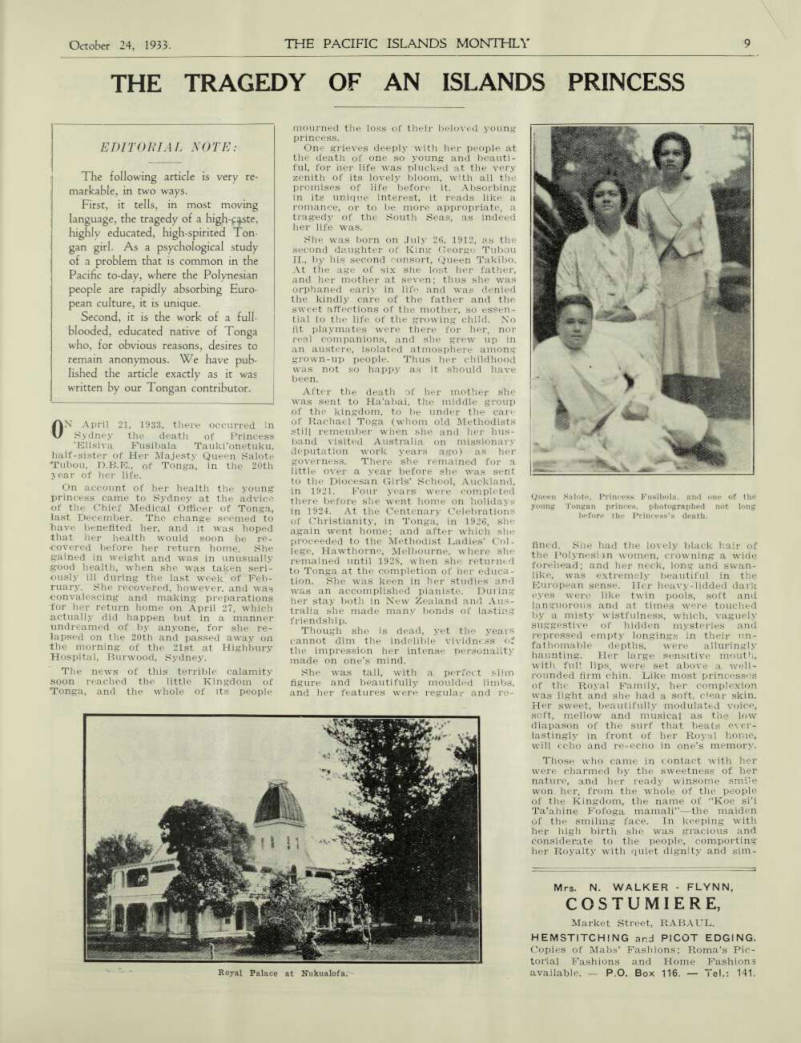
Queen Salote, Princess Fusibola, and one of the young Tongan princes, photographed not long before the Princess’s death.
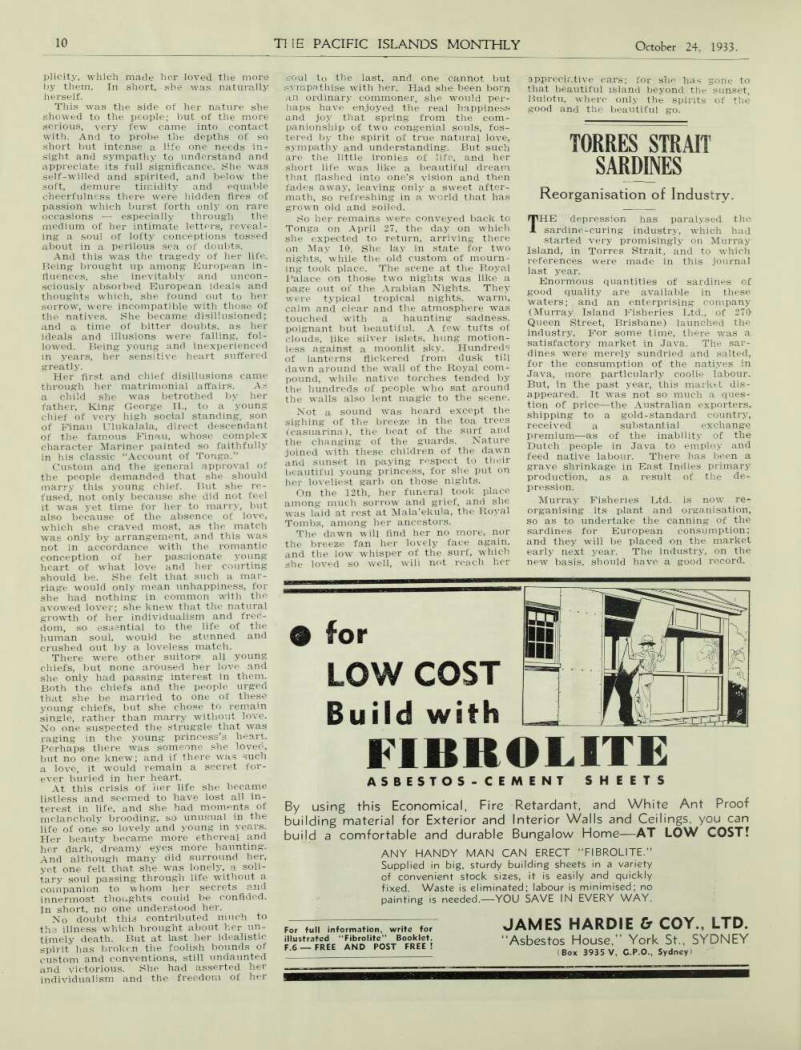
Royal Palace at Nukualofa.
plicity, which made her loved the more by them. In short, she was naturally herself.
This was the side of her nature she showed to the people; but of the more serious, very few came into contact with. And to probe the depths of so short but intense a life one needs in sight and sympathy to understand and appreciate its full significance. She was self-willed and spirited, and below the soft, demure timidity and equable cheerfulness there were hidden fires of passion which burst forth only on rare occasions especially through the medium of her intimate letters, reveal ing a soul of lofty conceptions tossed about in a perilous sea of doubts.
And this was the tragedy of her life.
Being brought up among European in fluences, she inevitably and uncon sciously absorbed European ideals and thoughts which, she found out to her sorrow, were incompatible with those of the natives. She became disillusioned; and a time of bitter doubts, as her ideals and illusions were falling, fol lowed. Being young and inexperienced in years, her sensitive heart suffered greatly.
Her first and chief disillusions came through her matrimonial affairs. As a child she was betrothed by her father, King George II., to a young chief of very high social standing, son of Finau Ulukalala, direct descendant of the famous Finau, whose complex character Mariner painted so faithfully in his classic “Account of Tonga.”
Custom and the general approval of the people demanded that she should marry this young chief. But she re fused, not only because she did not feel it was yet time for her to marry, but also because of the absence of love, which she craved most, as the match was only by arrangement, and this was not in accordance with the romantic conception of her passionate young heart of what love and her courting should be. She felt that such a mar riage would only mean unhappiness, for she had nothing in common with the avowed lover; she knew that the natural growth of her individualism and free dom, so essential to the life of the human soul, would be stunned and crushed out by a loveless match.
There were other suitors, all young chiefs, but none aroused her love and she only had passing interest in them.
Both the chiefs and the people urged that she be married to one of these young chiefs, but she chose to remain single, rather than marry without love.
No one suspected the struggle that was raging in the young princess’s heart.
Perhaps there was someone she loved, but no one knew; and if there was such a love, it would remain a secret for ever buried in her heart.
At this crisis of her life she became listless and seemed to have lost all in terest in life, and she bad moments of melancholy brooding, so unusual in the life of one so lovely and young in years.
Her beauty became more ethereal and her dark, dreamy eyes more haunting.
And although many did surround her, yet one felt that she was lonely, a soli tary soul passing through life without a companion to whom her secrets and innermost thoughts could be confided.
In short, no one understood her.
No doubt this contributed much to the illness which brought about her un timely death. But at last her idealistic spirit has the foolish bounds of custom and conventions, still undaunted and victorious. She had asserted her individualism and the freedom of her
soul to the last, and one cannot but sympathise with her. Had she been born an ordinary commoner, she would per haps have enjoyed the real happiness and joy that spring froxn the com panionship of two congenial souls, fos tered by the spirit of true natural love, sympathy and understanding. But such are the little ironies of life, and her short life was like a beautiful dream that flashed into one’s vision and then fades away, leaving only a sweet after math, so refreshing in a world that has grown old and soiled.
So her remains were conveyed back to Tonga on April 27, the day on which she expected to return, arriving there on May 10. She lay in state for two nights, while the old custom of mourn ing took place. The scene at the Royal Palace on those two nights was like a page out of the Arabian Nights. They were typical tropical nights, warm, calm and clear and the atmosphere was touched with a haunting sadness, poignant but beautiful. A few tufts of clouds, like silver islets, hung motion less against a moonlit sky. Hundreds of lanterns flickered from dusk till dawn around the wall of the Royal com pound, while native torches tended by the hundreds of people who sat around the walls also lent magic to the scene.
Not a sound was heard except the sighing of the breeze in the toa trees (casuarina), the beat of the surf and the changing of the guards. Nature joined with these children of the dawn and sunset in paying respect to their beautiful young princess, for she put on her loveliest garb on those nights.
On the 12th, her funeral took place among much sorrow and grief, and she was laid at rest at Mala’ekula, the Royal Tombs, among her ancestors.
The dawn will find her no more, nor the breeze fan her lovely face again, and the low whisper of the surf, which she loved so well, will not reach her
appreciative ears; for she has gone to that beautiful island beyond the sunset, Bulotu, where only the spirits of the good and the beautiful go.