Modern Munchausen Gets Loose In New Guinea.
pp. 8-44 · Read in the full issue
Lies of Yellow Canadian Journalist Are Amazing and Amusing.
NOT long ago, a strong protest was made in the Commonwealth Parliament concerning a series of articles which had been published in the “Toronto Star,’' a Canadian news paper, in which conditions in the Terri tories of Papua and New Guinea had been grossly misrepresented.
We now have received copies of the articles referred to; and seldom have we read more priceless examples of irresponsible yellow journalism. They profess to describe the new gold in dustry in New Guinea, and conditions incidental thereto; but they may be more truthfully described as a tissue of ridiculous lies.
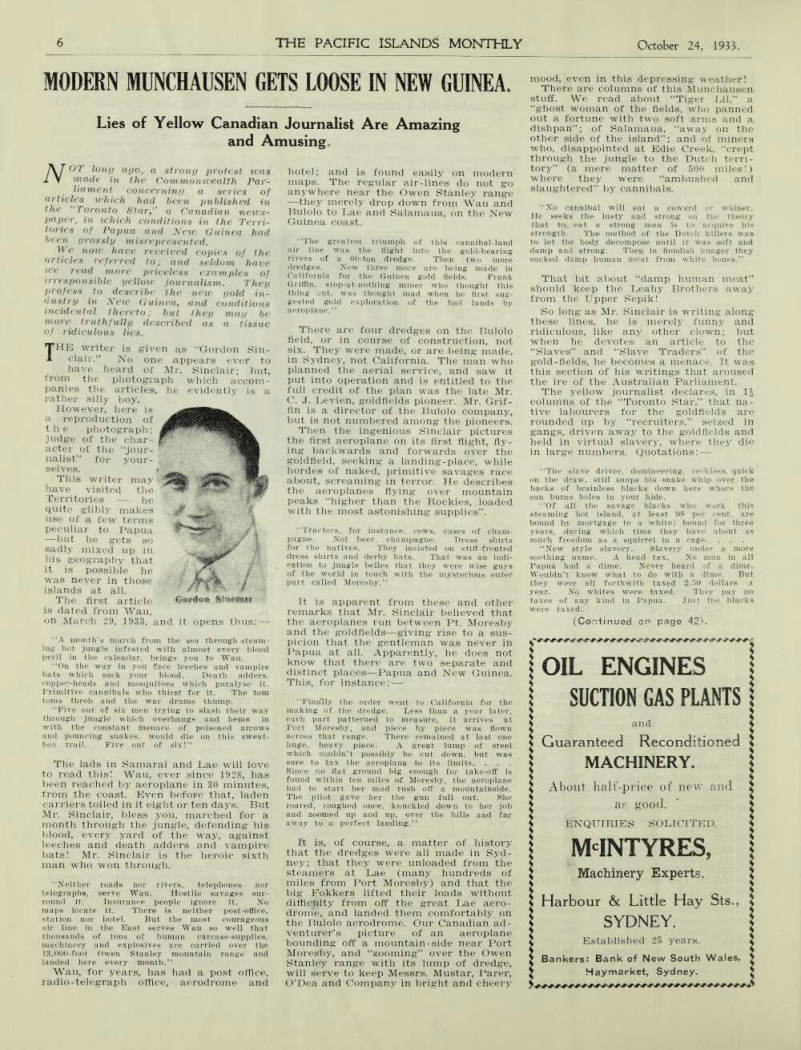
THE writer is given as “Gordon Sin clair.” No one appears ever to have heard of Mr. Sinclair; but, from the photograph which accom panies the articles, he evidently is a rather silly boy.
However, here is a reproduction of the photograph; judge of the char acter of the “jour nalist” for your selves.
This writer may have visited the Territories he quite glibly makes use of a few terms peculiar to Papua —but he gets so sadly mixed up in his geography that it is possible he was never in those islands at all.
The first article is dated from Wau,
on March 29, 1933, and it opens thus: “A month’s march from the sea through steam ing hot jungle infested with almost every blood peril in the calendar, brings you to Wau.
“On the way in you face leeches and vampire bats which suck your blood. Death adders, copper-heads and mosquitoes which paralyse it.
Primitive cannibals who thirst for it. The tom toms throb and the war drums thump.
“Five out of six men trying to slash their way through jungle which overhangs and hems in with the constant menace of poisoned arrows and pouncing snakes, would die on this sweat box trail. Five out of six!”
The lads in Samarai and Lae will love to read this! Wau, ever since 1928, has been reached by aeroplane in 30 minutes, from the coast. Even before that, laden carriers toiled in it eight or ten days. But Mr. Sinclair, bless you, marched for a month through the jungle, defending his blood, every yard of the way, against leeches and death adders and vampire bats! Mr. Sinclair is the heroic sixth man who won through.
“Neither roads nor rivers, telephones nor telegraphs, serve Wau. Hostile savages sur round it. Insurance people ignore it. No maps locate it. There is neither post-office, station nor hotel. But the most courageous air line in the East serves Wau so well that thousands of tons of human carcass-supplies, machinery and explosives are carried over the 13,000-foot Owen Stanley mountain range and landed here every month.”
Wau, for years, has had a post office,
radio-telegraph office, aerodrome and
hotel; and is found easily on modern maps. The regular air-lines do not go anywhere near the Owen Stanley range —they merely drop down from Wau and Bulolo to Lae and Salamaua, on the New Guinea coast.
“The greatest triumph of this cannibal-land air line was the flight into the gold-bearing rivers of a 60-ton dredge. Then two more dredges. Now three more are being made in California for the Guinea gold fields. Frank Griffin, stop-at-nothing miner who thought this thing out, was thought mad when he first sug gested gold exploration of the bad lands by aeroplane.”
There are four dredges on the Bulolo field, or in course of construction, not six. They were made, or are being made, in Sydney, not California. The man who planned the aerial service, and saw it put into operation and is entitled to the full credit of the plan was the late Mr.
C. J. Levien, goldfields pioneer. Mr. Grif fin is a director of the Bulolo company, but is not numbered among the pioneers.
Then the ingenious Sinclair pictures the first aeroplane on its first flight, fly ing backwards and forwards over the goldfield, seeking a landing-place, while hordes of naked, primitive savages race about, screaming in terror. He describes the aeroplanes flying over mountain peaks “higher than the Rockies, loaded with the most astonishing supplies”.
“Tractors, for instance, cows, cases of cham pagne. Not beer, champagne. Dress shirts for the natives. They insisted on stiff-fronted dress shirts and derby hats. That was an indi cation to jungle belles that they were wise guys of the world in touch with the mysterious outer part called Moresby.”
It is apparent from these and other remarks that Mr. Sinclair believed that the aeroplanes run between Pt. Moresby and the goldfields—giving rise to a sus picion that the gentleman was never in Papua at all. Apparently, he does not know that there are two separate and distinct places—Papua and New Guinea.
This, for instance: “Finally the order went to California for the making of the dredge. Less than a year later, each part patterned to measure, it arrives at Port Moresby, and piece by piece was flown across that range. There remained at last one huge, heavy piece. A great lump of steel which couldn’t possibly be cut down, but was sure to tax the aeroplane to its limits. . . .
Since no flat ground big enough for take-off is found within ten miles of Moresby, the aeroplane had to start her mad rush off a mountainside.
The pilot gave her the gun full out. She roared, coughed once, knuckled down to her job and zoomed up and up, over the hills and far away to a perfect landing.”
It is, of course, a matter of history that the dredges were all made in Syd ney; that they were unloaded from the steamers at Lae (many hundreds of miles from Port Moresby) and that the big Fokkers lifted their loads without difficulty from off the great Lae aero drome, and landed them comfortably on the Bulolo aerodrome. Our Canadian ad venturer’s picture of an aeroplane bounding off a mountain-side near Port Moresby, and “zooming” over the Owen Stanley range with its lump of dredge, will serve to keep Messrs. Mustar, Parer, O’Dea and Company in bright and cheery
mood, even in this depressing weather!
There are columns of this Munchausen stuff. We read about “Tiger Lil,” a “ghost woman of the fields, who panned out a fortune with two soft arms and a dishpan”; of Salamaua, “away on the other side of the island”; and of miners who, disappointed at Edie Creek, “crept through the jungle to the Dutch terri tory” (a mere matter of 500 miles!) where they were “ambushed and slaughtered” by cannibals.
“No cannibal will eat a coward or whiner.
He seeks the lusty and strong on the theory that to eat a strong man is to acquire his strength. The method of the Dutch killers was to let the body decompose until it was soft and damp and strong. Then in fiendish hunger they sucked damp human meat from white bones.”
That bit about “damp human meat” should keep the Leahy Brothers away from the Upper Sepik!
So long as Mr. Sinclair is writing along these lines, he is merely funny and ridiculous, like any other clown; but when he devotes an article to the “Slaves” and “Slave Traders” of the gold-fields, he becomes a menace. It was this section of his writings that aroused the ire of the Australian Parliament.
The yellow journalist declares, in 1½ columns of the “Toronto Star,” that na tive labourers for the goldfields are rounded up by “recruiters,” seized in gangs, driven away to the goldfields and held in virtual slavery, where they die in large numbers. Quotations: “The slave driver, domineering, reckless, quick on the draw, still snaps his snake whip over the backs of brainless blacks down here where the sun burns holes in your hide.
“Of all the savage blacks who work this steaming hot island, at least 98 per cent, are bound by mortgage to a white; bound for three years, during which time they have about as much freedom as a squirrel in a cage. ...
“New style slavery. Slavery under a more soothing name. A head tax. No man in all Papua had a dime. Never heard of a dime.
Wouldn’t know what to do with a dime. But they were all forthwith taxed 2.50 dollars a year. No whites were taxed. They pay no taxes of any kind in Papua. Just the blacks were taxed.
(Continued on page 42).
Gordon Sinemir
“To get poll tax money the blacks had to work. Not to get it meant going to gaol.
Even that wasn’t a bad idea. Lots went to gaol and rather enjoyed it. But the recruiters, playing on the vanity and greed of chiefs, offered these hooper-doopers tobacco, hatchets, knives, coloured beads, mirrors and other trade junk for 50 to 100 boys, and the traffic in brown bodies was on.
“These savage blacks have and show deep affection for their sons, and no more pitiable sight has ever been witnessed than a recruiter driving away the young manhood of a town while mothers scream and weep in an agony of sorrow.”
Anyone who knows New Guinea knows that this is all imaginative and exag gerated rubbish; and that there is no part of the world where the welfare of indentured native labourers is more jeal ously guarded than in Australia’s Pacific territories. Many of Australia’s adminis trative troubles are due to the coddling and spoon feeding of the natives. That an irresponsible youth should be allowed to present such a picture to a section of the Canadian people is only another ex ample of the political and social dangers that lie in yellow journalism.
Incidentally, this article on “Slavery” also suggests that Mr. Sinclair was never
in the territories at all. He writes it as from "Port Moresby, Papua, March 22,” and refers frequently to “recruiting” in Papua; yet there is comparatively little recruiting in Papua, and probably not one Papuan native has been taken to the New Guinea goldfields. The goldfields labourers have been recruited mostly from the north-east New Guinea dis tricts, and from New Britain,