Stevenson’S House On Butaritari
pp. 36-37 · Read in the full issue
Island.
Where "T’Imatan Ni Kore Boki" Tarried Awhile.
By Ernest Osborne.
ON June 24, 1889, the “Equator,” trad ing schooner, at Honolulu, picked up Robert Louis Stevenson and his companions — Mrs. Stevenson (his mother), Lloyd-Osbourne, and the artist Joe Strong—for Apia, Samoa. Paul Hof lich, a trader, and Rich, an Russian ex sea captain, were passengers. The skip per was Scottish, the mate Norwegian, and the second mate a Finn.
A heavy gale marked Stevenson’s 38th birthday, for which occasion he com posed the song, “On Board the Old ‘Equator,’” with the refrain: “Where has your top-mast gone, I pray?
Captain, darling, where has your top mast gone?”
On board the “Equator,” Stevenson and Osbourne in collaboration wrote “The Wreckers.” Subsequently, cruising through the Line Islands on his way with a troupe of native dancers, R.L.S. made a visit to San Francisco, and back to Samoa to find sepulchre at Vailima.
Circumstance decreed that I became
intimately acquainted with the cottage on Butaritar. atoll, in that equatorial Central Pacific Group, where the spinner of detectable yarns idled a while.
A few years after Steven son’s visit, I resided as a trader for copra succes sively in Keuea, Teareareke and Tanimaiaki villages.
During seven years’ resi dence on that doldrum-set, rainswept island, when visiting Butaritari town, I camped many a time in the cottage which had
been occupied by the distinguished writer. On native holidays and gala occasions, such as the anniversary of King Te Bureimoa’s coronation, the Christmas and New Year’s week of dances and festivities, and Queen Vic toria’s, and, later, King Edward’s, Birth days, I was in residence several days together with one or more rival copra traders from up the lagoon coast. Those were days when traders were so far un spoiled that keenest business competi tion was not permitted to interfere with conviviality.
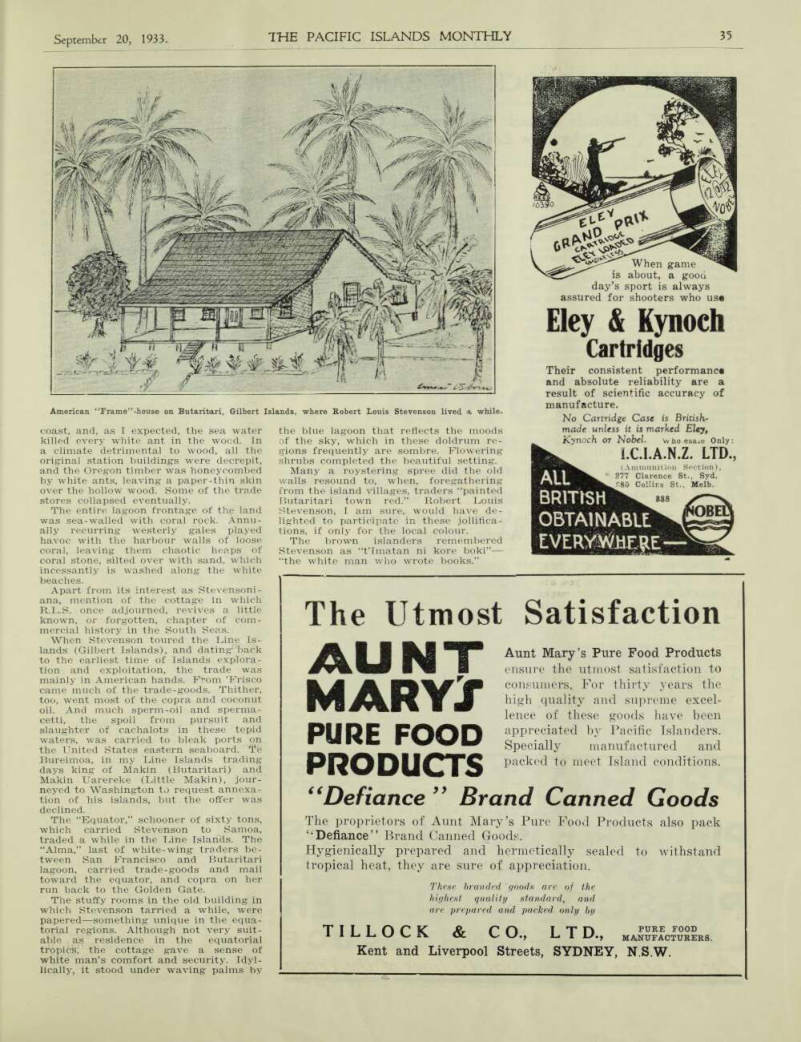
The cottage was a one-storey, wooden “frame house,” containing a bedroom on each side of a large central apartment, under shingle roof. Full-length front and back verandahs were under the same roof. Between the kitchen and bathroom, on the back verandah, was ample space for lazing and viewing the blue lagoon, which seemed to rise to meet the hori zon, so low is the island. On the reef, in view from the old-world cottage across the lagoon corner, Nakuti en trance-island sits emerald-green by the ship passage, flanked by the much larger, verdant Bikate.
About two acres in area, the grounds comprised a trade-station compound.
Cocos palms dotted the allotment. A few banana plants grew in soil brought as ballast in copra-loading ships from various distant parts of the world. A young mango tree—the only mango on the island or in the group—was doing well, generated from a seed planted by the late Captain Robert Cable, of Syd-
ney, who, even at that time, was old in the Island trade. Past the front Veran dah the level, moss-grown road of coral “slick” marched with the white picket fence. Opposite, the Sacred Heart Mission residence and the wooden, two storey house of a local trader, were backed by a forest of graceful palms.
Near by, were other trading stations and Butaritari native town.
This property, which should be re membered in literary history for its as sociation with R.L.S., had just come into the possession of the Pacific Islands Co., Ltd., or Sydney and London. When phos phate of lime was discovered on Nauru and Ocean Island, in adjustment of busi ness interests and joint working of the deposits, the property passed to der Jaluit Gesellschaft, of Hamburg, whose “Haupt-Agentur”—head station —was in Jaluit, in the Marshall Islands, in 1900.
That great South Sea trading company became extinct in the War.
Possessing ample landed interests on the atoll, der Jaluit Gesellschaft resold the estate to the Sacred Heart Mission —keen seekers of freehold on islands where leasehold of native land, and that only in limited area, virtually is the only tenure permitted whites and other in vaders. Just about that time, the Ger man company disposed of other land held in the British ruled Gilbert Islands —possibly a move made advisable by some political complication of the mo ment threatening, or the gigantic conflict foreseen.
Crawford, or Wightman—remembrance of names by contemporary whites and the dusky native monarch, was vague— were original owners of the station pro perty. An American style managerial residence, lattice enclosed, without ceil ing and with shingle roof, stood at an angle to the road. On land reclaimed from the lagoon reef, three trade and bulkstores perched on coral foundation, with sheltering verandah fronting the boat harbour, permitting delivery direct into the stores from unloading surfboats.
The copra store shipping jetty straddled the harbour coral wall opposite.
The old American copra-house, of Stevenson’s time, had just been de molished. Owing to acute shortage of sawn timber on the island, I used the least white ant-infested material in erection of my first trade station build ings in Keuea village. I rafted the stuff; natives pushed it up ten miles of lagoon
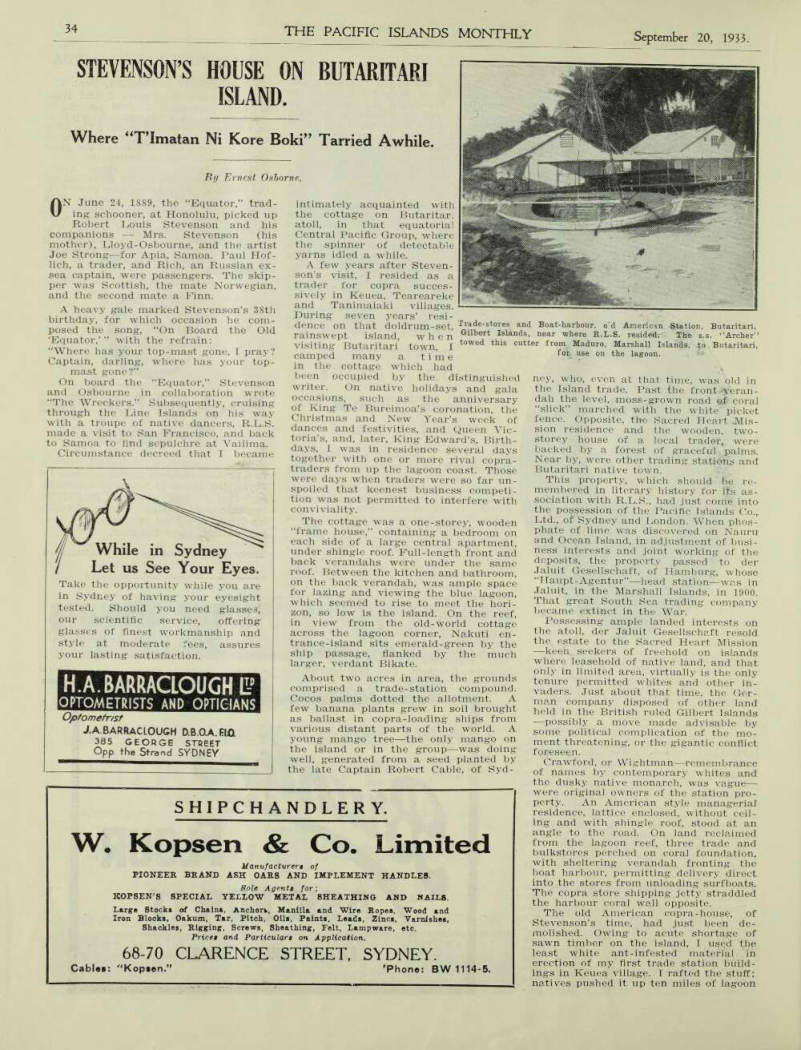
Trade-stores and Boat-harbour, old American Station, Butaritari, Gilbert Islands, near where R.L.S. resided. The s.s. “Archer” towed this cutter from Maduro, Marshall Islands, to Butaritari, for, use on the lagoon.
coast, and, as I expected, the sea water killed every white ant in the wood. In a climate detrimental to wood, all the original station buildings were decrepit, and the Oregon timber was honeycombed by white ants, leaving a paper-thin skin over the hollow wood. Some of the trade stores collapsed eventually.
The entire lagoon frontage of the land was sea-walled with coral rock. Annu ally recurring westerly gales played havoc with the harbour walls of loose coral, leaving them chaotic heaps of coral stone, silted over with sand, which incessantly is washed along the white beaches.
Apart from its interest as Stevensoni ana, mention of the cottage in which R.L.S. once adjourned, revives a little known, or forgotten, chapter of com mercial history in the South Seas.
When Stevenson toured the Line Is lands (Gilbert Islands), and dating back to the earliest time of Islands explora tion and exploitation, the trade was mainly in American hands. From ’Frisco came much of the trade-goods. Thither, too, went most of the copra and coconut oil. And much sperm-oil and sperma cetti, the spoil from pursuit and slaughter of cachalots in these tepid waters, was carried to bleak ports on the United States eastern seaboard. Te Bureimoa, in my Line Islands trading days king of Makin (Butaritari) and Makin Uarereke (Little Makin), jour neyed to Washington to request annexa tion of his islands, but the offer was declined.
The “Equator,” schooner of sixty tons, which carried Stevenson to Samoa, traded a while in the Line Islands. The “Alma,” last of white-wing traders be tween San Francisco and Butaritari lagoon, carried trade-goods and mail toward the equator, and copra on her run back to the Golden Gate.
The stuffy rooms in the old building in which Stevenson tarried a while, were papered—something unique in the equa torial regions. Although not very suit able as residence in the equatorial tropics, the cottage gave a sense of white man’s comfort and security. Idyl lically, it stood under waving palms by
the blue lagoon that reflects the moods of the sky, which in these doldrum re gions frequently are sombre. Flowering shrubs completed the beautiful setting.
Many a roystering spree did the old walls resound to, when, foregathering from the island villages, traders “painted Butaritari town red.” Robert Louis Stevenson, I am sure, would have de lighted to participate in these jollifica tions, if only for the local colour.
The brown islanders remembered Stevenson as “t’lmatan ni kore boki” — “the white man who wrote books.”
American “Frame”-house on Butaritari, Gilbert Islands, where Robert Louis Stevenson lived a while.