Gordon Thomas Is
p. 31 · Read in the full issue
Caned.
Recent Article Displeases Papua.
Port Moresby, Aug. 31.
THE sermon of Mr. Gordon Thomas, “Papua Publicity and Patrols,” was not impressive.
It is quite evident that he does not know Papua at all —his knowledge is second-hand and inaccurate. It would be better if he studied the maps and the annual reports of Papua a little, and did not rely exclusively upon “hard bitten old timers who miss very little that goes on in Papua.”
What does he mean when he writes: “The exploits of the Papuan service have gone down to history years ago, and on the archives of research you will find their doings recorded”? What are archives of research? And how are people to find the records of ex ploits there? But Mr. Thomas’ use of the perfect tense seems to imply that the exploits ceased years ago and that there are to be no more of them, and that’s a pity, Mr. Thomas is on dangerous ground when he suggests that the information given in reference to Humphreys’ patrol in 1917 was unreliable. Humphreys did pass successfully and peacefully through unknown country after crossing the Papua-New Guinea boundary and be fore reaching the Waria Valley.
The Waria was visited previously, as he was informed, and was also patrolled by a German force, whose Mauser clips and cartridge cases Humphreys found there.
Mr. Thomas makes a dignified refer ence to “historical data”. Where does he get them from? He might find the following references useful; (1) The Papuan Annual Report for 1917-18.
(2) Sir Hubert Murray’s book, “Papua of To-day”. (3) Humphreys’ book, “Patrolling in Papua”.
Hide’s patrol was not confined, as Mr.
Thomas suggests, to the Tiveri River or to the “Lake Kamu goldfields area,” but extended across to Wau, and re turned by a different route.
The “Lake Kamu watershed” is a little indefinite, and very little is offi cially known of the “activities by prospectors” there. But neither the un defined watershed nor the activities have anything at all to do with Hide’s patrol. Mr. Thomas should consult a map of the district.
Really, Mr. Thomas should not write about Papua. He may be perfectly sound on wistful notes, tribal jealousies and archives of research, but even with his informant behind him he should not venture on “historical correctness” —at least, so far as this Territory is concerned. —MOLLIE LETT.
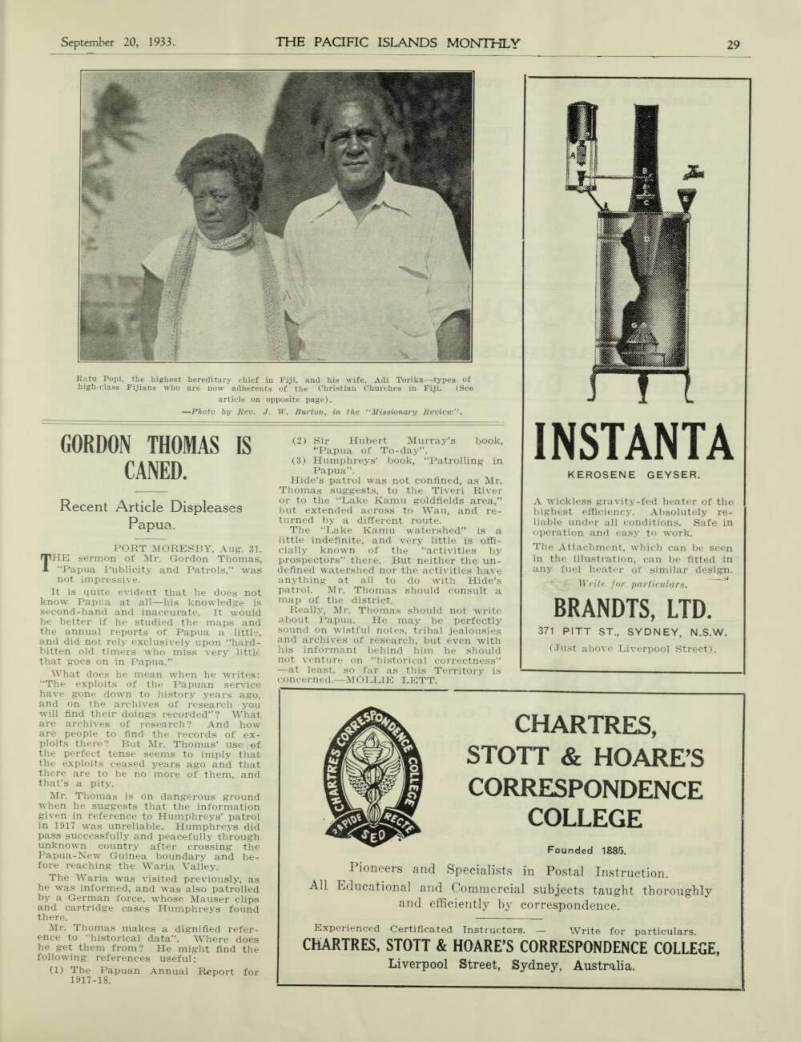
Ratu Popi, the highest hereditary chief in Fiji, and his wife, Adi Torika —types of high-class Fijians who are now adherents of the Christian Churches in Fiji. (See article on opposite page). —Photo by Rev. J. W. Burton, in the “Missionary Review".