Death Of Loved And Respected Frenchman.
pp. 17-18 · Read in the full issue
Remarkable Career of Late Dr. Cassiau, of Tahiti.
From Our Own Correspondent.
Papeete, Aug. 9.
AN atmosphere of restraint and sad ness was apparent throughout the July celebrations this year on account of the fact that Dr. F. Cassiau, the Mayor of Papeete, was lying desperately ill in the local hospital as the result of complications following an operation he had undergone for the removal of a tumour.
For many days the issue was uncertain and the population awaited the daily bulletin with alternate despair and hope; but in spite of the best medical care and the ministrations of devoted friends Tahiti’s best beloved and most esteemed citizen finally succumbed on July 28.
Dr. Cassiau was born in Mauritius in 1870, of French parents, who had
become naturalised British subjects through force of circumstances, so it is not surprising that, when he came of age, he should wish to take French nationality, and that his medical studies and preliminary training were completed in France.
Soon after his arrival in Tahiti, in 1903, he received the appointment of Administrator to the Gambiers, a small group of islands forming the southern most limit of French Oceania, return ing after some years to Tahiti to take charge of the Papeete Hospital. At this time he also acted as Port doctor, and in this capacity his attractive personality gained him a host of friends among the officers and passengers on the mail steamers.
When the war commenced in Europe, Dr. Cassiau was one of the first to embark for the field of action, and he re mained there till the cessation of hostilities. For his gallant and distinguished services there he was awarded the Legion d’Honneur, the Croix de Guerre with three citations, and several other decorations; he also received special recognition in connection with an epidemic among the French troops in Serbia.
As Mayor of Papeete, to which office he was elected in 1922, and which he held with conspicuous ability till the
time of his death, Dr. Cassiau was in strumental in bringing about many notable improvements, in spite of the incredible difficulties with which he was confronted, particularly in the water supply and sanitary arrangements of the town. The small public park near the market place is also due to his foresight, and for this alone he will be gratefully remembered.
In his private practice the doctor lived up to the noblest ideals of his profession, for money never entered his calculations when there was suffering to be relieved. His charity cases among the poor received the same conscientious attention as did those who could afford to pay his ridiculously small and tardily presented accounts. No one, white, brown, yellow, or black, ever rang his door bell and failed to get the right
kind of response to an urgent call, for his benevolent philosophy of life was big enough to embrace all humanity.
As an obstetrician he could have acquired fame in any country. It was in this branch of medical science that he appeared most interested, and in which he displayed a prescience and skill amounting to genius; seldom indeed were his cases anything but entirely successful.
We adults may deplore the loss of Dr. Cassiau’s benign influence in local affairs and miss his booming “Bon jour, mon vieux” along the Papeete waterfront, but we at least get some stimulation by recalling the unique use fulness of his career. To the hundreds of children he helped into the world, however, and whose infantile troubles he tended, there is no compensation whatsoever for the loss of “Papa”
Cassiau. His demise is also an irreparable loss to the native community, because his 30 years of experience gave him a wonderful understanding of Polynesian psychology, and helped him to overcome the antipathy they all have to European methods of treatment.
Dr, Cassiau was a tireless worker,
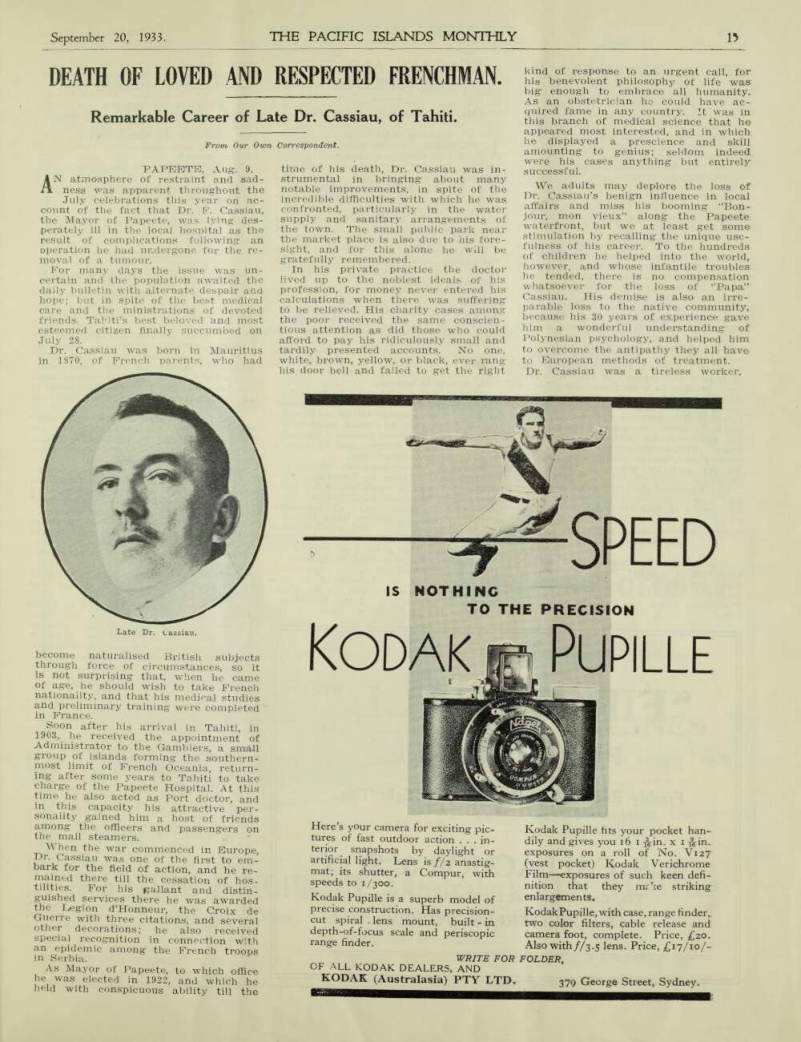
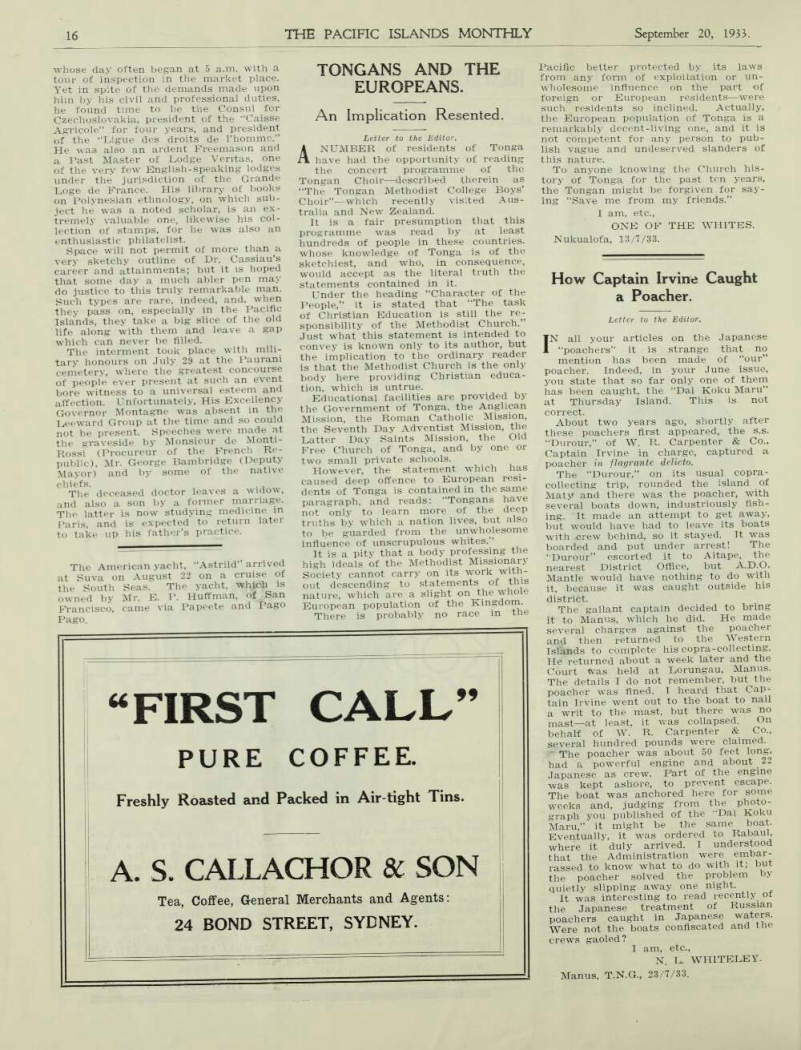
Late Dr. Cassiau.
whose day often began at 5 a.m. with a tour of inspection in the market place.
Yet in spite of the demands made upon him by his civil and professional duties, he found time to be the Consul for Czechoslovakia, president of the “Caisse Agricole” for four years, and president of the “Ligue des droits de l’homme.”
He was also an ardent Freemason and a Past Master of Lodge Veritas, one of the very few English-speaking lodges under the jurisdiction of the Grande Loge de France. His library of books on Polynesian ethnology, on which sub ject he was a noted scholar, is an ex tremely valuable one, likewise his col lection of stamps, for he was also an enthusiastic philatelist.
Space will not permit of more than a very sketchy outline of Dr. Cassiau’s career and attainments; but it is hoped that some day a much abler pen may do justice to this truly remarkable man.
Such types are rare, indeed, and, when they pass on, especially in the Pacific Islands, they take a big slice of the old life along with them and leave a gap which can never be filled.
The interment took place with mili tary honours on July 29 at the Paurani cemetery, where the greatest concourse of people ever present at such an event bore witness to a universal esteem and affection. Unfortunately, His Excellency Governor Montague was absent in the Leeward Group at the time and so could not be present. Speeches were made at the graveside by Monsieur de Monti- Rossi (Procureur of the French Re public), Mr. George Bambridge (Deputy Mayor) and by some of the native chiefs.
The deceased doctor leaves a widow, and also a son by a former marriage.
The latter is now studying medicine m Paris, and is expected to return later to take up his father’s practice.
The American yacht, “Astrild” arrived at Suva on August 22 on a cruise of the South Seas. The yacht, which is owned by Mr. E. P. Huffman, of San Francisco, came via Papeete and Pago Pago.