Foodstuffs For
p. 48 · Read in the full issue
Tahiti.
Is Australasian Trade Likely to Suffer.
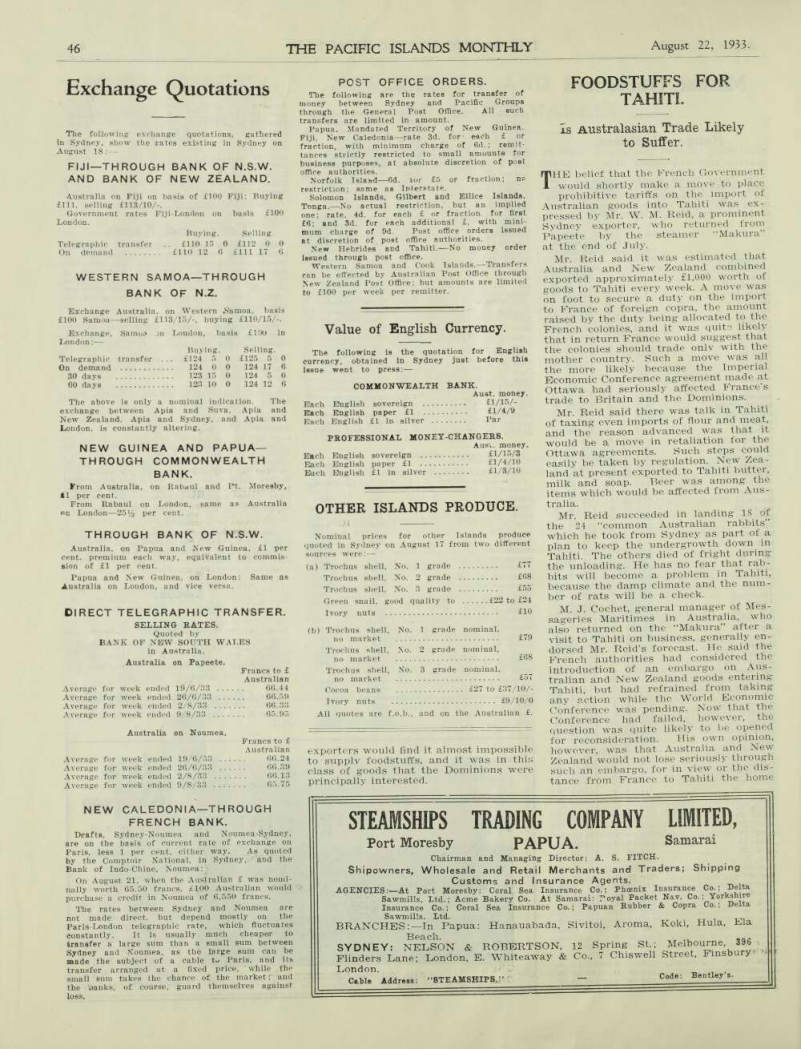
THE belief that the French Government would shortly make a move to place prohibitive tariffs on the import of Australian goods into Tahiti was ex pressed by Mr. W. M. Reid, a prominent Sydney exporter, who returned from Papeete by the steamer “Makura” at the end of July.
Mr. Reid said it was estimated that Australia and New Zealand combined exported approximately £ 1,000 worth of goods to Tahiti every week. A move was on foot to secure a duty on the import to France of foreign copra, the amount raised by the duty being allocated to the French colonies, and it was quite likely that in return France would suggest that the colonies should trade onlv with the mother country. Such a move was all the more likely because the Imperial Economic Conference agreement made at Ottawa had seriously affected France’s trade to Britain and the Dominions.
Mr. Reid said there was talk in Tahiti of taxing even imports of flour and meat, and the reason advanced was that it would be a move in retaliation for the Ottawa agreements. Such steps could easily be taken by regulation. New Zea land at present exported to Tahiti butter, milk and soap. Beer was among the items which would be affected from Aus tralia.
Mr. Reid succeeded in landing 18 of the 24 “common Australian rabbits” which he took from Sydney as part of a plan to keep the undergrowth down in Tahiti. The others died of fright during the unloading. He has no fear that rab bits will become a problem in Tahiti, because the damp climate and the num ber of rats will be a check.
M. J. Cochet, general manager of Mes sageries Maritimes in Australia, who also returned on the “Makura” after a visit to Tahiti on business, generally en dorsed Mr. Reid’s forecast. He said the French authorities had considered the introduction of an embargo on Aus tralian and New Zealand goods entering Tahiti, but had refrained from taking any action while the World Economic Conference was pending. Now that the Conference had failed, however, the question was quite likely to be opened for reconsideration. His own opinion, however, was that Australia and New Zealand would not lose seriously through such an embargo, for in view or the dis tance from France to Tahiti the home
exporters would find it almost impossible to supply foodstuffs, and it was in this class of goods that the Dominions were principally interested.