Ancient Stone.
p. 25 · Read in the full issue
Archaeological Theories.
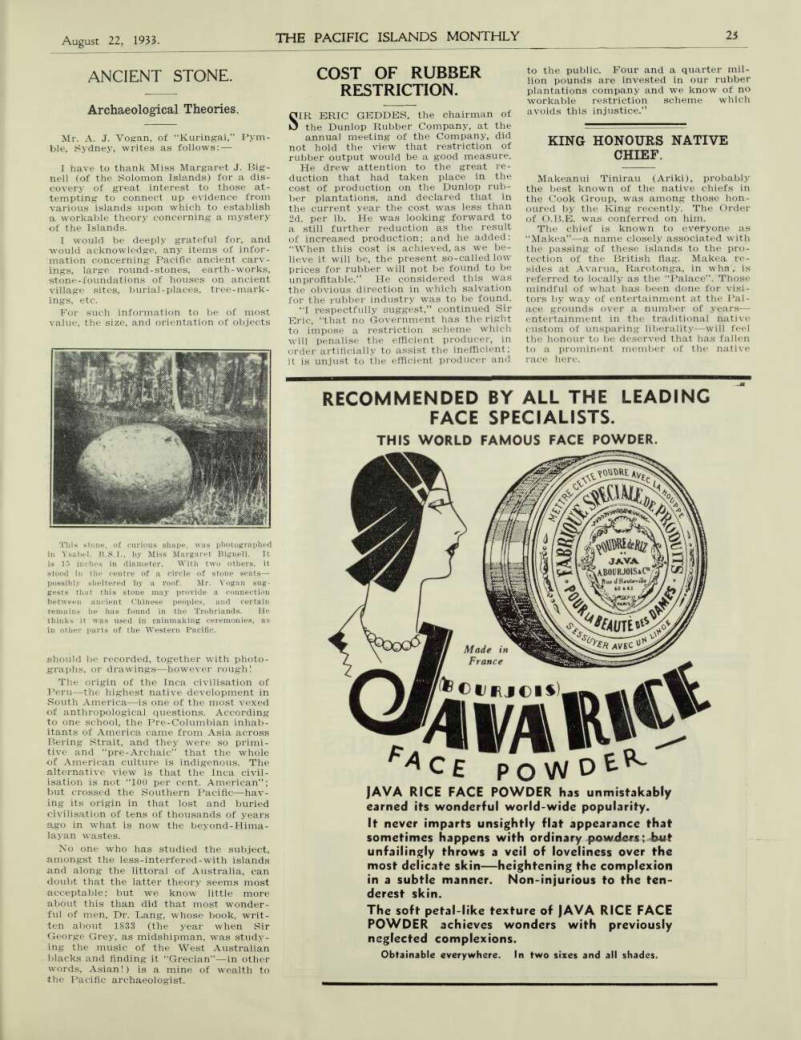
Mr. A. J. Vogan, of “Kuringai,” Pym ble, Sydney, writes as follows: I have to thank Miss Margaret J. Big nell (of the Solomon Islands) for a dis covery of great interest to those at tempting to connect up evidence from various islands upon which to establish a workable theory concerning a mystery of the Islands.
I would be deeply grateful for, and would acknowledge, any items of infor mation concerning Pacific ancient carv ings, large round-stones, earth-works, stone-foundations of houses on ancient village sites, burial-places, tree-mark ings, etc.
For such information to be of most value, the size, and orientation of objects
should be recorded, together with photo graphs, or drawings—however rough!
The origin of the Inca civilisation of Peru —the highest native development in South America —is one of the most vexed of anthropological questions. According to one school, the Pre-Columbian inhab itants of America came from Asia across Bering Strait, and they were so primi tive and “pre-Archaic” that the whole of American culture is indigenous. The alternative view is that the Inca civil isation is not “100 per cent. American”; but crossed the Southern Pacific —hav ing its origin in that lost and buried civilisation of tens of thousands of years ago in what is now the beyond-Hima layan wastes.
No one who has studied the subject, amongst the less-interfered-with islands and along the littoral of Australia, can doubt that the latter theory seems most acceptable; but we know little more about this than did that most wonder ful of men, Dr. Lang, whose book, writ ten about 1833 (the year when Sir George Grey, as midshipman, was study ing the music of the West Australian blacks and finding it “Grecian” —in other words, Asian!) is a mine of wealth to the Pacific archaeologist.
This stone, of curious shape, was photographed in Ysabel, B.S.I., by Miss Margaret Bignell. It is 15 inches in diameter. With two others, it stood in the centre of a circle of stone seats — possibly sheltered by a roof. Mr. Vogan sug gests that this stone may provide a connection between ancient Chinese peoples, and certain remains he has found in the Trobriands. He thinks it was used in rainmaking ceremonies, as in other parts of the Western Pacific.