Aiagairi.
p. 11 · Read in the full issue
By Rev. Harold Short, F.R.G.S.
AIAGAIRI was a brown man, bound in the middle with a strip of bark. We met in a Papuan establishment. I was passing through, but he was mak ing quite a stay. Four months, the R.M. said.
Aiagairi had speared his aunt in one leg, as a punishment for procrastination.
She omitted to tell him immediately, on his return from a long hunt, that his mother had died the week before.
Aiagairi seemed not to enjoy the meals offered by the gaol cook. He spoke to no one, nor smiled. He desired only to sit gazing vacantly into space. Often, during some task, he would pause, dreamily, to watch the changing lights on the ranges—until the warder brought him back to earth, and a shovel. * * * Through weeks of durance, Aiagairi continued to eat little, and be si lent. True, he knew only a far mountain dialect; but most of his fellow sojourners were sophisticated gentry of the coast, who could pick up any Papuan lingo in a week or so.
Aiagairi, however, showed no wish to swop vocabularies, or to recognise his companions in any way.
It was assumed that he was somewhat silly. The other prisoners began to ignore him, in what time they had to gether. The warder was not unkind, and the R.M. was a sport. Aiagairi was given charge of the station goats. The appointment seemed satisfying to both parties.
Every day Aiagairi got more wistful.
The goat job gave him leisure for con templation; but oft-times his charges took the opportunity that this gave them to wander in forbidden places. Aiagairi was wonderfully submissive whenever the irate warder drew his attention to their pleasurance in the gardens. He was stoical, whatever happened—and a lot of strange things may occur in gaols.
The average Papuan endures prison existence as contentedly as he does the desolate periods of village life. The one big, mortifying difference is the closed cell at night. Though many share a
room and, doubtless, Papuan Nights Tales are as interesting as some from Arabia, these people do object to being locked in. However, it is not likely that their objection will raise a question in the House. * * * I digress. But, after all, this has to do with Aiagairi’s story. Another prisoner told me that Aiagairi refused to speak or laugh in the dark room. He was silent, even when the teller of a funny tale kicked him for not laughing.
For over three months, no word or sign of concern with local things was re corded. If there was an interest in his life, it lay afar. The hills, only, could hold it, for they alone gained his atten tion.
The R.M. suggested that the boy was considering in what part of his aunt’s anatomy he would stick a spear when he returned to those hills, and prophe sied that he would be brought back to the ever-waiting gaol. The R.M. is not even the son of a prophet! * * * During the fourth month of the prisoner’s term the magistrate went on one of those hard patrols that such men love. The journey lay through Aiagairi’s hills, so his worship took the captive as a carrier, for release at his village. It so happened that I, in perfect freedom, went, too.
We walked over grass lands and through forests, forded, swam and rafted rivers: trod rugged, mossy heights and skidded down slopes. All the way, Aia gairi bore his burden silently, ate such food as was placed before him without even saying grace, and sat apart during the resting times. But the look in his eyes seemed different. Intelligence in creased in them with each day’s march.
As we travelled through one gloriously watered valley, I noticed an eager spirit breaking through every feature of his primitive face. Then we waded round a rocky bend, that was wide enough for only the waters, until a glade between high forest hills opened before us.
In the centre, a party of Papuans was sitting, awaiting our heralded procession.
The ubiquitous New Guinea fire was there, with yams and bananas roasting, offerings for the visitors.
We greeted the grass-clad group. An “ex-signed” boy rose, revealing the one cotton garment among the crowd, and replied for all: “Taubadadia, Ba Mauri!”
We sat near them; and they hid in Papuan stolidity their wonder at our im posing company. * * * While the carriers were depositing their loads, we learned that these people had come from a village hidden in the forest slopes behind us. Its name was Guneia.
“Oh!” said the R.M., ‘‘this is Aiagairi’s village. Corporal, bring him to me!”
Aiagairi was led up, but his animated face was turned toward the villagers. A few words, passed on by the interpreter, let him know that he was free.
A comely brown girl, with a small but new grass skirt, and a very new baby, had risen and was moving toward Aiagairi.
He was gazing at the infant, and the woman at him. The face of the child was hidden under a breast; but the faces of the woman and the man were suf ficient to see. The R.M. looked at them and, although both of us are hard-bitten creatures, I think that he, too, became tenderer then.
As the woman put the baby into the vibrant arms of the father, we could see that the tiny, naked body was not two moons old. “Yes,” they told the inter preter, “it was their first.”
Aiagairi held it tightly, and gazed at it the while, then turned glistening eyes to us and smiled. We smiled back with eyes that glistened, too. * * * An old woman, with crinkled skin smeared with ashes, limped forward timorously.
Aiagairi looked at her, and smiled again.
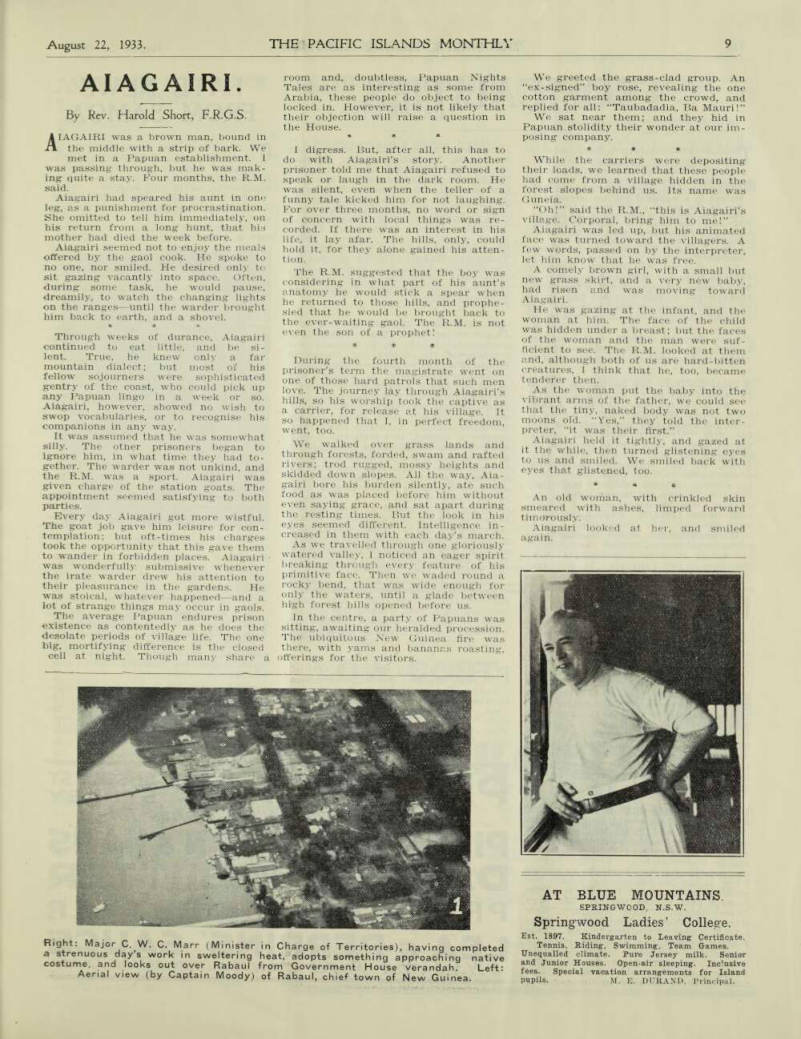
Right: Major C W. C. Marr (Minister in Charge of Territories), having completed a strenuous day s work in sweltering heat, adopts something approaching native costume, and looks out over Rabaul from Government House verandah. Left: Aerial view (by Captain Moody) of Rabaul, chief town of New Guinea.