Coconut Crabs.
p. 10 · Read in the full issue
“Latro Birgas” Is an Interesting Gentleman.
THE Coconut —or Robber —crab, scien tifically “Latro birgas,” is the most formidable crustacean in coconut land.
In its hermit-crab-resembling period of infancy, spent in a seashell (which is changed for a larger one as young Birgas grows) its enemies are various, and man is the worst. Consequently, the coconut crab is nowhere plentiful, and his adult
life continues in incessant peril. Birgas is good to eat, unfortunately for him.
Those fully grown are monstrosities.
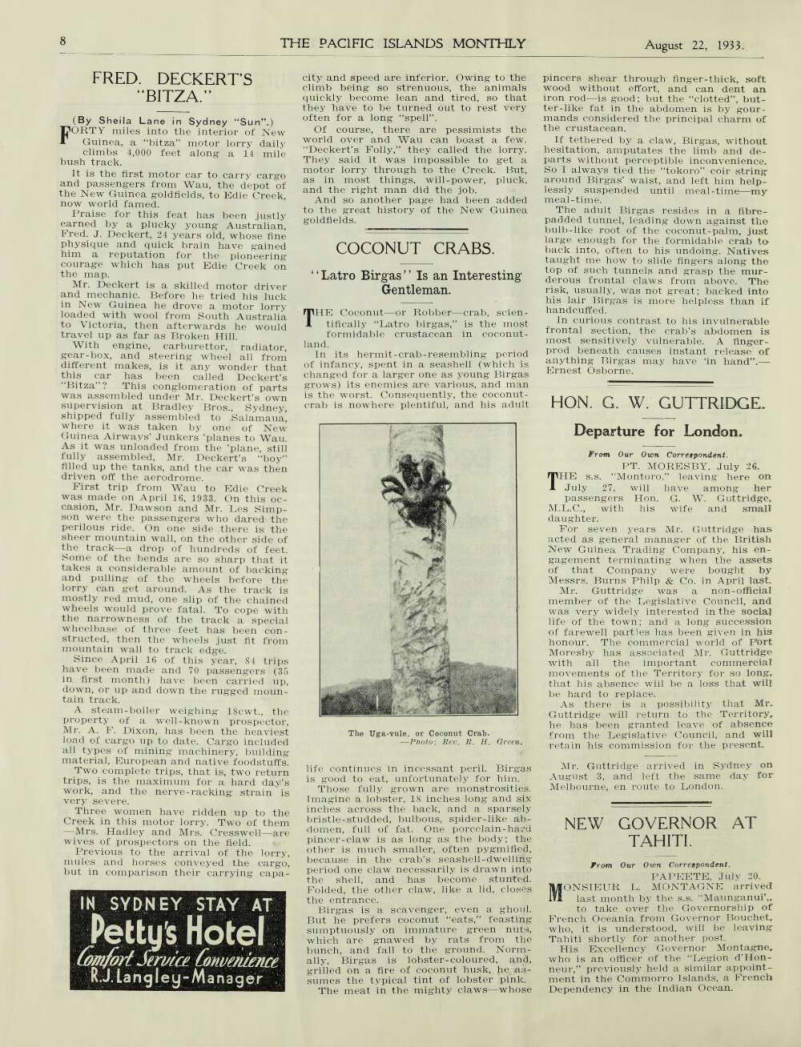
Imagine a lobster, 18 inches long and six inches across the back, and a sparsely bristle-studded, bulbous, spider-like ab domen, full of fat. One porcelain-hard pincer-claw is as long as the body; the other is much smaller, often pygmified, because in the crab’s seashell-dwelling period one claw necessarily is drawn into the shell, and has become stunted.
Folded, the other claw, like a lid, closes the entrance.
Birgas is a scavenger, even a ghoul.
But he prefers coconut “eats,” feasting sumptuously on immature green nuts, which are gnawed by rats from the bunch, and fall to the ground. Norm ally, Birgas is lobster-coloured, and, grilled on a fire of coconut husk, he as sumes the typical tint of lobster pink.
The meat in the mighty claws —whose
pincers shear through finger-thick, soft wood without effort, and can dent an iron rod—is good; but the “clotted”, but ter-like fat in the abdomen is by gour mands considered the principal charm of the crustacean.
If tethered by a claw, Birgas, without hesitation, amputates the limb and de parts without perceptible inconvenience.
So I always tied the “tokoro” coir string around Birgas’ waist, and left him help lessly suspended until meal-time —my meal-time.
The adult Birgas resides in a fibre padded tunnel, leading down against the bulb-like root of the coconut-palm, just large enough for the formidable crab to back into, often to his undoing. Natives taught me how to slide fingers along the top of such tunnels and grasp the mur derous frontal claws from above. The risk, usually, was not great; backed into his lair Birgas is more helpless than if handcuffed.
In curious contrast to his invulnerable frontal section, the crab’s abdomen is most sensitively vulnerable. A finger prod beneath causes instant release of anything Birgas may have ‘in hand”. — Ernest Osborne.
The Uga-vule, or Coconut Crab. — Photo: Rev. R. H. Green.