Selection Of New Guinea Officers.
p. 33 · Read in the full issue
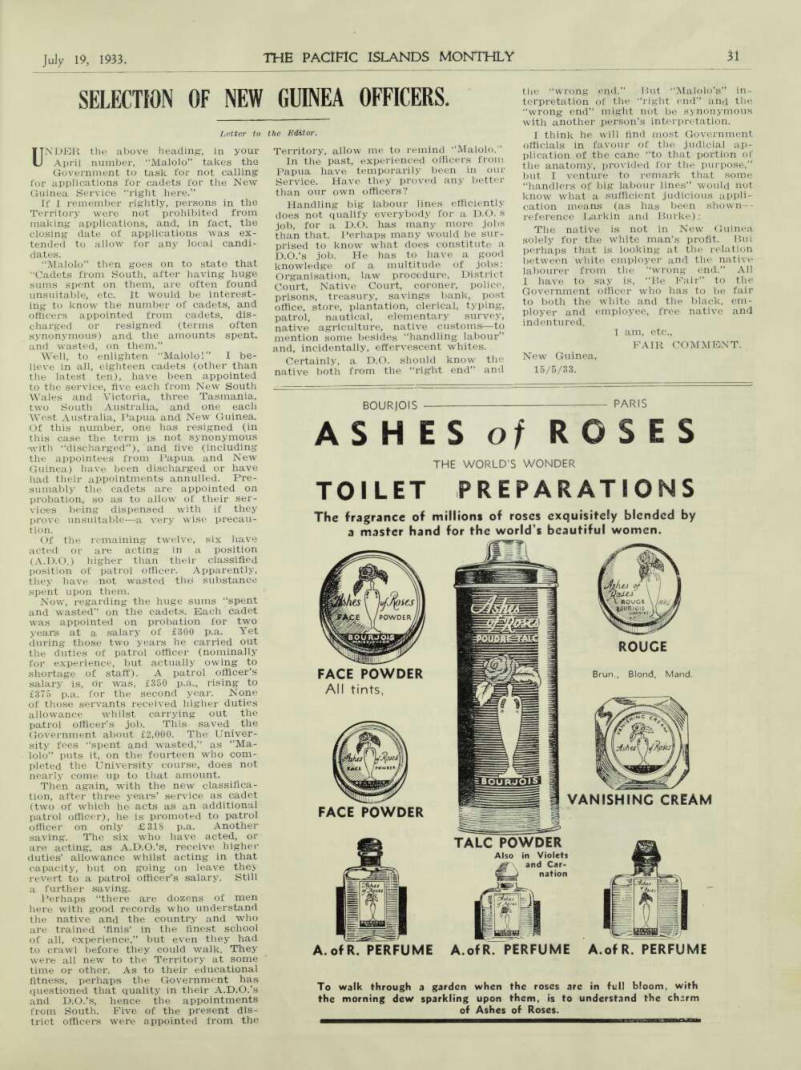
Letter to the Editor.
UNDER the above heading, in your April number, “Malolo” takes the Government to task for not calling for applications for cadets for the New Guinea Service “right here.”
If I remember rightly, persons in the Territory were not prohibited from making applications, and, in fact, the closing date of applications was ex tended to allow for any local candi dates.
“Malolo” then goes on to state that “Cadets from South, after having huge sums spent on them, are often found unsuitable, etc. It would be interest ing to know the number of cadets, and officers appointed from cadets, dis charged or resigned (terms often synonymous) and the amounts spent, and wasted, on them.”
Well, to enlighten “Malolo!” I be lieve in all, eighteen cadets (other than the latest ten), have been appointed to the service, five each from New South Wales and Victoria, three Tasmania, two South Australia, and one each West Australia, Papua and New Guinea, Of this number, one has resigned (in this case the term is not synonymous with “discharged”), and five (including the appointees from Papua and New Guinea) have been discharged or have had their appointments annulled. Pre sumably the cadets are appointed on probation, so as to allow of their ser vices being dispensed with if they prove unsuitable —a very wise precau tion.
Of the remaining twelve, six have acted or are acting in a position (A.D.O.) higher than their classified position of patrol officer. Apparently, they have not wasted the substance spent upon them.
Now, regarding the huge sums “spent and wasted” on the cadets. Each cadet was appointed on probation for two years at a salary of £300 p.a. Yet during those two years he carried out the duties of patrol officer (nominally for experience, but actually owing to shortage of staff). A patrol officer’s salary is, or was, £350 p.a., rising to £375 p.a. for the second year. None of those servants received higher duties allowance whilst carrying out the patrol officer’s job. This saved the Government about £2,000. The Univer sity fees “spent and wasted,” as “Ma lolo” puts it, on the fourteen who com pleted the University course, does not nearly come up to that amount.
Then again, with the new classifica tion, after three years’ service as cadet (two of which he acts as an additional patrol officer), he is promoted to patrol officer on only £318 p.a. Another saving. The six who have acted, or are acting, as A.D.O.’s, receive higher duties’ allowance whilst acting in that capacity, but on going on leave they revert to a patrol officer’s salary. Still a further saving.
Perhaps “there are dozens of men here with good, records who understand the native and the country and who are trained ‘finis’ in the finest school of all, experience,” but even they had to crawl before they could walk. They were all new to the Territory at some time or other. As to their educational fitness, perhaps the Government has questioned that quality in their A.D.O.’s and D.O.’s, hence the appointments from South. Five of the present dis trict officers were appointed from the
Territory, allow me to remind “Malolo.”
In the past, experienced officers from Papua have temporarily been in our Service. Have they proved any better than our own officers?
Handling big labour lines efficiently does not qualify everybody for a D.O. s job, for a D.O. has many more jobs than that. Perhaps many would be sur prised to know what does constitute a D.O.’s job. He has to have a good knowledge of a multitude of jobs: Organisation, law procedure, District Court, Native Court, coroner, police, prisons, treasury, savings bank, post office, store, plantation, clerical, typing, patrol, nautical, elementary survey, native agriculture, native customs—to mention some besides “handling labour” and, incidentally, effervescent whites.
Certainly, a D.O. should know the native both from the “right end” and
the “wrong end.” But “Malolo’s” in terpretation of the “right end” and the “wrong end” might not be synonymous with another person’s interpretation.
I think he will find most Government officials in favour of the judicial ap plication of the cane “to that portion of the anatomy, provided for the purpose,” but I venture to remark that some “handlers of big labour lines” would not know what a sufficient judicious appli cation means (as has been shown-reference Larkin and Burke): The native is not in New Guinea solely for the white man’s profit. But perhaps that is looking at the relation between white employer and the native labourer from the “wrong end.” All I have to say is, “Be Fair” to the Government officer who has to be fair to both the white and the black, em ployer and employee, free native and indentured.
I am, etc.,
Fair Comment.
New Guinea, 15/5/33.