Tallow.
pp. 28-29 · Read in the full issue
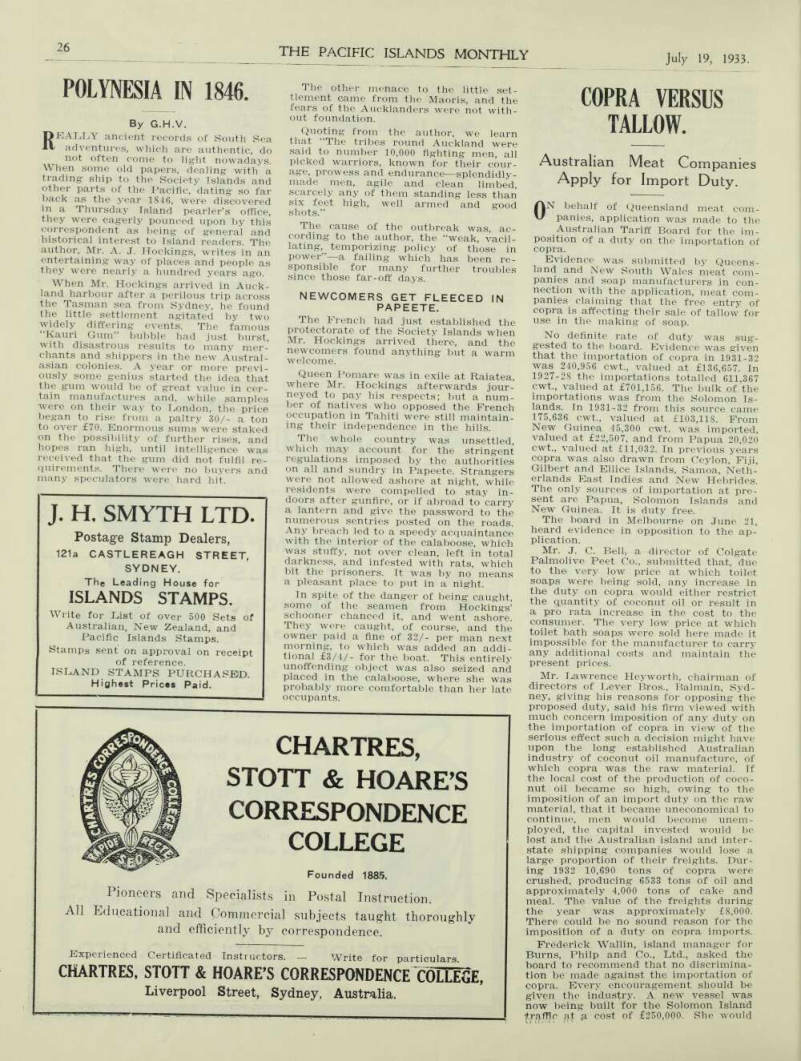
Copra Versus
Australian Meat Companies Apply for Import Duty.
ON behalf of Queensland meat com panies, application was made to the Australian Tariff Board for the im position of a duty on the importation of copra.
Evidence was submitted by Queens land and New South Wales meat com panies and soap manufacturers in con nection with the application, meat com panies claiming that the free entry of copra is affecting their sale of tallow for use in the making of soap.
No definite rate of duty was sug gested to the board. Evidence was given that the importation of copra in 1931-32 was 240,956 cwt, valued at £136,657. In 1927-28 the importations totalled 611,367 cwt, valued at £701,156. The bulk of the importations was from the Solomon Is lands. In 1931-32 from this source came 175,636 cwt., valued at £103,118. From New Guinea 45,300 cwt. was imported, valued at £22,507, and from Papua 20,020 cwt., valued at £11,032. In previous years copra was also drawn from Ceylon, Fiji, Gilbert and Ellice Islands, Samoa, Neth erlands East Indies and New Hebrides.
The only sources of importation at pre sent are Papua, Solomon Islands and New Guinea. It is duty free.
The board in Melbourne on June 21, heard evidence in opposition to the ap plication.
Mr. J. C. Bell, a director of Colgate Palmolive Peet Co., submitted that, due to the very low price at which toilet soaps were being sold, any increase in the duty on copra would either restrict the quantity of coconut oil or result in a pro rata increase in the cost to the consumer. The very low price at which toilet bath soaps were sold here made it impossible for the manufacturer to carry any additional costs and maintain the present prices.
Mr. Lawrence Heyworth, chairman of directors of Lever Bros., Balmain, Syd ney, giving his reasons for opposing the proposed duty, said his firm viewed with much concern imposition of any duty on tlm importation of copra in view of the serious effect such a decision might have upon the long established Australian industry of coconut oil manufacture, of which copra was the raw material. If the local cost of the production of coco nut oil became so high, owing to the imposition of an import duty on the raw material, that it became uneconomical to continue, men would become unem ployed, the capital invested would be lost and the Australian island and inter state shipping companies would lose a large proportion of their freights. Dur ing 1932 10,690 tons of copra were crushed, producing 6533 tons of oil and approximately 4,000 tons of cake and meal. The value of the freights during the year was approximately £8,000.
There could be no sound reason for the imposition of a duty on copra imports.
Frederick Wallin, island manager for Burns, Philp and Co., Ltd., asked the board to recommend that no discrimina tion be made against the importation of copra. Every encouragement should be given the industry. A new vessel was now being built for the Solomon Island fit & cost of £250,000. She would
be engaged in the importation of copra and if that importation were restricted the utilisation of such a vessel would be economically disastrous.
The inquiry was resumed in Mel bourne on June 26. There was no re sponse when the chairman asked if there was any evidence in support of or against the application. The only person present was a representative of a soap making firm, who was merely “watch ing” the inquiry, the firm having previ ously tendered evidence.
The inquiry was closed, and a few minutes later a representative of Vic torian meat interests arrived—too late to give evidence.