A Melbourne Shop-Girl’S Holiday.
pp. 23-24 · Read in the full issue
Written for “The Pacific Islands Monthly” by D.M.C.
FOR twelve months, daily behind the counter, as in duty bound, I sub scribed to the shop authorities dicta that “The customer is always right.”
Released from the bondage of the sales, and cash-complex, I was content to leave the infallible customer the vic tor, in my particular section of a great Bourke Street Emporium, since I was speeding away, in the Sydney Express, bound for a holiday trip to the Islands, the “Pearls of the Pacific,” in the steamer “Morinda”.
Of the seventy-five passengers on board the ship, three were Melbournians —the Rev. L. L. Wenzel, of Richmond, a school teacher, and the ship girl. Among other passengers were the much-
travelled Captain Frank Hurley, some Sydney solicitors, an English Judge, N.S.W. school teachers, a French doctor, and a young compatriot of his, a nun, and French Nursing Sister.
In my shop-girl French, a somewhat rusty acquirement, belonging to former days when I lived in Paris, I attempted to be friendly with the silent, lonely little lady in black, who spoke not the English language—though the seasick ness from which, Helas! she suffered, speaks in every language.
She told me, with sadness in her soft, brown eyes, that her departure from la Belle France was not an au revoir, but a good-bye, for she was self-exiled for life, to spend her days in the service of the sick, at the French Mission Station at Vila, in the New Hebrides. Only if she becomes tres malade, the sister said, might it be necessary for her to seek re stored health in Sydney.
Lord Howe Island.
The “Morinda,” after a heavy, rolling voyage, anchored about one mile off shore from Lord Howe Island, a cres cent-shaped one, seven miles in length, by one and a half miles in width. Grey blue mists were rising from its moun tains.
Off in a launch, the shore party reached the Lagoon landing jetty on a day of sunshjne. The shore line was
fringed with the green plumes of the beautiful, tall Kentia palms. White-tipped breakers rolled with a swirl and muffled “siss” on the yellow sands. The main road of the island is lined with Kentia palms and tropical growth, over the bush of which pale blue convolvulous climbed. Underfoot, the turf was car peted with purple and mauve flowers.
The Islanders, numbering 500, were very friendly. The men, and many of the women, too, wore shorts and open necked shirts, disclosing their brown chests.
The Islanders’ principal means of live lihood are sales of the seeds of the Kentia palms, which are sent to all parts of the world. Catching sharks, for their skins, is an industry that is rapidly de veloping. There are no motor cars. The means of conveyance are riding, horse and cart, and also a contraption of a few boards joined together, and mounted on four small wheels. On the boards are placed forms, whereon the islanders seat themselves.
Norfolk.
Norfolk Island has green grassy slopes upon which grow pine trees to the water’s edge. Coral reefs form a break water against which the waves surge in clouds of spume and foam. Landing at Norfolk Island is quite thrilling. One has to wait for the boat to be lifted on the crest of a wave, and at the right moment grasp two outstretched hands of one of the Islanders, and then jump for the jetty. Built of stone, it is wet and slippery. Having come safely through this peril, visitors gratefully pay a poll tax of 2/-, which is collected from all of them for revenue purposes. hlorfolk Island is nine miles in length, and Kingston, where we landed, is called its town. Those living elsewhere on the island are regarded as being in the country. At Kingston, the remains of the old convict buildings, granaries, and the hospital wherein Governor Went worth was born, are still standing. Some of the old cottages, which formerly housed prison warders, now are the homes of the Islanders.
When we returned to the jetty to catch the launch, rollers were breaking over the coral reefs. The engineer was standing on the front of the launch en deavouring to steady the dancing craft when a surf wave broke over the boat, washing the engineer into the sea, delug ing the passengers, and flinging the launch against the jetty. We dragged a very sea-soaked engineer aboard and he skilfully steered the launch through the breakers, over the coral reefs, and across a choppy sea to the “Morinda”.
Vila.
I rose at 5 a.m. to see the sun rising on Vila—a beautiful picture as it came up slowly between the hills. Later, I said goodbye to the little French Sister, with a promise to send her some snap shots taken on the voyage. At Vila we visited the British Hospital, a large, rambling place with accommodation for whites and natives. In the native wards, patients lie on boards placed on trestles, with just a grey blanket across them.
In the hospital were three nursing sis ters —ope from Adelaide and two from
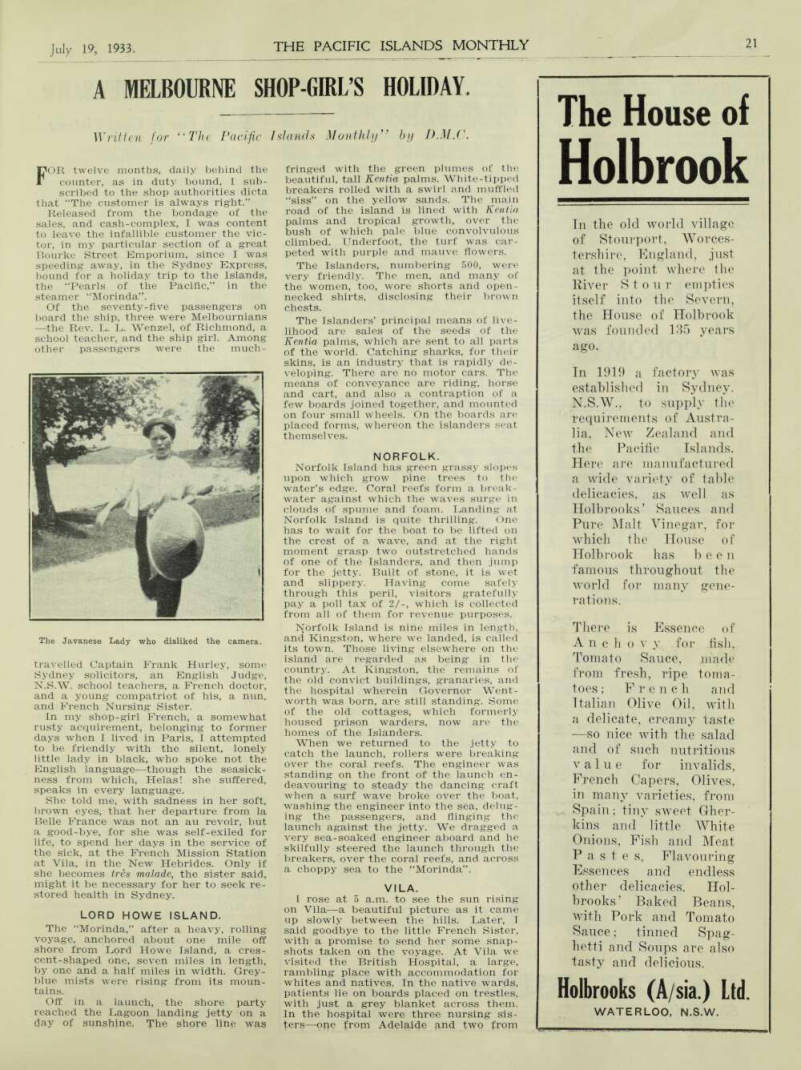
The Javanese Lady who disliked the camera.
Sydney. After leaving the hospital we visited different little islands scattered about the harbour.
In the afternoon we hired a car and drove through Shanty Town, the in habitants being Tonkinese. One Tonkin ese woman on the road refused to be photographed. She placed her large cane hat before her face, and made some very loud remarks of unknown purport, but her meaning was not hard to guess.
Even a proffered tip of a shilling did not tempt her to pose. Coming back we passed the irate lady once more, and before she knew it she was camera shot.
After passing through the Tonkinese quarter we drove into the country. The road first led through dense tropical growth among which were cocoa and coffee trees. As we went further out we passed coconut plantations on either side of the road. The plantations were neglected as there is a very poor mar ket for copra at present, and the planters are not cultivating it.
We left Vila for Tangoa, and on ar riving there went to the Presbyterian Mission Station, a large house with a wide verandah, on three sides of it on which were very fine specimens of tropi cal ferns. We did not see many natives as they had nearly all gone to their homes for the Christmas vacation.
Sailing again we reached Malo, and went across in the launch to a planta tion. It was a doleful place, with a neg lected plantation. After leaving Malo we called at several small islands.
Next day we entered the Segond Channel, and landed at an island called Aoba, a contrast to Malo. Aoba, with a mission station, was the best of the New Hebrides group of islands we had seen.
Landing was an adventure. From the ship’s launch we were transferred into a native boat. Within twenty yards of the shore natives carried us in. Aoba has wide roads lined with plantations of pineapples, coconut, custard apples, mangoes, melons, and other tropical fruit.
After leaving Aoba we touched at Hog Harbour, Norsup, a very pretty little French Settlement, Bushman’s Bay, Ton goa, and then returned to Vila, having been four days going through the islands of the New Hebrides.
Back in Bourke Street, I found the customer was still right, as I, too, was right, and ready, for another year’s work among the ribbons and laces.