Native Wife’S
p. 21 · Read in the full issue
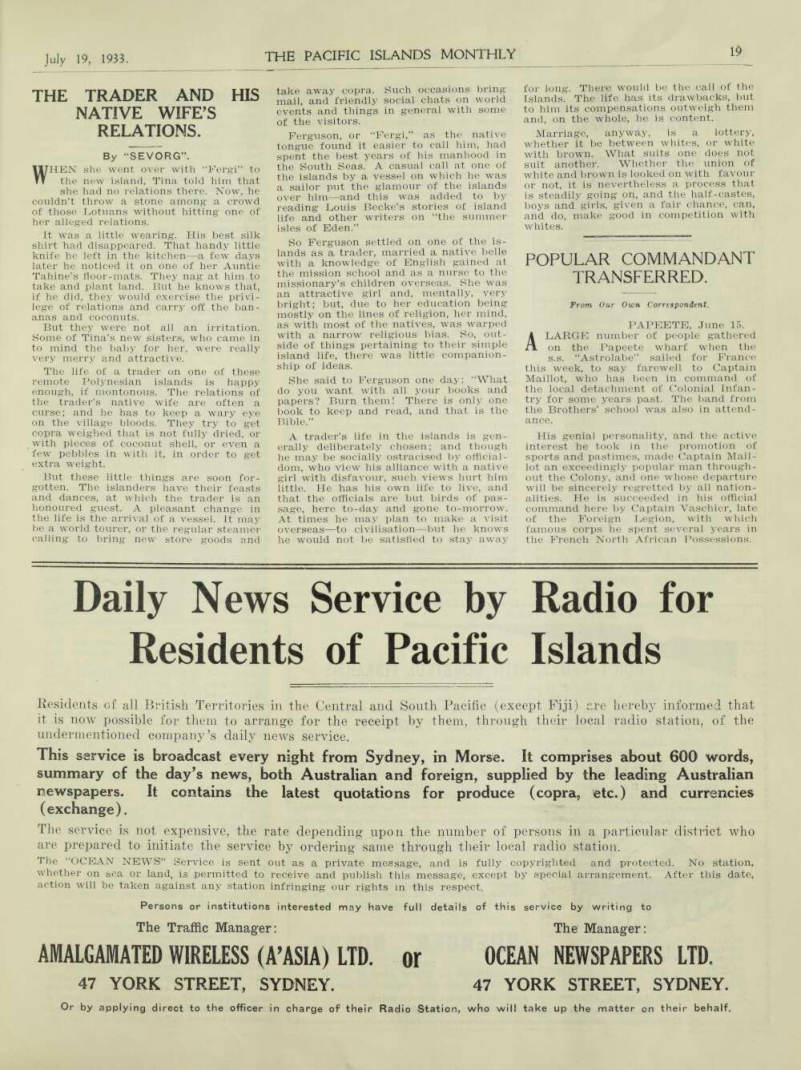
The Trader And His
Relations.
By “Sevorg".
WHEN she went over with “Fergi” to the new island, Tina told him that she had no relations there. Now, he couldn’t throw a stone among a crowd of those Lotuans without hitting one of her alleged relations.
It was a little wearing. His best silk shirt had disappeared. That handy little knife he left in the kitchen —a few days later he noticed it on one of her Auntie Tahine’s floor-mats. They nag at him to take and plant land. But he knows that, if he did, they would exercise the privi lege of relations and carry off the ban anas and coconuts.
But they were not all an irritation.
Some of Tina’s new sisters, who came in to mind the baby for her, were really very merry and attractive.
The life of a trader on one of these remote Polynesian islands is happy enough, if montonous. The relations of the trader’s native wife are often a curse; and he has to keep a wary eye on the village bloods. They try to get copra weighed that is not fully dried, or with pieces of coconut shell, or even a few pebbles in with it, in order to get extra weight.
But these little things are soon for gotten. The islanders have their feasts and dances, at which the trader is an honoured guest. A pleasant change in the life is the arrival of a vessel. It may be a world tourer, or the regular steamer calling to bring new store goods and
take away copra. Such occasions bring mail, and friendly social chats on world events and things in general with some of the visitors.
Ferguson, or “Fergi,” as the native tongue found it easier to call him, had spent the best years of his manhood in the South Seas. A casual call at one of the islands by a vessel on which he was a sailor put the glamour of the islands over him —and this was added to by reading Louis Becke’s stories of island life and other writers on “the summer isles of Eden.”
So Ferguson settled on one of the is lands as a trader, married a native belle with a knowledge of English gained at the mission school and as a nurse to the missionary’s children overseas. She was an attractive girl and, mentally, very bright; but, due to her education being mostly on the lines of religion, her mind, as with most of the natives, was warped with a narrow religious bias. So, out side of things pertaining to their simple island life, there was little companion ship of ideas.
She said to Ferguson one day: “What do you want with all your books and papers? Burn them! There is only one book to keep and read, and that is the Bible.”
A trader’s life in the islands is gen erally deliberately chosen; and though he may be socially ostracised by official dom, who view his alliance with a native girl with disfavour, such views hurt him little. He has his own life to live, and that the officials are but birds of pas sage, here to-day and gone to-morrow.
At times he may plan to make a visit overseas —to civilisation —but he knows he would not be satisfied to stay away
for long. There would be the call of the Islands. The life has its drawbacks, but to him its compensations outweigh them and, on the whole, he is content.
Marriage, anyway, is a lottery, whether it be between whites, or white with brown. What suits one does not suit another. Whether the union of white and brown is looked on with favour or not, it is nevertheless a process that is steadily going on, and the half-castes, boys and girls, given a fair chance, can, and do, make good in competition with whites.