On A Samoan Motor-Bus.
pp. 19-20 · Read in the full issue
Quaint Glimpses of Exotic Life.
AT the foot of the magnificent town clock tower, erected as a worthy memorial to the sons of Samoa who served overseas in the Great War, right in the heart of Apia, is situated the parking place for all Samoan motor ’buses plying for passengers down the West Coast of Upolu to Mulifanua.
Close to the main business quarter of the town, to Post Office, Bank, Customs House, this place is most convenient to people of the outside districts, who come to Apia for business purposes.
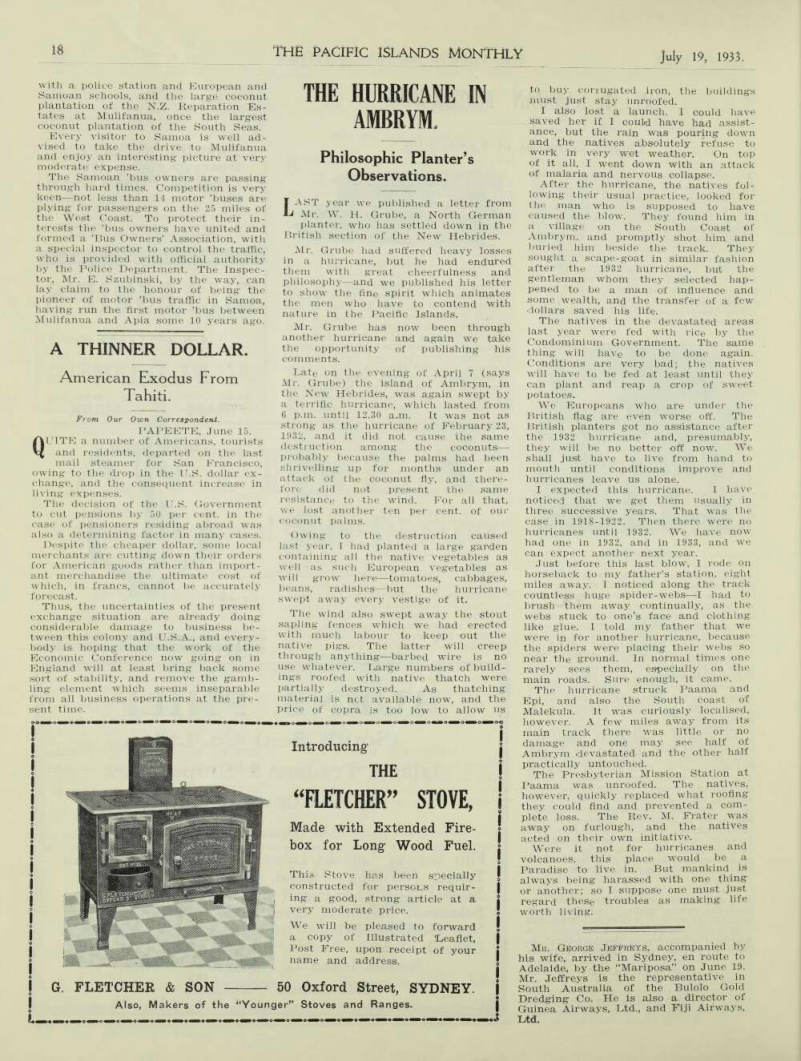
The observer is struck by the marvel lous colour scheme of the ’buses by
which, it seems, the owners seek to at tract the public’s attention and custom.
All colours of the rainbow are repre sented —red, blue, yellow, white, grey and brown. Here, for hours, ’buses are waiting till a sufficient number of pas sengers is assembled to warrant a start of the journey down-coast.
Often the ’bus drives first round the town to pick up intending passengers at various places, fale aiga’s (native res taurants), or at the Chinese stores.
There is no fixed time-table for Samoan ’buses —time is of little importance in Samoa, anyway!
Leisurely the ’bus is driven by its Samoan driver along Apia’s beach and the Savalalo Road, past the Marist Sis ters’ convent and school, and on along the well-kept concrete road to the west.
The driver hands you a ticket, a novel institution for Samoa, and you pay your shilling for a distance of about 15 miles or 2/- for the whole distance to Muli fanua, about 25 miles. The fare is cer tainly cheap enough, compared with fares in other countries and taking into consideration the high prices of oil, tyres, repairs, licenses, etc., with which ’bus and car owners are burdened in Samoa.
Through the village of Vaimoso, with the neat little office of the Mau now deserted, where High Chief Tamasese, killed in 1929, used to live. The ’bus drives on through Samoan villages, past the stately building of the Mormon Mis sion at Pesega, past trading stations, bathing pools—in which scores of happy children splash merrily about —past Vai tele plantation with, from time to time, a view out to the reef and the open sea.
The beautiful scenery and the glimpses of native life in their kaleidoscopic
change, are most attractive to the casual visitor to Samoa. The ’bus pas sengers are of no less interest to the student of Samoan life. Beside a few European traders, planters and mission aries sit Chinese coolies from the cocoa plantations, black Solomon Islanders with Samoan wives, and dark-skinned offspring, Samoan families, with baskets of bananas, taro, fowls, pigs, mats and household utensils. Then, again, there are some pretty, dark-eyed Samoan damsels, ever ready for a flirtation, some young, half-caste boys returning to work on Mulifanua Plantation, a dig nified Samoan teacher in spotless white coat and lava-lava, and a Catholic priest in black cassock. Or there may be some students of the Samoan Mission College at Malua and school children going back from Apia schools to their homes on the coast.
In the Samoan way, all the native passengers seem to be personal friends of the ’bus driver, and he does not mind waiting for them for a considerable time or stopping occasionally to let them transact some business with friends or relations in another village on the road.
The scenery on the coastal drive is ever changing; a film taken of the jour ney would present a very interesting picture of Samoan life and landscape.
There are various other points of in terest on the coast worthy of mention, such as the splendid new Catholic
Cathedral of Leauvaa, the London Mis sion Society’s College and Boys’ High School at Malua, the old Samoan capi tal and Government seat of Leulumoega,
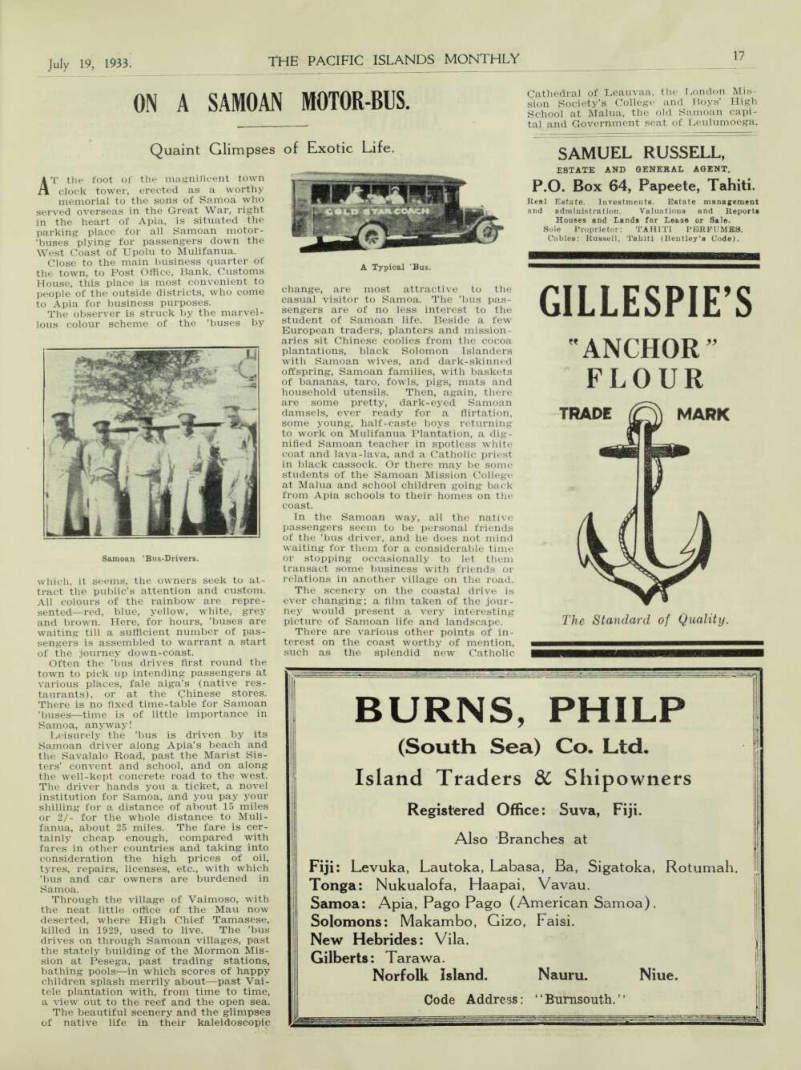
Samoan 'Bus-Drivers.
A Typical ’Bus.
with a police station and European and Samoan schools, and the large coconut plantation of the N.Z. Reparation Es tates at Mulifanua, once the largest coconut plantation of the South Seas.
Every visitor to Samoa is well ad vised to take the drive to Mulifanua and enjoy an interesting picture at very moderate expense.
The Samoan ’bus owners are passing through hard times. Competition is very keen—not less than 14 motor ’buses are plying for passengers on the 25 miles of the West Coast. To protect their in terests the ’bus owners have united and formed a ’Bus Owners’ Association, with a special inspector to control the traffic, who is provided with official authority by the Police Department. The Inspec tor, Mr. E. Szubinski, by the way, can lay claim to the honour of being the pioneer of motor ’bus traffic in Samoa, having run the first motor ’bus between Mulifanua and Apia some 10 years ago.