Attend Sydney University.
pp. 16-41 · Read in the full issue
Papuan Medical Students To
Interesting New Development In Australian Tropical Administration.
THE Administration of Papua has embarked upon a new and most interesting plan.
In September of this year a number
From Our Own Correspondent.
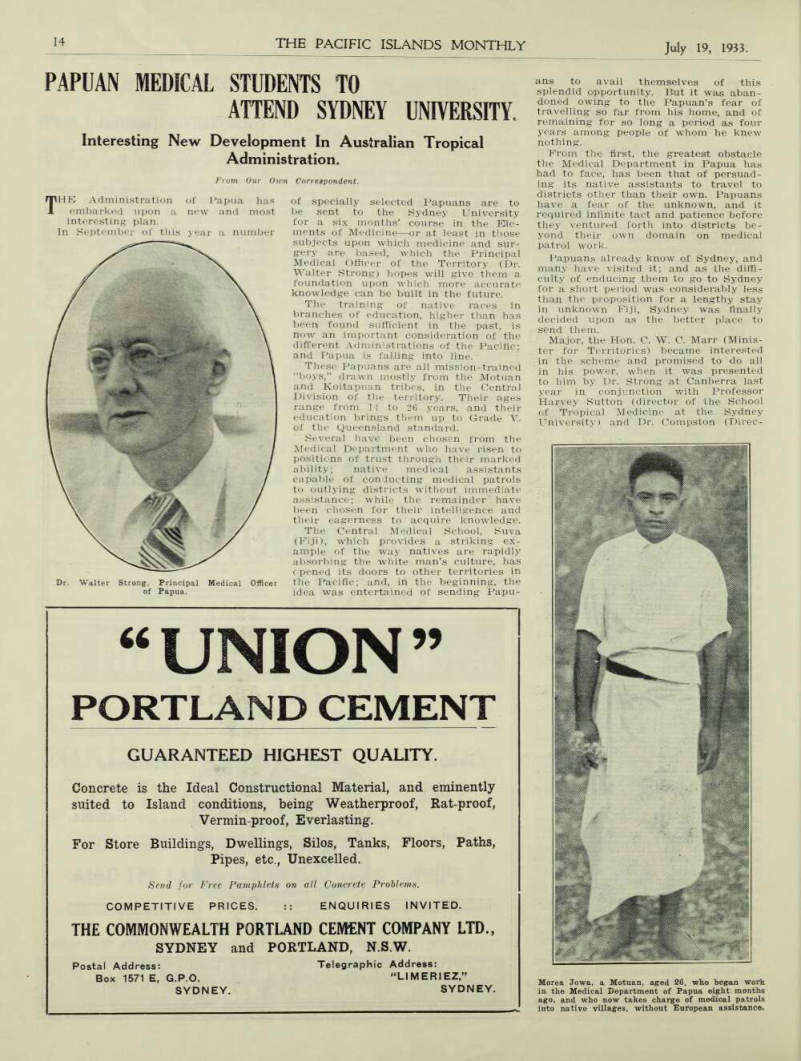
of specially selected Papuans are to be sent to the Sydney University for a six months’ course in the Ele ments of Medicine—or at least in those subjects upon which medicine and sur gery are based, which the Principal Medical Officer of the Territory (Dr.
Walter Strong) hopes will give them a foundation upon which more accurate knowledge can be built in the future.
The training of native races in branches of education, higher than has been found sufficient in the past, is now an important consideration of the different Administrations of the Pacific; and Papua is falling into line.
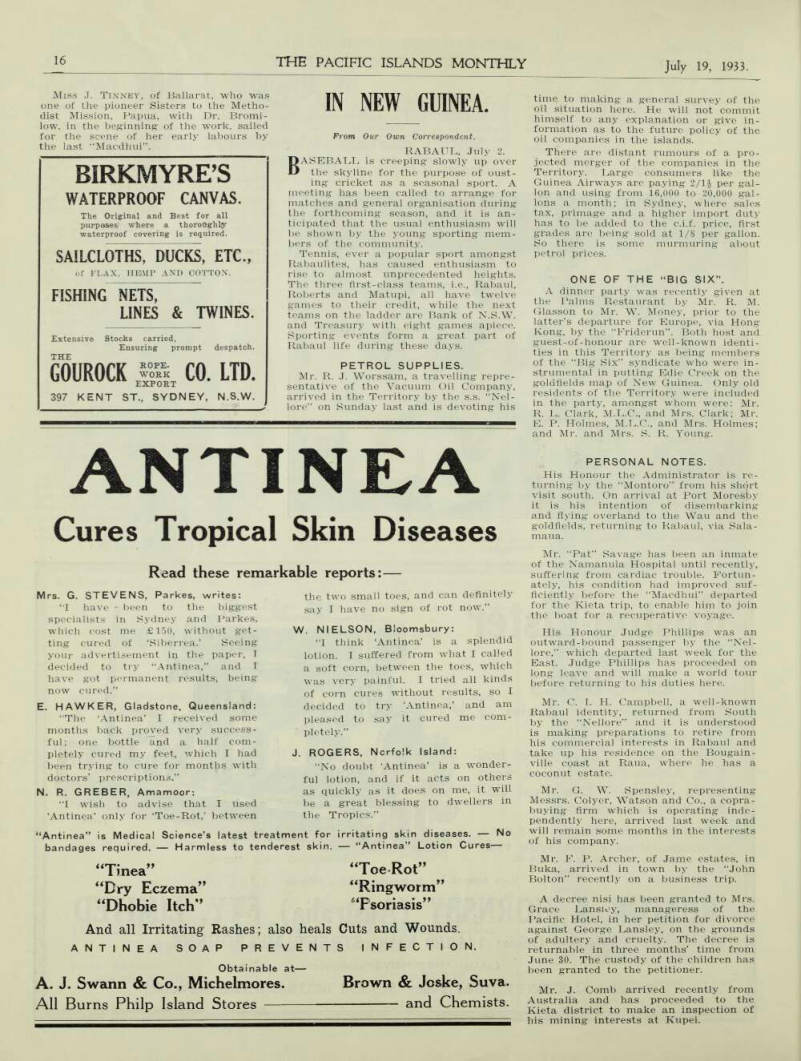
These Papuans are all mission-trained “boys,” drawn mostly from the Motuan and Koitapuan tribes, in the Central Division of the territory. Their ages range from 14 to 26 years, and their education brings them up to Grade V. of the Queensland standard.
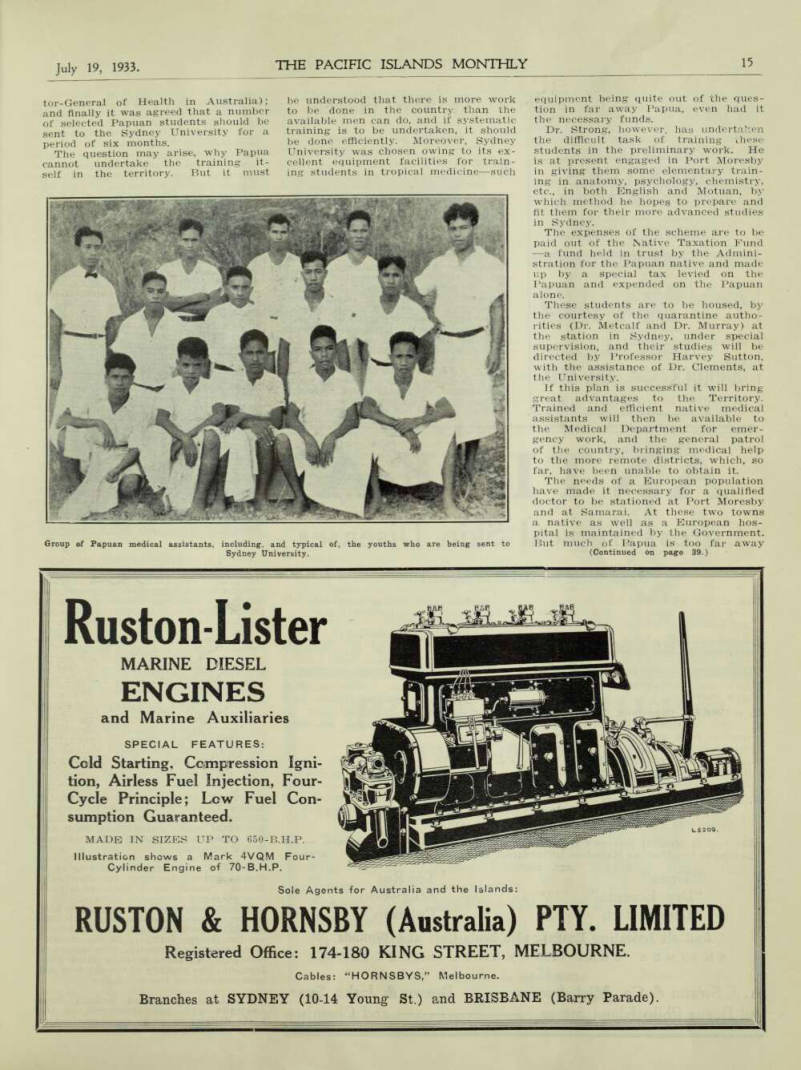
Several have been chosen from the Medical Department who have risen to positions of trust through their marked ability; native medical assistants capable of conducting medical patrols to outlying districts without immediate assistance; while the remainder have been chosen for their intelligence and their eagerness to acquire knowledge.
The Central Medical School, Suva (Fiji), which provides a striking ex ample of the way natives are rapidly absorbing the white man’s culture, has opened its doors to other territories in the Pacific: and, in the beginning, the idea was entertained of sending Papu
ans to avail themselves of this splendid opportunity. But it was aban doned owing to the Papuan’s fear of travelling so far from his home, and of remaining for so long a period as four years among people of whom he knew nothing.
From the first, the greatest obstacle the Medical Department in Papua has had to face, has been that of persuad ing its native assistants to travel to districts other than their own. Papuans have a fear of the unknown, and it required infinite tact and patience before they ventured forth into districts be yond their own domain on medical patrol work.
Papuans already know of Sydney, and many have visited it; and as the diffi culty of enducing them to go to Sydney for a short period was considerably less than the proposition for a lengthy stay in unknown Fiji, Sydney was finally decided upon as the better place to send them.
Major, the Hon. C. W. C. Marr (Minis ter for Territories) became interested in the scheme and promised to do all in his power, when it was presented to him by Dr. Strong at Canberra last year in conjunction with Professor Harvey Sutton (director of the School of Tropical Medicine at the Sydney University) and Dr. Compston (Direc
Dr. Walter Strong, Principal Medical Officer of Papua.
Morea Jowa, a Motuan, aged 26, who began work in the Medical Department of Papua eight months ago, and who now takes charge of medical patrols into native villages, without European assistance.
tor-General of Health in Australia); and finally it was agreed that a number of selected Papuan students should be sent to the Sydney University for a period of six months.
The question may arise, why Papua cannot undertake the training it self in the territory. But it must
be understood that there is more work to be done in the country than the available men can do, and if systematic training is to be undertaken, it should be done efficiently. Moreover, Sydney University was chosen owing to its ex cellent equipment facilities for train ing students in tropical medicine —such
equipment being quite out of the ques tion in far away Papua, even had it the necessary funds.
Dr. Strong, however, has undertaken the difficult task of training these students in the preliminary work. He is at present engaged in Port Moresby in giving them some elementary train ing in anatomy, psychology, chemistry, etc., in both English and Motuan, by which method he hopes to prepare and fit them for their more advanced studies in Sydney.
The expenses of the scheme are to be paid out of the Native Taxation Fund —a fund held in trust by the Admini stration for the Papuan native and made up by a special tax levied on the Papuan and expended on the Papuan alone.
These students are to be housed, by the courtesy of the quarantine autho rities (Dr. Metcalf and Dr. Murray) at the station in Sydney, under special supervision, and their studies will be directed by Professor Harvey Sutton, with the assistance of Dr. Clements, at the University.
If this plan is successful it will bring great advantages to the Territory.
Trained and efficient native medical assistants will then be available to the Medical Department for emer gency work, and the general patrol of the country, bringing medical help to the more remote districts, which, so far, have been unable to obtain it.
The needs of a European population have made it necessary for a qualified doctor to be stationed at Port Moresby and at Samarai. At these two towns a native as well as a European hos pital is maintained by the Government.
But much of Papua is too far away
(Continued on page 39.)
Group of Papuan medical assistants, including, and typical of, the youths who are being sent to Sydney University.
Miss J. Tinney, of Ballarat, who was one of the pioneer Sisters to the Metho dist Mission, Papua, with Dr. Bromi low, in the beginning of the work, sailed for the scene of her early labours by the last “Macdhui”.
from these two centres for the average village native to make much use of them, and much of the difficulty has been in reaching the natives who are unable to attend. Much village work has been done by missionaries, Govern ment officers and other Europeans, even though the Government maintains a travelling medical officer and four travelling European medical assistants, whose work is mainly that of treating outside villages. A special tribute was paid to the missions by Dr. Strong in his address on “The Medical Service of Papua” before the Royal Empire Society in Melbourne last year.