Stimulating Mining Operations.
Gold At £7/15/- Per Oz. Is
Review of Activities In N.G. and Papua,
THE continued rise in the price of gold —at the moment of this writing it is at £6/4/9 sterling per ounce, equal to £7/15/10 in Australian currency—is greatly stimulating the gold-mining in dustry. Not only is every concern that has reached the production stage now concentrating its efforts on production, but prospectors are out in every direc tion, in Central New Guinea, in the Ramu River and Bismarck Ranges area, and in the Papuan mountains, seeking for new fields.
In this connection, gold-seeking has been aided tremendously by the enter prise of Guinea Airways, Ltd. This en terprising company, which provides most of the aerial transport required for the established field, has now some twenty minor aerodromes in very wild and hitherto inaccessible country; and the regular arrival of aeroplanes with sup plies at these points has solved the main problem which faces prospectors who sought to penetrate the hinterland.
The luckiest of all the gold-producers is the Bulolo group. They have two dredges now working continuously at Bulolo; and two more in course of erec tion on their Bulowat area. One of these will commence operations in November —the other early next year. Gold is coming from the Bulolo dredges in a steadily increasing stream; and, prob ably in justified anticipation of a hand some dividend (which seems certain), the Bulolo shares are now away over 80/- on the Australian market.
Because of the increased value of gold, the dredges are able to take, in their stride, gold-bearing land that would not be worth working a year ago but which, to-day, more than pays for operating.
This, of course, correspondingly reduces working costs.
The Bulolo Company has been wise, as well as lucky. Its directors having once decided that big-scale operations, by aeroplane-transport and dredges, was the only way to work this field, threw themselves into the big enterprise with great energy, and completed their initial plan in a remarkably short time, con sidering the tremendous natural diffi culties with which they were confronted.
As a reward, they have reached produc tion in time to reap a marvellous harvest —which their enterprise fully deserves.
The position on the other half of the goldfield, controlled by New Guinea Goldfields, Ltd., is not so pleasing. This company is still engaged primarily in testing and developing, rather than in production—although it is reported that, from one source and another, it is send ing out an increasing quantity of gold.
It is evident that, before it can reach the stage of really big-scale production, it must face the question of writing down its enormous overhead load of dead capital.
New Guinea Goldfields, Ltd. has just concluded the transportation of plant which will allow its cyaniding tanks to be triplicated. This installation should be in operation by the end of the year, and should largely increase the amount of gold which the company will produce —and, possibly, should provide additional capital for urgently-needed develop mental operations.
There has been much criticism of New guinea Goldfields, Ltd. on account of the slowness of its operations—shareholders making bitter comparison with the happy condition of Bulolo shareholders — and there is a disposition to blame some of the company’s executives. This is un fair and unjustified. The real handicap that has been upon N.G.G. lies not in personnel, but in the enormous overhead load that was assumed in the system of forming and financing the Company. No one, up to date, can see how this com pany can make progress comparable with the Bulolo group until it is recon structed. It has the gold-bearing coun try, but its financial structure seems all wrong.
Mr. J. P. Blaike Webster, managing director of Mining Trust, Ltd., London, virtual owners of N.G.G., Ltd., arrived in Sydney on July 13, and is now on his way to Mount Isa (Queensland) and New Guinea. It is anticipated that he will investigate the whole position and important decisions may be taken. They should be taken quickly. It is by no means certain that gold will remain on its present high price.
Meanwhile, New Guinea Goldfields, Ltd. is showing considerable enterprise in assisting parties of prospectors to ex amine the areas in the Central districts, in the region behind Madang and the Sepik. There are numerous parties at work hereabouts. The Leahy Brothers are on a promising show near Mount Hagen, in the Bismarck Ranges; Ned Rowlands is said to be developing some thing of promise on the Upper Raimi; and others are engaged in a prospect on the Purari.
In Papua, on the Yodda. Mr. Ward Williams is now planning the introduc tion of a small dredge, which may be brought in to the Kokoda aerodrome in the Moths; and other parties are at work in various parts of the eastern Papuan mountains.
Position Of Misima Mine.
A correspondent in Papua has written us, asking for information concerning operations of a company on Misima Is land (Eastern Papua), known as Misima Options, Ltd. There have been various references to this company in past is sues of “The Pacific Islands Monthly”.
Misima Options, Ltd. was formed to take over what was left of the wreck of the Mount Sisa Company, which form erly held many leases on Misima Island Among the directors were General Lloyd and Major C. W. C. Marr. Mr. Marr re signed when he became a member of the Federal Government.
Misima Options, Ltd. began operations nearly two years ago, testing and, to a small extent, developing the lease.
Prospects were reported excellent, but financial conditions seemed to be an embarrassment. During the past six or nine months the new company met a series of troubles. It found itself with a law case concerning wages on its hands, which was bequeathed to it by the old Mt. Sisa Company. Then it appears to have had some dispute with Mr. Gordon, who was connected with the formation of the new company. There was friction and delay while this was being adjusted,
and Mr. Gordon is now residing in Syd ney. Then it was discovered the tunnel had fallen in, due to excessive rain and the shifty nature of the ground. In re cent weeks a new managerial organisa tion has been created. One of the Syd ney directors has gone to Misima to watch operations on behalf of the share holders, and to assist the manager and supervise clean-ups. Additional capital has been found recently; and a quantity of gold from the mine reached Sydney by the last “Macdhui”. Half a dozen Europeans and a considerable native staff are now on the job, and prospects are officially declared to be encouraging.
We understand that the mine is being operated by Misima Options, Ltd. but that the old Mt. Sisa Company retains a substantial interest in any profits that the mine may make.
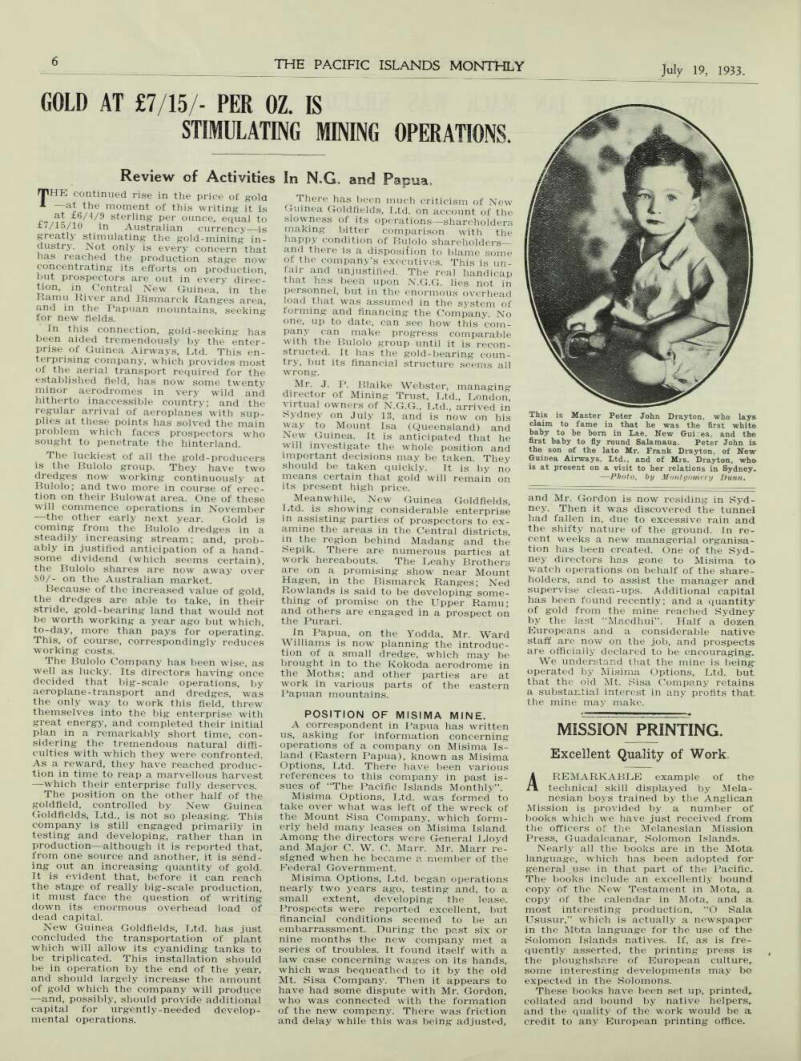
This is Master Peter John Drayton, who lays claim to fame in that he was the first white baby to be born in Lae, New Guinea, and the first baby to fly round Salamaua. Peter John is the son of the late Mr. Frank Drayton, of New Guinea Airways, Ltd., and of Mrs. Drayton, who is at present on a visit to her relations in Sydney. — Photo, by Montgomery Dunn.