Recent Fiji Flood.
p. 14 · Read in the full issue
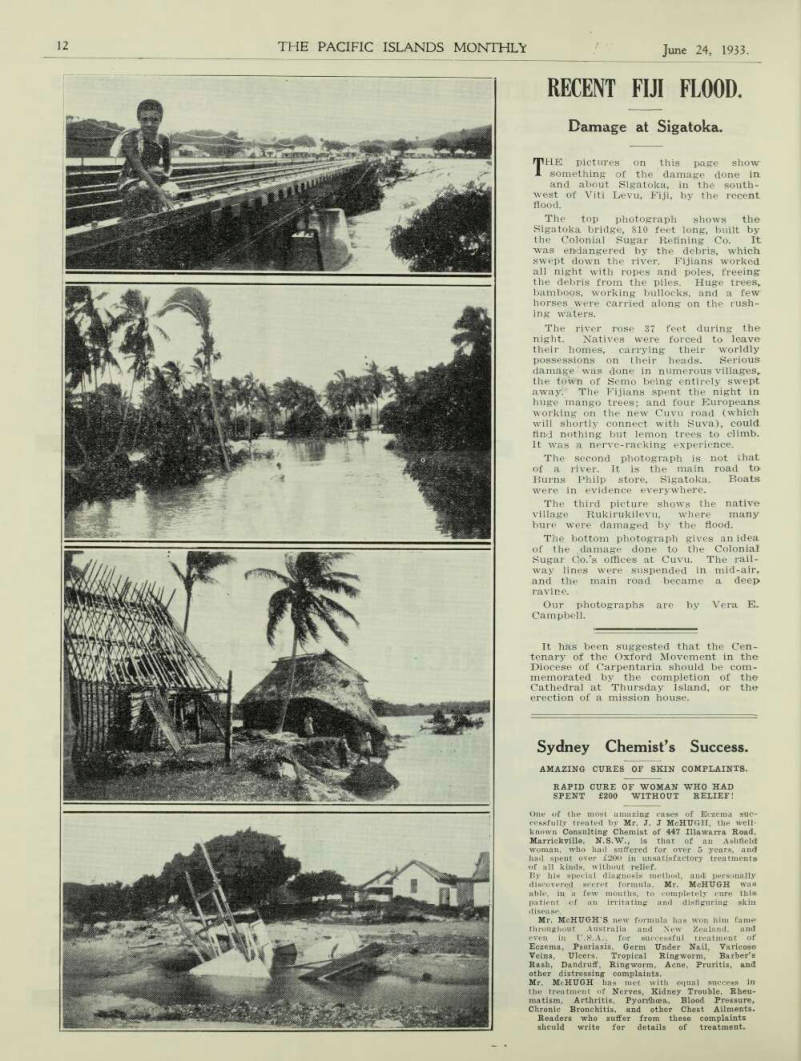
Damage at Sigatoka.
THE pictures on this page show something of the damage done in and about Sigatoka, in the south west of Yiti Levu, Fiji, by the recent flood.
The top photograph shows the Sigatoka bridge, 810 feet long, built by the Colonial Sugar Refining Co. It was endangered by the debris, which swept down the river. Fijians worked all night with ropes and poles, freeing the debris from the piles. Huge trees, bamboos, working bullocks, and a few horses were carried along on the rush ing waters.
The river rose 37 feet during the night. Natives were forced to leave their homes, carrying their worldly possessions on their heads. Serious damage was done in numerous villages, the tofan of Semo being entirely swept away! The Fijians spent the night in huge mango trees; and four Europeans working on the new Cuvu road (which will shortly connect with Suva), could find nothing but lemon trees to climb.
It was a nerve-racking experience.
The second photograph is not that of a river. It is the main road to Burns Philp store, Sigatoka. Boats were in evidence everywhere.
The third picture shows the native village Rukirukilevu, where many bure were damaged by the flood.
The bottom photograph gives an idea of the damage done to the Colonial Sugar Co.’s offices at Cuvu. The rail way lines were suspended in mid-air, and the main road became a deep ravine.
Our photographs are by Vera E.
Campbell.
It has been suggested that the Cen tenary of the Oxford Movement in the Diocese of Carpentaria should be com memorated by the completion of the Cathedral at Thursday Island, or the erection of a mission house.